
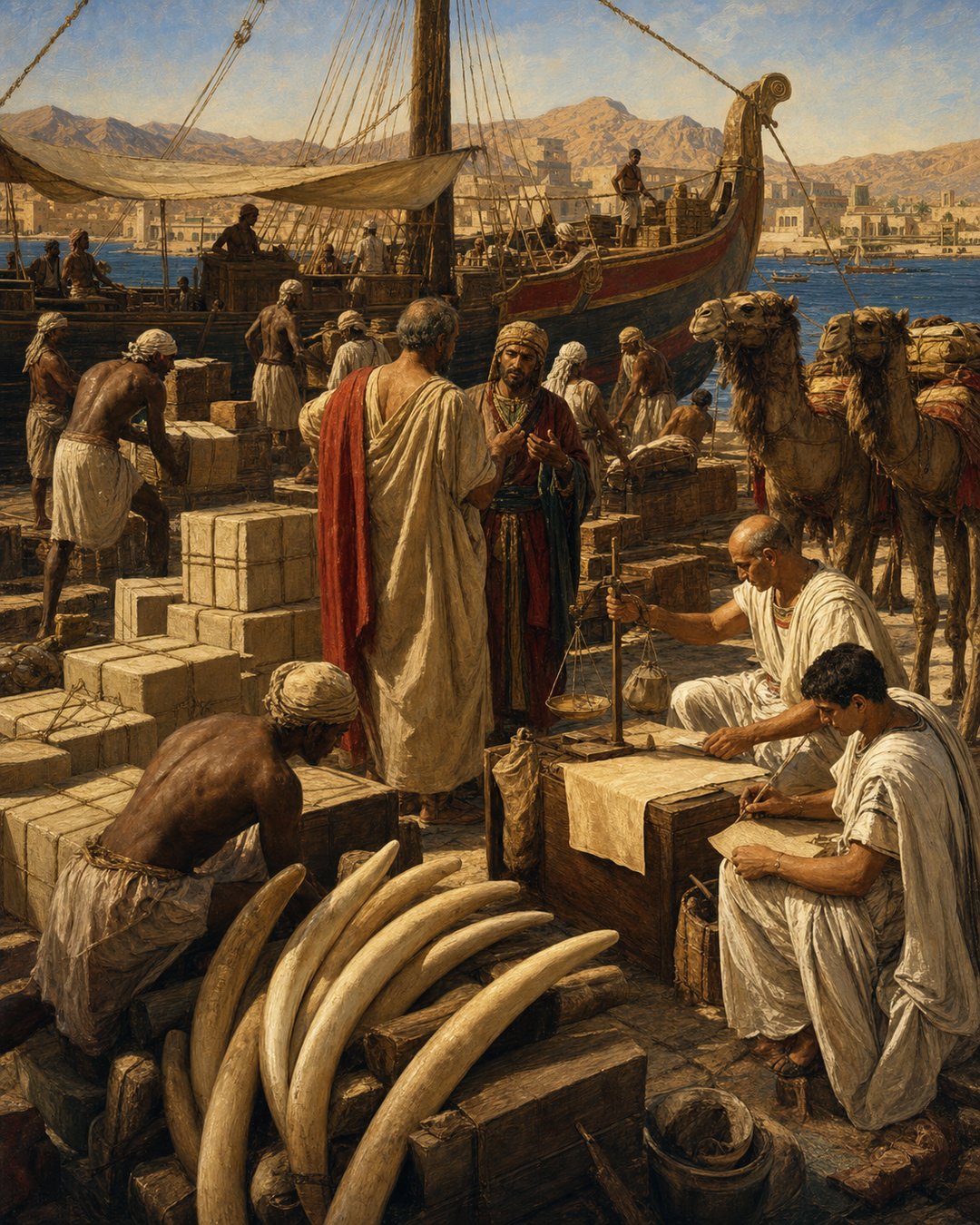
A torn papyrus preserves a ship called the Hermapollon, sixty boxes of Gangetic nard, thousands of pounds of ivory and a cargo valued in talents and drachmas. It is easy to read those fragments as an exotic shopping list. The more important revelation is less glamorous: Roman trade with India was held together by clauses about collateral, customs warehouses, camel drivers, river carriers, seals and default.
The document usually called the Muziris Papyrus dates to the middle of the second century CE. One side preserves part of a loan agreement connected with a voyage to Muziris on India’s Malabar Coast; the other calculates portions of the returning cargo. Because the sheet is incomplete, names and opening terms are missing. What remains is enough to follow merchandise across several changes of transport and to see how finance tried to keep ownership continuous when the goods moved far beyond any lender’s sight.
The Contract Begins Where the Sea Voyage Ends
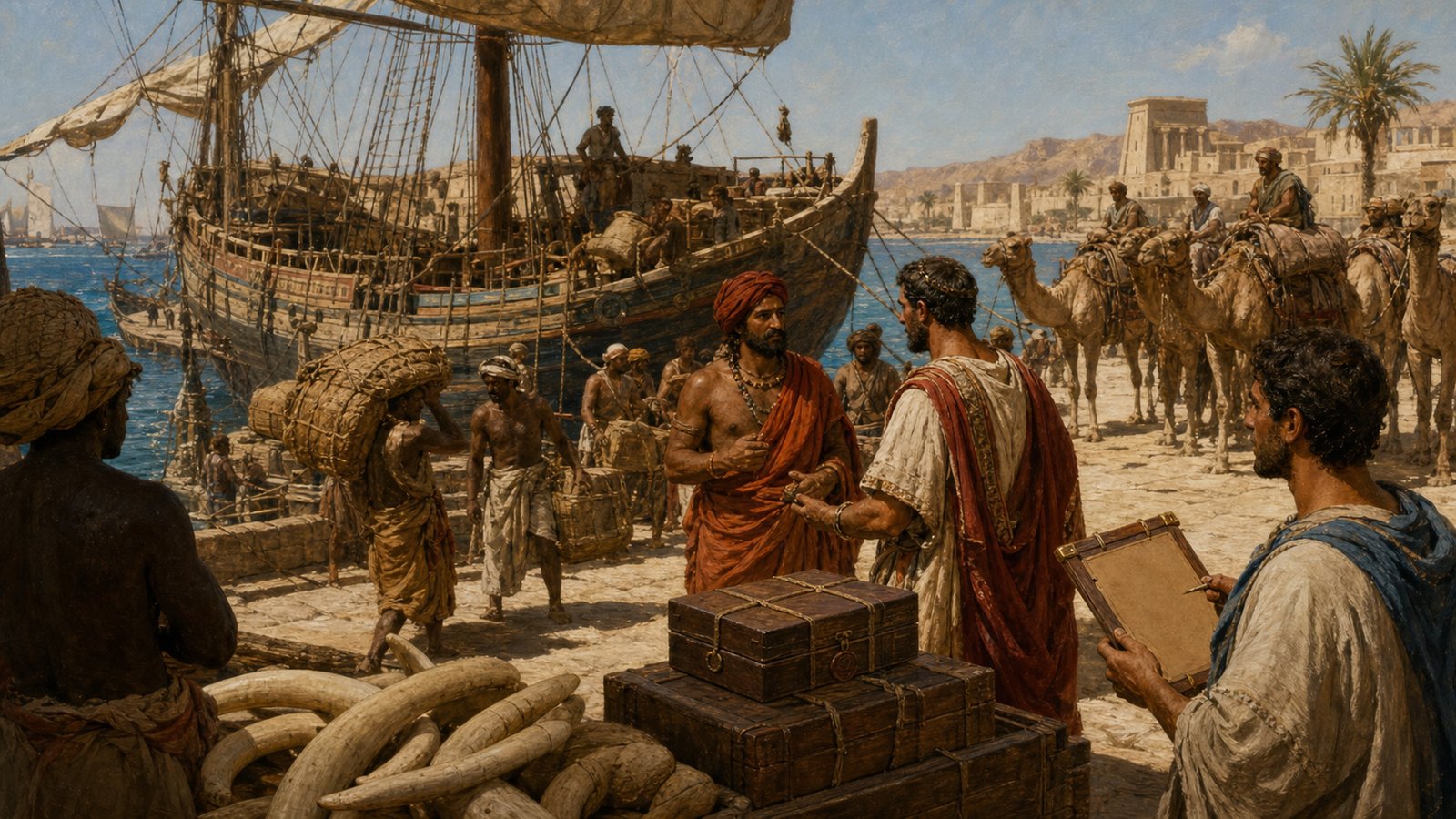
The surviving clauses are concerned with the Egyptian half of the route. Goods arriving from the Red Sea had to travel from the port region across the Eastern Desert toward Koptos, then down the Nile to Alexandria. The borrower promises to deliver money for extra charges to a camel driver, carry the goods through the desert under guard and protection, load them onto a river boat and place them in the customs warehouse at Alexandria.
Each verb marks a vulnerability. Bales could disappear between ship and caravan. Desert transport required animals, drivers and security. River workers expected payment. Customs officials needed to assess a cargo whose commercial weights did not necessarily match fiscal weights. The papyrus does not present “Rome and India” as two points joined by a clean line. It presents a chain of people who had to recognize the same legal claim.
That chain makes the document a useful companion to archaeological evidence for consumption. The broken amphorae at Monte Testaccio reveal what happened after standardized containers reached Rome. The Muziris contract catches luxury goods earlier, while ownership, tax and transport were still being negotiated on the road.
Collateral Travelled Farther Than the Creditor
The loan was secured on goods rather than trust alone. If repayment did not occur on the specified date, the creditor and his agents received broad authority over the pledged cargo. They could take possession without a fresh summons to judgment, pay the quarter-tax, move the remaining portions, sell them, pledge them again or even buy them at the current price.
That language turns distance into procedure. The lender did not need to stand at Muziris or accompany every camel. Administrators and managers could act in his place. A seal at Alexandria could connect the physical cargo with the contract. Default did not merely trigger a lawsuit years later; it opened an agreed route by which goods became available to satisfy the debt.
The agreement also allocates the outcome after sale. A surplus or shortfall relative to the capital remained with the borrower. That detail keeps the arrangement from looking like simple confiscation. Creditor and borrower were sharing a risky commercial process, but they were not sharing it equally. The contract defined who controlled the goods at the precise moment confidence failed.
Sixty Boxes of Nard Became a Column of Numbers
On the reverse, the papyrus lists sixty boxes of Gangetic nard. Nard was an aromatic product associated with northern India and used in perfumery and luxury preparations. The account assigns each box a value of 4,500 drachmas, producing a subtotal of forty-five talents. A fragrant substance that began as plants and labor appears here as standardized boxes and arithmetic.
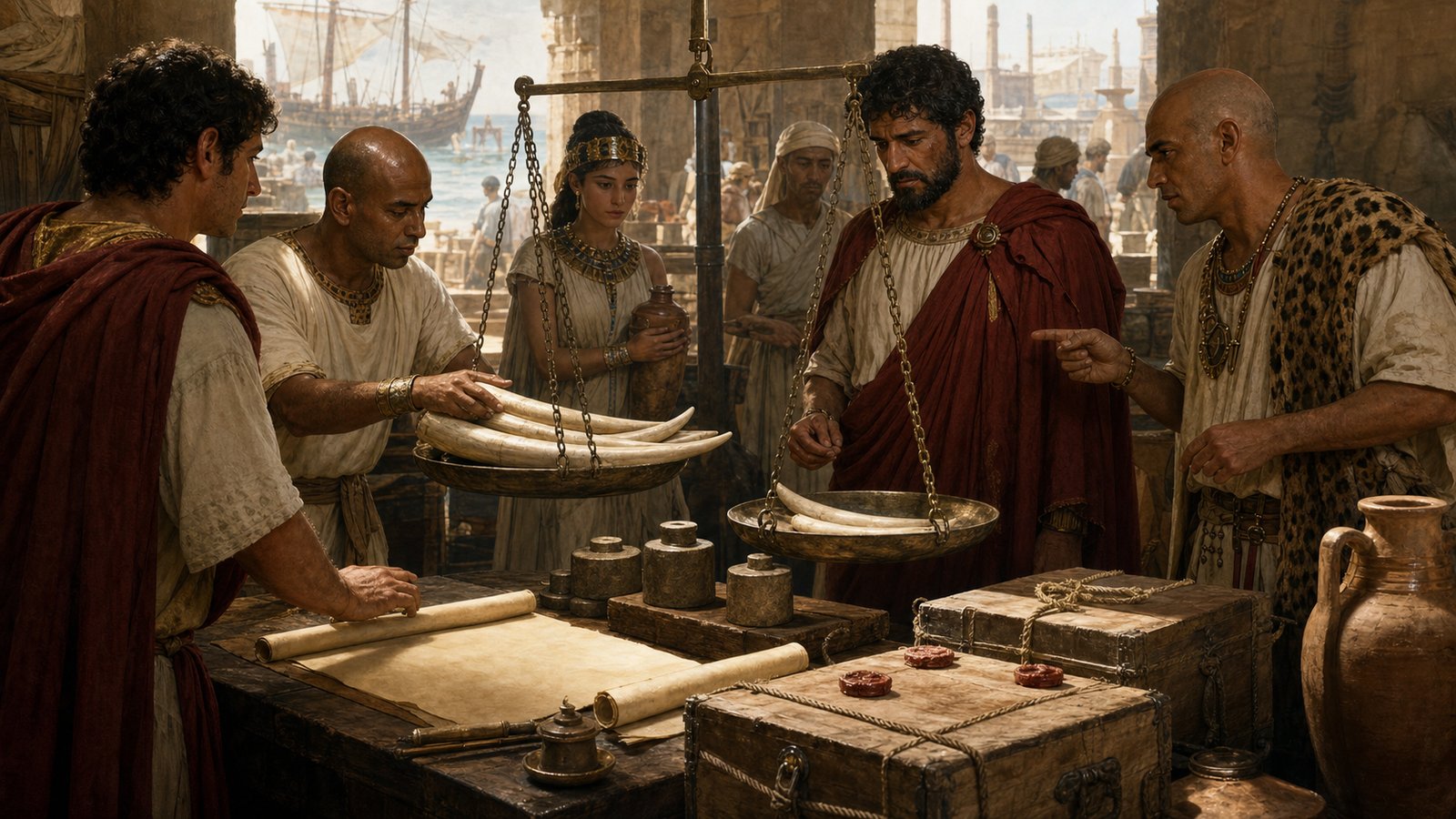
Ivory receives an even more elaborate treatment. The account distinguishes sound tusks from fragments, records weights, converts between the standard used for the quarter-tax and the ratio used among merchants, and applies different drachma values. The calculation preserves thousands of pounds of material. A tusk could be weighed one way by fiscal authorities and understood another way in commercial reckoning.
This is not clerical fuss detached from the real economy. A small difference multiplied across a heavy cargo changed the tax and the security behind the loan. The scribe’s columns were part of the machinery that made distant trade investable. They translated smell, weight and uncertain quality into quantities that lenders, officials and merchants could contest.
The Quarter-Tax Shaped Every Calculation
The papyrus repeatedly refers to the quarter-tax, the twenty-five percent customs levy associated with goods entering from the Red Sea trade. That rate explains why the account separates portions and recalculates weight according to the customs standard. Tax was not an expense added after profit had been counted. It shaped the way the cargo was divided, described and pledged.
The Alexandria warehouse mattered because it created a controlled point of assessment. The borrower promises to place the goods under the authority and seal of the creditor or his representatives. The state’s claim and the lender’s claim therefore intersected at a physical location. Before merchandise could circulate through Mediterranean markets, officials and private agents had to know which portion belonged to whom.
Roman long-distance commerce is often pictured through coins found in India or pepper served at elite tables. Those traces show exchange, but not the paperwork that absorbed risk. The contract demonstrates that taxation, private credit and transport were intertwined. A ship’s profitable arrival did not end the voyage financially; it began a sequence of obligations on land and river.
The Hermapollon Carried More Than a Fortune
The account gives the three recorded portions from the Hermapollon a combined value of 1,154 talents and 2,852 drachmas of silver. Converting ancient money into a modern price invites false precision because wages, purchasing power and commodity markets do not map cleanly across centuries. The safe conclusion is still startling: this was an exceptionally valuable consignment whose financing justified detailed control over every stage.
Its value was concentrated in relatively compact luxury goods. Nard and ivory could survive long transport while carrying enough worth to absorb the cost of ocean sailing, desert carriage, river freight, guards, taxes and interest. The pattern differs from bulky staples. Our article on garum and Mediterranean connection follows a product moved in large ceramic containers; the Muziris cargo made extreme distance economical through value per unit of weight.
The ship’s name is precious because most actors are anonymous. We do not know the full identities of borrower and lender from the damaged opening. Yet the named vessel anchors the abstraction. Somewhere between the Malabar Coast and Egypt, a hull carried merchandise whose ownership was already divided by agreement, anticipated tax and the possibility of default.
A Fragment Makes Global Trade Look Local Again
Grand language about an “Indo-Roman trade network” can make movement appear automatic. The papyrus restores friction. Someone hired the camel driver. Someone guarded the desert crossing. Someone paid river workers. Someone carried the goods into a warehouse, checked a seal, selected a weight standard and copied totals. The network existed only because each local handoff worked well enough for the next.
The document also warns against imagining a single imperial corporation directing the route. Private parties used Roman and Egyptian legal institutions, state customs infrastructure and layers of delegated agents. Their contract anticipated failure in detail because no government could remove monsoon risk, theft, damage, price changes or delay. Law did not eliminate uncertainty; it decided who would bear it.
One damaged sheet therefore preserves something more informative than proof that Romans liked Indian luxuries. It shows how a merchant converted a distant cargo into collateral before the final sale, and how a lender converted absence into authority through agents and clauses. Pepper, perfume and ivory reached consumers because paperwork could travel conceptually with the goods. The most sophisticated equipment on the route was not only the ship. It was the agreement that kept the cargo legible from Muziris to Alexandria.
Sources
Muziris Papyrus, SB XVIII 13167, translated by Dominic Rathbone; Oxford Research Encyclopedia of Classics, “Muziris Papyrus”; Periplus of the Erythraean Sea.