

Agrippina stepped from the ship at Brundisium holding an urn. Germanicus had left Italy as the empire’s most admired young commander. He returned as ashes carried by his widow, with their children following behind. Tacitus makes the harbor almost motionless before the crowd’s grief breaks through.
The landing came in AD 20, after Germanicus died at Antioch the previous autumn. News, suspicion and mourning had travelled ahead of the family. By the time Agrippina reached Italy, veterans, local people and visitors had gathered without needing a formal summons. They knew what the vessel in her arms represented.
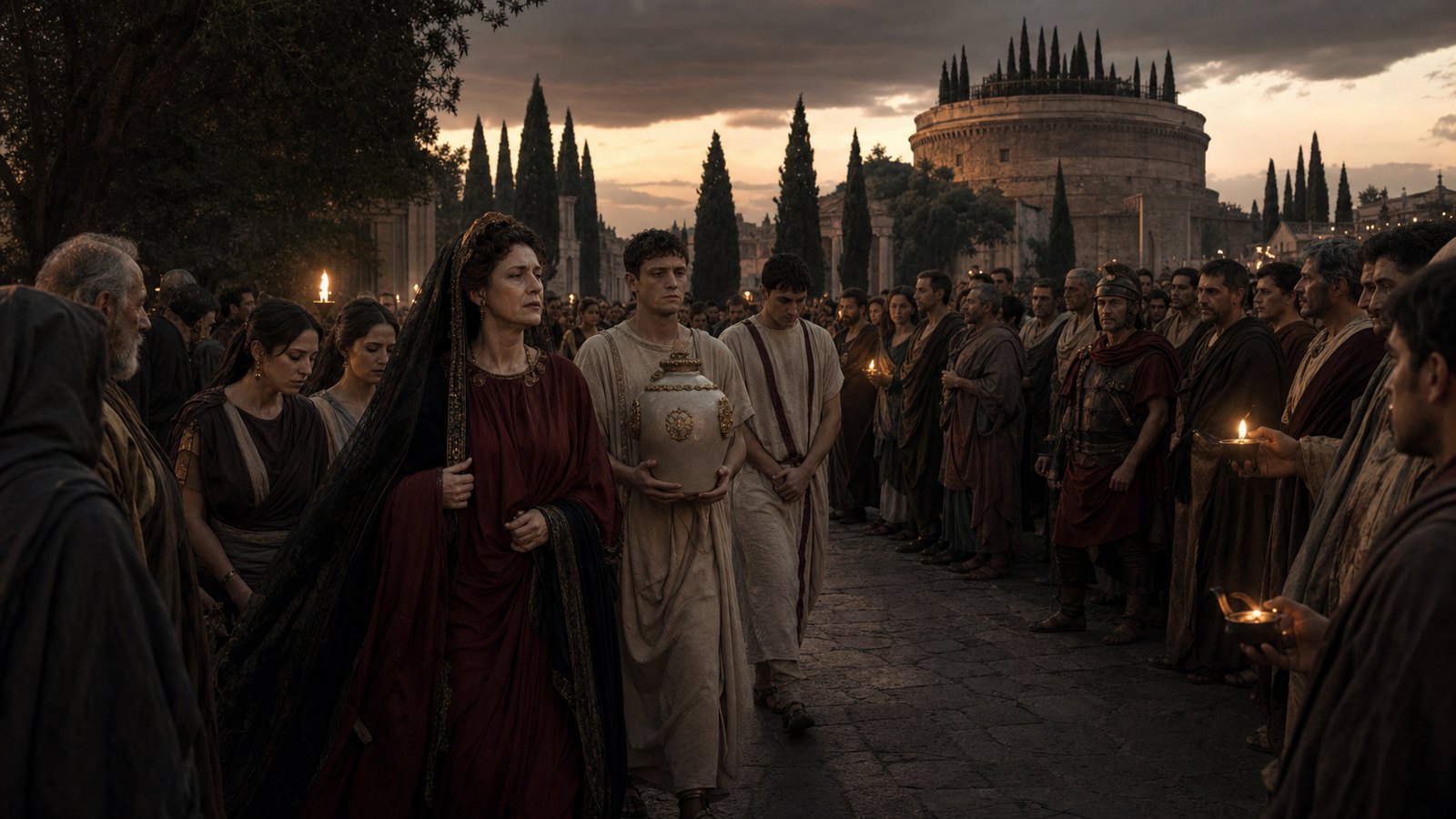
The journey that followed was not a triumph and not an ordinary family funeral. It became a moving public scene in which towns supplied mourners, magistrates offered respect and the road itself carried political feeling toward Rome. Agrippina did not need to accuse anyone. Her presence beside the ashes made every welcome—and every absence—visible.
Antioch Turned a Commander’s Death into a Crisis
Germanicus died at Antioch in Syria in AD 19. He was the adopted son of the emperor Tiberius, husband of Agrippina and father of a large imperial family. His military reputation and popularity meant that illness in a distant province could not remain a private event.
Before his death, Germanicus believed that Gnaeus Calpurnius Piso, the former governor of Syria, had worked against him. Ancient reports also preserve suspicions of poison and hostile ritual objects, but they do not provide modern certainty about murder. What is secure is that the conflict with Piso made the death politically explosive.
Agrippina cremated Germanicus and prepared to carry his remains home. The choice condensed a body, a marriage and a public career into one portable object. The urn could cross the Mediterranean while the accusations, rumours and expectations surrounding the death travelled beside it.
The imperial government could manage orders and ceremonies, but it could not dictate exactly how people would react to the sight of the widow and her children. The return therefore exposed the distance between official control and public affection.
Brundisium Waited Before the Ship Appeared
Tacitus opens the Italian return at Brundisium, the great Adriatic port connected to Rome by the Appian Way. Friends of the family, soldiers who had served under Germanicus and people who had never known him personally gathered there. Some came because of duty; others arrived because the event had become common grief.
The sources describe uncertainty about where the ship would land. People watched the sea and the waterfront. That waiting is important because it shows a crowd forming before any official procession could organize its emotions. The harbor became a threshold between overseas death and Italian memory.
When the fleet entered, Agrippina appeared carrying the urn and accompanied by her children. The crowd’s silence gave way to lamentation. Men and women mourned together, while distinctions between close companions and strangers narrowed in the shared recognition of loss.
Brundisium also fixed the route ahead. From this port the Appian Way tied southern Italy to Rome. A road built for movement, administration and conquest now carried ashes and public sorrow toward the capital.

The Urn Made Grief Impossible to Keep Abstract
An imperial death could be known through messengers, decrees and rumours. The urn changed the scale of knowledge. It was small enough for Agrippina to hold and heavy enough to demand careful movement. Everyone watching could connect the absent man to the visible burden carried by his widow.
Agrippina’s children sharpened the scene. They were not decorative attendants but Germanicus’s surviving family and members of the ruling dynasty. Their presence turned mourning toward succession, vulnerability and the future. A crowd looking at them could not separate family grief from imperial politics.
Tacitus emphasizes Agrippina’s composure as well as the public lament. Dignity made the image more forceful because it did not dissolve into theatrical display. She became the stable center around which others expressed what the political situation made dangerous to say directly.
The urn also differed from the ancestor masks displayed in elite Roman funerals. A mask returned a recognisable face to public view. Germanicus’s ashes offered no face at all, forcing memory onto Agrippina, the children and the crowd’s knowledge of the dead commander.
Italy Turned the Road into a Chain of Witnesses
The party moved north from Brundisium, and mourning did not remain confined to the first harbor. Municipal communities and colonies sent representatives. Local magistrates and ordinary inhabitants came out along the route. Each encounter repeated the recognition that Germanicus belonged to more than one household.
Tacitus notes military involvement as well. Veterans and serving soldiers had reasons to remember Germanicus as a commander rather than only as an imperial prince. Their presence gave the procession a second language: the discipline of service joined the disorder of grief.
The movement was cumulative. A single crowd can be dismissed as a local reaction; a succession of towns creates a map of feeling. As the urn approached Rome, reports of each reception could travel ahead, preparing the next community and increasing the political weight of the arrival.
No surviving itinerary allows every halt to be reconstructed with equal detail. The reliable point is the pattern described by the ancient narrative: the road repeatedly became a place where public bodies met a bereaved family. The journey mattered because it lasted long enough for mourning to gather witnesses.
Absence Became Part of the Procession
Tacitus pays close attention not only to those who appeared but to senior imperial figures who did not. Tiberius and Livia remained away from the public reception. Antonia, Germanicus’s mother, was also absent. Ancient explanations included grief, health, court calculation and the desire to avoid exposing emotion; none can be proven as the single motive.
For observers, however, absence could still be read politically regardless of private intention. The more openly communities received Agrippina, the more noticeable distance at the top of the imperial household became. Silence and nonappearance entered the story as evidence people could interpret.
Tiberius faced a difficult balance. A grand reception risked magnifying Germanicus’s popularity and the accusations around his death. Restraint risked looking cold. Imperial power was strongest in issuing commands, but public mourning created a test in which every response carried an unwanted meaning.
Agrippina’s role grew within that ambiguity. She did not arrive as a magistrate or army commander. She carried ashes. Yet the physical work of returning Germanicus placed her at the center of a public event the emperor could neither ignore nor entirely control.
The Mausoleum Closed the Journey but Not the Argument
Germanicus’s ashes were ultimately placed in the Mausoleum of Augustus. The location joined him to the ruling family’s dynastic tomb and gave the journey an architectural conclusion. The urn had crossed sea, harbor, road and city before entering a monument designed to hold imperial memory.
Burial did not end the political crisis. Piso returned to Rome and faced proceedings over his conduct. He died before the trial reached an ordinary conclusion, leaving a written defense and continuing controversy. The Senate’s response and official commemorations attempted to give public form to judgment and grief.
Agrippina’s later conflict with Tiberius would make the return seem like an early chapter in a longer struggle. It is tempting to read every gesture at Brundisium as if everyone already knew that future. They did not. The power of the scene comes from what was visible then: a famous death, unresolved suspicion, a widow, children and an urn.
The route through Italy transformed those elements into collective memory. Germanicus never spoke during the journey, and Agrippina needed no public oration to make his absence felt. The people lining the road supplied the response. By the time the ashes reached Rome, grief had become a political fact because thousands had seen themselves taking part in it.