
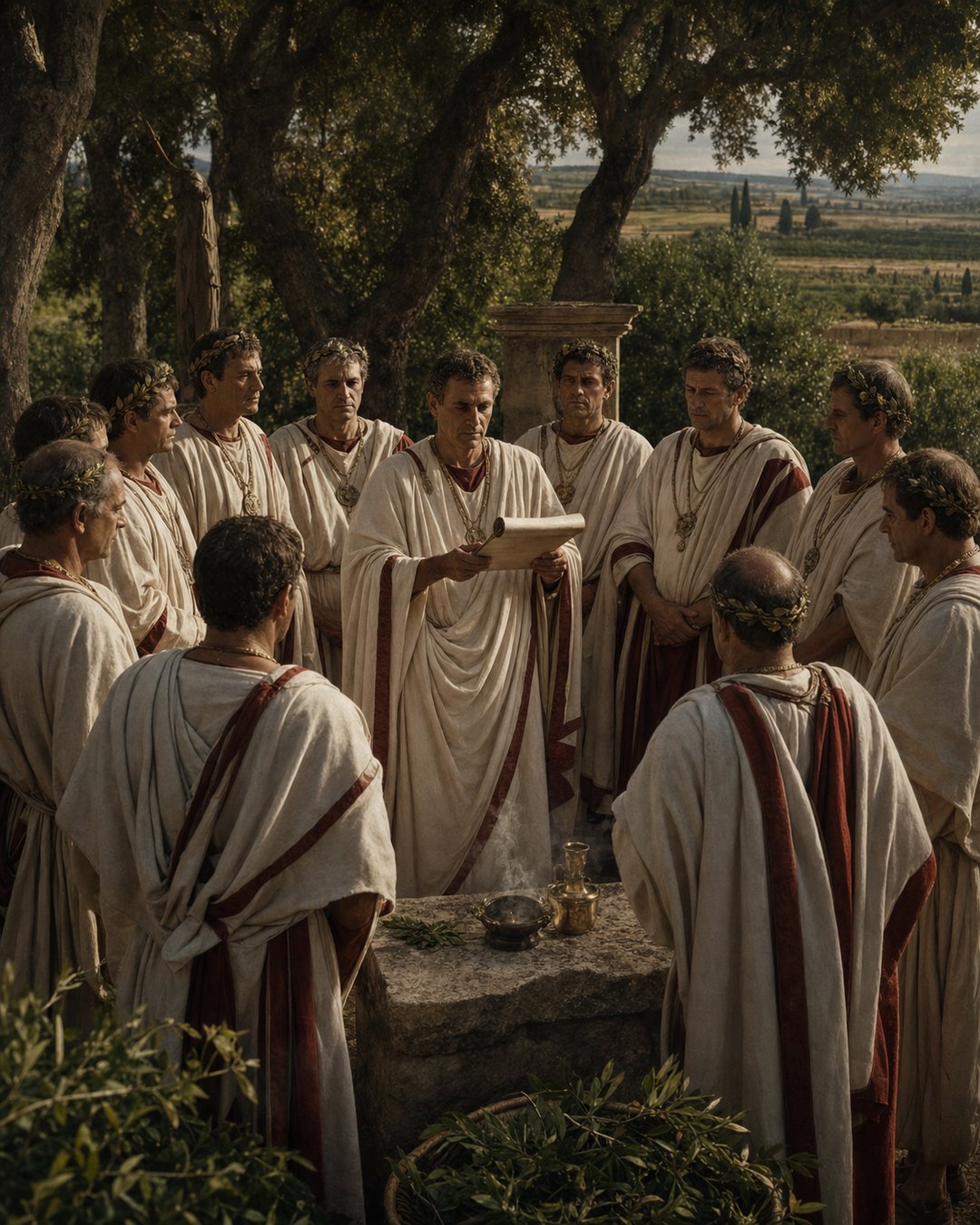
In AD 218, twelve Roman priests closed the doors of a sanctuary and began to dance. Their song asked the Lares for help and Mars not to let ruin fall upon the people. Yet its words did not sound like the Latin used in the streets, courts or imperial palace outside. The hymn belonged to a much older Rome.
The men were the Arval Brothers, a priestly college concerned with the fertility of cultivated land. Their annual rites for Dea Dia combined banquets, sacrifices, garlands, a sacred grove and a three-step dance. One inscription records the hymn they sang, preserving phrases so archaic that even later copyists seem to have struggled with them.
The survival of that song was not a simple triumph of memory. It depended on an institution that selected members for life, assigned ritual offices, repeated a detailed festival and carved its proceedings into stone. Rome kept an ancient voice alive by building a system around it.
Twelve Places Turned a Farming Rite into Public Office
The Arval Brothers formed a college traditionally numbered at twelve. Ancient explanations connected their name with arva, cultivated fields, because they offered public sacrifices for fertility. A foundation legend carried the group back to Romulus and the twelve sons of his foster mother Acca Larentia, giving an old agricultural duty the prestige of Rome’s first household.
Membership lasted for life. When a place became vacant, the remaining brothers chose a replacement, and major figures could belong. The college included emperors during the imperial period, but it did not become an ordinary rung in a political career. Its continuity came from filling the same ritual places across generations.
Each year the members appointed officers to direct the coming observance. The changing names mattered less than the repeated structure: a president, assistants and attendants knew which tasks had to occur and in what sequence. Institution carried details that no single participant could preserve forever.
This made the brotherhood different from a spontaneous village celebration. Its object was agricultural wellbeing, yet its membership stood close to the Roman state. The fields were not treated as a private concern. Grain, vines and harvests underpinned the city, armies and sacrifices, so ritual attention to cultivation became public work.
Dea Dia’s Festival Moved Between House, Grove and Field
The central festival occupied three days in May, with the exact dates announced in advance. The first and third days were observed in Rome, while the middle day drew the brothers to the grove of Dea Dia outside the city. Movement between urban houses and sacred woodland joined official Rome to the cultivated landscape beyond its walls.
Garlands of grain ears marked the agricultural purpose. Banquets, incense, wine and sacrificial victims organized the day into successive acts rather than one single offering. Servants and specialists supported the priests, but access changed as the rite moved from public-facing meals to restricted moments inside the sanctuary.
The grove had its own boundaries. Ancient records show that cutting or repairing within it could require an expiatory sacrifice, especially when iron tools disturbed sacred ground. A practical task therefore became a religious event. The point was not that Romans never altered a grove; it was that alteration had to be acknowledged and ritually managed.
This concern with place resembles the way Roman processions made belief visible through movement. The Arval festival used a different landscape, but it also gave meaning to a route. House, road, grove and sanctuary each required a distinct action.
Closed Doors Protected the Oldest Part of the Rite
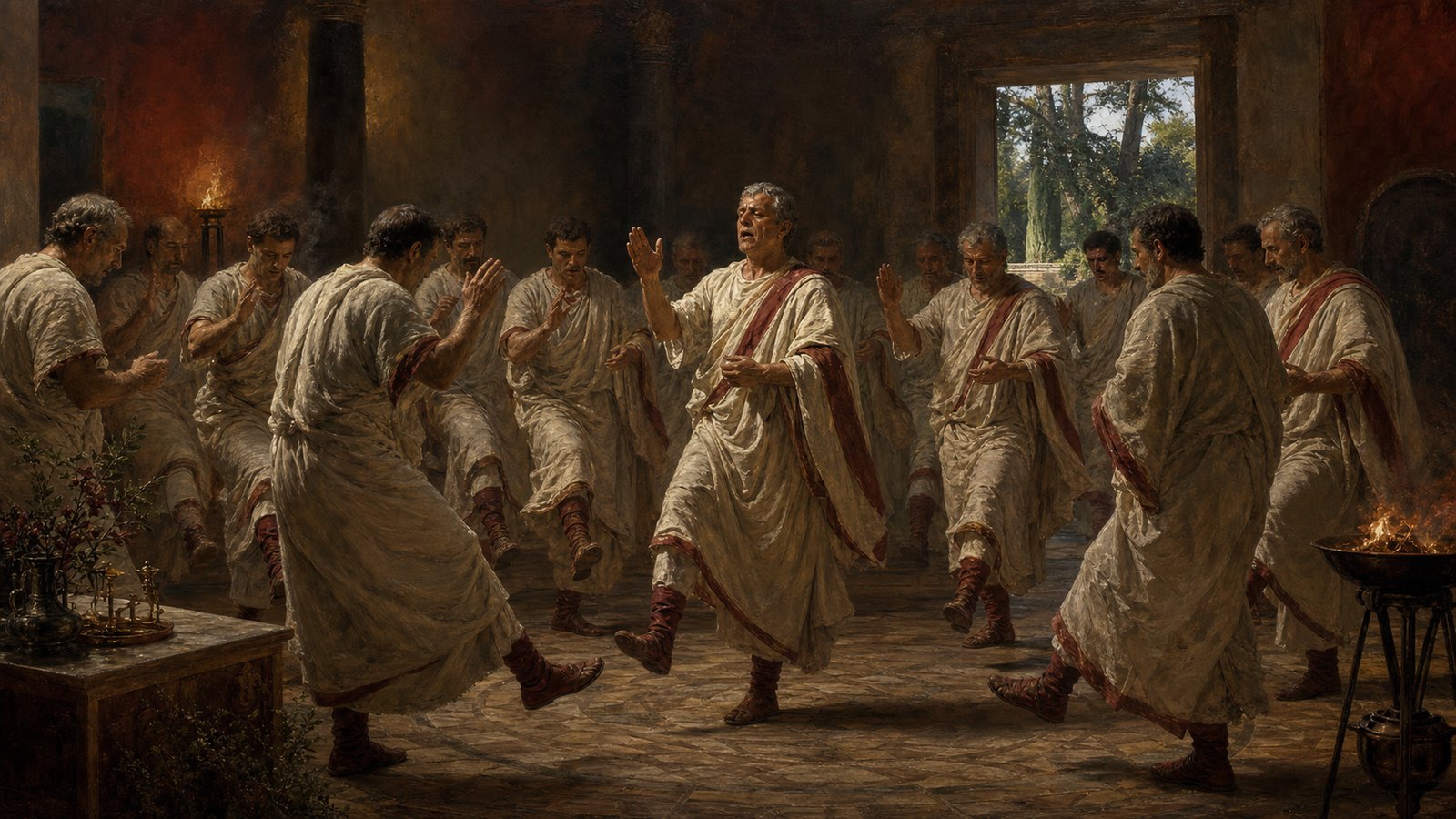
On the grove day, the brothers entered the sanctuary, dismissed attendants and shut the doors. There they received the written text of the hymn and performed a measured three-step dance. The act was repeated, with the song delivered three times according to the surviving record from AD 218.
The closed room did not make the rite secret in the modern sense. Its proceedings were later recorded, and the priesthood itself was public. Restriction instead separated performers from assistants at the moment when words and movement had to be executed by the college alone.
The dance, often described by the Latin term tripudium, turned recitation into coordinated bodily memory. Feet marked the pattern while voices carried the phrases. A hymn preserved only as prose could drift into ordinary speech; a hymn bound to a repeated movement retained an older shape because changing one part threatened the whole performance.
The brothers wore their formal priestly dignity into an act that was physical and collective. No single virtuoso owned the song. Twelve places, a leader, repeated lines and common steps distributed responsibility. The ritual survived because each generation entered a pattern larger than itself.
The Hymn Asked Mars to Stand Still
The Carmen Arvale begins by calling on the Lares to help. It then addresses Mars in an archaic form, asking him not to allow plague or ruin to fall upon the people. Another line urges the fierce god to stand satisfied at the threshold, and the song summons the Semones before ending in repeated cries of triumph.
Translation remains difficult because several words and forms are rare, damaged or preserved through uncertain spelling. Scholars can identify the broad movement of the appeal more securely than every grammatical detail. The hymn belongs to a stage of Latin far removed from the educated prose of the imperial age.
Mars appears here as more than the god of battlefield victory. The prayer places him at a boundary between destructive force and protected community. Asking him to halt disaster fits an agricultural rite because crops could be ruined by forces as frightening and uncontrollable as an enemy army.
The emphasis differs from the omens consulted before Roman battles. Those rites asked whether an action should proceed. The Arval hymn tried to maintain a relationship through recurring performance, turning protection into an annual obligation rather than a single decision.
A Stone Record Preserved More Than a Song
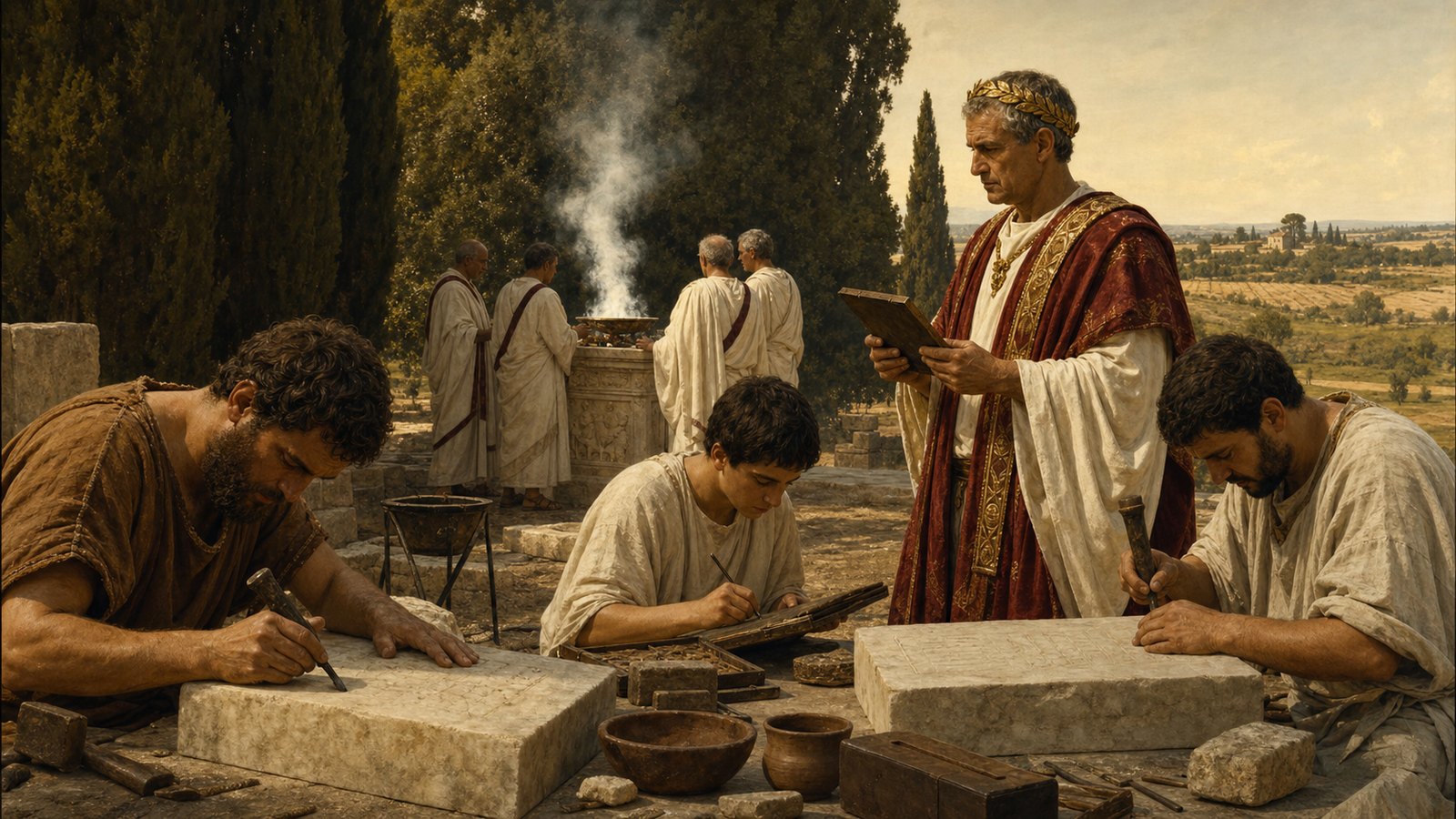
The hymn survives within the records known as the Acta of the Arval Brothers. Fragments found near the grove preserve names, dates, sacrifices, appointments and unusual events across the imperial period. Their detail allows historians to watch the membership and ceremony change while the college claimed continuity.
The AD 218 record is especially valuable because it writes out the archaic song. The stone did not preserve melody, pitch or the exact sound of the dancers’ feet. It preserved enough verbal sequence to prove that imperial priests were still performing language inherited from a much earlier religious world.
Inscription was therefore a second memory system beside ritual. Performance could carry timing and movement; stone could stabilize names and words after voices stopped. Neither system was complete alone. The acta are administrative, but their administrative precision is precisely why a fleeting song entered the historical record.
The surviving fragments also reveal interruptions and revival. The brotherhood declined in the late Republic and was restored under Augustus. Restoration did not recreate an untouched prehistoric ceremony. It placed an old college inside a new imperial order, where emperors could join and annual records displayed continuity.
Tradition Survived Because Romans Worked at It
It is tempting to imagine ancient religion as a body of beliefs simply handed down intact. The Arval evidence shows maintenance instead. Vacancies had to be filled, dates proclaimed, victims obtained, grove repairs expiated, words copied, doors closed and bodies moved together in the correct sequence.
The awkward language strengthens that conclusion. A song everyone understood naturally would need less scaffolding. The Carmen Arvale endured because unfamiliarity made exact form valuable. Its age was not an obstacle to the rite; age was part of what the rite presented as authority.
The brothers could not preserve everything. We do not possess their tune, and uncertainties remain in the text. What survives is still unusually intimate: a sequence of appeals once voiced by imperial Roman priests as they stepped in unison inside a sanctuary beyond the city.
The Arval Brothers kept Rome’s agricultural anxiety attached to an ancient vocabulary. Fields needed rain, protection and labour every year, while institutions needed appointments, records and repetition. Their hymn joins those two cycles. Crops returned through seasons; old words returned because people deliberately made room for them.