
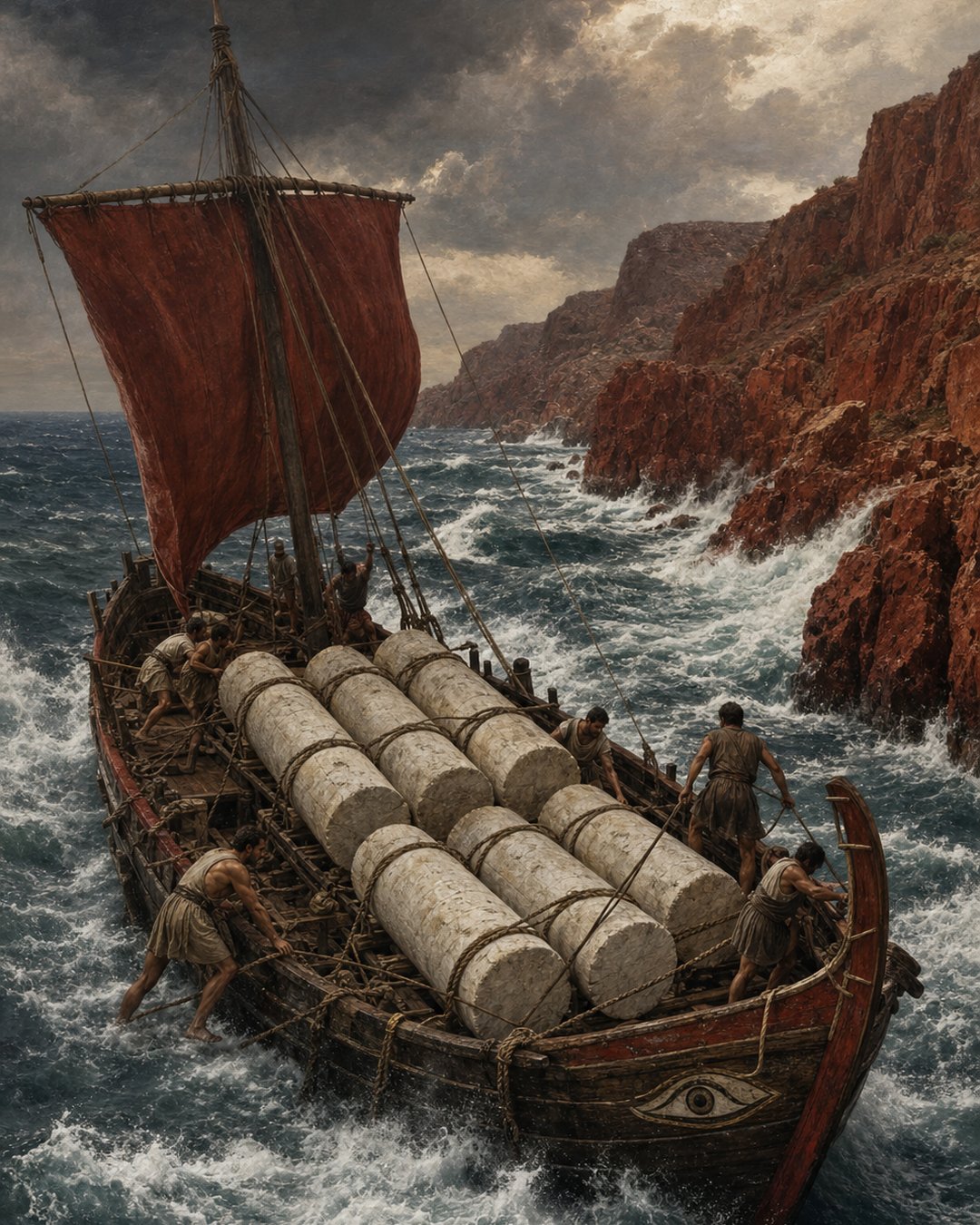
At Kızılburun—“Crimson Cape”—a ship went down with architecture on its deck. Eight marble drums and a single Doric capital had been assembled as the parts of one monumental column. They were not rubble from a ruined building. They were a building element still in transit, interrupted between quarry and sanctuary.
The carrier sank off the Aegean coast of what is now Türkiye in the early first century BCE. Its cargo weighed roughly sixty tonnes and settled 45 to 48 metres below the surface. Research traced the column marble to Proconnesus in the Sea of Marmara and identified the Temple of Apollo at Claros as the likely destination. The ship failed about fifty kilometres short of that journey’s end.
Those figures make the wreck dramatic, but its real importance is mechanical. A standing column hides every difficult action that placed it upright. Kızılburun preserved the opposite view: drums separated, surfaces still rough, transport objects scattered and fragile hull remains pinned beneath the stone. The wreck shows monumental building before the monument could make its labour disappear.
A Column Travelled as Nine Separate Problems
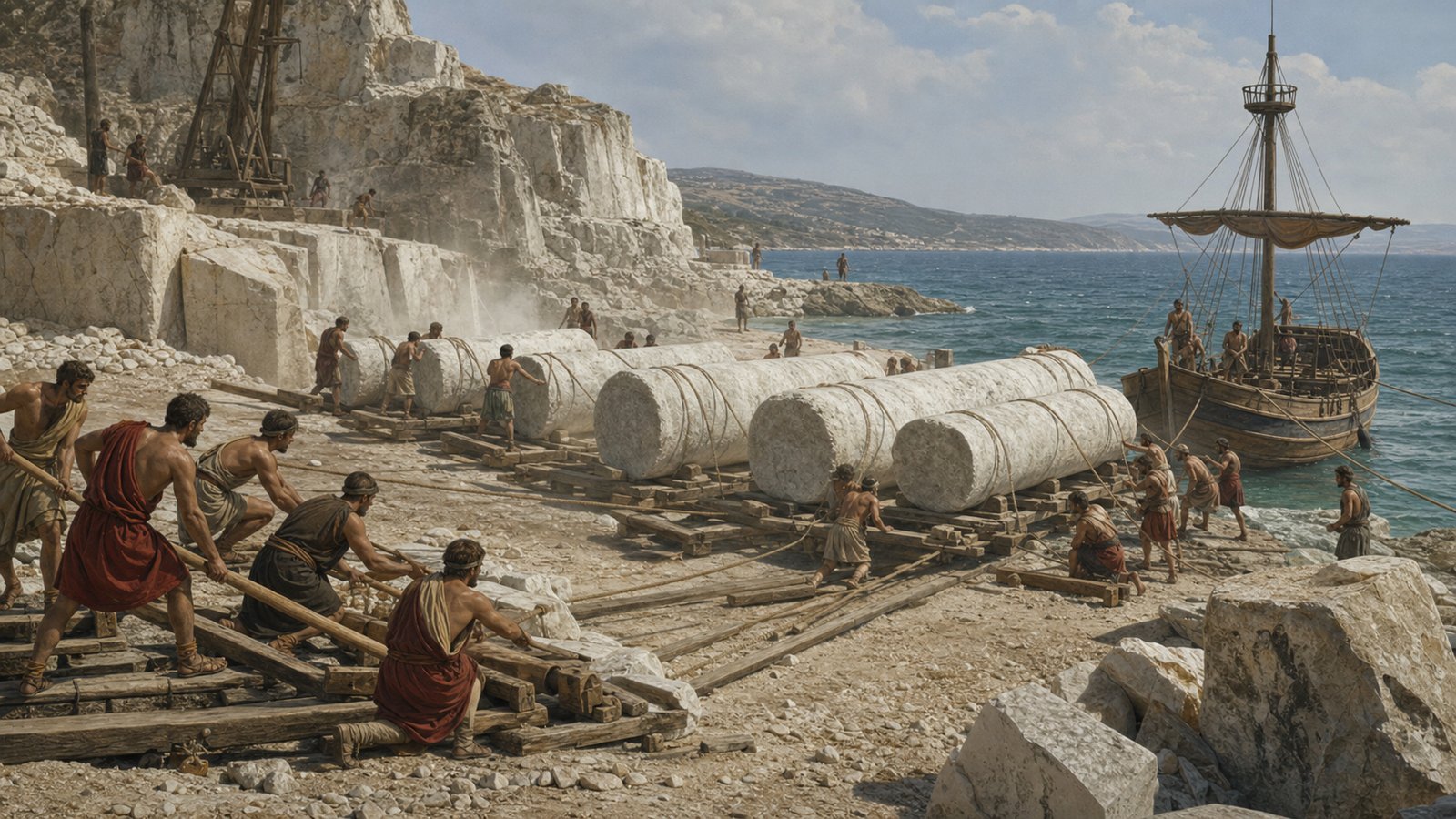
The cargo contained eight individual drums and one Doric capital. Each drum was a finished transport unit but not yet a finished column. Dividing the shaft reduced one impossible mass into several merely enormous masses, each of which still had to be moved from quarry face to shore, loaded into a hull and restrained against the motion of the sea.
The rough cylinders mattered. Final fluting and fine surface work could wait until the pieces reached their building site, protecting labour from damage during transport and avoiding decorative precision before the last handling stages. The wreck therefore caught the column between extraction and architectural completion.
The Doric order also made the discovery unusual for its date. The Institute of Nautical Archaeology notes that Ionic and Corinthian orders were generally preferred by architects in this period. Here, however, a complete Doric column travelled together as a coherent commission rather than a random heap of reusable blocks.
This shipment belonged to the same world of coordinated heavy labour explored in the Roman crane’s lifting system. Yet a quarry road and ship imposed different constraints: horizontal movement, rolling, braking, balance and hull stability had to succeed before any crane at the destination could raise the pieces.
An Amphora Gave the First Hint of a Date
The wreck was first located in 1993 during an Institute of Nautical Archaeology survey directed by Cemal Pulak. The only diagnostic artifact then visible was a Lamboglia 2 amphora resting against one of the drums. Its form suggested that the site might belong to the second or first century BCE, although its relationship to the stone cargo still needed testing.
A team directed by Tufan Turanlı returned in 2001 through the Shipwrecks of Anatolia project. Divers photographed and sketched the exposed remains. They also identified black-glaze bowls, oil lamps, transport amphoras and a small copper handle. Three more Lamboglia 2 amphoras appeared in association with the drums, strengthening the late Hellenistic or early Roman date.
This sequence is a useful reminder that a wreck does not introduce itself with a label. Date, route and function emerge from associations. One amphora offered a first clue; repeated forms and excavation context made that clue more persuasive. The marble announced the scale of the cargo, but smaller objects helped place the disaster in time.
Kızılburun also lies among several wrecks from different periods. The immediate area includes an earlier amphora carrier, Byzantine wrecks and a medieval millstone wreck. Careful recording was essential because proximity alone could not make every object part of the same sinking.
Proconnesus Marble Pointed North Before the Route Turned South
Analysis linked the column pieces to quarries on Proconnesus Island, now Marmara Island, in the Sea of Marmara. That origin gives the cargo a route before the wreck: stone left an island quarry, passed through maritime handling and travelled into the Aegean aboard a specialist carrier.
The likely destination was the Temple of Apollo at Claros. The match is described as very likely rather than absolutely certain, an important distinction. Archaeologists combine the dimensions and character of the column with its date, stone origin and geographical position; the sea has preserved strong convergence, not a surviving bill of lading naming the sanctuary.
If the identification is correct, only about fifty kilometres remained. That shortfall exposes how misleading “near arrival” can be for ancient freight. Every mile continued to place vessel, crew and commission at risk. A cargo that had crossed much of its route still had no architectural value at Claros until unloading and assembly were complete.
The ship’s own working systems had to hold that risk in check. Roman anchors made stopping an active manoeuvre, while ballast, lashings, sail handling and coastal judgment kept weight from becoming catastrophe. On this voyage, the system failed at the cape, even though the exact sequence of the sinking remains unknown.
Sixty Tonnes Turned a Hull into a Moving Foundation
The recovered marble cargo totalled about sixty tonnes. That number is not only a measure of commercial value. It describes the problem imposed on the ship: concentrated loads pushed downward through timber structure while waves twisted, lifted and dropped the hull around them.
Ancient shipwrights could build strong seagoing carriers, but strength depended on joined components sharing stress. The hull construction discussed in the archive’s study of mortise-and-tenon shipbuilding helps explain why preserving wreck timbers matters. Planking and joinery are evidence for how a vessel carried weight, not merely a container left after the cargo is removed.
Stone demanded restraint as well as buoyancy. A drum that shifted would not behave like sacks or amphoras that could settle around one another. Its mass and curved surface could concentrate force against neighboring cargo or the hull. Timber beds, ropes and deliberate placement converted separate cylinders into a managed load.
The wreck preserved the point where that arrangement ceased to function as transport and became an archaeological stack. Marble survived pressure and immersion far better than wood. The heavy pieces that once depended on the ship eventually protected, pinned and endangered the surviving hull beneath them all at once.
Recovering the Cargo Risked Erasing the Ship
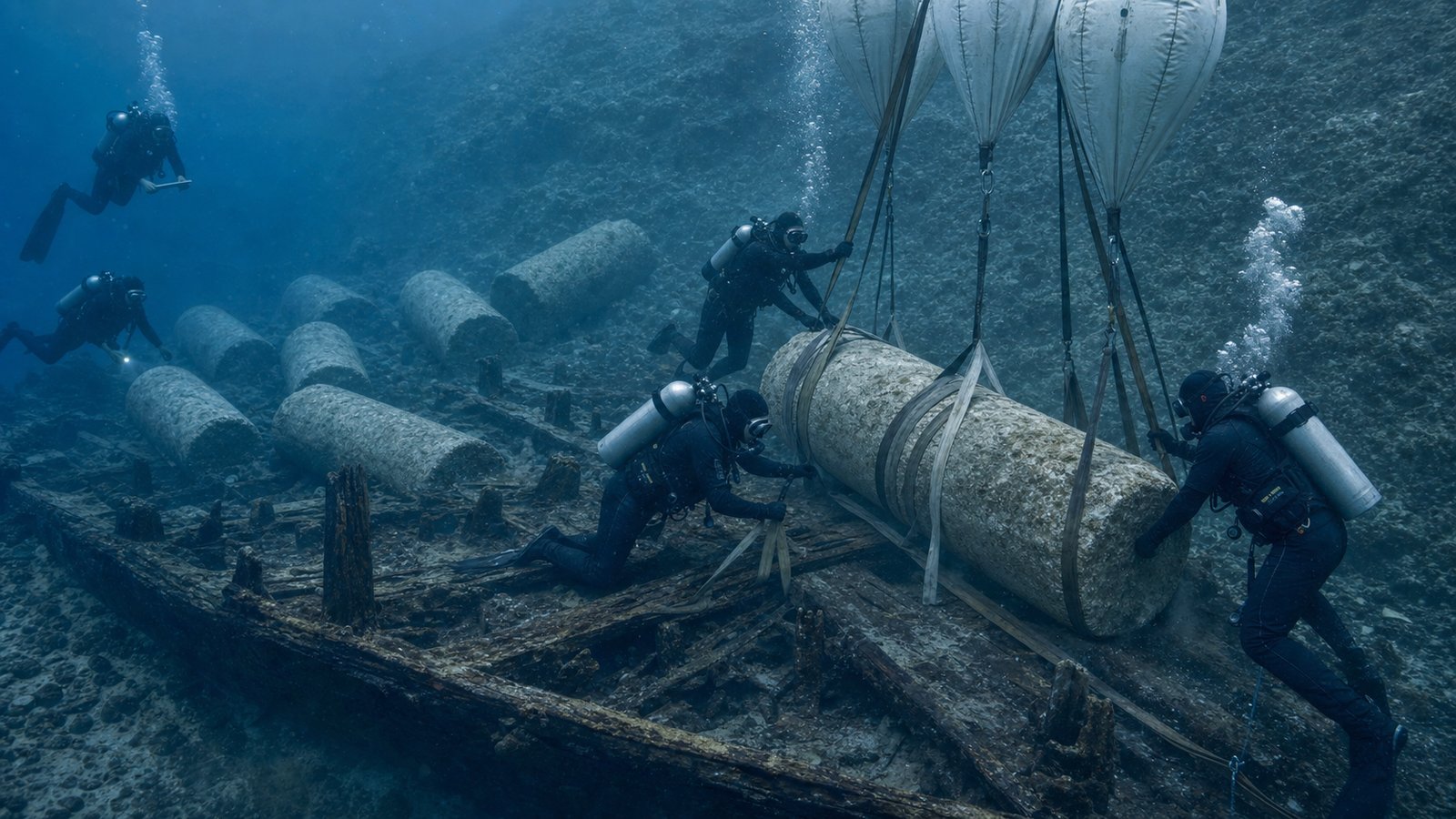
The Institute of Nautical Archaeology excavated the site over multiple seasons beginning in 2005, with recovery and study extending through 2011. The operational challenge was unusual: the large drums had to be rigged, hoisted, moved and raised from nearly fifty metres underwater, yet delicate waterlogged timbers lay directly below.
Simply attaching a line and pulling upward could have traded one discovery for another. Slings had to pass around multi-tonne cylinders; lift had to be controlled; divers worked at depth; and any roll or scrape could damage wood softened by long immersion. The recovery team developed methods over five seasons to separate cargo from hull without treating the marble as the only evidence worth saving.
Lift bags made buoyancy do work that a seabed crane could not conveniently perform. Their force still needed direction. Rigging had to keep a drum stable while it cleared neighboring material, moved through the water and reached a position from which it could be raised to the surface. A successful lift was measured by what remained undisturbed as much as by what came up.
This modern scene mirrors the ancient one in reverse. Ancient crews lowered weight into a hull without breaking it; archaeologists lifted the same weight away without breaking what remained. Both operations depended on load distribution, ropes, sequence and disciplined control of a mass that could not be handled by strength alone.
A Failed Delivery Preserved the Missing Half of a Monument
At a completed sanctuary, visitors would see vertical order: base, shaft and capital aligned, surfaces finished, transport erased. Kızılburun preserved the horizontal prehistory instead. The column had an origin, a route, a carrier and a sequence of unfinished states before it could become architecture.
The wreck also resists a simple story of Roman engineering as inevitable success. Quarry workers and sailors had already solved many problems. The stone had been extracted, shaped into transportable units, moved to the coast and loaded. Those achievements did not guarantee arrival. Monumental construction included losses that surviving monuments rarely record.
Archaeology recovered more than a valuable cargo. The drums, capital, amphoras, small finds and hull remains form a connected argument. Together they date the wreck, trace movement, reveal shipboard life and show the physical cost of carrying architecture by sea. Remove any one class of evidence and the route becomes less precise.
The Temple of Apollo at Claros may have been waiting for one more column when the carrier vanished near Crimson Cape. The sanctuary’s likely commission became a seabed assemblage instead. Fifty kilometres from completion, sixty tonnes of marble stopped being architecture-in-transit and became the clearest surviving record of how architecture travelled.