
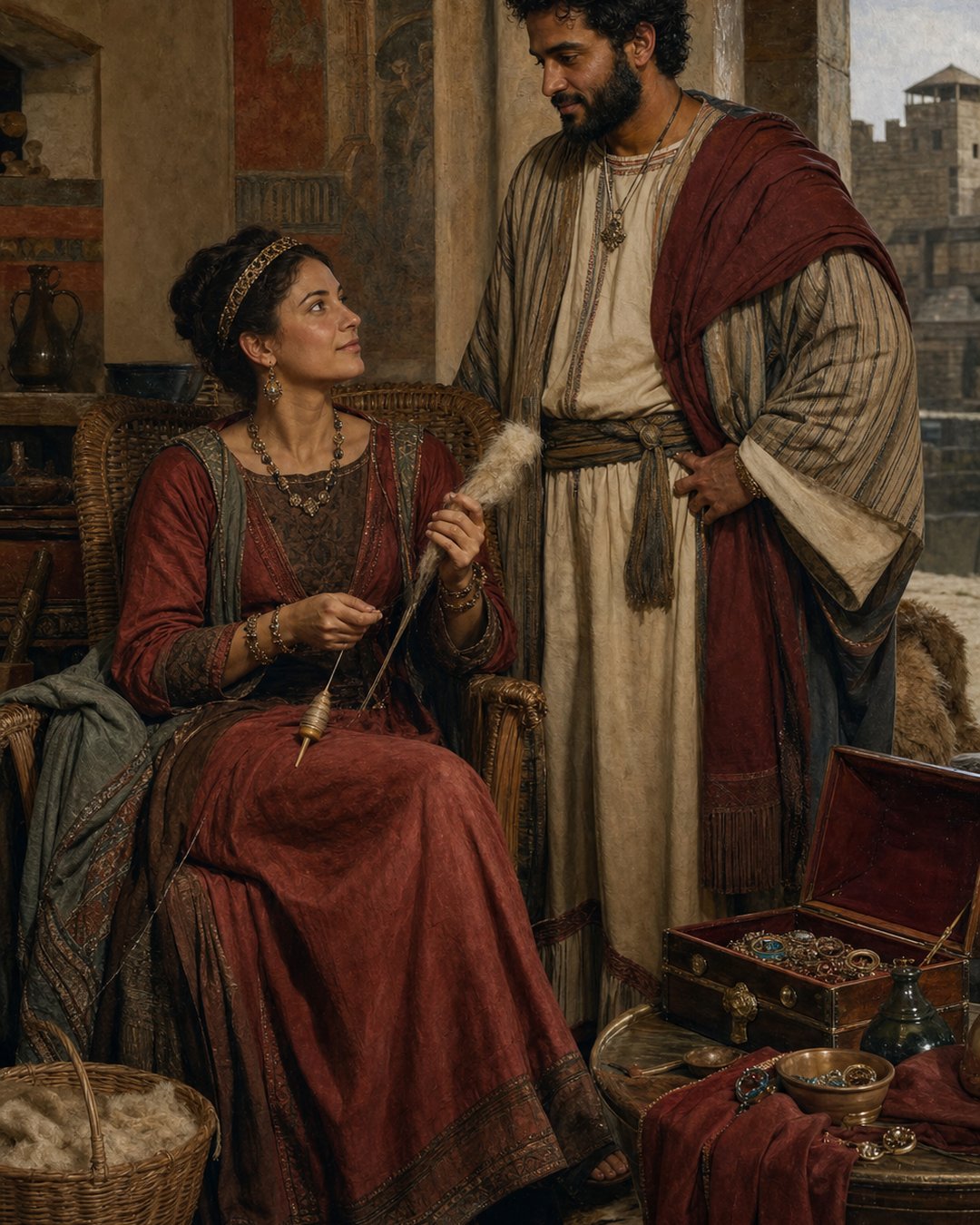
Four lines at the bottom of a sandstone monument carried a longer journey than most Roman roads. Three were cut in Latin. The fourth used Palmyrene Aramaic. Above them sat Regina, not as an emperor, priestess or mythic heroine, but as a richly dressed woman with wool-working tools and an open jewellery casket.
The stone was found in 1878 near the fort at South Shields, ancient Arbeia. Its Latin identifies Regina as a Catuvellaunian, a woman from southern Britain, and says that she died at thirty. It also calls her the freedwoman and wife of Barates, a man from Palmyra in Syria. The shorter Palmyrene line calls her his freedwoman and ends with a conventional cry of grief: “alas.”
Nothing here is culturally tidy. A British woman who had been enslaved was freed and married by a migrant from an eastern caravan city; they lived near a northern military supply base; and her costly memorial mixed languages, clothes, furniture and carving habits. Regina’s stone does not show a uniform Roman world. It shows people assembling a life from identities the empire had brought into contact.
A British Woman and a Palmyrene Man Reached the Same Frontier
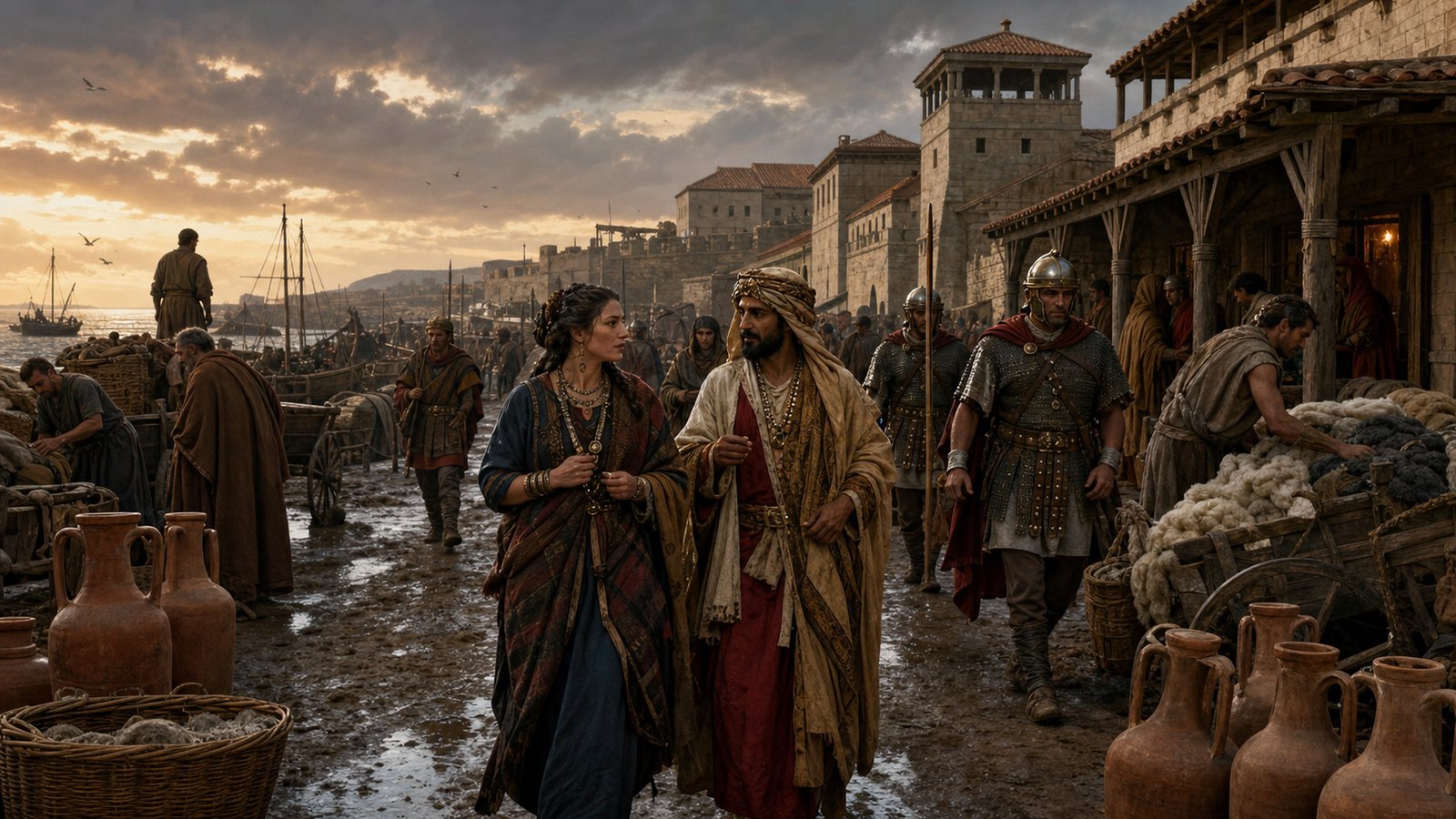
Arbeia stood at South Shields near the mouth of the River Tyne. The fort guarded an important sea approach and served the supply system connected with Hadrian’s Wall. It was a place where military movement generated a civilian settlement, and where cargoes, soldiers, craftspeople and families arrived from very different parts of the empire.
Regina came from the Catuvellauni, whose territory lay in south-eastern Britain. Barates named himself as Palmyrene, tying his origin to Palmyra in modern Syria. North East Museums describes him as a merchant, a plausible occupation in a settlement sustained by transport and supply. Their meeting at Arbeia linked two migrations: hers from southern Britain and his across much of the Roman world.
The monument does not explain how Regina became enslaved, when she travelled north or when Barates freed her. Those missing steps should remain missing. What the Latin does establish is a sequence of social facts: she had been his slave, became his freedwoman, and was also his wife. A life that the text compresses into nouns had crossed legal as well as geographical boundaries.
Manumission did not erase the past or create simple equality. Roman manumission created a public status with continuing relationships and obligations. Regina’s epitaph preserves both stages together. Barates chose to identify the woman he married through the bond from which he had released her.
Three Latin Lines Recorded Status, Origin and Age
The Latin begins with the abbreviated formula D M, for dis manibus, “to the spirits of the departed.” Such compressed formulas saved space and remained recognizable within Roman funerary practice. The inscription then names Regina, calls her freedwoman and wife, identifies her as Catuvellaunian and records her age as thirty.
Age matters because ancient epitaphs often give historians the only surviving number attached to an otherwise unknown person. Regina is not merely “Roman Britain” or “a freedwoman.” She was thirty when she died. Barates commissioned a substantial portrait monument for someone whose adult life had already contained enslavement, release, marriage and relocation.
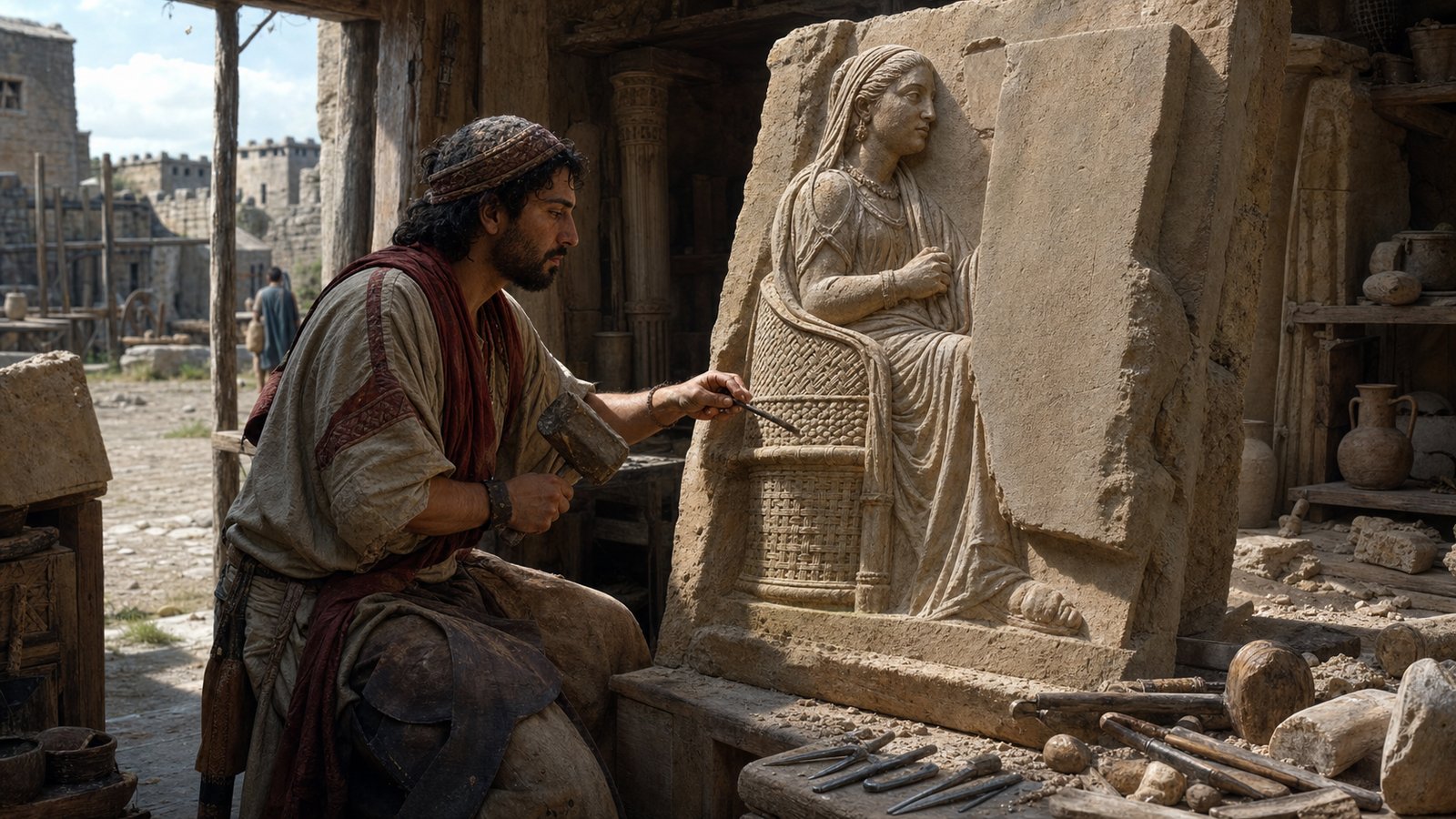
The lettering itself carries evidence. Roman Inscriptions of Britain records a contrast between confident Palmyrene cutting and erratic Latin. One analysis concluded that the sculptor was probably Palmyrene but worked under western influence. North East Museums notes a correction within the tribal name, where an earlier letter was removed and replaced. Latin may have been the carver’s third language after Palmyrene and Greek.
That imperfection is more revealing than a polished standard text would have been. The stone was not produced by an abstract imperial machine. Someone had to negotiate unfamiliar spelling, scripts and local monumental expectations with hammer and chisel. A linguistic mistake became physical evidence for the mixed workshop behind the memorial.
The Fourth Line Let Palmyra Speak at South Shields
Below the Latin runs a single Palmyrene Aramaic line. Roman Inscriptions of Britain translates it as “Regina, the freedwoman of Barates, alas.” The spelling of his name differs slightly from the Latin form, and the eastern line omits “wife,” but its final lament gives the memorial another voice.
The word “alas” sounds intimate to modern ears, although North East Museums cautions that it was a common Palmyrene funerary formula. Formula and feeling are not opposites. Barates selected the language and convention of his distant home for Regina’s grave, placing a familiar expression of loss beneath the public Latin account.
The University of Warwick describes this bilingual combination as unique in Roman Britain. That does not mean no other eastern language was spoken there. It means this monument made one such language durable in stone. Everyday multilingual speech normally disappears; Barates’s commission allowed one Palmyrene sentence to survive beside the Tyne.
The result resembles neither translation nor repetition exactly. Latin supplies civic categories—origin, age, marriage and the standard dedication to the dead. Palmyrene compresses the relationship into possession, emancipation and lament. Reading both prevents either line from becoming the whole of Regina.
A Wicker Chair and Wool Basket Built a Public Character
The portrait above the inscription is crowded with domestic signals. Regina sits frontally in a high-backed wicker chair. She wears a long robe and shorter tunic, a necklace and two bracelets. On her lap are a distaff and spindle; beside her stands a basket holding balls of wool. One hand opens a jewellery casket fitted with a prominent lock.
Wool-working equipment was not neutral decoration. Spinning was strongly associated with women and could symbolize domestic skill and virtue. The actual mechanics depended on controlling fibre and stored rotation, a process explored in the article on how spindle whorls prolonged the hand’s twist. On Regina’s stone, those tools tell viewers what kind of wife Barates wished her to appear.
That image need not be a literal snapshot of her day. North East Museums observes that a wealthy mistress might have assigned spinning to enslaved workers. Funerary portraiture selected virtues rather than documenting a random afternoon. The wool basket could announce household order even if other hands did much of the labour.
The jewellery and casket deliver a second message. The box is raised on legs, fitted with metal plates and shown with a lock; it advertises valuables, while the large monument itself advertises the means to commission it. Regina is presented as industrious and prosperous at once. Former enslavement remains in the words below, but the portrait insists on her position as mistress of a wealthy household.
The Monument Mixed Styles Instead of Choosing One
Regina sits within a western architectural niche, yet several details point east. The oval behind her head resembles a nimbus more than the ribbed shell common on Romano-British monuments. Her heavy necklace and bracelets have herringbone patterns paralleled at Palmyra. Even the wicker chair’s weave may follow an eastern visual convention.
Other choices remain rooted in provincial Britain. Her layered, long-sleeved clothing was not elite Mediterranean costume. North East Museums dates the stone to the second half of the second century, while its project catalogue gives a narrower range of about AD 175–200. The outfit belongs to changing provincial fashion, not to a generic marble ideal imported unchanged from Rome.
The monument therefore does not ask whether Regina was British, Roman, freed, wealthy or connected to Palmyra. It holds all those conditions together. This is why funerary evidence can recover people whom political narratives ignore. The article on ordinary lives in Roman funerary inscriptions shows the larger pattern; Regina’s stone is an unusually dense example because image, law, language and migration converge on one surface.
The stone itself has also suffered. Roman Inscriptions of Britain records it in four fragments, with Regina’s face hacked away. Yet the damaged portrait still preserves the chair, wool, clothes and casket, while the inscription preserves age, people and origins. The face is gone, but her identities did not vanish with it.
Regina’s epitaph turns the edge of empire into a meeting place rather than a line on a map. A woman from the Catuvellauni and a man from Palmyra reached Arbeia by routes the monument does not reconstruct. What survives is what they made there: a household, a changed legal relationship and a memorial in which Latin speaks first, Palmyrene answers, and domestic objects complete the story.