
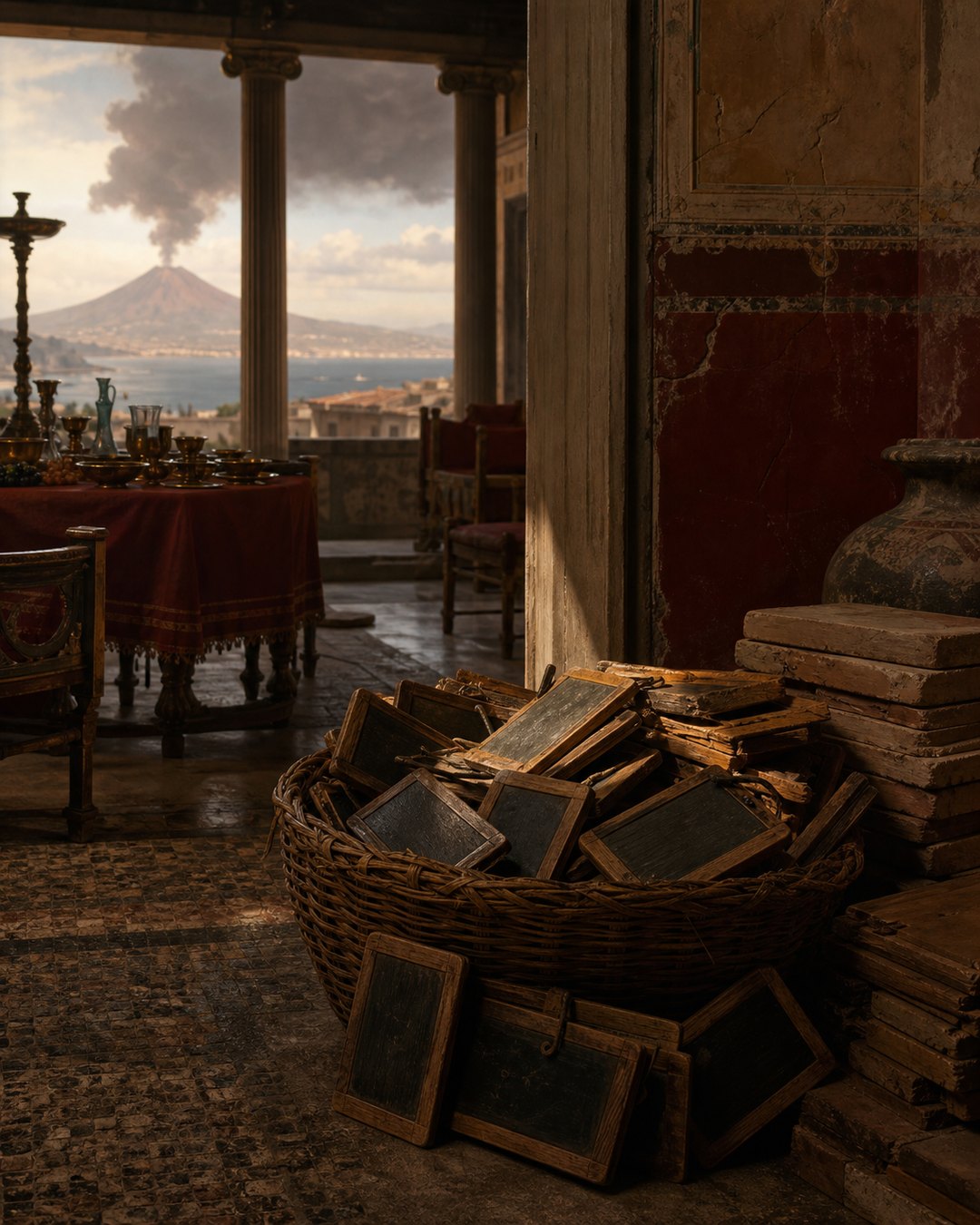
The most revealing Roman bank archive did not survive in a marble office or a state treasury. It survived in a wicker basket. Road workers found it in 1959, in a building south of Pompeii where decorated dining rooms opened onto a small garden. Inside were wooden writing tablets whose wax once carried loans, guarantees, receipts, court promises and the names of witnesses. The eruption of AD 79 buried the building, but the papers—if wax and wood can be called paper—belonged to an earlier business world.
That displacement is the first surprise. The contracts were mostly made at Puteoli, the enormous port across the Bay of Naples, not at Pompeii. The tablets followed the people who kept them. Their journey turns a legal archive into something more intimate: the portable memory of a family enterprise, carried away from the warehouses after its claims had expired and eventually left among furniture, construction materials and maritime gear.
The basket beside the road
The discovery was hurried. Construction crews were cutting a road through the Agro Murecine when archaeologists reached the suburban complex, about 600 metres south of Pompeii. They uncovered only part of it before the work pressed on. Five decorated dining rooms faced a garden. In one room, damp ground had protected a basket full of tablets for nearly nineteen centuries.
Exposure immediately created another emergency. Waterlogged wood and wax began to deteriorate in the air. Some conservation treatments trapped moisture, and wax surfaces flaked away. The most dependable record of many documents became the photographs made soon after excavation. Later infrared work recovered strokes from surfaces that the naked eye could no longer read. The archive therefore reaches us through two accidents: wet soil saved it, then photography saved part of it again.
Scholars now count 127 documents, although some preserve only a name or a few words. They date from AD 26 to 61. By the eruption, many had already lost their value as enforceable evidence. Booklets had been dismantled, witness panels were missing, and old tablets lay in a room being used for storage during refurbishment. This was not a live filing cabinet frozen at a normal working moment. It was obsolete business memory waiting in the wrong place.
Business happened across the bay
The archive’s centre of gravity was Puteoli. Before Ostia’s later expansion, this harbor handled ships, grain, luxury cargoes and the financial traffic that gathered around them. The documents repeatedly name three men: Gaius Sulpicius Faustus, Gaius Sulpicius Cinnamus and Gaius Sulpicius Onirus. Cinnamus had been Faustus’s freedman. Their shared name marks a household relationship, but the tablets show men managing credit as an enduring enterprise rather than merely carrying messages for an aristocratic patron.
That matters because Roman finance can look overly grand when viewed only through senatorial fortunes or imperial taxes. Here the scale is closer to the wharf. Merchants needed money before cargo sold. Lenders needed security while prices moved. Witnesses, seals and duplicate texts made a promise usable among people who might later disagree. The system belonged to freeborn citizens, freedpeople and others who understood enough procedure to make law work far from Rome’s courts.
The Sulpicii were not modern deposit bankers behind counters. Their documents show a flexible business of loans, guarantees, brokerage and enforcement. A useful comparison is the cargo financing preserved in the Muziris papyrus, where distance and risk shaped a contract. At Puteoli, the uncertainty could be closer: a warehouse full of grain, a seasonal price, a borrower’s promise and the possibility that the market would move the wrong way.
Seven thousand measures of grain
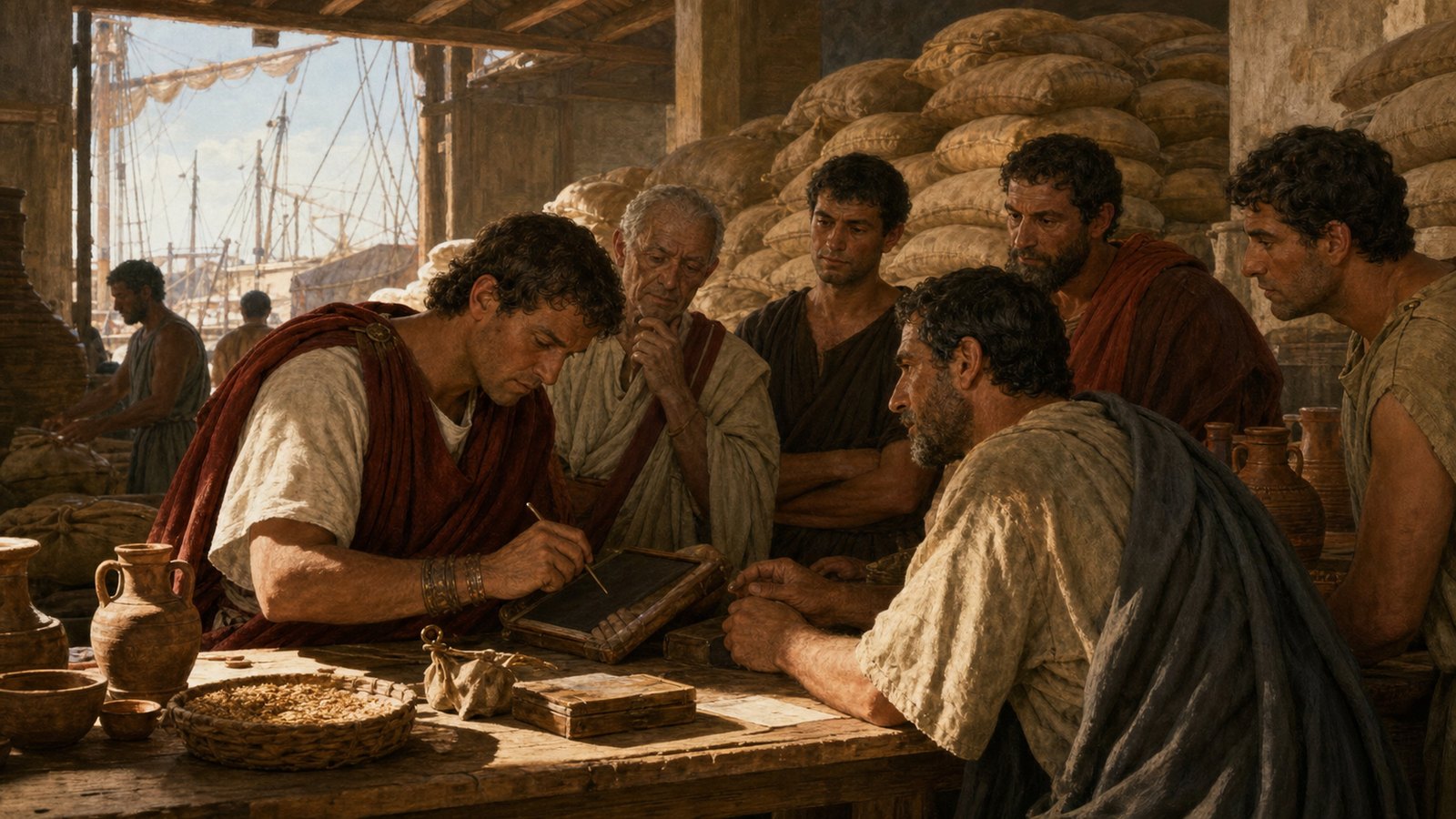
One sequence follows Gaius Novius Eunus. On 18 June AD 37 he borrowed 10,000 sesterces from Hesycus Euenianus, an imperial freedman, with Faustus involved as witness. The security was physical and enormous: 7,000 modii of grain plus 4,000 modii of chickpeas, lentils and other foods stored in the Horrea Bassiana at Puteoli. On 2 July, Eunus borrowed another 3,000 sesterces.
The numbers reveal a commercial bet. Alexandrian grain arrived seasonally. A merchant who bought when ships had swollen supply could hope to sell later as stores diminished and prices rose. But pledged grain was not the same as repaid money. A year passed, and the documents recorded another promise. By 15 September AD 39, after accounts had been calculated, 1,250 sesterces still remained outstanding.
The final instrument tightened pressure. It imposed a penalty of 20 sesterces for every day of delay. Eunus also swore by Jupiter Best and Greatest, by the divine power of Augustus and by the genius of the living emperor Caligula. Religious language could not create grain or cash, but it made default morally heavier. A commercial failure was placed before gods, emperor, witnesses and the borrower’s own written hand.
This is why the tablets are more vivid than a summary of Roman banking. They preserve deterioration in stages: confidence, added borrowing, missed repayment, renegotiation and an extraordinary oath. The warehouses that made stored grain credible also made it possible to pledge food that remained physically out of the lender’s hands. Credit depended on architecture, recordkeeping and reputation at once.
How wax became evidence
A tablet was a small machine for controlling disagreement. Wooden leaves were recessed and filled with wax. Two or three leaves could be tied as a diptych or triptych. The transaction appeared in an inner version protected by closure and in an outer version available for consultation. Witnesses sealed the package and placed their names where tampering could be noticed.
The arrangement balanced access against security. A creditor did not need to break the sealed text for every reminder, yet a disputed promise could be checked against the protected copy. The same practical intelligence appears in Roman document seals: authority was made visible through materials, cords, impressions and an agreed procedure rather than through paper alone.
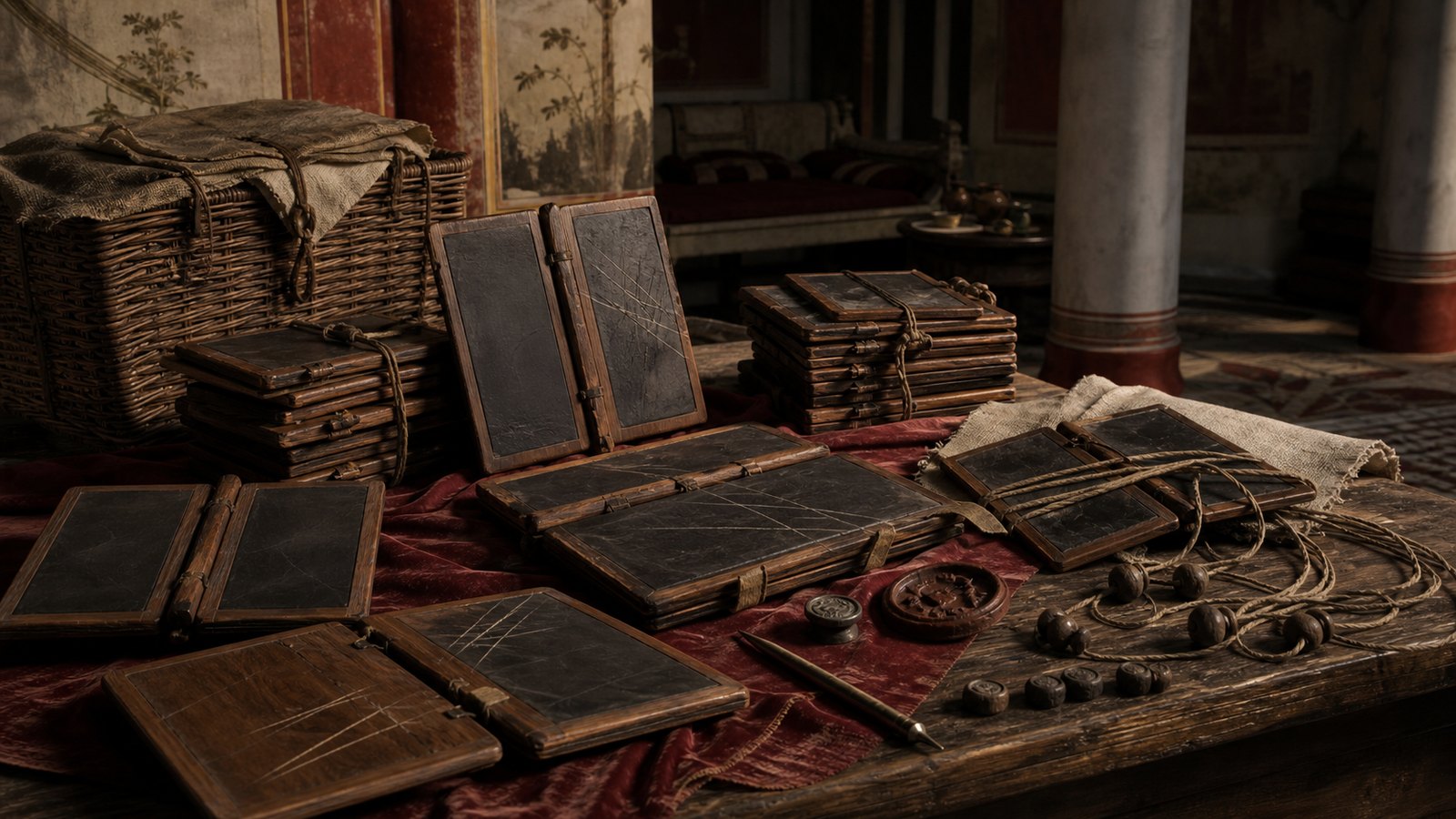
Finished obligations also left marks. Some tablets carry three large scratched letters for solutum, paid. Others were crossed with long diagonal strokes. A canceled contract did not simply disappear. Its body remained while a new physical sign changed its legal meaning. The archive could therefore show both the existence of a debt and the fact that it had ceased to bind.
The people inside the procedure
Legal history often preserves rules without the awkward people who had to use them. The Murecine tablets reverse that emphasis. Cinnamus moved from freedman within Faustus’s household to an active financier. Women appear in business contexts. Borrowers made mistakes, sought extensions and offered collateral. Scribes produced cleaner exterior copies while personal hands could preserve phonetic spellings inside.
Eunus’s oath is especially human. His interior wording contains forms that educated writers considered old-fashioned or incorrect. Those details do not make the contract unserious. They show law passing through a real voice. Roman private law was not confined to jurists speaking perfect formulas in the capital. It was practiced by people at a port who knew which promise, witness, penalty and sacred guarantee might keep a deal alive.
The basket ultimately survived because it was no longer useful. Had the documents remained active, they might have been carried elsewhere, scraped clean or burned. Instead, incomplete booklets and canceled claims were stored in a room under renovation. Their legal death made their archaeological life possible.
What emerged in 1959 was not merely a collection of old contracts. It was the infrastructure of trust after the money had stopped moving: wax scarred by styluses, cords that once held witnesses, names linking slavery to freedom, and figures recording hope against risk. Rome’s commerce depended on ships and warehouses, but it also depended on small wooden leaves that could remember exactly who had promised what.
Sources
Ostia Antica, “The Archive of the Sulpicii”; Judaism and Rome, “An Oath Sworn to Jupiter (TPSulp 68)”; Giuseppe Camodeca, Tabulae Pompeianae Sulpiciorum.