
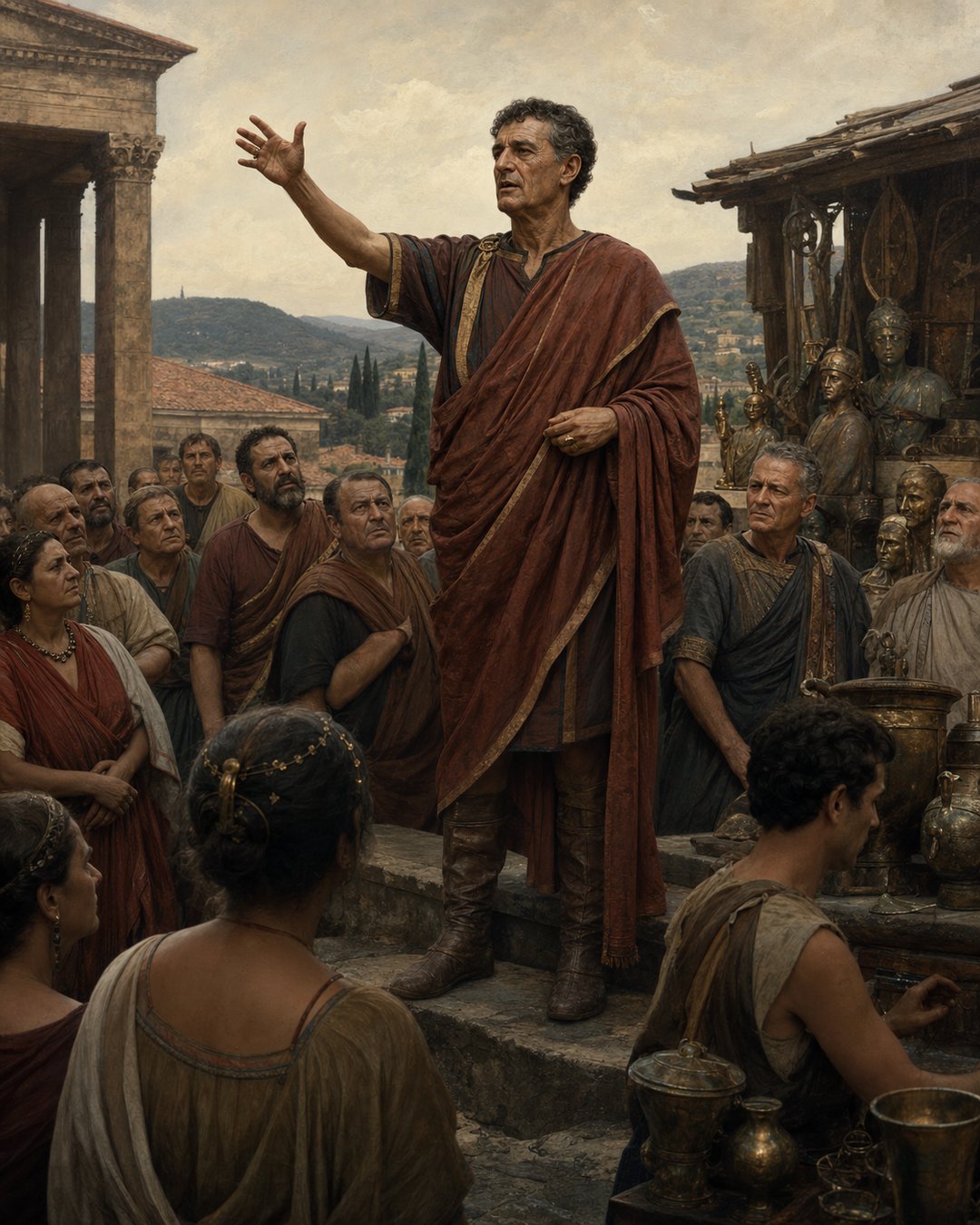
A bronze man lifts his right hand above an audience that vanished more than two thousand years ago. The fingers are spread, the palm faces outward and the arm clears the folds of a narrow toga. His lined face is not youthful or divine. He looks like an officeholder asking a crowd to listen.
The figure is known as L’Arringatore, “The Orator.” An inscription identifies him by the Etruscan form of his name, Aule Metele, usually rendered Aulus Metellus in Latin. Yet almost everything about his public appearance—toga, high boots, close-cropped hair and speaking pose—belongs to the political language Rome was spreading through Italy.
That combination makes the statue more revealing than a clean label such as “Etruscan” or “Roman.” It shows a local community using old language and skilled local bronze work to build a newer kind of authority. The raised hand did not erase an identity. It translated one magistrate into an image that an increasingly Roman world understood.
The Hem Names a Man the Statue Refuses to Idealize
The statue is approximately life-size, about 170 centimetres or 67 inches high. It depicts a mature man standing frontally with his weight shifted slightly onto one leg. His mouth is a little open, as though speech has begun, while creases around the eyes and across the forehead resist the smooth perfection of a god or heroic youth.
The lower edge of the toga carries three lines in Etruscan. Smarthistory gives the name as Aule Metele and identifies him as the son of Vel and Vesi. Its interpretation treats the bronze as a votive offering set up by a named dedicator through the deliberation of the people. The exact wording requires specialist reconstruction, but its civic character is clear: this was a public act, not a private portrait hidden inside a house.
Museo Omero describes the dedication more loosely as a statue erected to Aulus Metellus through public subscription. Both accounts connect the figure to collective recognition. The monument makes an individual visible because a community authorized the display, funded or sanctioned it and placed his body before an audience.
The realism of the face serves that purpose. Wrinkles make the man particular and experienced rather than universally beautiful. The portrait advertises the kind of age that could be read as service, judgment and accumulated standing. As with Eumachia’s name in Pompeii’s forum, authority enters public space through a carefully controlled material presence.
Roman Clothes Wrapped an Etruscan Name
Aule Metele wears a tunic beneath a short, narrow toga often called the toga exigua. The right arm remains free, allowing the broad speaking gesture. On his feet are high formal boots associated with Roman senators, and a prominent ring on the left hand reinforces elite status. Clothing turns the bronze body into a readable political rank.
Nothing in that costume requires the man to have abandoned every local allegiance. Central Italy in the later first millennium BCE was not divided into sealed cultural boxes. Communities traded, fought, negotiated and borrowed forms across generations. By the early first century BCE, Roman institutions and elite habits offered a powerful shared vocabulary even where Etruscan names and language persisted.
The statue holds both conditions at once. Its inscription uses Etruscan letters and family naming. Its public costume looks Roman. Its pose belongs to the world of magistrates addressing citizens, while its making follows the deep bronze-working tradition of Etruscan workshops. One element does not cancel the others.
This is why “Romanization” can be useful only if it describes a process rather than a switch. The bronze does not show a blank local culture receiving a finished Roman identity. It shows people selecting signs that worked. A toga and boots could connect a local officeholder to expanding Italian norms while the dedication still named him in the language of his community.
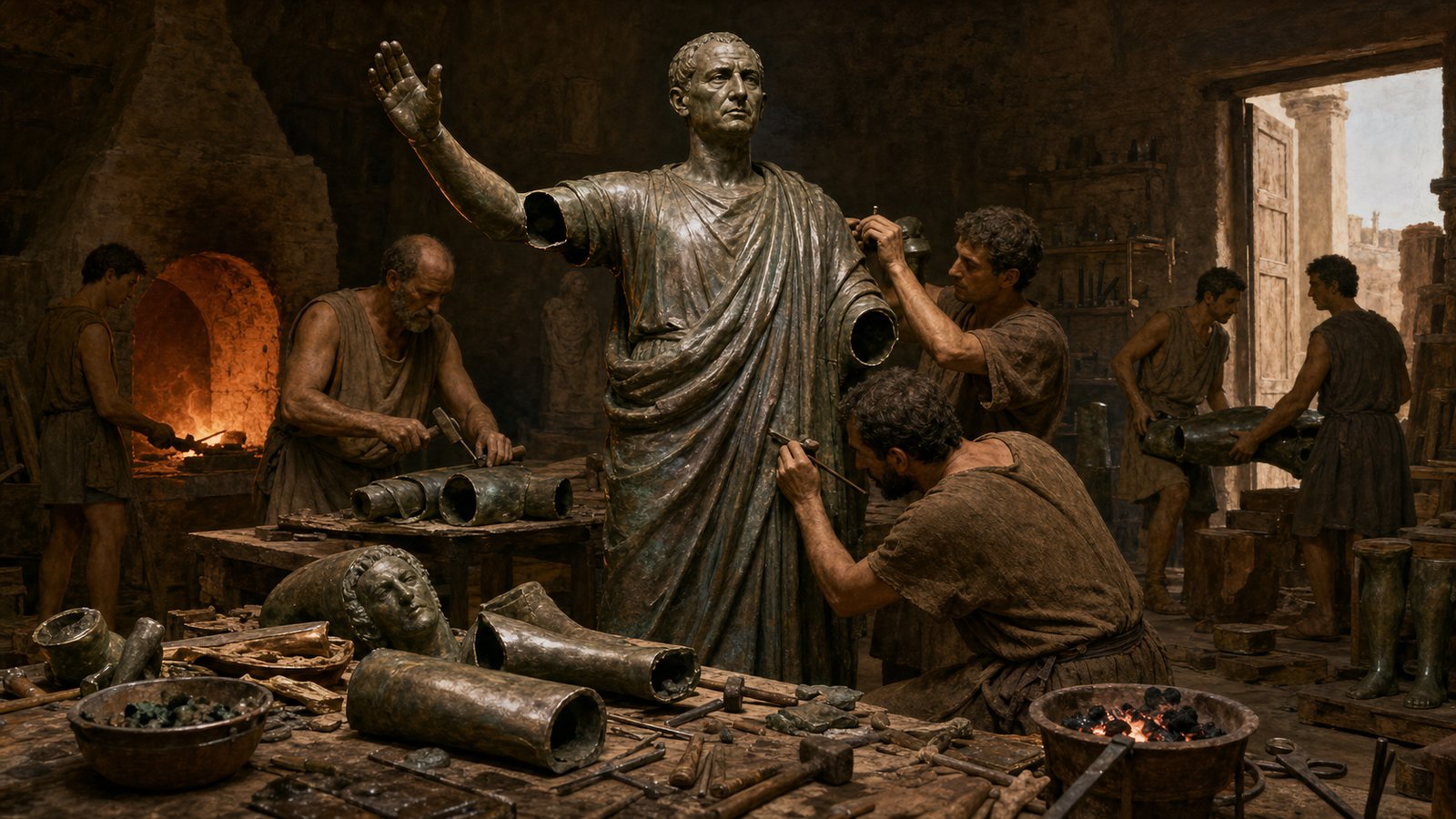
A Workshop Built Authority in Hollow Bronze
L’Arringatore is hollow-cast rather than a solid mass of metal. That technique allowed a life-size figure to be made with a comparatively thin bronze shell around a core. Large components could be cast and joined, then chased and finished until seams stopped distracting from the continuous body seen by an audience.
The technical achievement matters politically. Bronze was durable, expensive and visually forceful. It caught changing light across the forehead, folds and raised fingers. A stone figure could command attention too, but bronze made the extended arm seem especially alive while declaring that substantial resources stood behind the honor.
The hand is deliberately emphatic. Museo Omero notes that it is larger than strict anatomy would require. That exaggeration makes sense at viewing distance: the body part carrying the public gesture had to remain legible above and beyond nearby heads. The sculpture is not merely a likeness. It is an instrument designed to make speech visible even when the speaker is permanently silent.
Such work also complicates any story in which Roman political imagery simply arrived from Rome fully formed. Local craftspeople helped manufacture the visual culture of Roman Italy. Etruscan metal knowledge did not disappear before the new order; it supplied the skill through which that order could be seen.
The Open Palm Turned Speech into Permanent Office
The raised right hand can be read as greeting, calming or preparing to address an assembly. It is not a clenched fist and not a military salute. The open palm controls attention without showing a weapon. Combined with the slightly open mouth, it freezes the moment when a crowd is expected to yield the floor.
A living speech disappears as soon as sound fades. The statue converts that temporary performance into a permanent attribute. Aule Metele never needs to remember the next sentence. He is always the magistrate about to speak, always publicly composed, always deserving the attention the gesture requests.
This differs from preserving a dead relative through resemblance alone. Roman funeral masks carried family memory into public ceremony, but the Orator fixes one civic action in place. His identity is not presented chiefly through ancestry, battle equipment or divine favor. It is presented through competent participation in government.
The gesture therefore reveals what the community valued in the image. Physical dominance is secondary. A toga-clad man can govern by standing correctly, displaying status and speaking within an authorized setting. The body becomes evidence of procedure: office has a costume, an audience and a recognizable way of claiming silence.
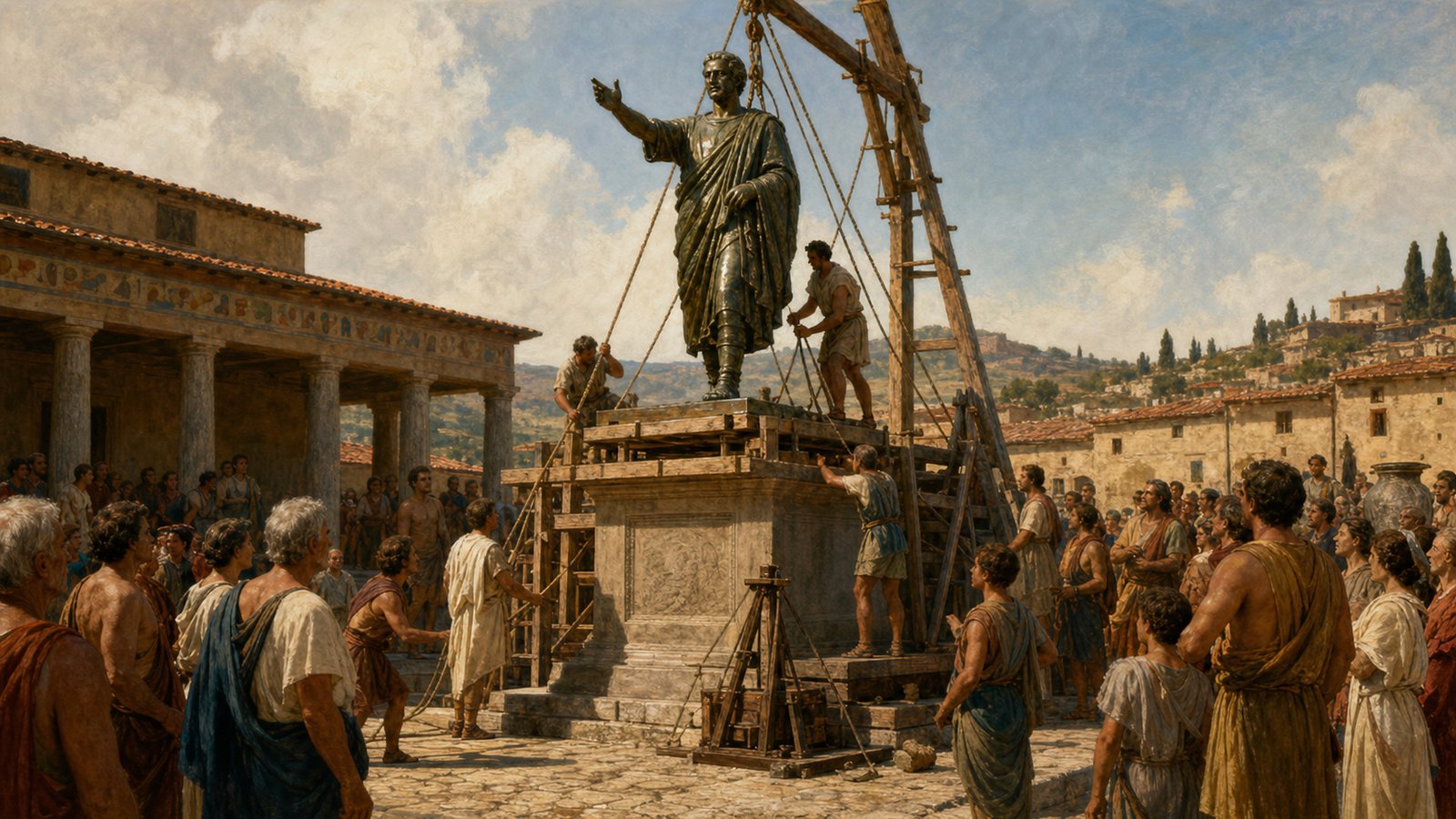
Recovery in 1566 Gave the Bronze a Second Political Life
The statue was recovered in 1566 in the Lake Trasimeno area. Smarthistory places the find at Lake Trasimeno, while Museo Omero specifies Sanguineto on its shore. It quickly entered the collection of Cosimo de’ Medici, Grand Duke of Tuscany, moving from an ancient civic setting into a Renaissance courtly one.
That transfer changed what the object could do. Its first base and audience were gone, and the political dispute or ceremony that produced it could no longer be reconstructed in full. In a Medici collection, the bronze became evidence of Tuscan antiquity, technical mastery and the deep past claimed by a newer ruling house.
The modern title L’Arringatore foregrounds the pose rather than the inscribed name. Luigi Lanzi is credited with popularizing that description because the figure so clearly resembles a public speaker. The nickname is effective, but the Etruscan dedication remains the more exact anchor: it restores the individual whom the generalized role can obscure.
Today the original is held by the National Archaeological Museum in Florence. Its survival is unusually complete for an ancient bronze, a material often melted and reused. That rarity can make the figure seem isolated, but it should instead remind us how many other public bronzes once populated Italian communities and vanished.
The statue’s most important boundary is not between art and politics. It is the unstable boundary between Etruscan and Roman. The name at the hem, the local bronze craft, the Roman dress and the enlarged speaking hand all belong to the same object. Aule Metele stands where one political language was becoming dominant, yet he does so without becoming anonymous.
The open palm still asks for attention. What follows is no recoverable speech, only a body assembled from choices. Those choices show that cultural change was negotiated in public—through letters, clothes, metal, office and gesture—before later histories compressed it into the rise of Rome.