
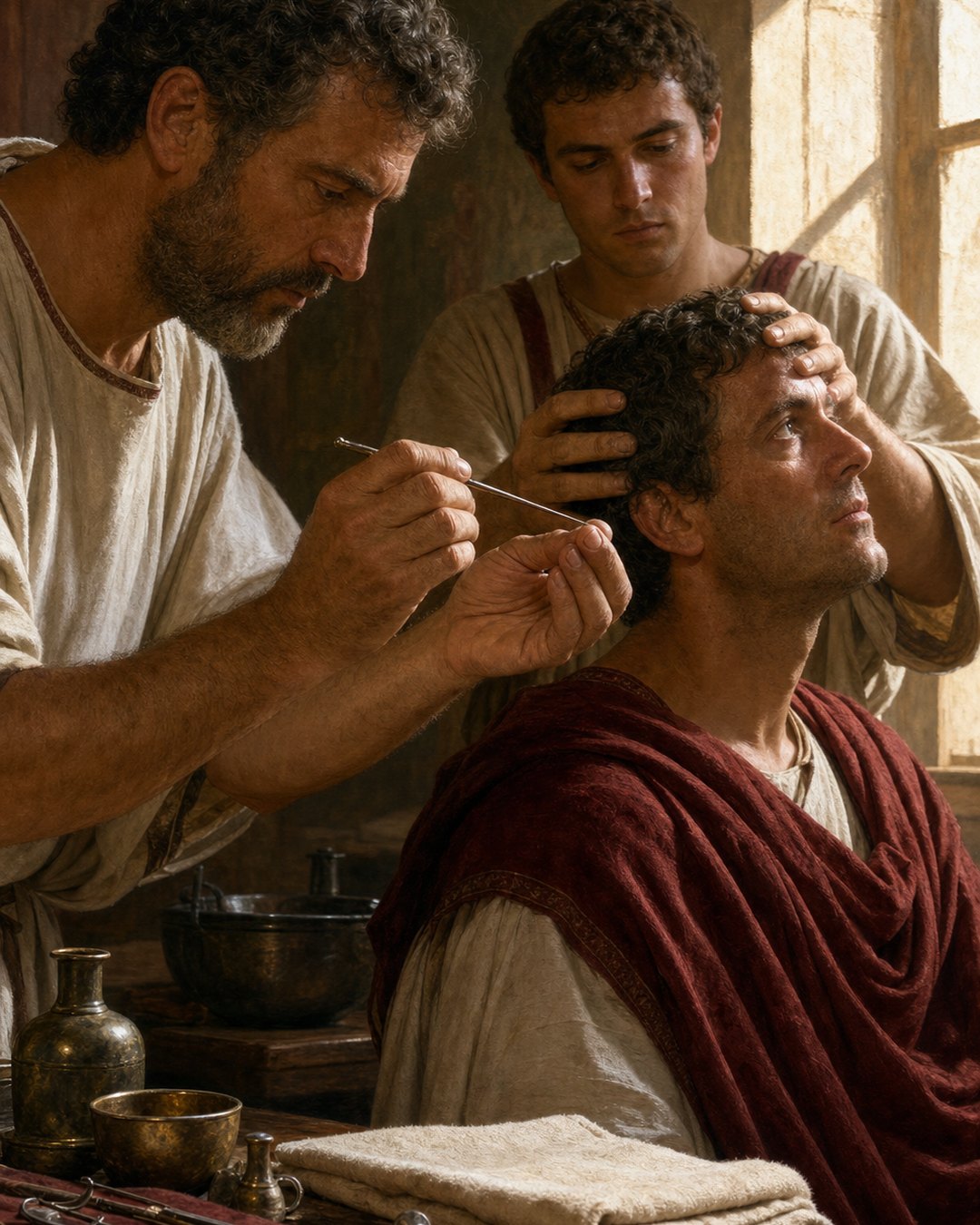
A patient sat facing the light while another person held his head from behind. One eye was covered with wool. The surgeon took a needle fine enough to enter the side of the other eye, but not so fine that it bent away from his hand. A slight movement, the Roman medical writer Celsus warned, could destroy sight permanently.
The operation was meant to treat a cataract, the clouding that had blocked the pupil. The surgeon did not remove the clouded lens. He entered from the temple side, turned the point toward the obstruction and pressed it down until the pupil opened to light again. If the opacity rose, he broke it into pieces and pushed those fragments aside.
This was couching: a dangerous procedure with poor anatomy behind it, yet a remarkably exact choreography. Celsus’s account in De Medicina preserves selection rules, room arrangement, hand positions, movements and aftercare. Read in sequence, it shows that Roman eye surgery depended less on a dramatic thrust than on controlling everything around a needle.
Celsus First Decided Which Clouded Eyes Were Worth the Risk
Celsus wrote in the early first century CE, but his surgical books gathered knowledge associated with a longer Greek and Alexandrian medical tradition. His account begins by distinguishing a recent cataract, which he thought might sometimes respond to medicines, from a chronic one that required surgery. He called the operation one of the most delicate a practitioner could attempt.
His explanation of the disease was wrong by modern standards. Celsus imagined a humour forming in an empty space in front of the eye’s inner structures, gradually hardening until it obstructed the faculty of sight. A modern cataract is clouding of the eye’s crystalline lens itself. The error matters because couching worked by displacing that lens rather than clearing it.
Even within that mistaken model, the physician did not operate on every pale pupil. Celsus thought there was hope when the opacity was small and still, with a sea-water or glistening-steel colour, and when the patient could still sense a flash of light at the side. A large, misshapen, golden or freely moving opacity was a bad sign.
Age, eye shape and the history of the illness entered the decision too. Childhood and old age were unfavourable; an intermediate age was preferred. A small or sunken eye made access less promising, while a cataract following severe disease, violent head pain or a heavy blow carried a worse prognosis. Selection was therefore the first surgical act: refusing the cases least likely to survive the wager.
Three Days of Preparation Led to One Bright Room
Celsus did not move directly from diagnosis to needle. The patient was to eat moderately and drink water for three days before treatment, then abstain from everything on the preceding day. The rules reflected ancient dietary medicine, but they also reveal an attempt to make the body and the day of surgery predictable.
For the procedure, the patient sat opposite the surgeon in a well-lit room and faced the light. The surgeon occupied a slightly higher seat. This arrangement aligned the eye, the operator’s hand and the strongest available illumination before lenses, electric lamps or magnification could assist the work.
An assistant stood behind and held the patient’s head still. Celsus’s blunt warning explains the need: a small movement could ruin vision forever. Wool covered and bandaged the opposite eye, reducing distraction and perhaps helping the treated eye remain fixed. The room became a human instrument assembled from patient, assistant, light and surgeon.
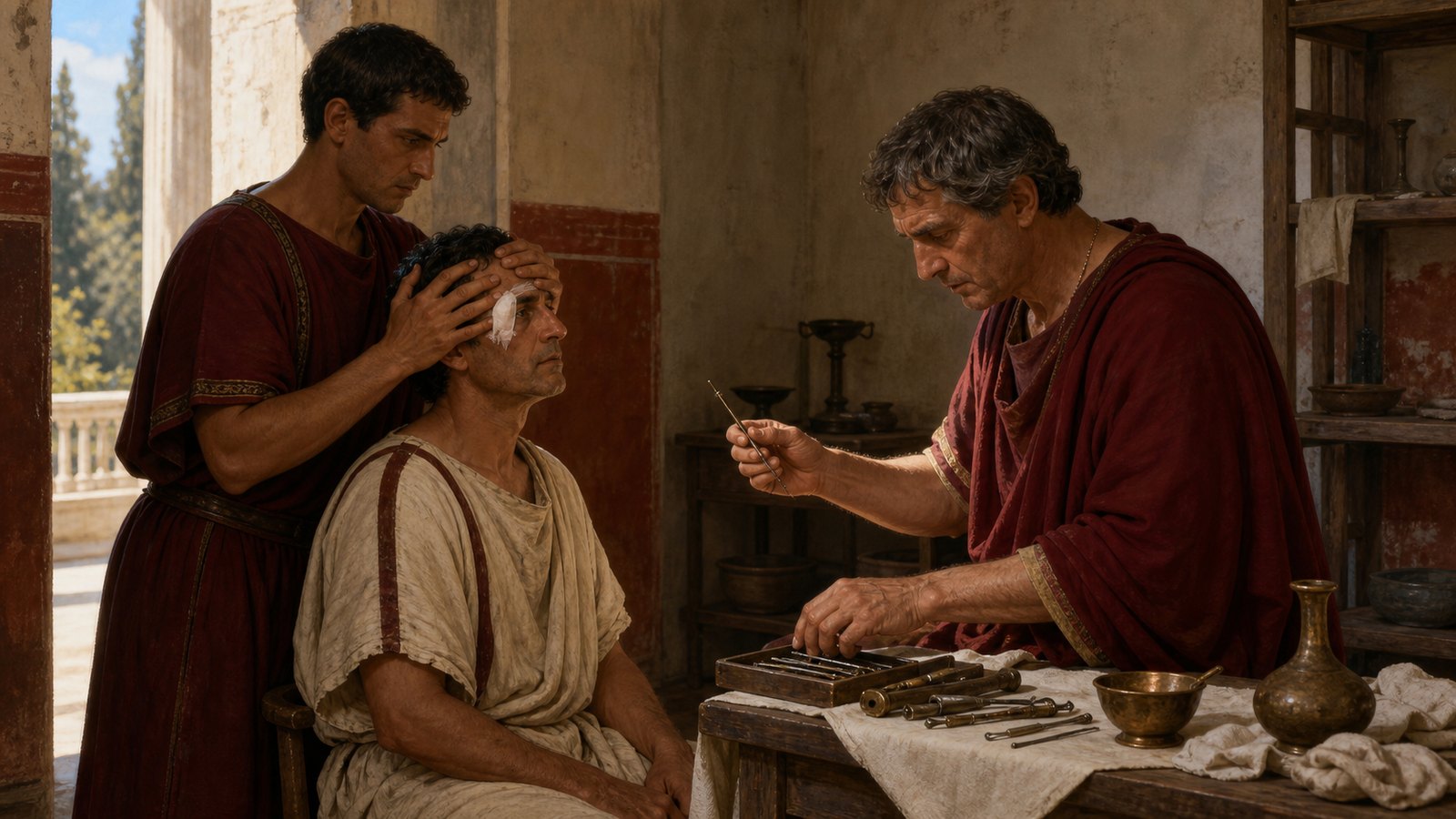
The choice of hand was equally specific. The surgeon used the right hand on the patient’s left eye and the left hand on the right. Crossing in this way gave the point a workable approach from the outer, temple side. Celsus’s ideal surgeon elsewhere in Book VII had a strong, steady hand, clear sight and the ability to work with either hand—qualities that this operation demanded all at once.
The Point Entered Between Pupil and Temple
The needle had to be sharp enough to penetrate but not excessively fine. Celsus placed the entry through the two outer coats of the eye at a point between the pupil and the outer corner near the temple, away from the cataract’s centre and positioned to avoid a visible vein. His anatomy was imperfect, but the route resembles the basic logic later associated with cataract couching.
He told the operator not to enter timidly. Once the point passed into what he regarded as an empty space, resistance would cease; even a practitioner of moderate experience, he claimed, could feel the change. That sentence captures both the tactile knowledge of ancient surgery and its danger. The hand had to interpret resistance inside an organ it could not see through.
The manoeuvre was not a single jab. The needle was inclined toward the opacity, rotated gently and used little by little to guide the obstruction below the pupil. Once it had crossed beneath the pupil, firmer pressure was applied so that it would settle there. The visual axis reopened because the clouded lens was no longer directly in front of it.
If the opacity stayed down, Celsus considered the cure accomplished. If it rose again, the surgeon used the same needle to divide it into several parts that could be tucked away separately. Modern knowledge makes the hazard obvious: nothing had been removed, the eye had been penetrated without antisepsis and the displaced lens or fragments could cause inflammation, glaucoma and lasting damage.
Opening a Line of Sight Was Not the Same as Restoring an Eye
Couching could give some patients useful light or rough vision, but it could not reproduce normal focus. The crystalline lens contributes much of the eye’s focusing power. Pushing it out of the visual axis left the patient effectively without that lens in its proper position, even when the operation cleared the central darkness.
The procedure therefore offered a narrow kind of success. Someone who had been unable to distinguish people, doorways or daylight might regain enough vision to navigate, while fine detail remained poor. Results varied with the true condition of the eye, the cataract’s maturity, damage caused by the needle and the body’s response afterward.
Archaeological finds show that couching was not merely a literary fantasy. A modern review of cataract history records Roman ophthalmic tools and needle handles, including a 12.7-centimetre couching needle from a Roman camp in Bedfordshire and iron cataract needles from a shipwreck off Sicily dated around 200 CE. Steel points often disappeared while bronze handles survived.
Those objects do not prove that every pointed instrument performed the operation Celsus described; probes served many purposes. Taken with the detailed text, however, they place eye surgery inside a material world of specialist tools. The same world appears in the Roman belief that surgery began with disciplined hands and in the forceps-and-grip choreography of tooth extraction.
Wool, Egg White and Stillness Followed the Needle
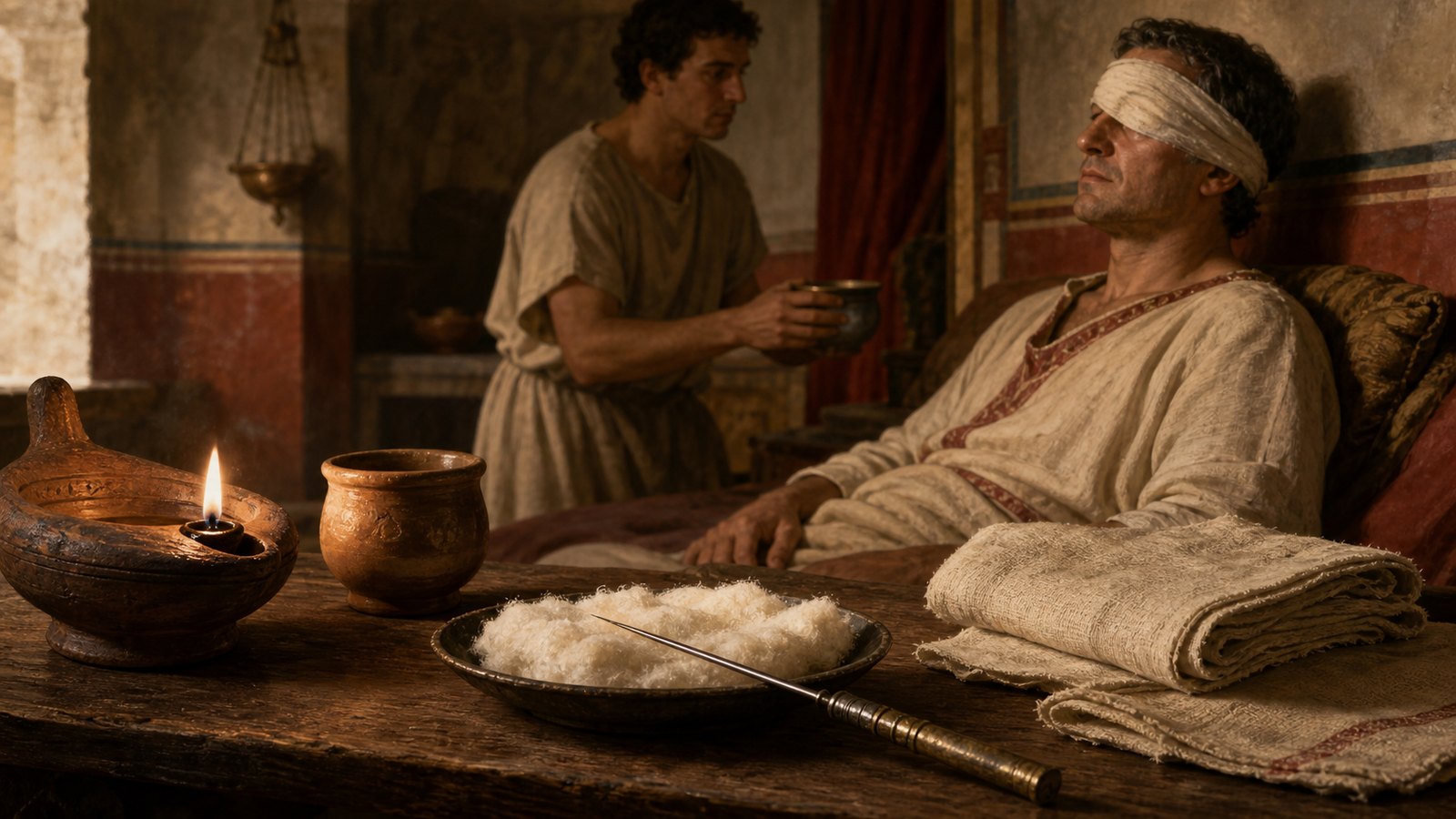
When the lens had been depressed, the surgeon withdrew the needle straight out. Soft wool soaked in egg white went over the eye, followed by an application intended to restrain inflammation and then bandages. Celsus offered no anaesthetic sequence and no germ theory. Pain control, infection and internal injury remained enormous limits on the operation.
The patient was ordered to rest and abstain. Celsus delayed food until the next day, began with liquids so that movement of the jaws would not disturb the eye, and allowed wound-style foods only after inflammation settled. Water alone remained the drink for a period. The operation continued beyond the surgeon’s hand into controlled posture, chewing and time.
This attention to aftercare links the cataract passage to Celsus’s broader surgical outlook. His practitioner was supposed to feel pity without allowing cries to hurry the cut or reduce what had to be done. That ideal can sound cold, but it recognizes a practical conflict: compassion without steadiness could make a dangerous movement more dangerous still.
The text also preserves knowledge because someone organized it. Like Galen’s account of books destroyed in the fire of 192, De Medicina reminds us how much ancient medicine depended on vulnerable copies. Celsus gives us no success rate and no patient’s voice. What survives is the operator’s sequence, precise enough to reconstruct a bright room and the silence demanded inside it.
The finest detail is not the needle’s point but the system around it. A mature cataract had to be chosen, a head held, the opposite eye covered, the correct hand used and the obstruction moved by degrees. Roman medicine misunderstood the lens, yet it understood that a fraction of movement separated a possible glimpse of light from irreversible blindness. Couching lived inside that fraction.