
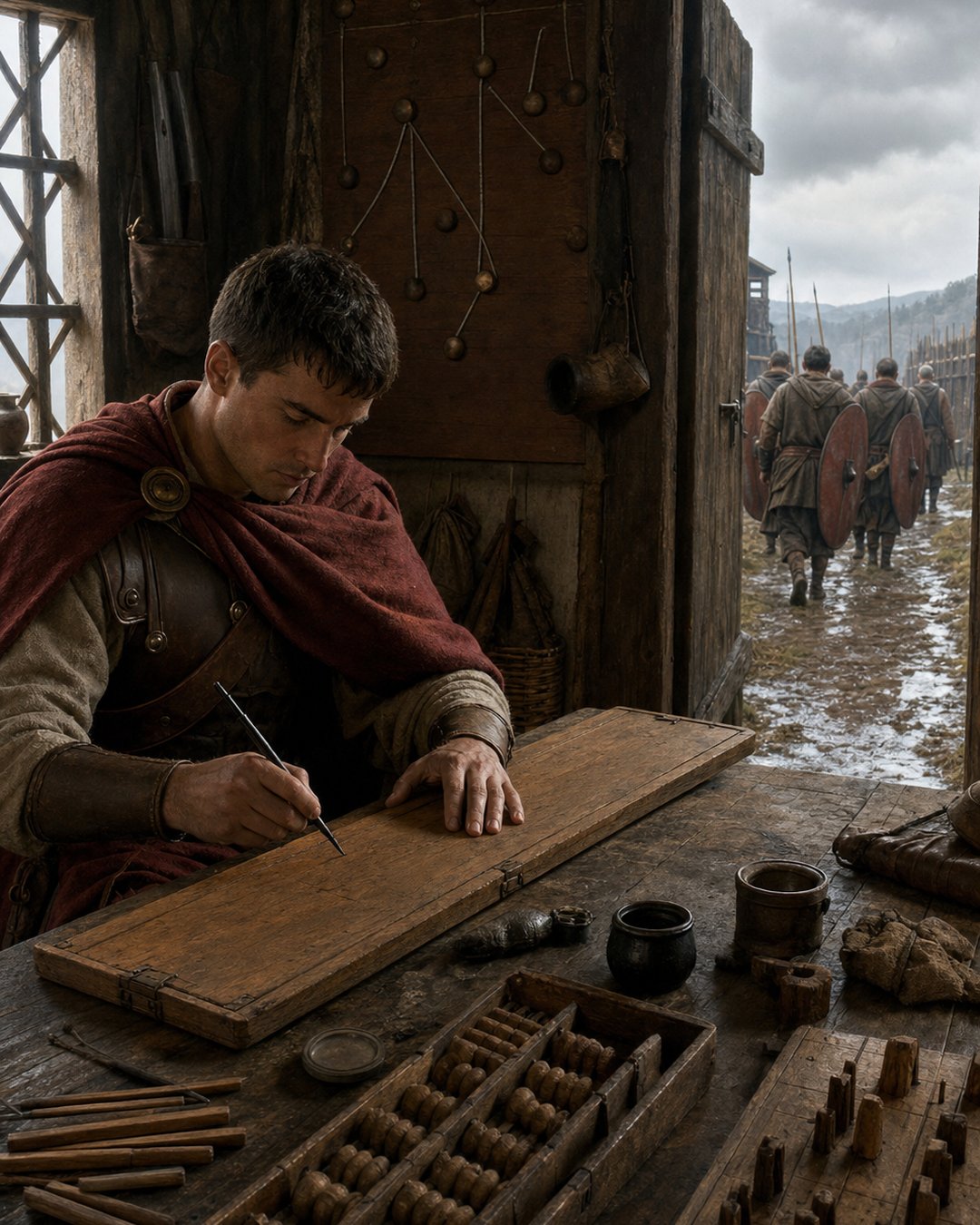
On 18 May in the 90s AD, a clerk at Vindolanda began with a reassuringly large number: 752 men in the First Cohort of Tungrians. Then subtraction took over. Guards served the provincial governor. A far larger body stood at Coria, probably Corbridge. A centurion was in London. Other groups occupied damaged lines. By the time the clerk reached the men physically present, only 296 remained.
The report survives as Vindolanda Tablet 154, ink written across the grain of a tall oak diptych. Its surface is abraded, and a few small numerals remain uncertain, but the structure is complete. It names the commander Iulius Verecundus, totals absentees, separates the present from the fit and records sick, wounded and men suffering inflamed eyes.
This is not a battle narrative. Nobody charges, boasts or dies heroically. Yet the tablet may describe military reality more accurately than a victory monument. A Roman cohort was an accounting category, a command network and a pool of specialists before it was a formation assembled on parade. Readiness emerged only after every detachment and damaged body had been counted.
The Clerk Began with 752 and Immediately Broke the Number Apart
The heading dates the report to 18 May and identifies the First Cohort of Tungrians under the prefect Iulius Verecundus. Its total was 752, including six centurions. That approaches a notional eight hundred men, but the editors caution that actual auxiliary organization did not always match tidy modern reconstructions.
The tablet itself reinforces the warning. A nominally large unit had only six centurions, and most of those officers were away from Vindolanda. The figures are not a theoretical establishment copied from a handbook. They represent a day’s attempt to make scattered people add up.
The document’s large size is striking. At 86 millimetres wide and 394 high, it is roughly twice the length of many surviving leaf tablets from the site. Nearly half remained blank. The editors therefore do not think it was cut specially for this report; an unusually large available piece of oak simply received a compact administrative text.
Physical damage obscures parts of the middle, but totals control the reading. The absent groups add toward 456, leaving 296 present. Below that subtotal, medical categories reduce the usable force again. Arithmetic is not decoration here. It is the framework that lets fragmentary assignments remain part of one coherent report.
Corbridge Held More Tungrians Than Their Home Fort
The largest recorded detachment numbered 337 at a place written as Coris. The editors identify this with Coria, probably Corbridge. That group alone exceeded the entire number left at Vindolanda. Two centurions may have supervised it, although the precise small numeral is among the uncertain readings.
Fort names can mislead when they imply self-contained garrisons. A unit’s title and commander might belong to Vindolanda while a majority of its people served elsewhere. Corbridge was a crucial junction and supply centre, so a large detachment there could answer operational needs beyond one fort’s walls.
Another forty-six Tungrians served as singulares legati, infantry contributed to the governor’s guard, associated with the office of Ferox. A lone centurion appears at Londinium. His task is not stated; the editors cautiously suggest a special mission or message. The surviving report records location, not invented motive.
The account of the Corbridge armour hoard and its workshop evidence reconstructs equipment at that northern hub. Tablet 154 adds bodies to the picture. Corbridge did not merely receive objects and supplies; it temporarily contained a major share of a cohort assigned elsewhere.
Detached Duty Was Normal Enough to Need Its Own Arithmetic
After Coria and London come smaller groups whose destinations are too damaged to recover securely: six, nine, eleven, perhaps one and a final forty-five. Several had centurions; the forty-five apparently did not. The report resists the desire to make every detachment tell a complete story.
The scale is clearer than the labels. Total absentees reached 456, including five centurions. More than three-fifths of the cohort’s recorded strength was away from the nominal base. This was not necessarily desertion, leave or failure. The clerk placed recognized assignments under absence because the administrative question was physical availability at Vindolanda.
Such fragmentation let one unit serve provincial systems larger than itself. Men guarded officials, reinforced another centre, carried orders and likely performed tasks lost in the damaged lines. The cost was command complexity. Prefects needed current lists because a total of 752 said almost nothing about what the fort could deploy that morning.
The report was probably an internal interim document rather than a polished annual return. Its May date fell near the season of increasing military activity. Whether reports were compiled monthly cannot be proved from this leaf alone, but the format shows repeated administrative habits: heading, dispersed groups, subtotal, present men, health deduction, usable remainder.
Thirty-One Bodies Changed “Present” into “Fit”
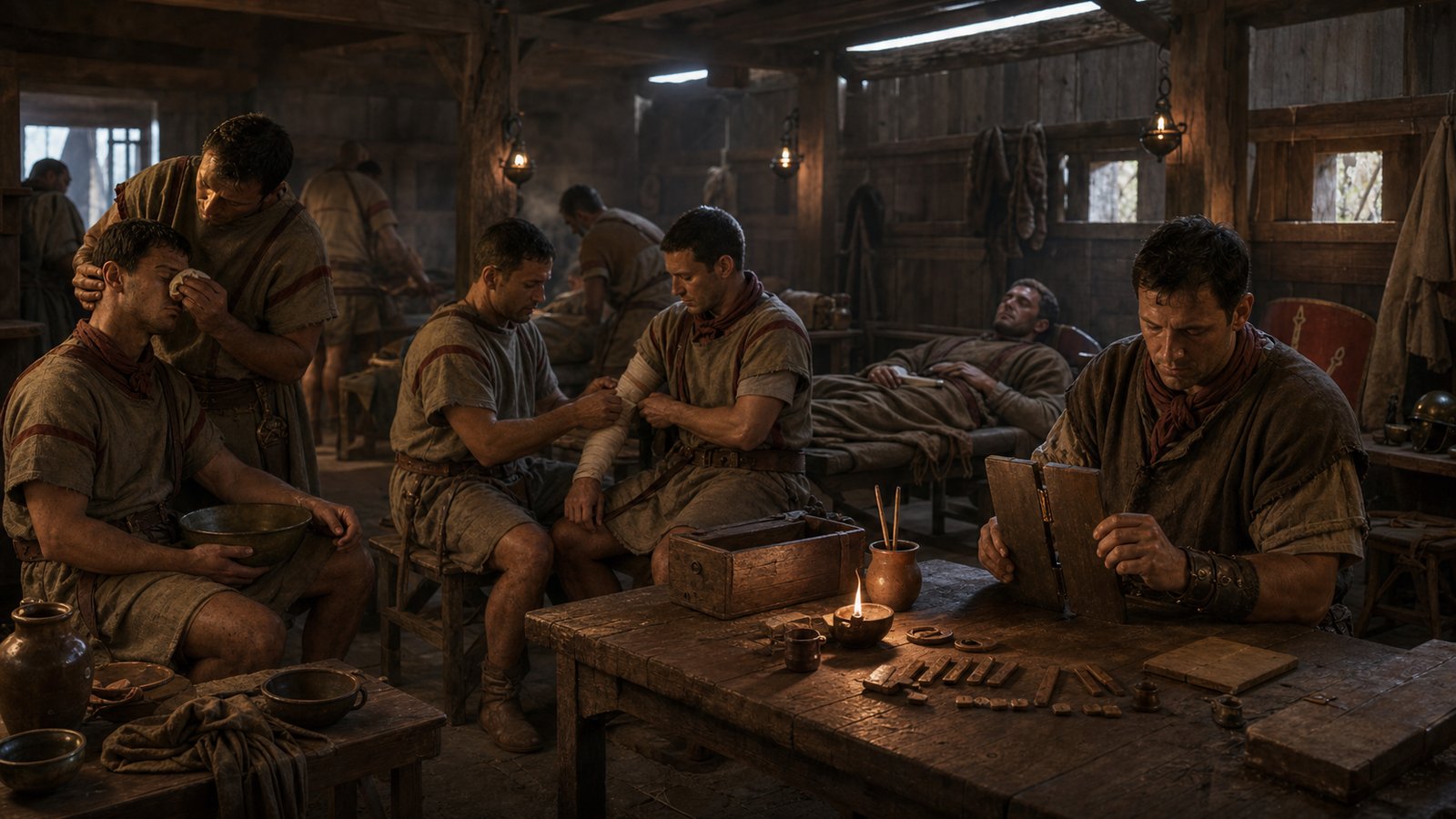
Presence was not the final category. Of the 296 at Vindolanda, fifteen were sick, six wounded and ten suffered from lippitudo, inflammation or discharge of the eyes. The subtotal unfit was thirty-one. That left 265 described as healthy or fit for service, including a single centurion.
The medical detail is unusually specific for a strength report. Illness and wounds are expected military categories; eye trouble seems humbler. On a windy, smoky frontier with crowded rooms and shared equipment, it could still remove ten men from effective duty. The clerk treated impaired sight as a readiness problem rather than a footnote.
More than ten percent of those present were unfit. Applied carelessly, that percentage could be mistaken for the cohort’s overall health, but the absent majority had already left the denominator. The report only diagnoses the men counted at base. Its strength lies in such boundaries: it tells us exactly what was being reconciled and where certainty stops.
The article on boxing gloves beneath a Vindolanda cavalry barrack brings training down to leather, sweat and impact. The strength report supplies the institutional counterpart. Exercise mattered, but commanders also needed a daily distinction between a man on the roll, a man in the fort and a man actually able to serve.
One Oak Leaf Replaces the Parade-Ground Illusion
The tablet was found in a ditch in 1988 and is now in the British Museum. It dates from Vindolanda’s earliest occupation phases, around AD 92–97. Old Roman Cursive ran across oak rather than along the grain. The hand was competent, practical and largely uninterested in elegance.
Its survival depends on the waterlogged conditions that preserved hundreds of thin wooden texts at Vindolanda. Oxford’s digital project describes nearly 780 published documents spanning less than fifty years. Letters often attract attention because they preserve voices; Tablet 154 preserves a system thinking in totals.
Those totals complicate cinematic Rome. Six centuries did not wait at full strength for a trumpet. Men were allocated through a provincial network, officers travelled with detachments and sickness cut the remainder. A unit could be institutionally whole while geographically scattered.
The document also shows why bureaucracy was a military technology. Without the list, Verecundus had a name and an impressive theoretical figure. With it, he could see that Corbridge held more of his cohort than Vindolanda did, that five of six centurions were away and that only 265 men at base were fit.
No surviving line says what happened next. The report’s purpose was readiness, not storytelling. Its final subtraction is therefore its payoff: 752 on the books became 265 usable at Vindolanda. Roman command depended on understanding everything that happened between those numbers.