
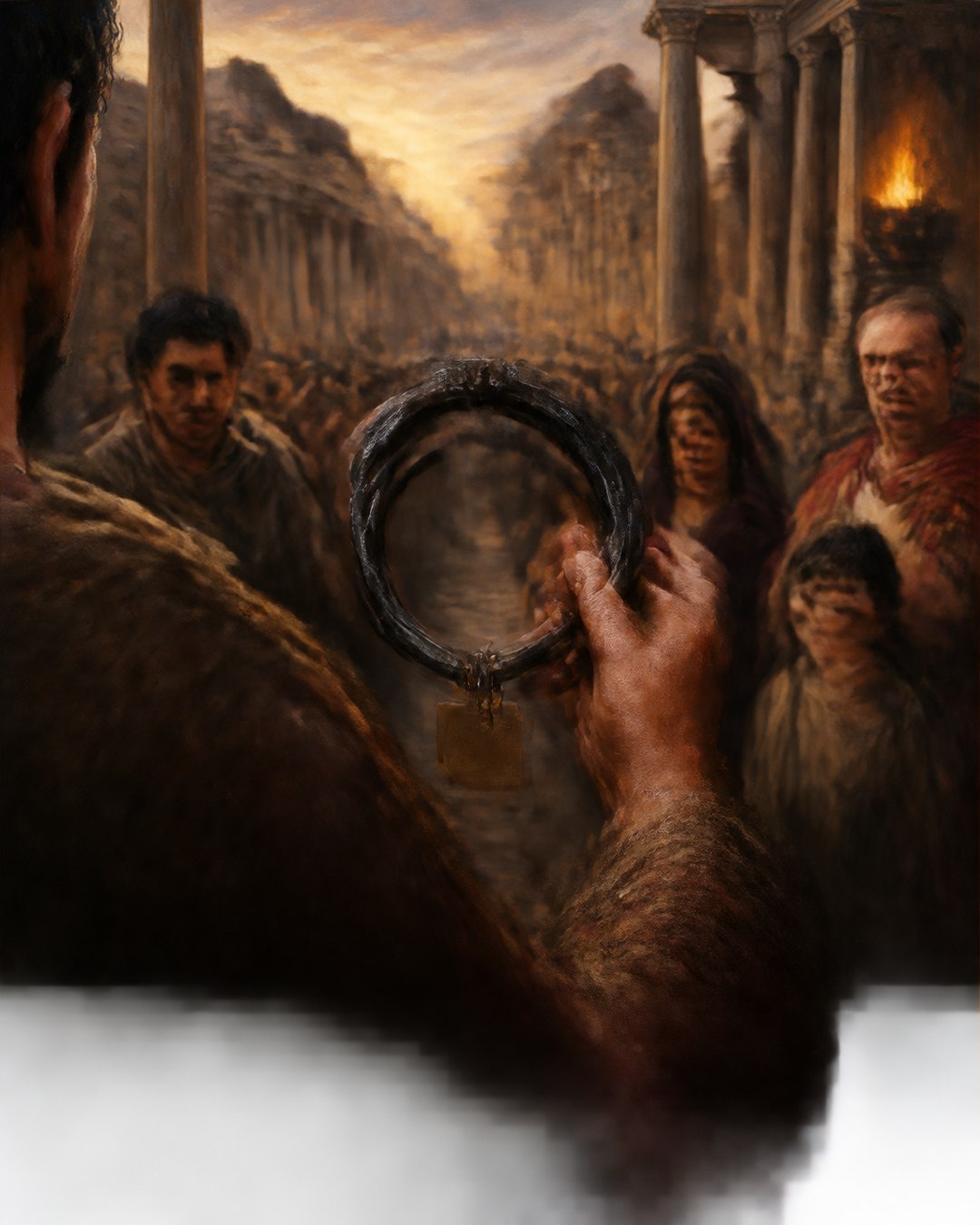
A late Roman neck ring survives with a voice attached to it. The voice is not the wearer’s. A small bronze plate orders whoever reads it to seize a fugitive, return him to a man called Zoninus and collect a solidus. The person inside the iron is never named.
The object now called the Zoninus collar dates to the fourth or fifth century. Its iron ring and inscribed tag remain together, a rare completeness that forces text and hardware into the same interpretation. The Latin message was not merely descriptive. It was designed to make strangers act.
That is the collar’s historical force. It shows urban slavery operating beyond a household wall. Metal prevented easy removal, letters broadcast ownership, and a gold reward gave the public a reason to enforce it. Five centimetres of bronze transformed the wearer’s body into a moving notice.
The Ring Was Closed, Not Clasped
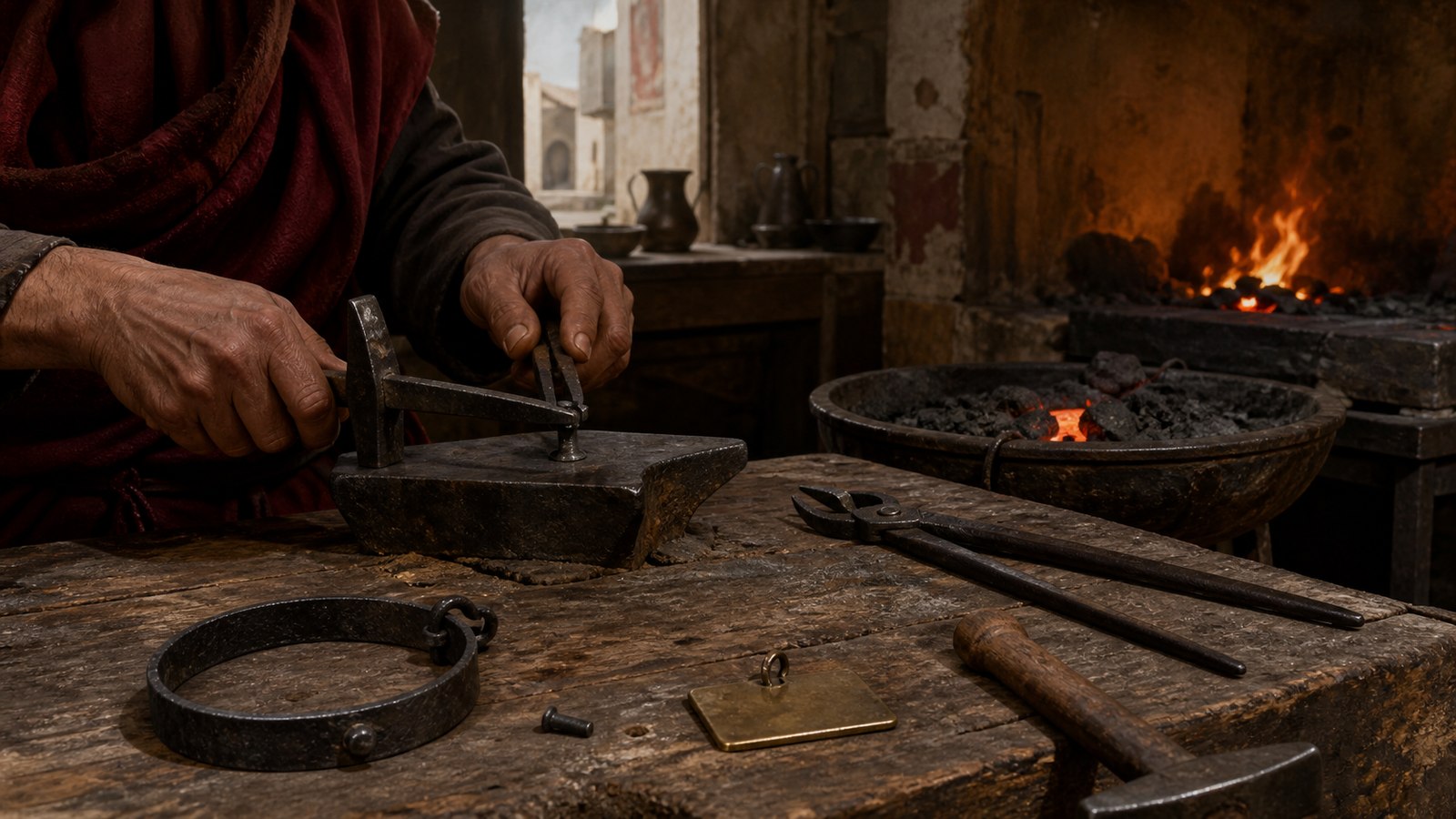
The collar consisted of an iron ring with a bronze tag suspended from it. The ring was not a necklace with a convenient catch. It was riveted shut, and its roughly twelve-centimetre diameter made the act of fastening part of the punishment. Removal required tools, cooperation or damage to the object.
Jennifer Trimble’s archaeological study stresses that late Roman slave collars must be read as material, visual and textual things at once. That is especially important here because the Zoninus example retains the tag with its ring. If the inscription is copied into a book and the iron is treated as a separate curiosity, the physical argument disappears.
The joined object made two different kinds of constraint reinforce each other. Iron controlled what the wearer could take off. Bronze carried a legible command through streets, markets and doorways. The collar did not need to imprison someone in one room; it attempted to make the city itself less escapable.
This differs from the public ceremony of Roman manumission. Manumission used witnesses and legal form to change a person’s status. The collar used public visibility to insist that an existing status follow the wearer everywhere.
A Tiny Tag Issued a Complete Order
The bronze plate is approximately five centimetres square and only about a millimetre thick. Its letters, cut in capitals and separated in places by points, compress a complete transaction onto one face. The inscription begins with the fugitive condition, commands restraint, names Zoninus and promises payment.
Translated plainly, the message says: “I have run away; hold me. When you have brought me back to my master Zoninus, you will receive a solidus.” The grammar makes the wearer speak in the first person, but the sentiment belongs to the enslaver. The captive body is forced to announce its own capture instructions.
The solidus was not an abstract promise of gratitude. It named a gold coin and gave the reader a concrete incentive. Reward language widened the enforcement circle beyond officers or household dependants. Anyone able to read the plate—or hear it read—could understand that returning the wearer had monetary value.
A palm-branch mark follows the text. It does not soften the order. The visual finish instead shows that practical coercion could be given the habits of ordinary inscription: measured letters, punctuation, a concluding sign and a durable metal surface.
The Owner Kept His Name; the Wearer Lost One
Zoninus appears because ownership required an address in human form. The unnamed wearer appears only through verbs: fled, hold, bring back. This imbalance is not an accident of preservation. It was the working logic of the tag. A stranger needed to know whom to contact, not whom the collar enclosed.
That makes the object an unusually sharp example of documentary inequality. Roman inscriptions often preserve names that literature ignores, as Regina’s bilingual tombstone does for a freedwoman in Britain. The Zoninus plate reverses that gift. Epigraphy preserves the enslaver and erases the enslaved individual while still using his body as the writing surface.
We should not invent a missing biography to compensate. The collar does not securely tell us the wearer’s birthplace, age, work, language, route of flight or whether another escape followed. Even gender is inferred from scholarly discussion rather than supplied by a personal name on the plate.
What survives is a relationship designed by one side. The owner claimed return, the maker shaped iron and bronze, and potential readers were offered money. The wearer’s own purpose appears only indirectly in the first fact announced by the inscription: flight had occurred.
Forty-Five Survivors Point to a Late Antique Practice
The Zoninus collar belongs to a group of roughly forty-five surviving Roman slave collars, mostly from Italy and especially Rome and central Italy, with examples also known from North Africa. The group is concentrated in late antiquity rather than distributed evenly across the whole Roman period.
That chronology matters. Slavery was foundational centuries earlier, but this particular habit of inscribed metal collars is documented mainly in the fourth and fifth centuries. The objects therefore should not be treated as a timeless uniform worn by every enslaved Roman. They reveal one late form of control within a much longer institution.
The Zoninus example is famous partly because its completeness is exceptional. Many antiquities reached collections with find circumstances poorly recorded, and this collar’s own findspot is unknown. It was documented by the middle of the eighteenth century, long before modern archaeological recording could preserve soil layer, building context or associated objects.
The missing findspot sharply limits reconstruction. Archaeologists cannot connect the collar to a particular house, workshop, street deposit or burial, and they cannot recover nearby objects that might identify the setting in which it was discarded. The metal supplies measurements and technique, while the inscription supplies language; the surrounding episode has been lost.
Trimble identifies that collecting history as part of the evidence problem. Antiquarian publication often separated inscriptions from objects, privileging readable words while neglecting weight, wear, attachment and viewing conditions. Reuniting those aspects changes the question from “What does the Latin say?” to “What did this thing make possible?”
The answer also depends on viewing distance. A five-centimetre plate could not command an entire forum like a monumental inscription. It worked at close range, when another person approached the wearer, noticed the metal and stopped long enough to read. The collar converted an ordinary face-to-face encounter into a possible act of capture.
The Street Became Part of the Restraint
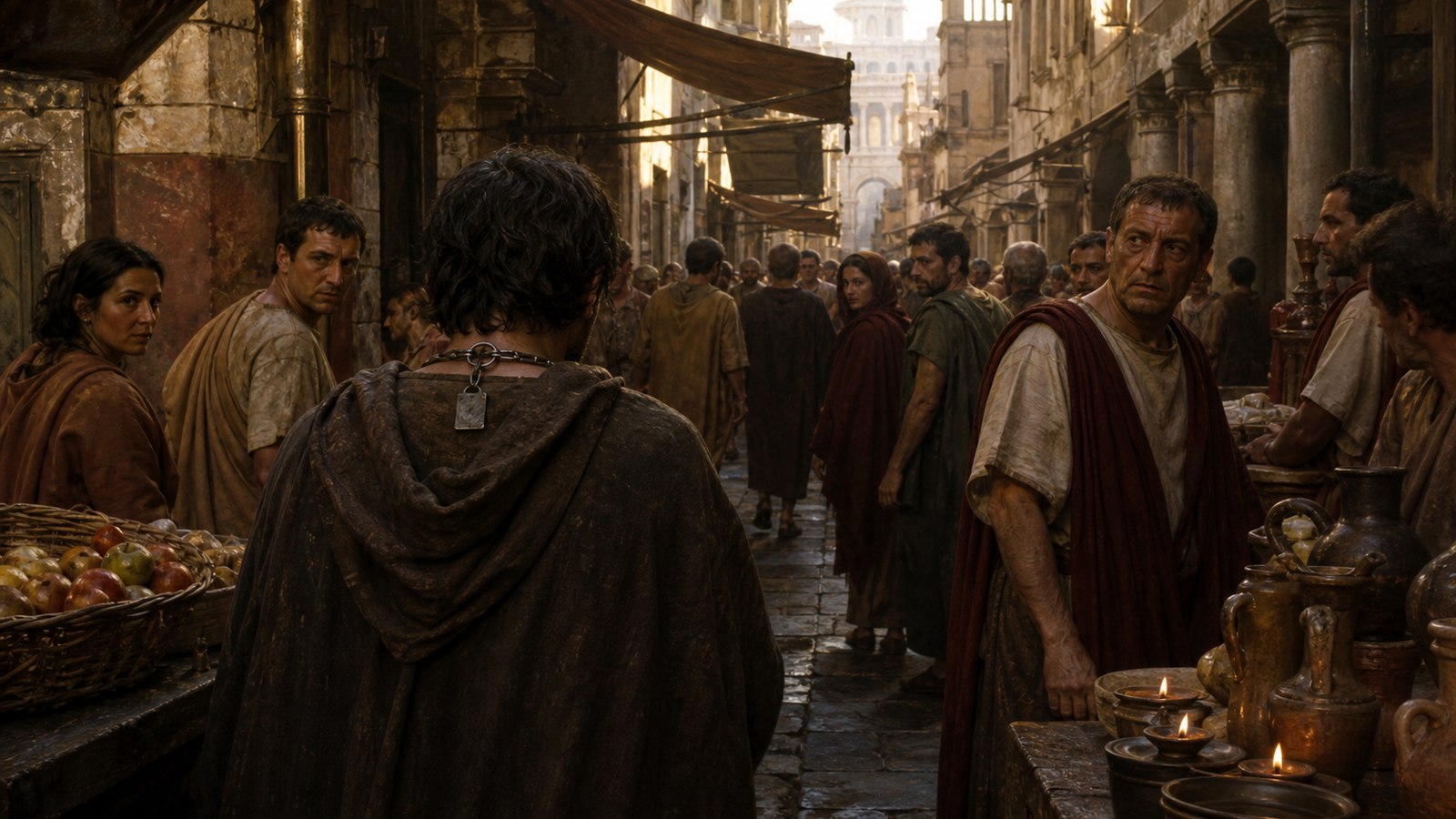
A collar could not chase anyone. Its effectiveness depended on social recognition. Readers had to notice the tag, understand enough Latin, accept the owner’s claim and choose the reward or the authority behind it over the fugitive’s freedom. Coercion was therefore distributed across objects and people.
The plate also exploited the density of urban life. In a city, the wearer could encounter shopkeepers, porters, household staff, guards, patrons and passers-by at close range. A visible metal tag turned proximity into risk. Even a person who could not read might recognize the collar’s form or ask someone else to interpret it.
At the same time, survival should not be confused with perfect effectiveness. The inscription exists because somebody feared flight enough to commission it. It cannot tell us how often collars worked, how wearers concealed them, who refused to cooperate or whether communities sometimes helped fugitives instead.
The object’s deepest cruelty lies in the mismatch between how much it says and how little it lets its wearer say. It records a price, an owner and an order with remarkable precision. It withholds a life. Read as ring, tag and public script together, the Zoninus collar makes late Roman slavery visible as a system that tried to turn literacy and ordinary streets into extensions of the chain.