

The edict did more than ask Rome’s richest women for money. It ordered 1,400 of them to declare their property, threatened penalties for concealment or false valuation, and promised rewards to informers whether free or enslaved. The Second Triumvirate needed cash for another Roman civil war. Its shortage was being converted into an inspection of women’s estates.
The women first used the route expected of them: they approached women inside the rulers’ households. Octavian’s sister and Antony’s mother received them sympathetically, according to Appian, but Fulvia drove them from her door. The rejected petitioners then crossed the boundary between household influence and public confrontation. They went to the triumvirs’ tribunal in the Forum and chose Hortensia to speak.
Appian gives her argument in direct speech, though he wrote long after 42 BCE and should not be treated as a stenographer. What survives is still unusually specific. Hortensia separated guilt from kinship, voluntary aid from coercion, and war for communal survival from war among Roman factions. By the next day, the list had fallen from 1,400 women to 400.
A Treasury Shortfall Arrived as an Edict
The confrontation belonged to the violent finances of the triumviral period. Octavian, Antony and Lepidus had proscribed enemies, confiscated property and expected sales to support preparations for war. Appian says buyers were scarce: some feared bad luck, some felt shame, and some worried that displaying new wealth would make them targets. The rulers remained short by 200 million drachmas in his account.
Their response was an assessment aimed at 1,400 of the richest women. Each was to value her property and surrender whatever portion the triumvirs required. This was not a fixed public subscription whose cost could be understood in advance. The demand paired an open-ended contribution with surveillance: concealment and false declaration brought fines, while informers could expect rewards.
Property gave the women visibility to the state but not a normal share in the offices that directed it. Roman elite women could inherit, own and manage substantial assets under particular legal arrangements, yet magistracies, military commands and formal voting belonged to men. The levy exposed that imbalance with unusual sharpness. Wealth was being counted as public when revenue was needed, while political authority remained closed.
The danger was also familial. Proscription had already removed fathers, husbands, sons and brothers from many households. Confiscation could reorder fortunes in a day. Hortensia’s case therefore began from cumulative loss: the state could not plausibly punish women as extensions of accused male relatives and then claim their estates as neutral resources for the next round of conflict.
Three Doorways Failed Before the Forum Opened
The women did not begin by staging a public speech. Appian says they appealed to the women connected with the triumvirs. Octavia, sister of Octavian, and Julia, mother of Antony, did not fail them. Fulvia, Antony’s wife and a formidable political actor in her own right, repulsed them from her doors. The sources do not preserve a negotiated proposal from those meetings, only sympathy on one side and rejection on the other.
That sequence matters because it shows strategy rather than spontaneous outrage. Elite Roman households were political spaces. A relative could carry a request inward without pretending to hold a magistracy. The petitioners first tried to work through those relationships, but household access could not bind the three rulers. When the indirect route failed, they moved toward the place where authority was publicly displayed.
Appian describes them forcing their way to the tribunal while people and guards divided to let them pass. The detail creates a datable mini-scene in 42 BCE: a group selected from 1,400 threatened property owners enters the Forum, a crowd opens around them, and the triumvirs are made to hear a complaint outside the protective filtering of their homes. The setting transformed a private burden into a visible constitutional question.
This movement resembles the earlier women’s campaign against the Oppian Law only at first glance. Both used collective presence when male institutions constrained direct participation. Yet the earlier dispute concerned a wartime luxury restriction that survived after the emergency; Hortensia faced targeted valuation under civil-war rulers who had made informers part of the collection machinery.

Hortensia Separated Kinship from Guilt
The women selected Hortensia as their voice. She was the daughter of Quintus Hortensius Hortalus, the celebrated advocate who had rivalled Cicero in the late Republic. Appian presents her as inheriting enough of that forensic tradition to organize a public case. Her pedigree gave the audience a familiar standard of eloquence, but the speech worked through distinctions rather than family prestige alone.
First came responsibility. If the women themselves had wronged the triumvirs, Hortensia argued, they could be proscribed like actual enemies. But they had not declared anyone a public enemy, destroyed houses, raised an army or obstructed the triumvirs’ honours. Punishment could not simply pass through fathers, husbands or sons and settle on female property without an accusation against its owner.
Then came participation. Appian’s Hortensia asks why women should pay when they had no part in honours, commands or statecraft—the prizes over which the rulers fought. This was not a general refusal of every obligation to a community. It tied the unprecedented demand to exclusion from the very decisions producing the civil war. The levy wanted the assets of citizenship while withholding its governing offices.
Her logic differs from Cicero isolating Catiline before the Senate. Cicero spoke as consul from the centre of recognized office and turned an opponent into the object of collective suspicion. Hortensia spoke for people outside magistracy and made the rulers’ procedure itself the object of scrutiny. Authority had to answer a voice it had not officially authorized.
Jewellery for Carthage Was Not Land for Civil War
The speech anticipated the obvious reply: Rome was at war. Hortensia answered with precedent. Roman women had once contributed when the city and empire faced catastrophe in the struggle with Carthage. But, in Appian’s version, that gift had been voluntary. It came from jewellery, not a compulsory valuation of fields, houses, dowries and the property that sustained a free woman’s position.
The comparison did careful work. It did not deny that women could sacrifice wealth for collective survival. Instead, it separated a chosen emergency contribution from a state assessment enforced by fear of informers. Material categories made the difference tangible. Jewellery could be offered; landed property and houses structured continuing independence, family security and social rank.
Hortensia also challenged the identity of the enemy. A Gallic or Parthian invasion threatening the common safety would call forth zeal, she said, but women should not finance Romans against Romans. She named precedents from recent political violence: they had not contributed to Caesar or Pompey, and neither Marius, Cinna nor even Sulla had imposed such a tax on them.
The last name sharpened the insult. Sulla represented dictatorship and proscription, yet the triumvirs claimed to be restoring the commonwealth while demanding something he had not. Appian’s wording may reflect later literary shaping, but the argumentative architecture is coherent: historical memory turns the rulers’ own republican language against an exceptional fiscal measure.
The Lictors Stopped When the Crowd Shouted
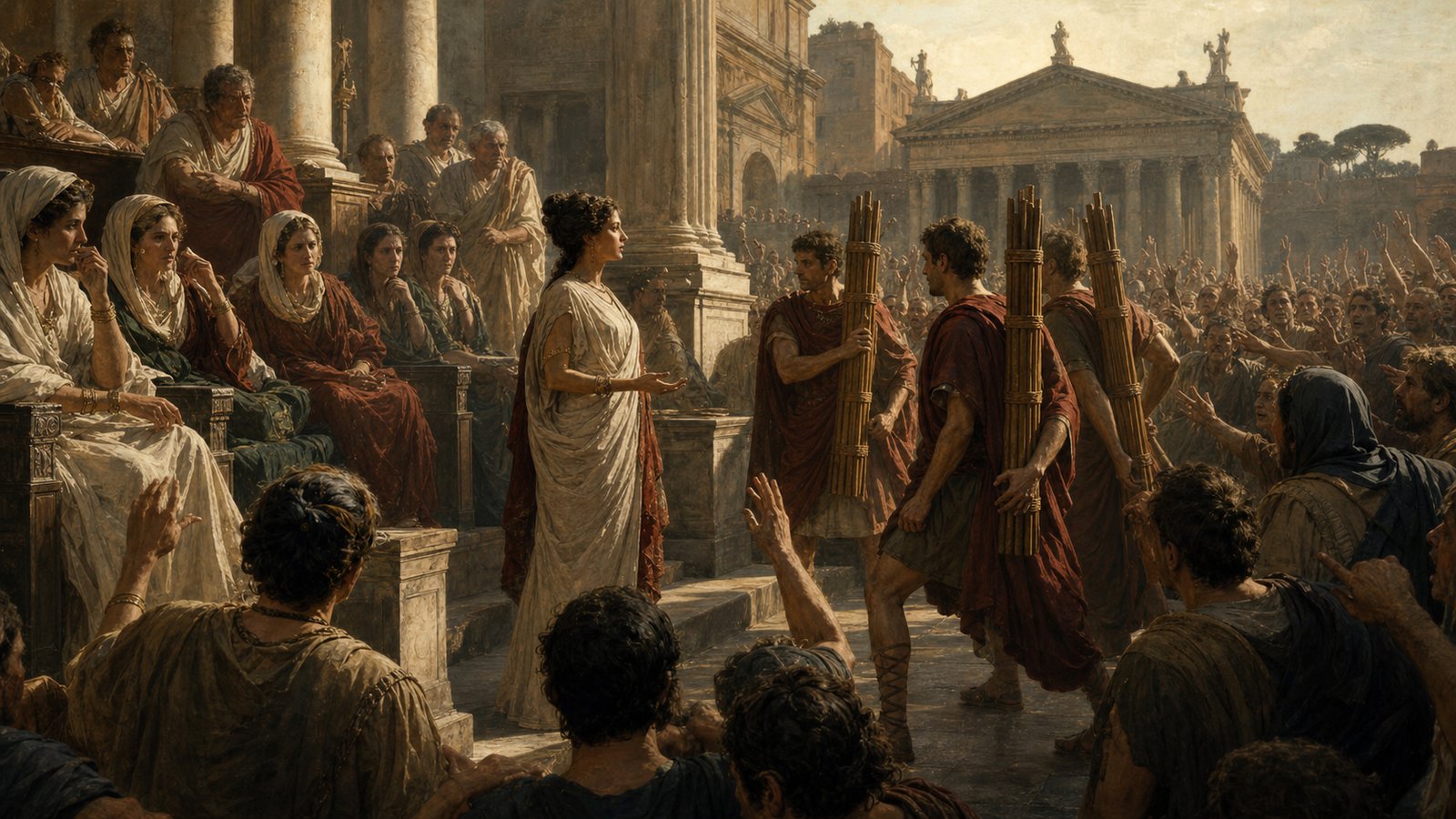
The triumvirs were angry. Appian says they objected that women dared to hold a public meeting while men were silent, demanded reasons from magistrates and refused money while men served in the army. That response reveals what had become threatening. The sum mattered, but so did the spectacle of excluded people requiring public justification from rulers accustomed to issuing edicts.
They ordered lictors to drive the women from the tribunal. The lictors began until cries rose from the crowd outside; then they stopped. No battle followed. The sensory evidence is brief but decisive: official attendants moving forward, voices swelling around the Forum, and coercion checked because removal now carried a public cost. The triumvirs postponed the question until the next day.
The revised order did not abolish forced finance. It reduced the number of women required to declare property from 1,400 to 400. At the same time, men possessing more than 100,000 drachmas—including citizens and strangers, freedmen, priests and men of every nationality—were ordered to lend one fiftieth of their property at interest and contribute a year’s income to the war.
Hortensia therefore did not win a modern equality settlement, nor did every assessed woman escape. She helped force a retreat from a much broader targeted levy and pushed the fiscal burden into a different, wider arrangement. The result is powerful because it is limited and measurable. One speech did not end triumviral violence; it changed the next day’s numbers.
The episode survives through Appian, a Greek historian writing roughly two centuries after the event, so his polished direct speech cannot be heard as a verbatim recording. Yet the names, sequence, demands and outcome preserve a political mechanism with rare clarity. Collective organization opened the Forum, forensic argument exposed the levy, a crowd constrained the lictors, and 1,000 women disappeared from the assessment list.