
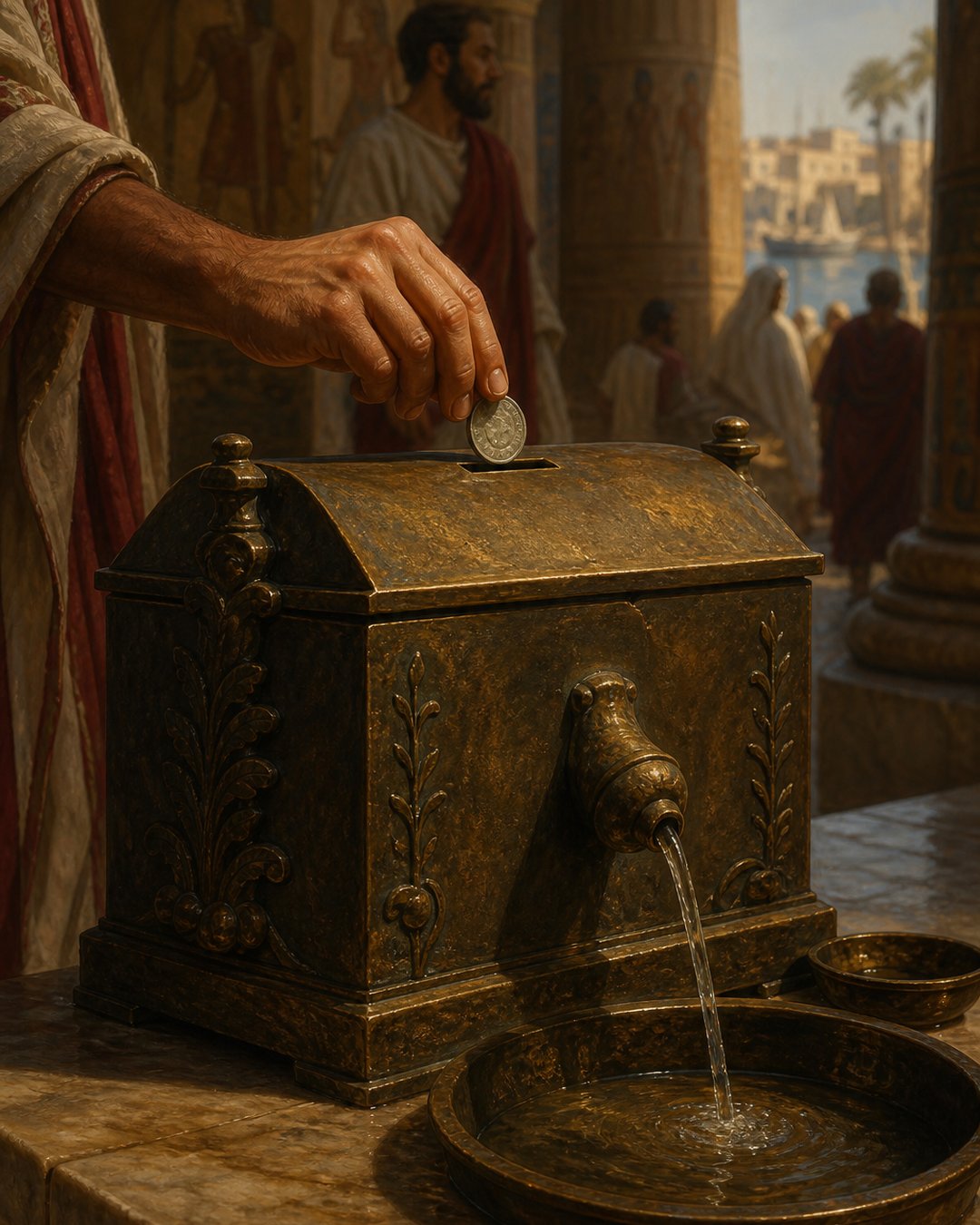
The worshipper did not turn a tap. Hero of Alexandria describes a chest-like sacrificial vessel with a slot at the top and water hidden inside. A coin worth five drachmas dropped through the opening onto a metal plate. Its weight tipped a lever, raised a lid from a small outlet box and released water through a pipe.
The flow carried its own ending. The plate tilted far enough for the coin to slide away. Once the combined weight of plate and coin disappeared, the lid became heavier than the plate alone. It fell back into place and stopped the water. Payment, permission and shutoff occurred in one gravity-driven sequence.
Calling this the first vending machine captures the surprise but can hide the cleverest part. Hero did not merely exchange a coin for liquid. He described a mechanism that discriminated between weights, opened a valve for a limited interval and reset itself. The temple setting joined ritual provision to mechanical control without requiring a visible attendant at every use.
Hero Began with a Chest and a Hidden Reservoir
The device appears as number 21 in Hero’s Pneumatica under a precise heading: a sacrificial vessel that flows only when money is introduced. The text imagines an outer chest with an opening in its mouth. Inside sits a separate water vessel and a small outlet box connected to a pipe leading beyond the chest.
This arrangement separates what the visitor sees from what performs the work. The slot announces where the coin goes; the external pipe reveals the result. The reservoir, lever and valve remain concealed. Mechanical cause therefore unfolds behind a ritual-facing surface, much as plumbing could remain invisible behind a fountain façade.
Hero’s Alexandria belonged to the Roman imperial world, but his technical writing grew from a longer Greek tradition of geometry, mechanics and pneumatics. The date of his life is not perfectly documented; modern scholarship generally places him in the first century CE. His treatise preserves devices involving air pressure, siphons, floats, weights, valves and theatrical automata.
The coin vessel belongs inside that experimental catalogue. It should be read beside Roman water clocks and their controlled flow, yet its task is different. A clock seeks continuity. Hero’s temple machine seeks a brief release initiated by one deliberate input.
Five Drachmas Made the Plate Heavier
Hero specifies a coin of five drachmas. The denomination matters mechanically because the machine depends on a threshold: the lid must outweigh the plate by itself, while the plate and coin together must outweigh the lid. A lighter object need not move the beam far enough; the intended coin supplies the necessary extra force.
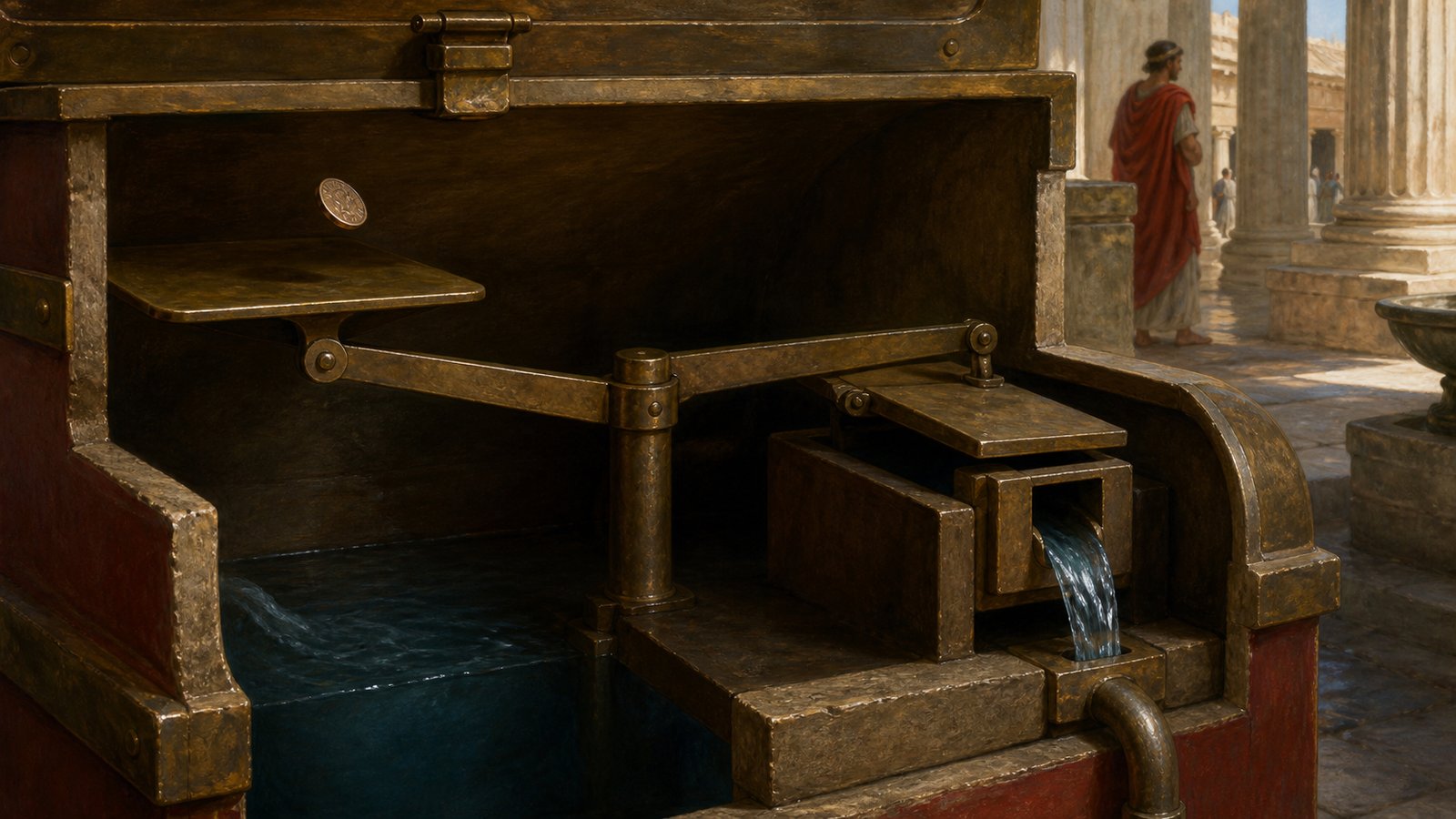
Inside the chest, a vertical rod supports the turning lever. One end broadens into a plate positioned beneath the slot. The other end suspends a lid fitted to the small outlet box. The plate receives the payment, while the lid controls whether water can enter the discharge pipe.
The balance is intentionally uneven. At rest, the lid wins and seals the box. When the coin lands, the plate wins and lifts the lid. Hero’s description is less about a magical vessel than about tuning two competing weights around a pivot. The device works because each state has a different heavier side.
This is a physical decision rule. No official inspects the payment, and no inscription needs to command the valve. The selected mass changes the machine’s state. Roman coinage already made authority and value portable; here a coin’s literal heaviness also becomes an instruction.
The Falling Coin Timed Its Own Purchase
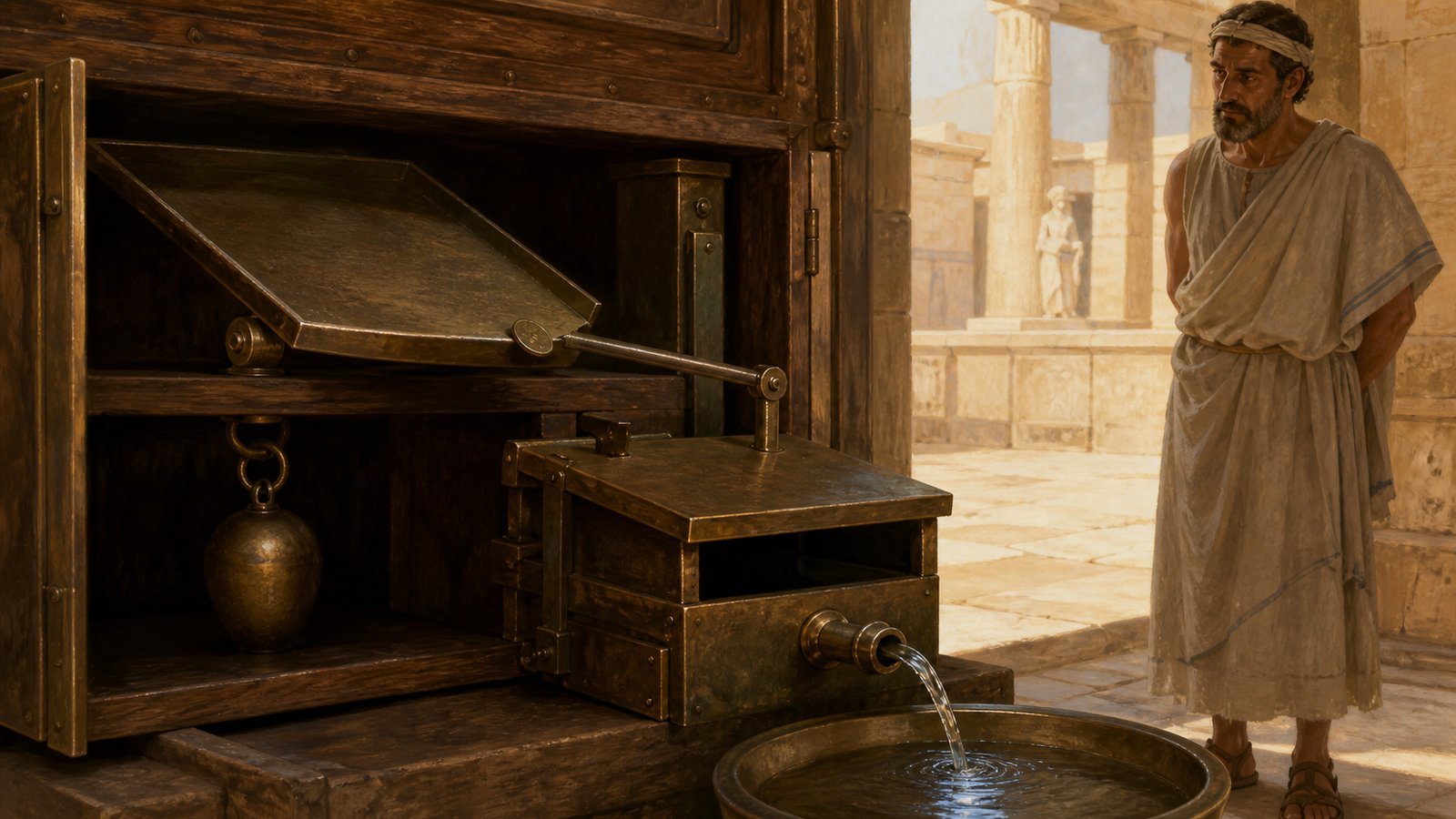
Opening was only half the problem. A valve that stayed open after payment would empty the reservoir. Hero solved that without a clockwork escapement. As the lever tipped, the plate ceased to be level. The coin then slid or fell away from the surface that had received it.
Losing the coin restored the original balance. The lid, heavier than the empty plate, descended into the outlet box. Water stopped. The same object that began the transaction therefore helped limit it: the coin remained on the plate long enough to produce a discharge, then its departure triggered closure.
The quantity delivered would depend on practical details that Hero does not reduce to one universal figure—the flow of the pipe, the travel of the lever, the plate’s angle and how quickly the coin moved. His phrase promises water flowing around the users, not a standardized modern bottle. The mechanism controls duration more clearly than exact volume.
Gravity performs every stage. It pulls the coin onto the plate, lets the loaded plate overcome the lid, moves the coin off the tilted surface and brings the heavier lid down again. The machine consumes no stored spring and needs no person to reset the valve. Someone must refill the reservoir and recover payments, but each cycle closes itself.
Ritual Water Became a Managed Resource
Hero calls the apparatus sacrificial, placing it among practices that used water at a sacred setting. Elsewhere in the same treatise he describes bronze wheels at Egyptian temple porticoes and vessels from which worshippers could sprinkle themselves with purifying water. Mechanical delivery and ritual action were not separate worlds in his collection.
A coin-operated outlet could manage access to a prepared supply. That does not prove every sanctuary charged worshippers through such a machine, nor does Hero identify a surviving installation. The text is a design description, and its transmission tells us securely what could be conceived and explained. Archaeological deployment must be argued separately.
The distinction matters because famous labels encourage overstatement. ‘Ancient vending machine’ suggests rows of commercial appliances and a mass consumer habit. Hero gives one sacrificial device, one specified coin and one hydraulic result. Its social setting is sacred provision; its mechanical logic happens to resemble later coin-operated sale.
That narrower claim is more interesting. Technology did not wait for a modern shop before connecting payment to access. In Hero’s design, ritual order, economic contribution and hydraulic control meet at a lever. The machine translates a social condition—money introduced—into a physical condition—water temporarily released.
A Treatise Preserved the Machine Better Than Bronze
No complete original machine from Hero’s workshop survives with a label proving this exact device stood in a named temple. What survives is the technical text, copied and translated across centuries, plus its diagrammatic tradition. The evidence records a design logic rather than an excavated appliance with a secure floor plan.
Hero writes operationally. He names the chest, reservoir, outlet box, vertical rod, lever, plate and lid, then states the required relation between their weights. That specificity makes reconstruction possible. A modern model can demonstrate the motion, but the model tests the text; it does not become the ancient artefact the text lacks.
The same caution applies to Aquincum’s archaeological water organ. There, surviving metal parts and a find context anchor reconstruction. Hero’s coin vessel reverses the evidence: unusually detailed instructions survive, while the installed object does not. Both cases show how ancient mechanism reaches us through incomplete but different archives.
The five-drachma coin makes the design memorable because it seems familiar. Its real achievement is stranger and more exact. A small disc passes through a sacred chest, changes a balance, opens hidden water and removes itself from the equation. The worshipper sees a brief flow. Behind it, weight has become permission and gravity has enforced the limit.