
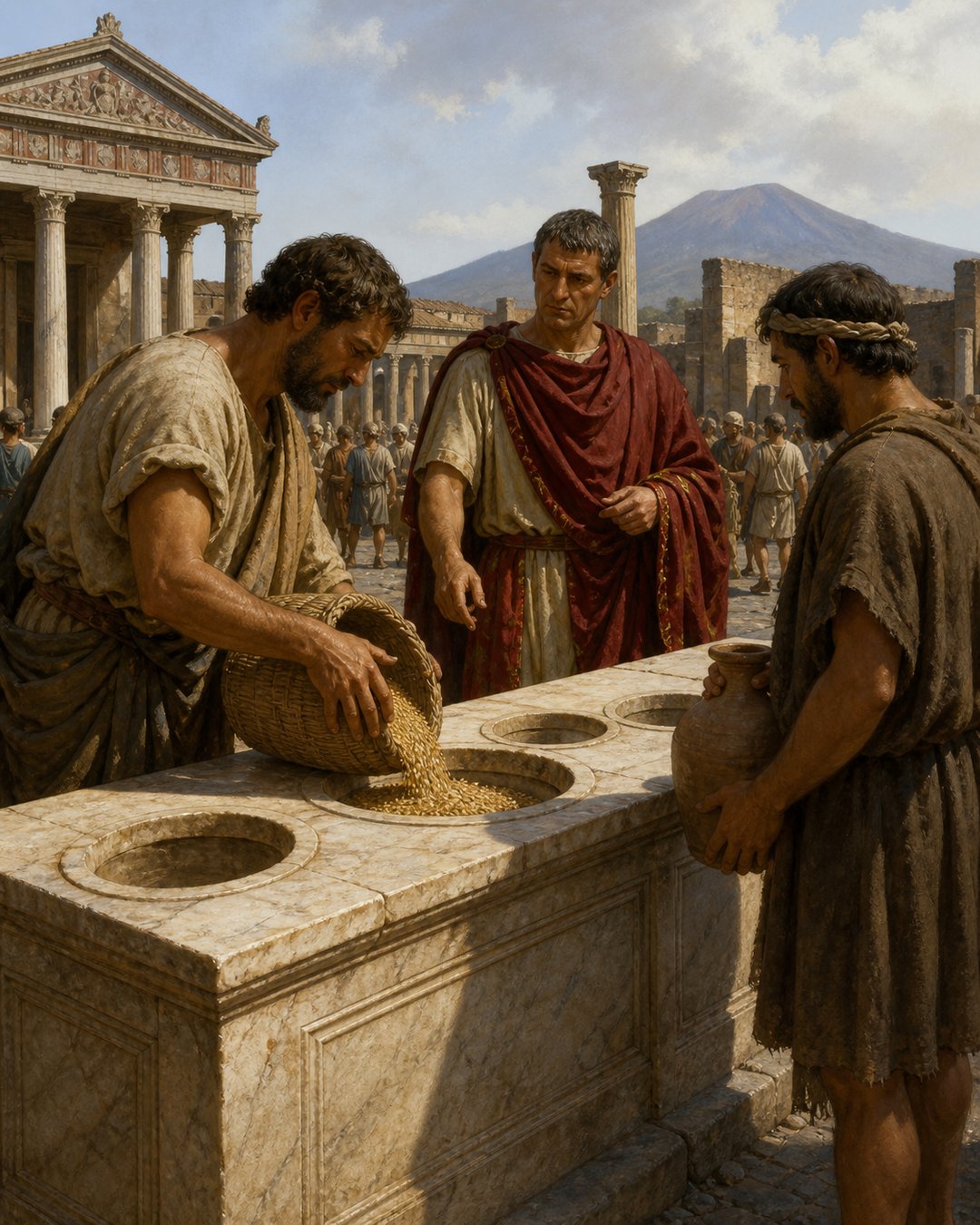
A trader could argue about the size of a jar. The stone could answer. On the western side of Pompeii’s Forum, a marble counter presented a row of hollow standards for checking how much a vessel really held. Grain or liquid went into the appropriate basin, a cap closed it, and the contents were released after the comparison. Measurement became something that could be performed in public rather than trusted in private.
The counter is known as the Mensa Ponderaria. Its name can make it sound like a table for weighing, yet the surviving installation checked capacity: how much a container could hold. The object joined a physical volume to a civic location, municipal authority and an inscription. A buyer did not need to accept a merchant’s painted mark when an official standard stood beside the Forum.
Its most revealing feature is not simply that Pompeii possessed measures. The bench had a history. Oscan labels were erased, holes were altered, and Roman standards were installed under named magistrates. A tool that settled small disputes over cereals or liquids also preserved a larger political transition in stone.
Nine Openings Turned Volume into a Visible Test
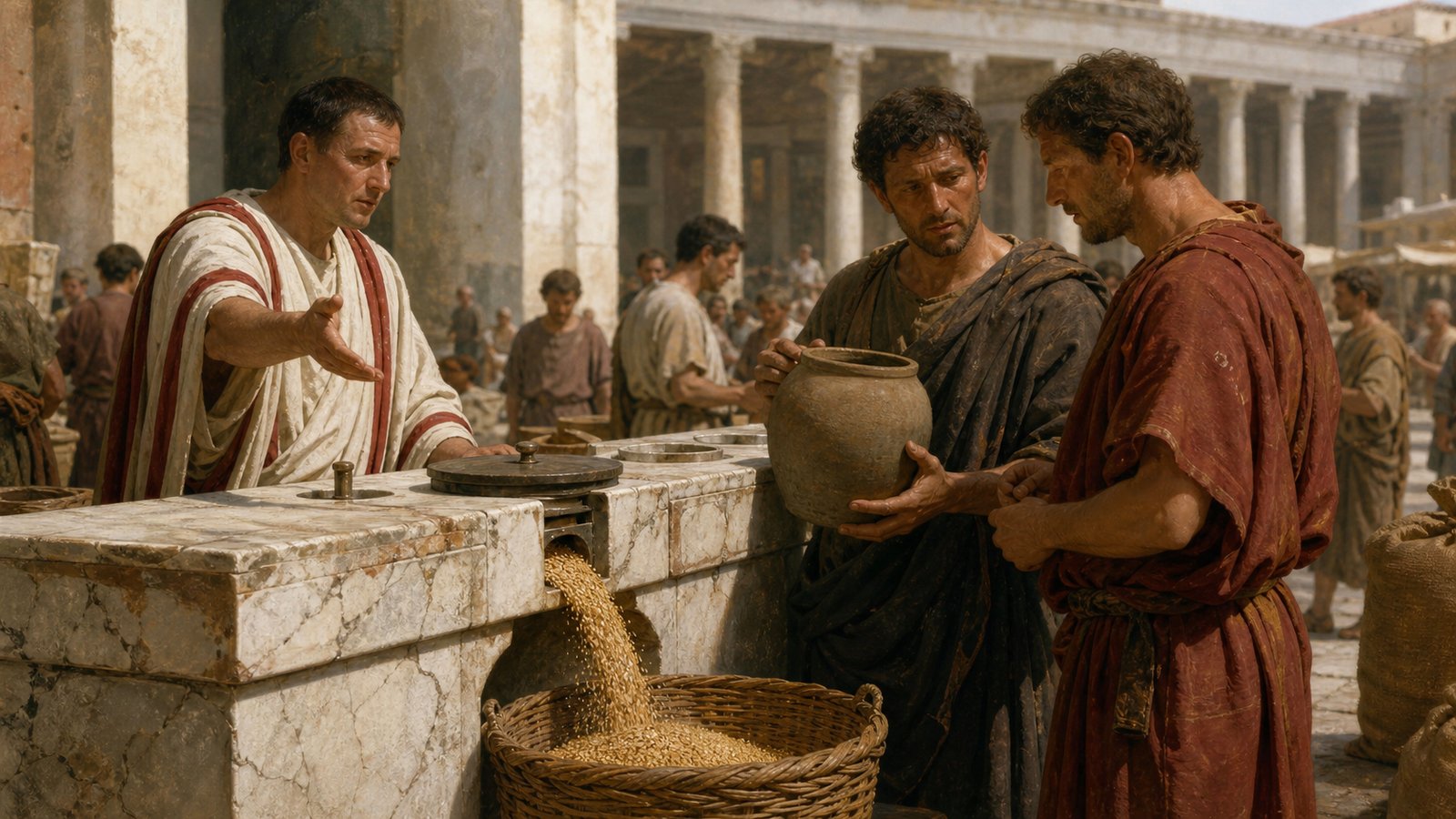
The official Pompeii Archaeological Park describes the installation as a counter used to check capacity measures employed in trade. Both liquids and solid foods such as cereals could be tested. The commodity was placed in the appropriate standard container, the opening was sealed with a cap, and the contents were emptied after verification. Each step reduced room for improvisation: choose the standard, fill it, close it, release it.
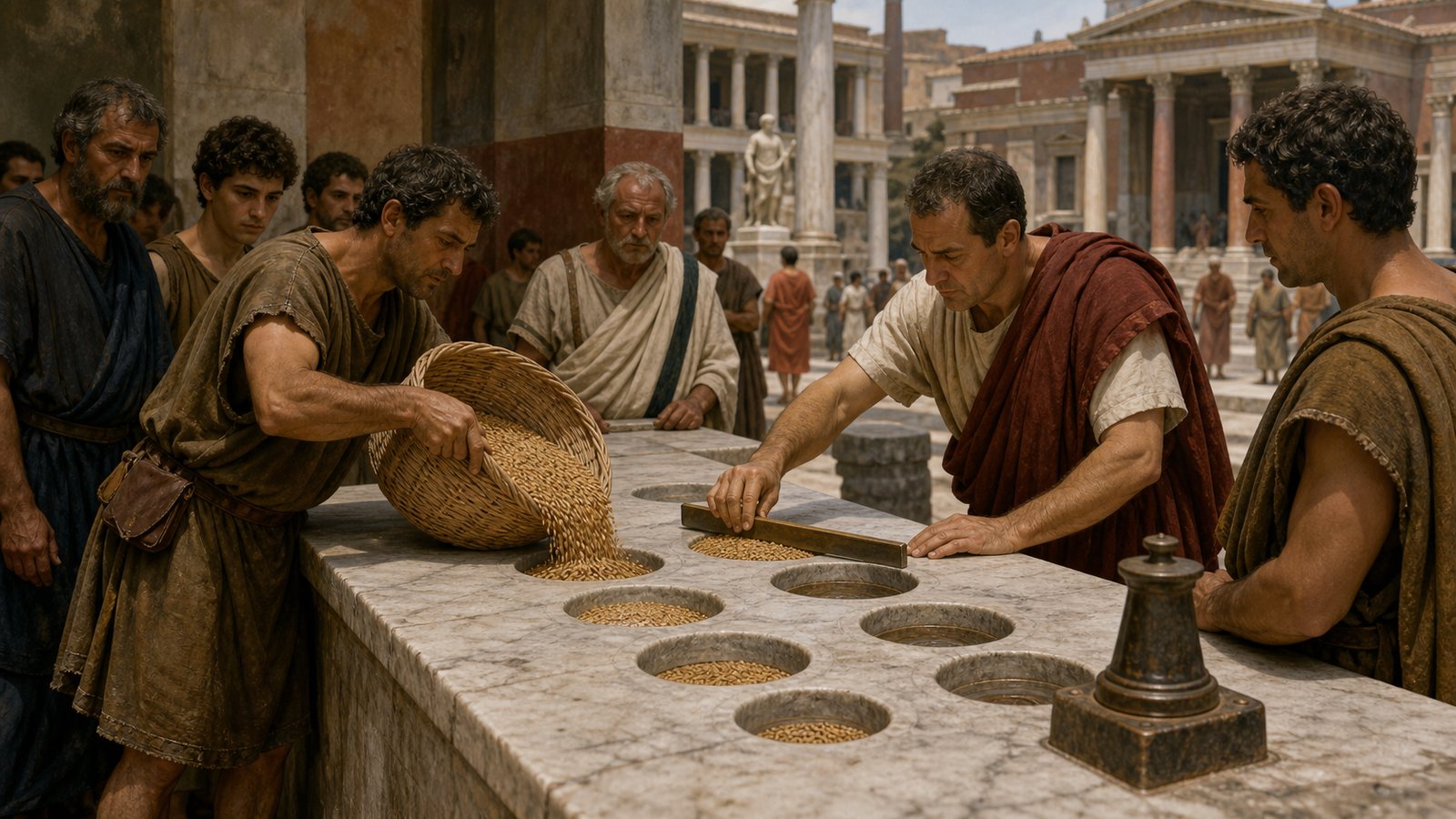
A detailed archaeological record notes five central basins and four smaller openings at the corners after a major modification. The arrangement did not offer one universal hole. Different volumes needed different cavities, and a user had to select the one that corresponded to the vessel or quantity in question. The bench therefore worked as a family of standards held in one durable surface.
The release mattered as much as the fill. A standard that trapped grain or wine would be awkward for repeated use and invite disputes over residue. Photographs and excavation descriptions show the measuring table as an apparatus rather than decoration: the top received the material, while the construction permitted it to be emptied beneath. Repetition turned one comparison into a civic routine.
This was more physical than the calculation preserved in Roman counting boards and their movable counters. An abacus could total units; the Mensa Ponderaria established what one unit of capacity meant at this particular market. Arithmetic depended on a standard before multiplication could begin.
The Forum Gave the Standard an Audience
The counter stood in a niche along the western perimeter wall of the Sanctuary of Apollo, beside Pompeii’s Forum. Its position placed verification close to the town’s most public commercial, religious and political space. The installation did not hide inside a merchant’s storeroom, where the owner controlled access and interpretation.
Public placement changed the balance in a disagreement. A seller’s scoop and a buyer’s jar could be carried to a standard neither party owned. The stone did not remove every opportunity for fraud—filling technique, surface level and handling still required judgment—but it supplied a common reference. Trust rested less on personality because the comparison could be witnessed.
That role fits the social rhythm of Roman market days, when exchange and public information met. Standards were useful not merely because goods moved, but because strangers and neighbours needed to agree on quantities. The Forum made that agreement visible enough to become enforceable.
The surviving table also gives ordinary transactions unusual archaeological weight. Ancient histories rarely narrate the moment when someone challenged a cereal measure. A row of calibrated hollows preserves the problem indirectly. Pompeii invested stone, space and magistrates’ authority because discrepancies in everyday containers mattered often enough to justify a permanent answer.
Erased Oscan Labels Exposed an Older System
The Mensa Ponderaria existed before Pompeii became a Roman colony. The Archaeological Park points to three Oscan inscriptions as evidence of that earlier phase. They once labelled basins in the local language and were later deleted. Standardisation did not begin with an empty slab; it worked on a tool that already carried civic habits.
The erasures are historically eloquent precisely because they are absences. A new regime did not need to discard the entire counter. It could retain the useful object, alter its openings and remove the labels that tied those openings to the previous system. Continuity of marketplace practice sat beside a deliberate change in official language and calibration.
Pompeii was founded as a Roman colony in 80 BC, according to the Park’s account of the bench. Another archaeological summary dates a radical modification to around 20 BC, when new holes were cut, the five central basins were enlarged and four smaller corner measures were added. The evidence therefore warns against compressing every change into one instant. Colonial status and physical recalibration belong to a process, not necessarily the same morning.
The revised bench joined Pompeii’s capacities to those used at Rome. That connection did not make every local transaction identical across the empire, but it gave the town an authoritative comparison with the capital’s system. The political change reached the marketplace through the size of cavities and the words cut across their front.
Two Duumvirs Put Their Names Beneath the Measure
A Latin inscription records the officials responsible. It names Aulus Clodius Flaccus, son of Aulus, and Numerius Arcaeus Arellianus Caledus, son of Numerius. Both are identified as duumvirs with judicial power. The standard was not presented as a nameless gift of ‘Rome’; local magistrates carried out the work.
The text says they saw to the equalising or standardisation of the measures in accordance with a decree of the town councillors. That chain is compact but important. The councillors authorised the action, duumvirs executed it, craftsmen altered the stone, and traders then encountered the result as a practical rule. Municipal government became a volume that could be filled.
Naming the officials also made the intervention accountable and memorable. Anyone reading the inscription could connect the new standards with an office and a decree. The words asserted that the cavities were not arbitrary replacements made by one vendor. They carried the authority of Pompeii’s civic institutions.
The bench illuminates municipal law from below. Grand bronze charters list offices and procedures; this marble tool shows one consequence at hand level. A decree could end as grain level with the rim of a basin. Civic power was not only announced in assemblies. It was built into the instruments that structured an ordinary sale.
The Original Left the Forum, but the Procedure Remains Legible
The object visible at Pompeii today is a copy. The original is kept in the National Archaeological Museum of Naples, where the archaeological record gives it inventory number 3828. Separating original and site protects the ancient stone, but it also requires modern visitors to reconstruct the relationship between object, niche and Forum.
Excavation records date the discovery to 1816–1817; one journal entry describes a marble slab with five round holes and an inscription found on 11 May 1816. Later drawings and photographs documented the counter, its face and its changing display. The modern history of recording is part of why its earlier alterations can be examined at all.
The most responsible reading avoids turning the bench into a flawless ancient consumer-protection office. The sources establish its position, cavities, commodities, caps, emptied contents, inscriptions and magistrates. They do not preserve every operating rule, every attendant or the outcome of a specific dispute. Interpretation should stay close to what the apparatus made possible: comparison under civic authority.
That is already a substantial achievement. A private container could be checked against a public volume; an Oscan standard could be recut into a Roman one; a council decree could survive as holes, erasures and names. Pompeii’s counter made fairness tangible without making it automatic. The stone could answer only because the town first decided which answer would count.