
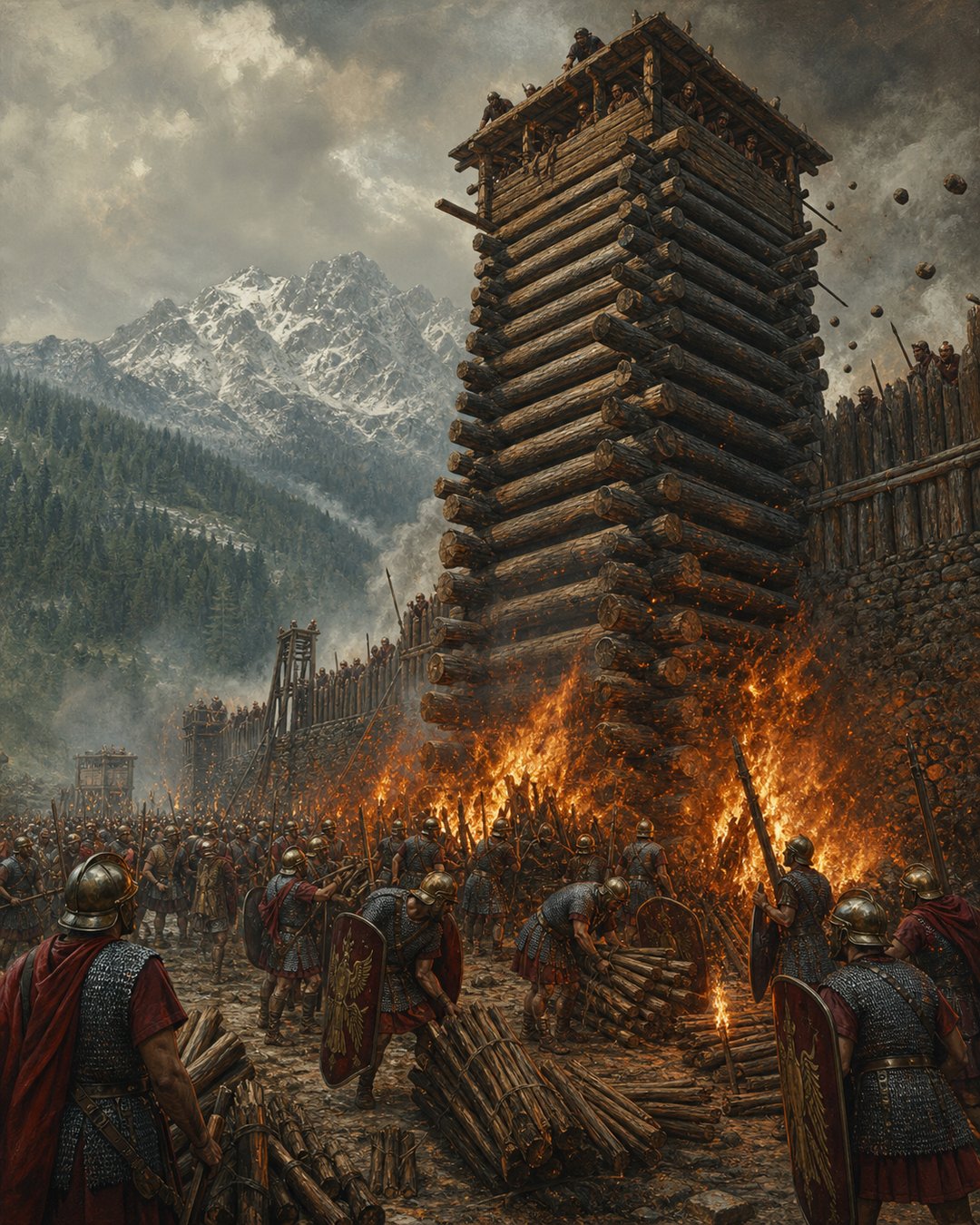
The soldiers carried exactly what a wooden tower should have feared: bundles of dry firewood and burning torches. They packed them around the structure outside Larignum’s gate and watched flames climb so high that, in Vitruvius’s telling, they seemed to reach the sky. Everyone expected the tower to collapse. When the fire died, its crossed beams were still standing.
That failure changed the attack. Julius Caesar had ordered the Alpine fortress to supply provisions, and its inhabitants had refused. His men could not simply burn away the high platform from which defenders threw stones and darts. Caesar moved them beyond arrow range, blockaded the place and accepted its surrender. Only then did the attackers ask what kind of timber had defeated their fire.
The answer was larch. Vitruvius turns one compact siege episode into a material investigation: where the tree grew, why he believed it resisted flame and rot, how its weight complicated transport, and where its timber nevertheless travelled. The tower survived because wood was not one uniform category. Species, moisture, resin, density and supply route could matter as much as the torch.
A Provision Order Became a Test of Timber
Vitruvius places Caesar and his army near the Alps when an order went out to neighbouring towns for provisions. Larignum trusted its fortifications and refused. The scene begins with logistics rather than a grand campaign plan: an army needed food, a fortified community withheld it, and Caesar answered by bringing force to its gate.
A tall tower stood in front of that entrance. Its beams crossed alternately at their ends, the same stacked geometry Vitruvius compares to a funeral pyre. From the top, defenders could throw darts and stones down on troops approaching the walls. Height converted an ordinary timber frame into control over the ground below.
The defenders’ darts were heavy and did not travel far, at least in the explanation preserved by Vitruvius. That offered the attackers a narrow opportunity. Soldiers could approach close enough to deposit fuel before the tower’s occupants stopped them at greater distance. Caesar’s men therefore treated the structure according to the obvious weakness of timber: they surrounded it with combustible material and added torches.
This was not the slow carbonisation used by Roman charcoal burners controlling a covered wood fire. It was an attempt to make flame move quickly from loose fuel into structural beams. The entire tactical expectation depended on the tower becoming its own fuel once the bundles beneath it had ignited.
The Flames Spent Themselves Before the Tower Did
The first spectacle seemed to confirm the plan. Flames wrapped around the tower and rose dramatically. An observer could see heat and height without seeing what was happening inside the beams. Surface fire looked like structural destruction, but appearance was ahead of the material process.
When the added fuel was exhausted, the tower remained unhurt in Vitruvius’s account. The larch had been exposed to fire without continuing to burn by itself. That distinction matters. He does not claim that no heat could ever consume it. He says it would not take flame or make charcoal on its own and would only waste away gradually when burned together with other wood, as stone is fired in a lime kiln.
His comparison would have been concrete to a builder. A Roman lime kiln held material inside prolonged, concentrated heat; a hurried ring of torches at a gate produced a different thermal environment. Larch’s resistance bought time precisely where a normal timber structure was expected to feed the attack against itself.
Vitruvius explains the behaviour with the four elements used in ancient natural philosophy. He assigns larch little fire and air, much water and earth, and few pores through which fire could enter. Modern botany and combustion science use different mechanisms and language. His account should therefore be read as an ancient theory attached to a reported observation, not quietly translated into a modern laboratory result.
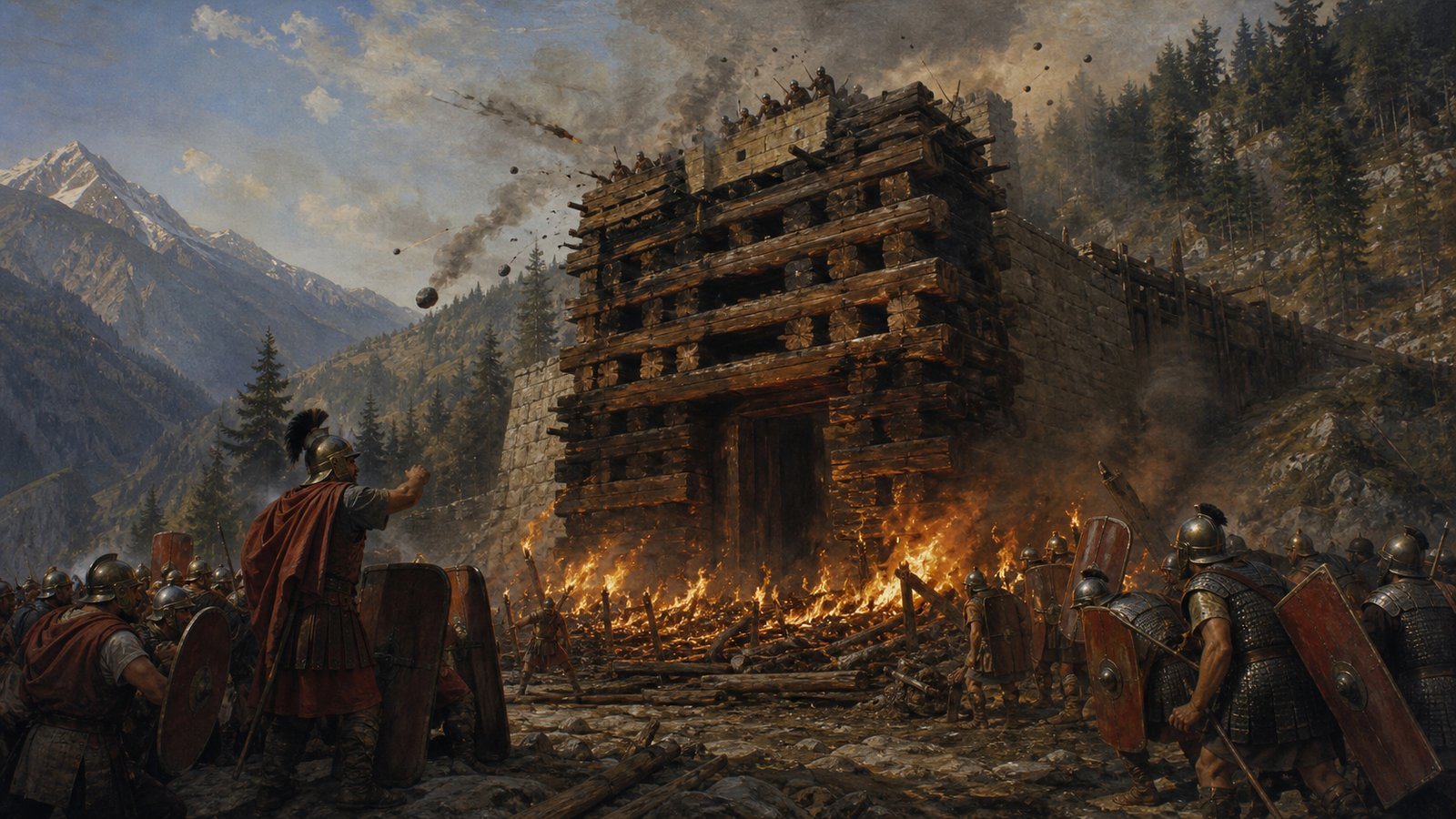
Caesar Changed from Burning to Blockade
The tower did not make Larignum unconquerable. It removed one quick solution. Caesar ordered a blockade outside the range of missiles, turning the contest from ignition to isolation. The fortress surrendered, and Vitruvius describes its inhabitants as trembling when they delivered the town.
That sequence gives material knowledge a tactical consequence without making the material magical. Larch did not defeat an army. It forced the army to change method. The same tower that denied the expected shortcut could not replenish food, break an encirclement or reverse the imbalance between one fortified community and Caesar’s forces.
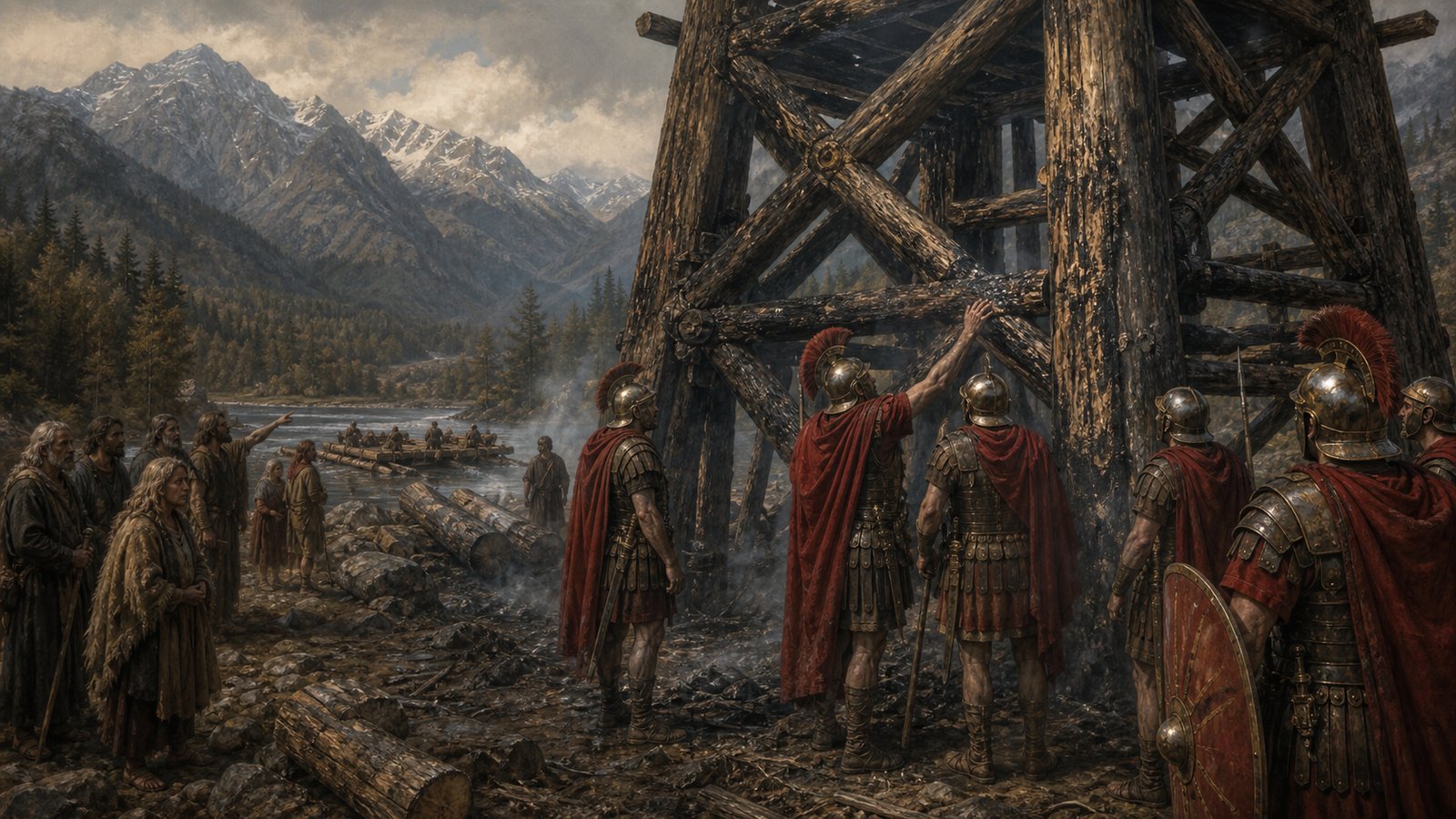
After surrender came inquiry. The Romans asked where the inhabitants obtained timber that would not burn as expected. Local people pointed out trees growing abundantly in the district. The encounter moves from threat to identification: a species that had been part of the landscape became strategically legible only after its performance contradicted an attacker’s assumption.
Vitruvius links the fortress name, Larignum, to larigna, his word for larch. Etymology offered him a tidy ending, although modern readers should not make one narrated name explain the whole botanical history. What the passage securely demonstrates is the author’s desire to bind place, material and discovery into one memorable technical lesson.
Weight Drew a Boundary Around the Useful Wood
Fire resistance was only one property in Vitruvius’s inventory. He says larch resisted rot and worms because of the extreme bitterness of its juices. He also calls it so heavy that it would not float by itself. Transport therefore required vessels or fir rafts rather than simply releasing logs to travel freely with the current.
The route followed the Po toward Ravenna. From there, Vitruvius names Fano, Pesaro, Ancona and other Adriatic communities as users of the timber. Those place names turn a siege curiosity into a supply map. A useful species became building material where rivers, rafts, ships and coastal distribution could carry its weight.
Rome lay outside that easy chain. Vitruvius says the timber would be valuable in the capital if transport were possible, especially as plates beneath the eaves of detached houses. Eaves were exposed points where flying embers or a neighbouring flame could catch. His proposal targeted a vulnerable edge rather than imagining that every wall and roof could be rebuilt in rare timber.
The transport problem is the article’s quiet counterweight to the spectacular fire. An excellent material does not become common merely because an architect admires it. Abundance at an Alpine fortress, river access to Ravenna, heavy logs and the distance to Rome all shaped practical use. Performance and distribution had to meet before larch could protect a building.
Vitruvius Preserved an Observation and Its Limits
The passage appears in Book Two of On Architecture, where Vitruvius surveys building materials and different timbers. He notes that larch had pine-like leaves, straight fibres and was no harder to work in joinery than pine. He also describes a liquid resin with the colour of Attic honey. The tower story sits inside that builder’s catalogue, not inside Caesar’s surviving campaign narrative.
That source position requires care. Vitruvius supplies the siege, the test, the surrender, the naming story and the trade route. Repeating his details with attribution is responsible; turning every flourish into independently confirmed military reportage is not. Flames ‘reaching the heavens’ are literary scale. The material claim is strongest where his account distinguishes ignition, slow consumption, weight, workmanship and transport.
Even the apparently simple word ‘fireproof’ can mislead. Vitruvius allows that larch will eventually be consumed amid other burning wood. His claim is resistance to catching and sustaining flame, not invulnerability to unlimited heat. That narrower reading also makes the tactical episode plausible on its own terms: the soldiers’ fuel burned out before the structural wood had been destroyed.
Larignum’s tower survives only in words, not as excavated beams available for testing. Yet the narrative preserves a useful Roman habit of thought. A failed action became evidence; evidence prompted a question; a local answer expanded into advice about joinery, eaves and supply. Fire revealed the material, but transport decided its reach. The tower’s real lesson was not that wood could ignore flame. It was that builders and soldiers paid a price for assuming all wood behaved alike.