
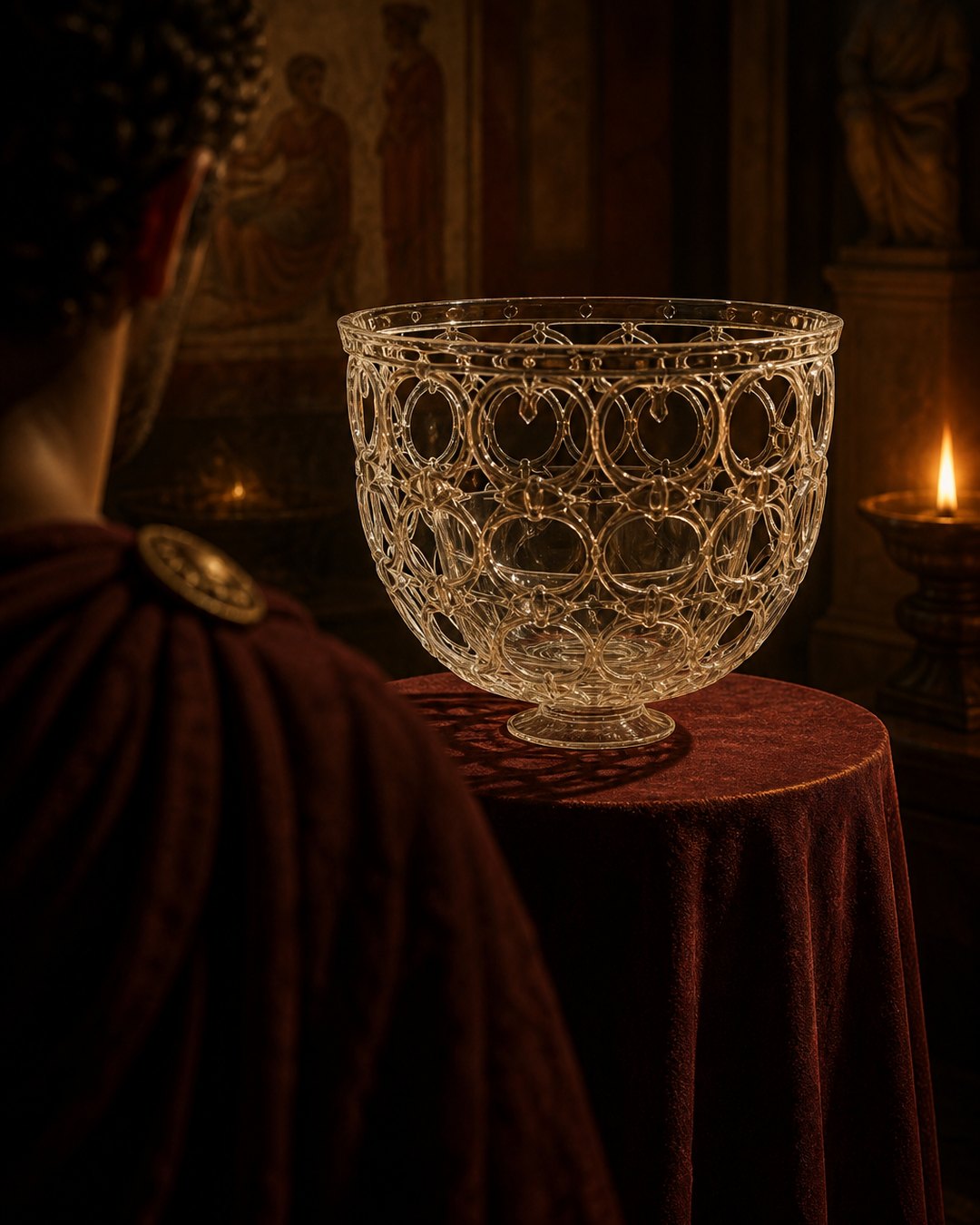
At first glance, the glass seems to be doing something impossible. A clear hemispherical bowl sits inside an open lattice of circles, hearts and rings. The outer network appears to float away from the vessel wall, yet it does not fall. Slender bridges, placed where the pattern hides them, hold the cage to the cup. There is no separate sleeve wrapped around an ordinary bowl. Both layers began as one thick mass of glass.
The vessel now called the Constable-Maxwell cage cup belongs to a tiny, spectacular family of late Roman objects known as diatreta. Its surface carries no emperor, battle or long inscription to explain itself. Instead, the evidence resides in depth: glass left standing, glass ground away, and connections narrow enough that one careless cut could erase months of work.
Its purpose is less secure than its manufacture. Upright cage cups with drinking wishes plainly served at exceptional tables. This one is broad and hemispherical. A close parallel carried an ancient metal collar, raising the possibility that such bowls hung as oil lamps. The object therefore holds two kinds of suspense at once: how did a cutter free the lattice without breaking it, and what happened when the finished cage met wine or flame?
The Cage Is Not a Second Piece
Bonhams described the vessel as carved from a thick blank of colourless glass. The internal cup and its outer network are parts of that same original body. A cutter did not make a bowl, weave a separate glass basket and join the two afterward. The apparent gap had to be excavated from solid thickness while selected points remained untouched.
That distinction changes how the object should be seen. The circles and heart-shaped meshes are not decoration painted onto a surface. They stand proud of it. Behind them, the cup wall retreats inward. Very slender glass bridges connect lattice to vessel, often concealed behind intersections so that the engineering does not interrupt the illusion of suspension.
The result is an object with two visual skins but one material history. Light can cross the open spaces, strike the inner bowl and return through the cage. A hand turning it would see the network slide across the wall behind, although nothing actually moves. Depth, not colour, creates the changing effect.
That sets the cup apart from the Lycurgus Cup’s shift from green to red. The Lycurgus vessel changes because transmitted and reflected light interact differently with its glass. The Constable-Maxwell cup makes light legible through holes, shadows and physical separation. Both astonish, but their mechanisms are not interchangeable.
Making It Meant Choosing What Not to Remove
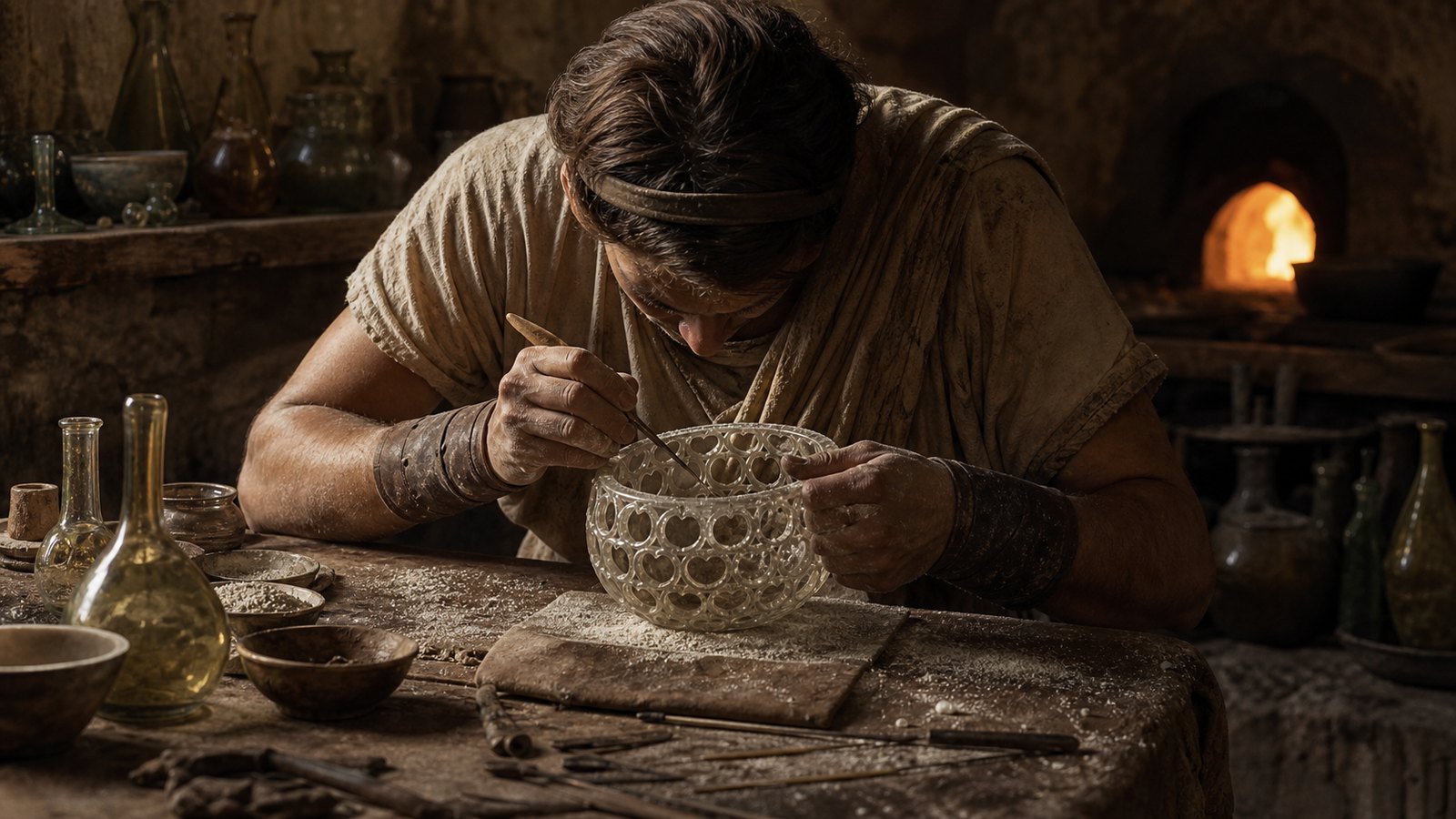
The ancient sequence is reconstructed rather than preserved in a workshop manual. The starting requirement was substantial: a blank thick enough to contain both the inner wall and the future cage. The cutter then had to establish the vessel’s profile, map the network, open the spaces around it and undercut behind the surviving bars without severing the bridges.
Every completed opening increased the cost of the next mistake. Glass does not forgive a slipped wheel or an unseen crack by accepting a patch. A failure late in the process could destroy the lattice after most of the labour had already been invested. Bonhams calls the manufacture slow, time-consuming and fraught with potential disaster throughout.
The pattern imposed more than decorative repetition. Concentric bands had to remain visually coherent around a curved body. Circles and heart-shaped meshes needed junctions strong enough to survive undercutting. The hidden bridges had to be thick enough to support the cage but discreet enough to preserve its floating appearance. Beauty and structural calculation occupied the same few millimetres.
This was subtraction as a luxury language. A plain cup displays the glass that remains visible. A diatretum also displays the expensive voids a specialist managed to create. The owner possessed not only a vessel but evidence that a craftsperson had repeatedly approached the point of ruin and stopped at exactly the right depth.
Its Shape Refuses a Simple Drinking-Cup Story
Cage cups are often discussed as elite drinking vessels, and some examples make that function explicit. Upright beakers from Milan and Cologne carry wishes equivalent to ‘Drink, may you live many years’ in Latin or Greek. Their inscriptions turn the act of lifting the vessel into part of the message.
The Constable-Maxwell cup is different in form. It is hemispherical, with a splayed rim and an openwork flange below. Bonhams placed it in a typological subgroup defined by the network and overhanging flange. It lacks the long upright body that makes the inscribed beakers easy to picture in a drinker’s hand.
Form does not make drinking impossible. A precious bowl could be held carefully, supported in a fitting or presented only on special occasions. Yet the hemisphere asks how it was steadied and where fingers went without loading the delicate cage. The absence of an inscription removes one of the clearest functional clues found on other diatreta.
That uncertainty is useful. Archaeological labels can turn a family resemblance into a false biography. ‘Cage cup’ identifies construction and broad vessel type; it does not prove that every surviving example met a guest’s lips. For this object, shape should remain in the argument rather than being flattened by the category name.
A Metal Collar Makes the Lamp Hypothesis Serious
The closest comparison cited in the sale catalogue is a smaller cage cup now associated with the Corning Museum of Glass. It has an outsplayed rim, openwork flange, hemispherical body and two rings of circular and heart-shaped meshes. Most importantly, a copper-alloy collar was attached below its rim in antiquity.
That collar, together with a hanger consisting of hooks, loops and looped elements, prompted a different reconstruction. The hanger itself may be later, but the ancient collar shows that metal hardware belonged on the vessel. A suspended use cannot be dismissed as a modern fantasy built only from the cup’s appearance.
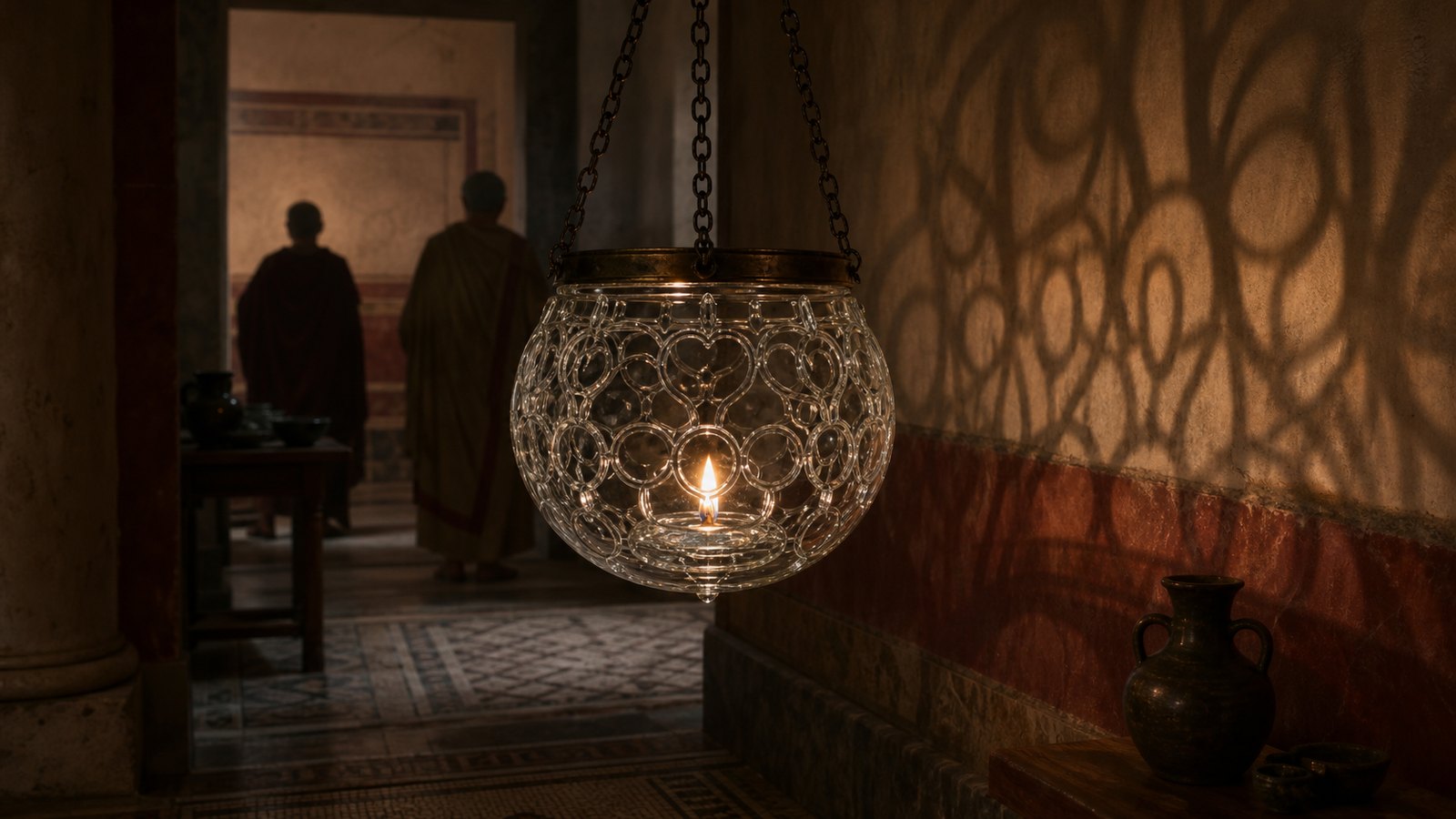
If the Constable-Maxwell vessel held oil and a wick, its outer cage would become more than a demonstration of cutting. Light from the bowl could pass through the open network and throw geometric bands across nearby walls or floors. The spaces removed by the craftsperson would reappear as patterned illumination.
The proposal remains conditional. No ancient collar is documented on the Constable-Maxwell cup itself, and a close parallel is not a duplicate life story. The strongest statement is mechanical: its hemispherical relative had ancient suspension hardware, and this makes a lamp function plausible for the group. It does not make every cage cup a lamp or erase the securely inscribed drinking examples.
Exorbitant Labour Restricted the Audience
Bonhams connected the manufacturing risk to price. A thick blank, specialist labour and high probability of catastrophic loss made cage cups exorbitantly expensive. The catalogue argues that, like early imperial cameo vessels, they could have been commissioned only by the wealthiest members of Roman society.
The comparison with the Portland Vase’s carved cameo glass is revealing. Both crafts demanded that a maker think beneath the visible surface. The Portland cutter removed a pale layer to release figures against dark blue. The cage-cup cutter penetrated farther, opening air between network and wall while preserving tiny supports.
Neither process needed a heap of gems to communicate expense. Time, skill and irreversibility were sufficient. A knowledgeable viewer could recognize that the object had survived stages at which ordinary production would have failed. Its rarity was built into the method before it entered any banquet room or illuminated interior.
The surviving history reinforces that elite afterlife without proving an ancient owner. The cup belonged to the Constable-Maxwell collection, later to the British Rail Pension Fund collection, and appeared in major exhibitions and long museum loans. Those modern movements document collecting prestige. They do not identify the Roman patron who first accepted the cutter’s risk.
Fifty Fragments Widen the Map but Not the Answer
By the 2004 sale, the reported total of whole and fragmentary cage cups had risen above fifty. Earlier discoveries clustered heavily in western Europe, while later fragments also came from the Mediterranean. Bonhams notes that the Constable-Maxwell and Corning examples were allegedly found in the east, though an allegation is not the same as a secure excavation record.
The expanding distribution made a single workshop less convincing. Highly specialized cutters may have worked near major glass-producing centres on the Syrian coast, at Alexandria, in Italy or Cologne, and perhaps near late Roman imperial residences where luxury goods circulated. The list is a map of possibilities, not a set of proven maker’s signatures.
A lost parallel from a stone sarcophagus at Hohensülzen offers one chronological anchor. Grave goods suggested burial around AD 300 or slightly later, and that date has been used when considering the Constable-Maxwell vessel and the related Corning cup. Typology can place them in a late Roman craft world, but it cannot restore the missing workshop ledger.
The cup’s most honest story therefore ends with controlled alternatives. It may have held a ceremonial drink. Its form and close parallel make hanging lamplight plausible. What is certain is stranger than either scene alone: a craftsperson took one thick colourless blank and removed enough glass to make an outer cage seem independent, while leaving bridges so slight that the support nearly disappears. Roman luxury here was the mastery of the part that was no longer there.