
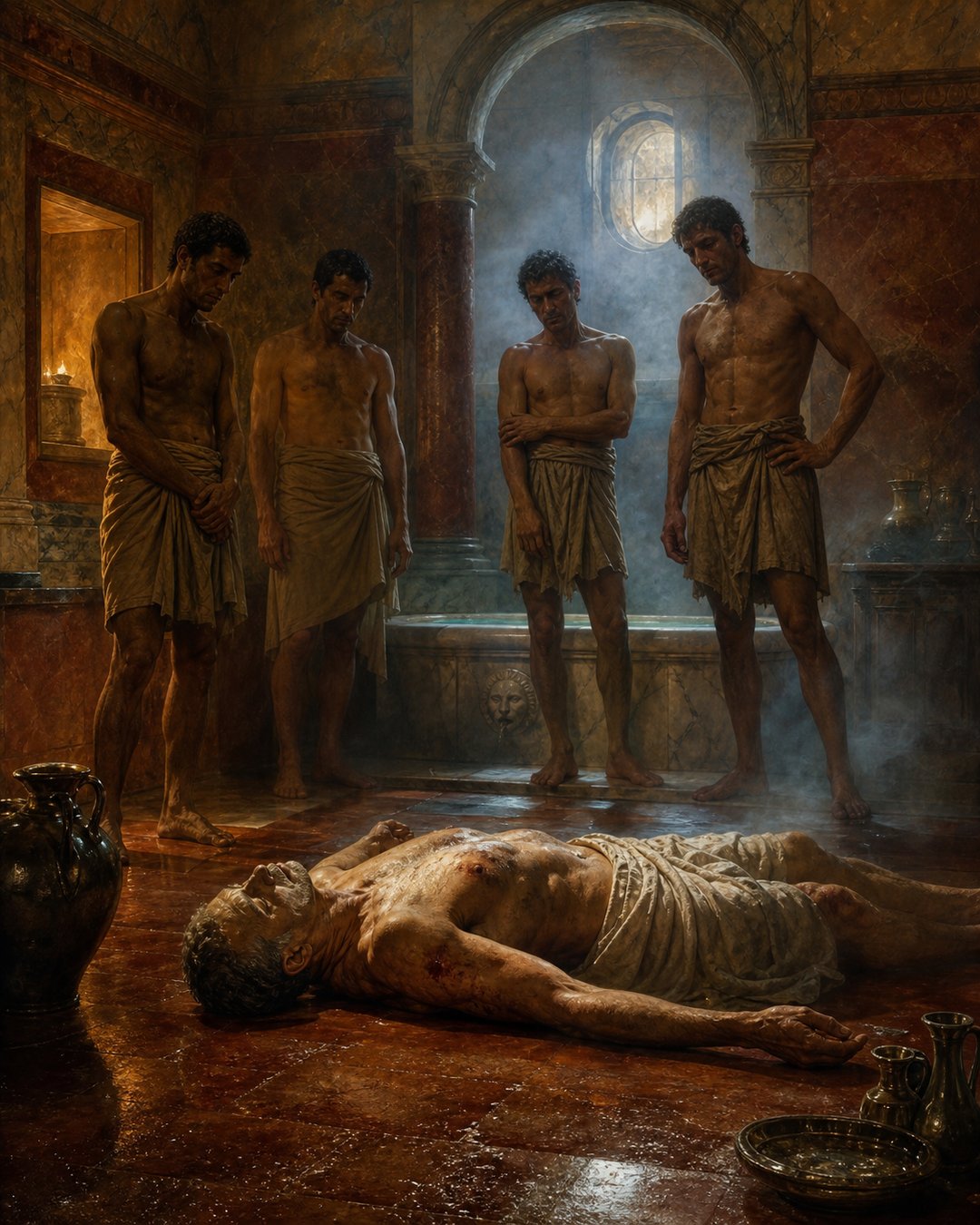
Larcius Macedo’s attackers thought the heated floor would tell them whether he was dead. Enslaved men had surrounded the former praetor while he bathed at his villa near Formiae, beaten him and thrown him onto the hot pavement. Macedo stayed stretched out and motionless. Pliny the Younger says he either felt nothing or successfully pretended not to feel.
The deception worked. The attackers had him carried out as though the heat, not violence, had overcome him. More loyal members of the household received the body; concubines arrived crying out. In the cooler place, amid voices, Macedo opened his eyes and moved. Only when it was safe did he reveal that he lived.
Pliny tells this in Letter 3.14 to Acilius. It is a vicious story, but also a carefully built one. The bath changes from place of service to attack, from a test of death to a cover story, and finally into evidence. Pliny then adds an earlier public-bath humiliation as if Macedo’s end had been foreshadowed. His warning exposes elite fear, yet the letter never gives the attackers’ testimony. The enslaved appear as danger, instruments of rescue or fugitives inside a moral lesson written for another free man.
Pliny Gives the Victim a Reputation Before the Attack
Pliny opens by calling the event atrocious and worthy of a letter. He identifies Macedo as a man of praetorian rank, then immediately describes him as a proud and cruel master. He adds a sharp family detail: Macedo remembered too little—or rather too much—that his own father had been enslaved.
That description does not excuse the assault, but it prevents Macedo from entering the story as an uncomplicated innocent. Pliny wants his reader to feel both horror and the instability of status. A household head whose family history touched slavery exercised senatorial-era authority over enslaved people and was then attacked inside his own villa.
The father’s past is not explained further in the letter. Pliny uses it as moral compression. Remembering servile origin might have encouraged restraint; remembering it anxiously might instead sharpen arrogance. The author leaves the paradox in a barbed phrase rather than offering evidence about Macedo’s motives.
That ambiguity should guide how we read the episode. Pliny knew elite Rome and wrote polished correspondence, not a court transcript. His opening supplies the character judgment through which he wants Acilius to interpret what follows. The household conflict reaches us already framed by a member of the same property-owning class that the story is meant to alarm.
The Bath Let the Household Reverse Its Usual Roles
Macedo was bathing at his villa in the Formian district when enslaved men suddenly surrounded him. One seized his throat, another struck his face, and others attacked his torso and genitals. Pliny’s distribution of actions makes the assault collective. No single attacker owns the whole blow-by-blow sequence.
A private bath ordinarily advertised resources: water, fuel, heated rooms, attendants and leisure. It also made the bather dependent. Clothing and public posture were set aside; servants managed spaces, temperatures and access. The room that materialized ownership could leave the owner unusually exposed to those whose work made it function.
This reversal gives a darker edge to the social choreography of Roman bathing. Public baths mixed bodies, rank and routine among many observers. Macedo’s villa bath narrowed the audience but concentrated household relations. The attack could happen because service brought enslaved people close enough to the master’s unguarded body.
Pliny does not report what the attackers said or what preceded the assault. He labels Macedo cruel, but he supplies no specific grievance and no voice from the enslaved men. Any confident reconstruction of motive would go beyond the letter. What the text firmly gives is proximity: domination and intimate service shared one room until the relationship became open violence.
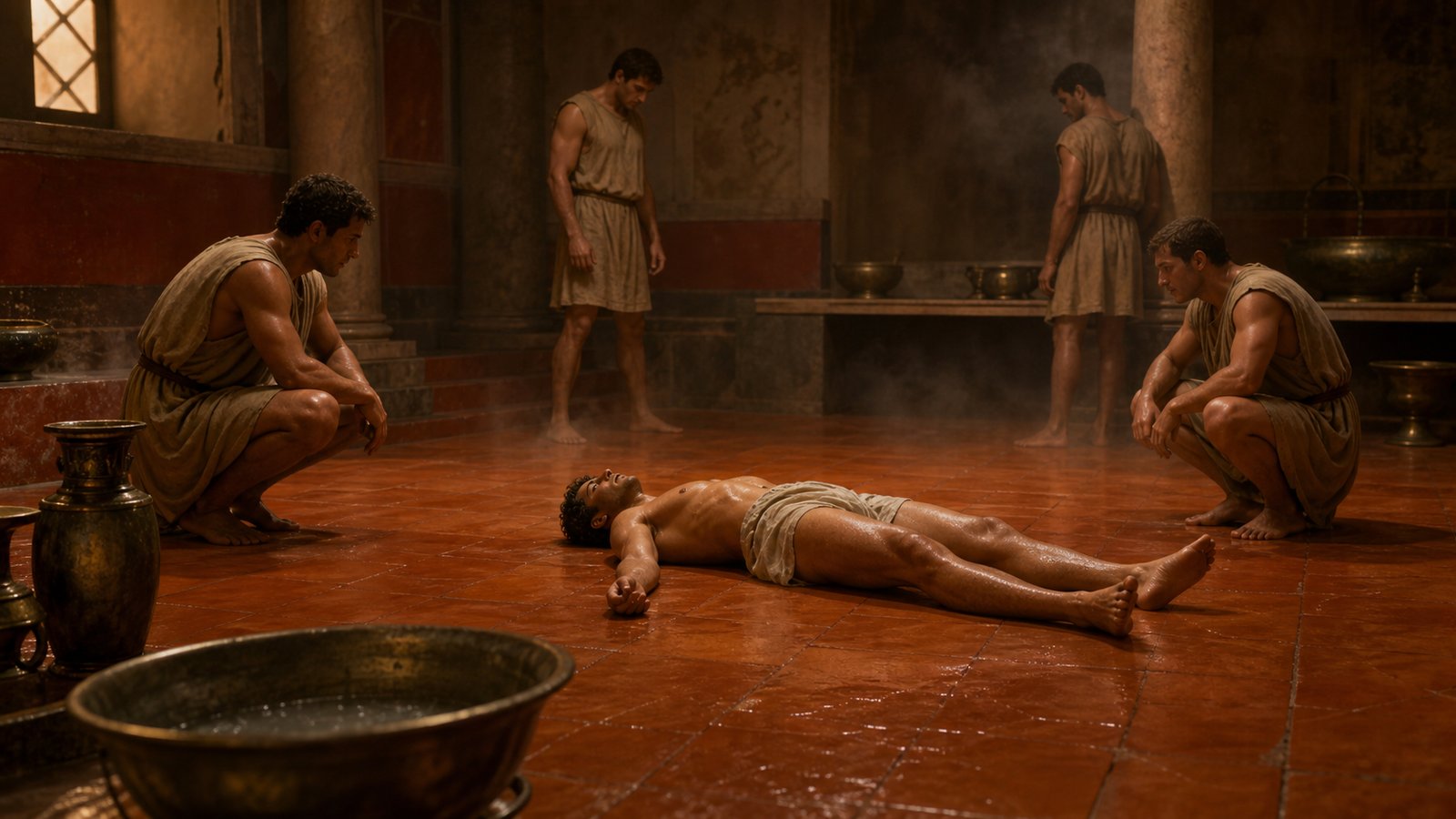
The Heated Pavement Became a Test of Death
Believing Macedo lifeless, the attackers threw him onto the heated pavement to see whether he was still alive. The floor was not passive scenery. Heat should have produced an involuntary response. Macedo’s survival depended on denying the room that evidence.
Pliny offers two possibilities. Perhaps Macedo could no longer feel the heat; perhaps he simulated insensibility. Either way, he lay motionless and completed the appearance of a finished death. The phrase gives the victim one decisive act without pretending the narrator knows his internal state.
The attackers then had him carried out as though overcome by the bath’s heat. Their test became their cover story. A luxurious technology that had helped them probe the body could also explain a collapse to the rest of the household. Hot rooms already carried physical strain, so the staged removal translated violence into apparent accident.
Here the scene depends on sequence. If Macedo reacted too soon, he remained among attackers. If he never revived, their fiction became reality. By waiting until removal, he allowed one group’s interpretation—dead or helpless—to move him into another group’s care. The bath’s controlled temperature created both the danger and the narrow route out.
Cold Air and Household Voices Reopened the Case
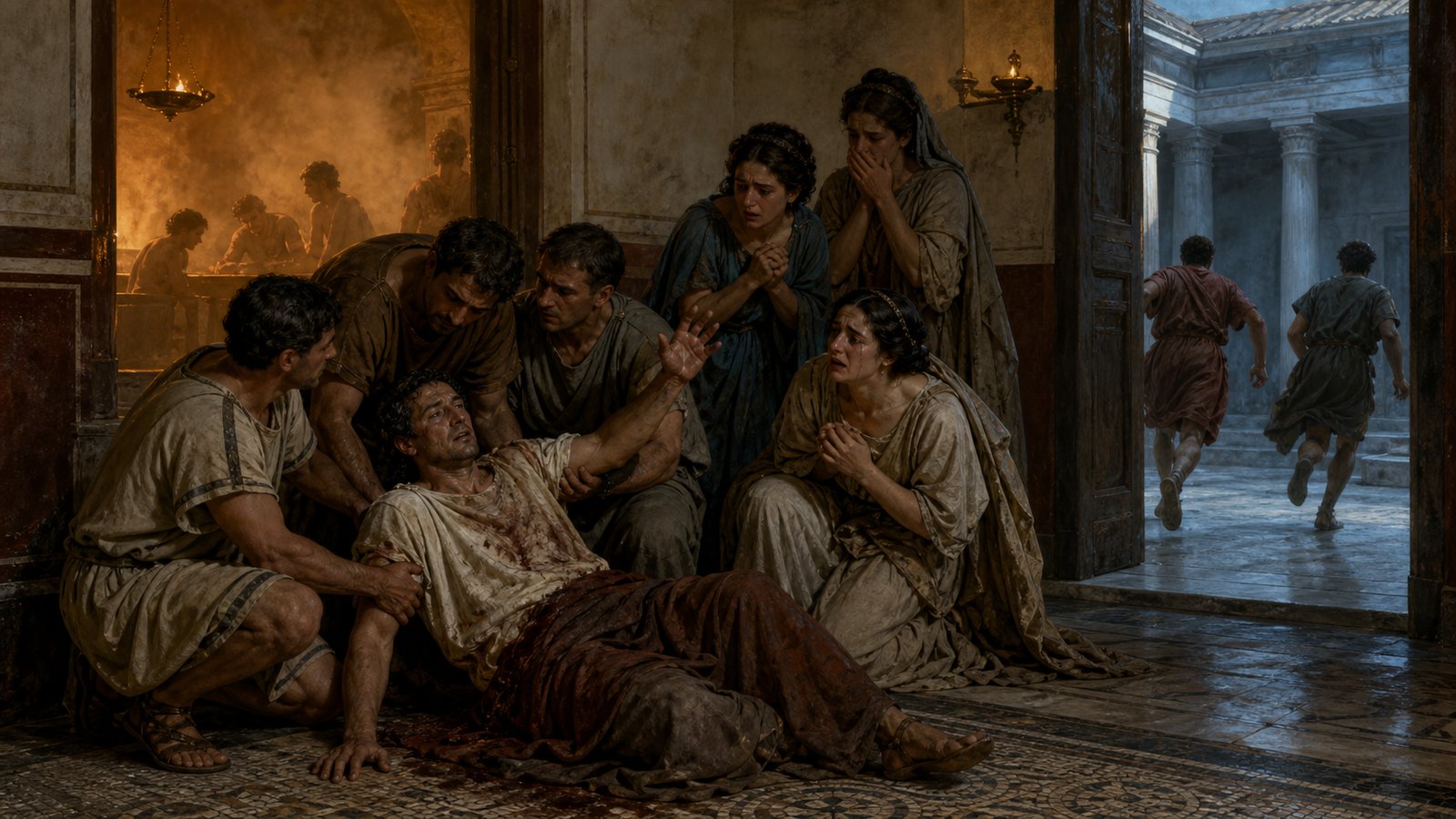
Outside the heated area, more loyal enslaved attendants received Macedo. Concubines rushed in with cries and lamentation. Pliny says voices roused him and the cooler location revived him. He raised his eyes, moved his body and acknowledged that he lived only after it had become safe to do so.
The contrast is almost theatrical: hot floor and forced stillness inside, cool air and noise outside. Yet every element carries social information. The household was not a single bloc. Some enslaved people attacked, others assisted, while women identified as concubines supplied the emotional scene that also helped restore the victim.
Macedo’s movement changed the event’s legal and practical status. A body carried out under an accidental explanation became a living witness to attempted killing. The attackers fled. Pliny says a large portion were captured while others remained under search.
The letter gives no trial proceedings, names or punishments. It moves rapidly from identification to pursuit because Pliny’s interest is the master’s vulnerability, not a procedural record. Compare Pliny’s letters about Christian trials in Bithynia, where interrogation and imperial reply structure the narrative. Here household terror replaces administrative detail. Arrest is enough to signal that the social order has resumed its force.
Macedo Lived Long Enough for Vengeance, Not Recovery
Macedo survived for a few difficult days and then died. Pliny says he had the consolation of vengeance and was vindicated while alive in the way murdered people usually were after death. The formulation makes punishment part of the victim’s final recovery of status.
The author then generalizes. Masters face dangers, humiliations and mockery, and no one can feel secure merely because he is mild or lenient. People are killed, Pliny claims, not according to a master’s character but according to an offender’s criminality. That conclusion partly retreats from his opening emphasis on Macedo’s cruelty.
The tension is revealing. Pliny first makes character relevant enough to mention, then warns fellow owners that good character offers no guarantee. He turns one household’s conflict into class solidarity. The lesson is not reform of slavery or inquiry into abuse; it is vigilance among those who hold power over people living close to them.
Before closing, Pliny remembers another bath incident involving Macedo. In a public bath at Rome, one of Macedo’s enslaved attendants lightly touched a Roman equestrian to request passage. The equestrian turned and struck Macedo rather than the attendant so hard that he nearly fell. Pliny calls the humiliation ominous in light of the later death.
The anecdote lets the bath follow Macedo across two scenes. In public, another free man makes the master answer physically for an enslaved attendant’s touch. At the villa, enslaved men attack the master directly. Pliny arranges them as steps from insult to destruction, but hindsight creates that staircase. The first incident did not cause the second; the author gives it meaning after the outcome.
Letter 3.14 therefore preserves both event and elite interpretation. Its hot floor, feigned death, cold revival and arrests make a gripping chain of claims that can be traced to Pliny. Its larger moral belongs to Pliny’s world: masters imagine themselves exposed even at the centre of households built on coercion. Read critically, the bath does not prove that every owner was equally unsafe. It shows how quickly intimate dependence could reverse—and how a skilled letter writer converted that reversal into a warning for his own rank.