
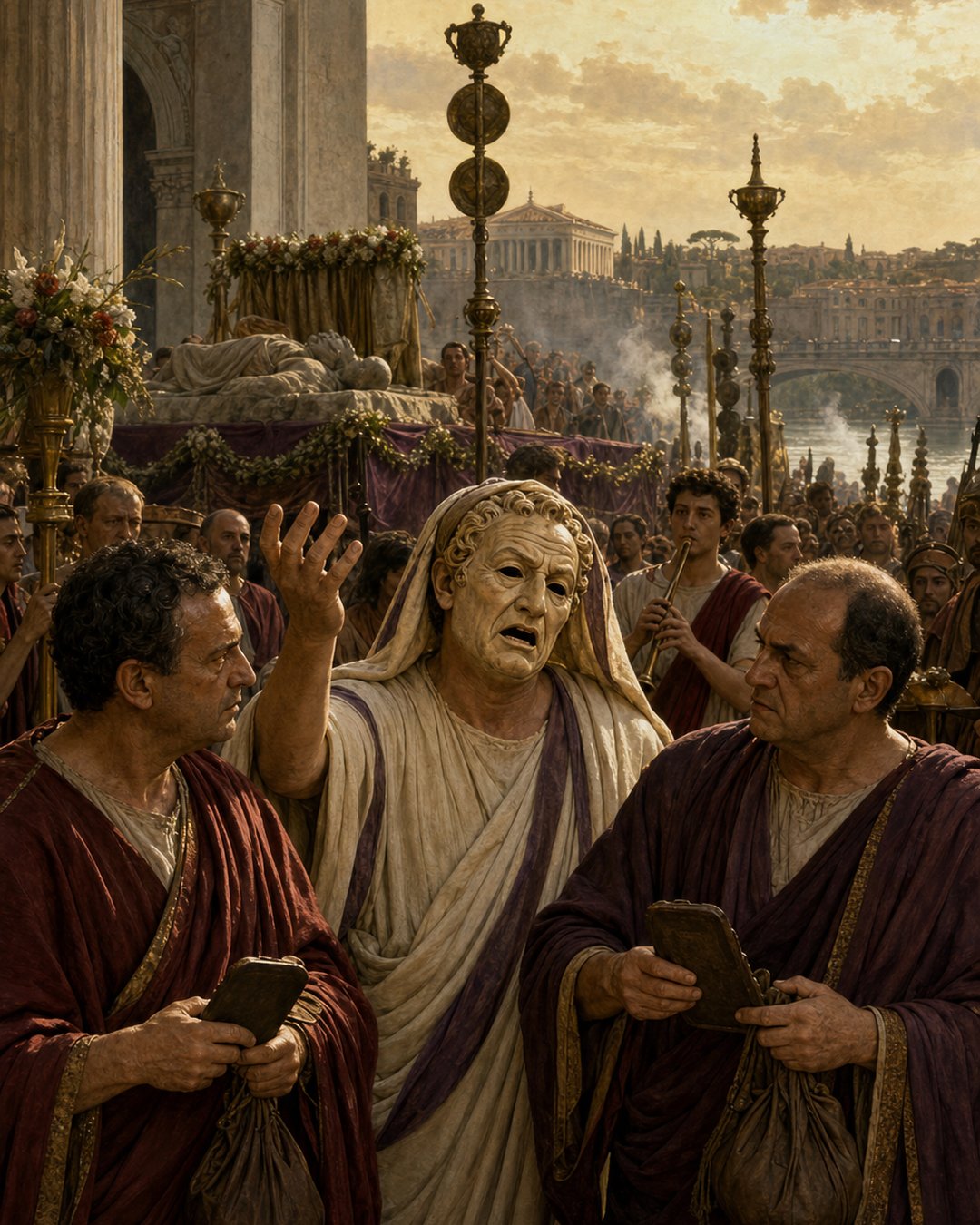
Vespasian’s funeral procession had already put a price on imperial memory: ten million sesterces. The figure enters Suetonius’s biography through a question shouted by Favor, a leading actor of mimes. Favor was wearing the dead emperor’s mask and performing the actions and words by which Vespasian had been known in life.
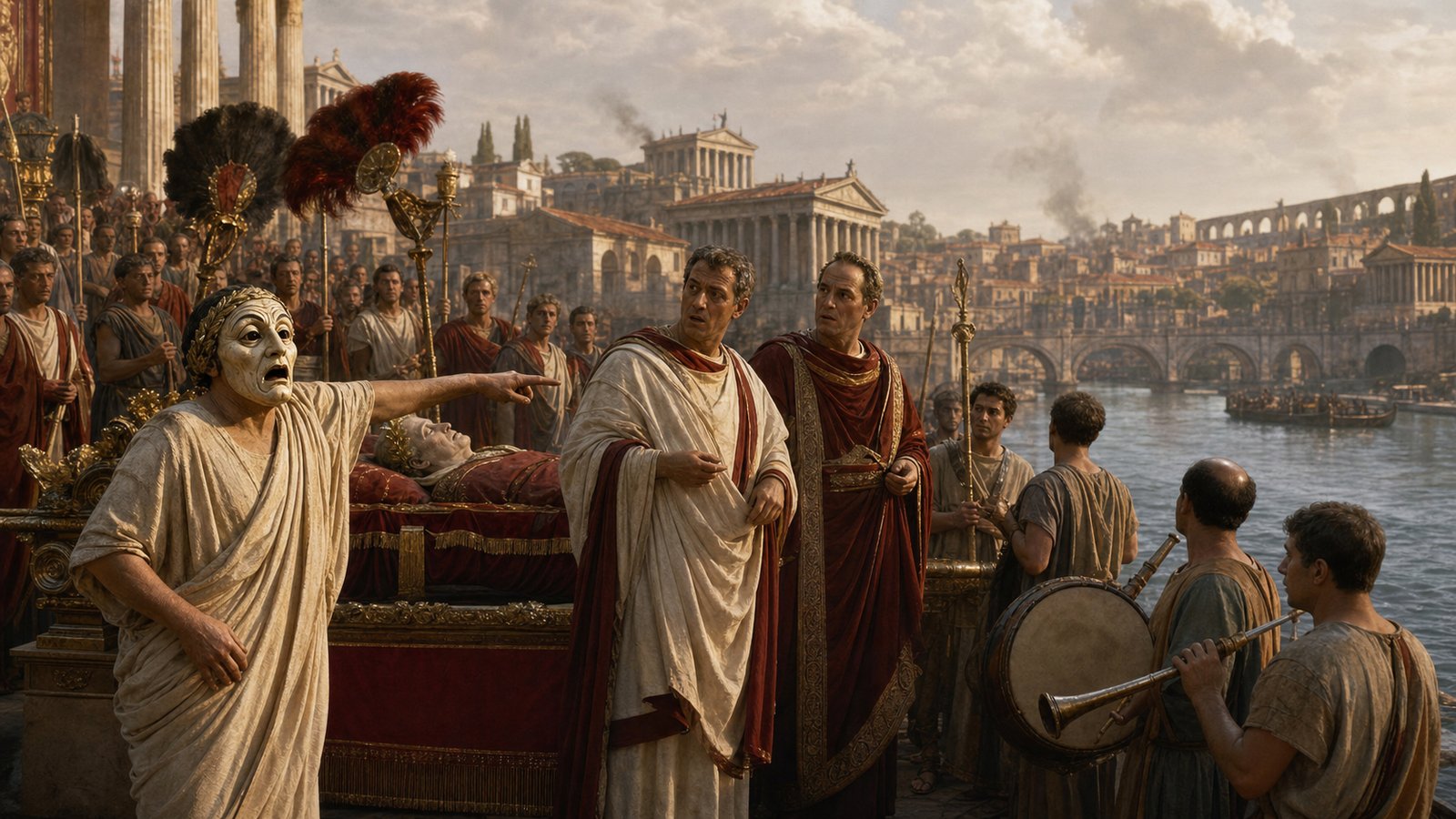
When the officials gave him the cost, the actor answered in character. Give him one hundred thousand sesterces, he cried, and throw him into the Tiber. The joke cut the ceremony’s stated expense to one hundredth of its reported price while letting the emperor’s old reputation for watching money speak from behind his own funeral mask.
This is not a private deathbed quip. Suetonius places it after a ledger of Vespasian’s gifts, salaries, entertainments and public generosity, followed by the claim that none of it erased his reputation for covetousness. Favor’s performance made that conflict visible. The procession honoured an emperor; the impersonator asked what the honour cost; the answer became the material for one last Vespasian joke.
Suetonius Builds a Ledger Before the Punchline
The funeral anecdote arrives only after Suetonius has counted Vespasian’s spending. The emperor, he says, helped senators reach the property qualification of their rank. Needy former consuls received annual support of five hundred thousand sesterces. Cities damaged by earthquake or fire were restored, while men of talent and the arts received encouragement.
The next chapter makes the accounting more specific. Vespasian established an annual public salary of one hundred thousand sesterces for teachers of Latin and Greek rhetoric. Eminent poets received large rewards. So did artists, including restorers associated with the Venus of Cos and the Colossus. Suetonius is not presenting an emperor who simply refused expenditure.
One refusal, however, explains the logic he wanted expenditure to serve. A mechanical engineer proposed moving heavy columns to the Capitol cheaply. Vespasian rewarded the invention but declined to use it, saying that the engineer must allow him to feed the poor commons. Whether the line captures policy or biography’s taste for character-revealing speech, it frames spending as a choice among constituencies.
That tension also runs through the bronze law that confirmed Vespasian’s powers. Authority needed public forms, but public forms never floated free of political calculation. Suetonius’s sequence prepares us to hear Favor’s funeral question as more than heckling. Cost had already become one of the biography’s ways of measuring the ruler.
A New Stage Paid Actors in Exact Sums
Suetonius then moves from civic aid and teaching salaries to performance. At the plays dedicating the new stage of the Theatre of Marcellus, Vespasian revived older musical entertainments. The setting matters because the funeral joke will also depend on a professional performer working inside an established public form.
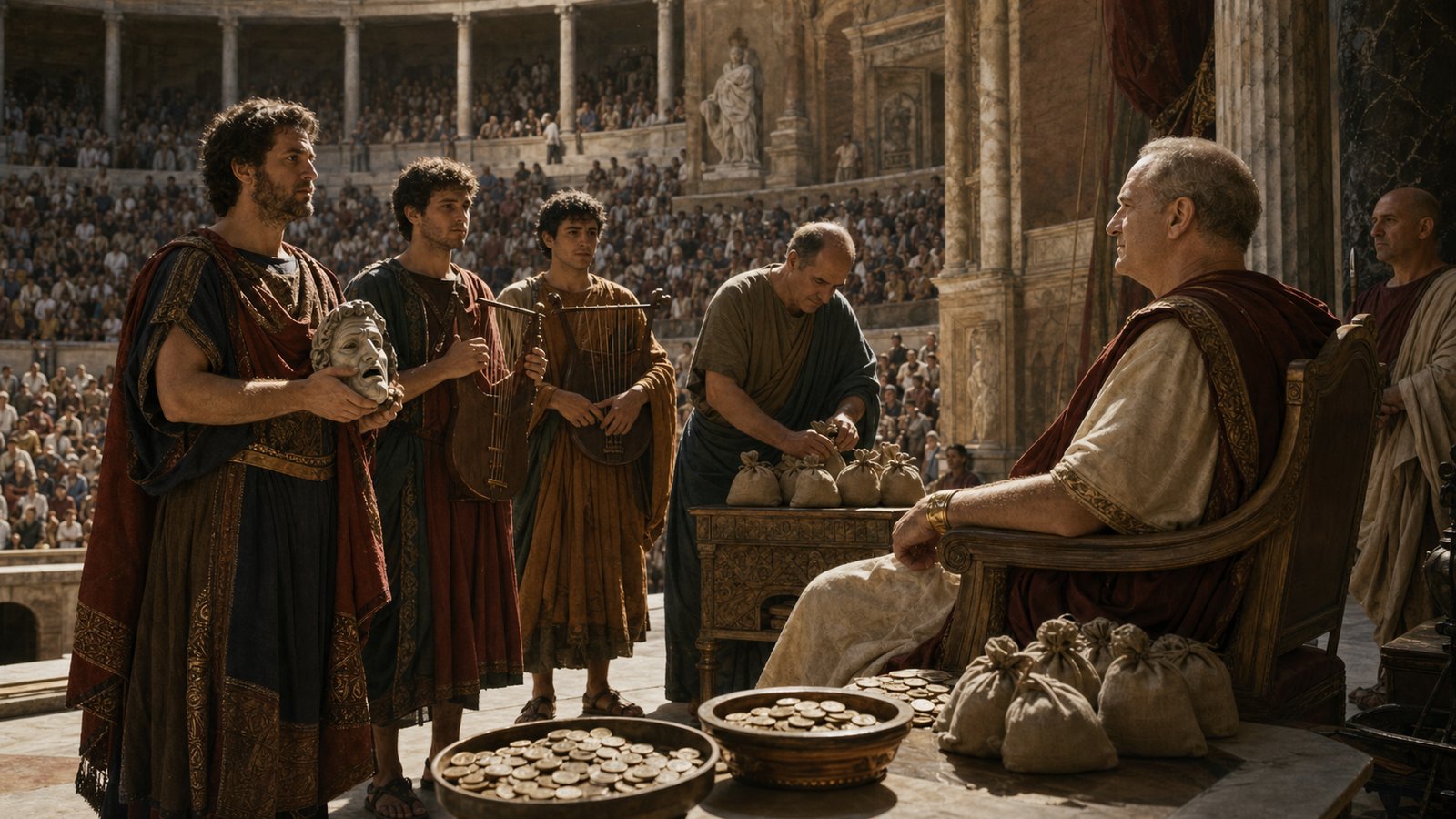
Payments again come itemized. Apelles, a tragic actor, received four hundred thousand sesterces. The lyre players Terpnus and Diodorus received two hundred thousand each. Several performers received one hundred thousand; the smallest payments were forty thousand, and golden crowns were also awarded.
Those figures establish a scale the later joke can exploit. Favor’s requested hundred thousand was not a random expression meaning ‘much less.’ In Suetonius’s immediately preceding list, one hundred thousand is a recognizable performer’s reward. The mime effectively quotes the emperor’s entertainment economy back at the funeral officials.
Roman acting also depended on making a role legible to a crowd. Our article on how theatre masks carried roles across an auditorium follows that visual problem in stage performance. Favor’s task was narrower and more dangerous: the face was identifiable, the model had ruled Rome, and spectators could compare the imitation with a recently lived public character.
Generosity Could Not Kill an Alexandrian Nickname
Vespasian held formal and sumptuous dinners, Suetonius says, in order to help market traders. He gave presents to women on the Kalends of March and to men during Saturnalia. These details continue the portrait of money moving outward through ceremony, seasonal custom and deliberate support of economic activity.
Then the biographer reverses direction with two words: even so. Despite the gifts, salaries, restorations, prizes and dinners, Vespasian could not escape his earlier reputation for covetousness. The Alexandrians kept calling him Cybiosactes, a name Suetonius associates with one of their kings notorious for scandalous stinginess.
A hostile nickname is not a neutral verdict on fiscal policy. Suetonius preserves it because it survived as a compact judgment. It reduced complicated revenue choices and imperial expenditure to a memorable type: the emperor who clung too tightly to money. The biography sets public benefaction beside public mockery without resolving the contradiction.
That unresolved reputation supplies Favor’s material. If audiences had known Vespasian only as lavish, asking the funeral price would lead nowhere. If they had known him only as miserly, the enormous procession could look like simple hypocrisy. The joke needs both accounts at once: an emperor who spent in large, named sums and remained famous for objecting to cost.
Favor Put a Dead Emperor Back into Character
Suetonius names Favor as a leading performer of mime and describes the action as customary. Wearing Vespasian’s mask, Favor imitated the deeds and sayings of the deceased. The funeral therefore included more than an image carried silently through the city. It gave the dead man a moving body and a recognizable manner.
The mask linked Favor’s performance to a broader Roman habit of making status visible through faces. Yet this was not simply the ancestral procession explored in the wax faces that returned dead consuls to the Forum. Suetonius’s actor speaks, asks, listens and improvises around the present funeral’s actual expense.
Favor’s first line is a request for information: how much would the procession cost? He directs it to the procurators, officials who could answer. Suetonius makes the exchange work through sequence. The actor does not invent a ridiculous number; the responsible administrators supply ten million sesterces in reply to a loudly voiced question.
Only then does the impersonation sharpen. Favor asks for one hundred thousand and offers the cheaper disposal. The line combines the dead emperor’s supposed financial instincts with the performer’s own plausible fee. The mime is simultaneously Vespasian bargaining over his funeral and Favor naming the amount for which he would complete the job by a radically less dignified route.
The Tiber Offer Cut Ceremony Down to Arithmetic
Ten million divided by one hundred thousand is one hundred. The counteroffer therefore prices the Tiber solution at one percent of the procession. The arithmetic is simple enough to hear instantly, but exact enough to connect the punchline to the monetary lists Suetonius has just supplied.
The destination completes the insult. A formal procession managed the emperor’s passage into public memory; being flung into the Tiber would eliminate the costly choreography. Favor does not challenge whether Vespasian deserved commemoration in an abstract speech. He makes an imagined Vespasian prefer humiliating economy to expensive honour.
We should not turn one biographical anecdote into a transcript of Roman public opinion. Suetonius wrote a shaped life, selected sharp sayings and arranged material by theme. His chapter order makes generosity, covetous reputation and funeral mimicry reinforce one another. The surviving scene tells us securely what story the biographer chose to preserve, not what every spectator thought.
Even with that caution, the mechanism is revealing. Imperial ceremony could absorb controlled mockery because the mockery helped produce recognizability. Favor honoured the custom by wearing the mask and imitating the ruler; he fulfilled the role by exposing the trait audiences were expected to know. Praise alone would not have made the impersonation convincing.
Vespasian’s final performed character was therefore built from a dispute that his gifts had failed to settle. He had funded teachers, artists, actors, cities, senators, dinners and festivals. Suetonius still ends the account of that spending with an actor offering a cheaper funeral. Ten million sesterces purchased the grand procession, but the remembered line belongs to the man who asked to take one hundred thousand and skip it.