
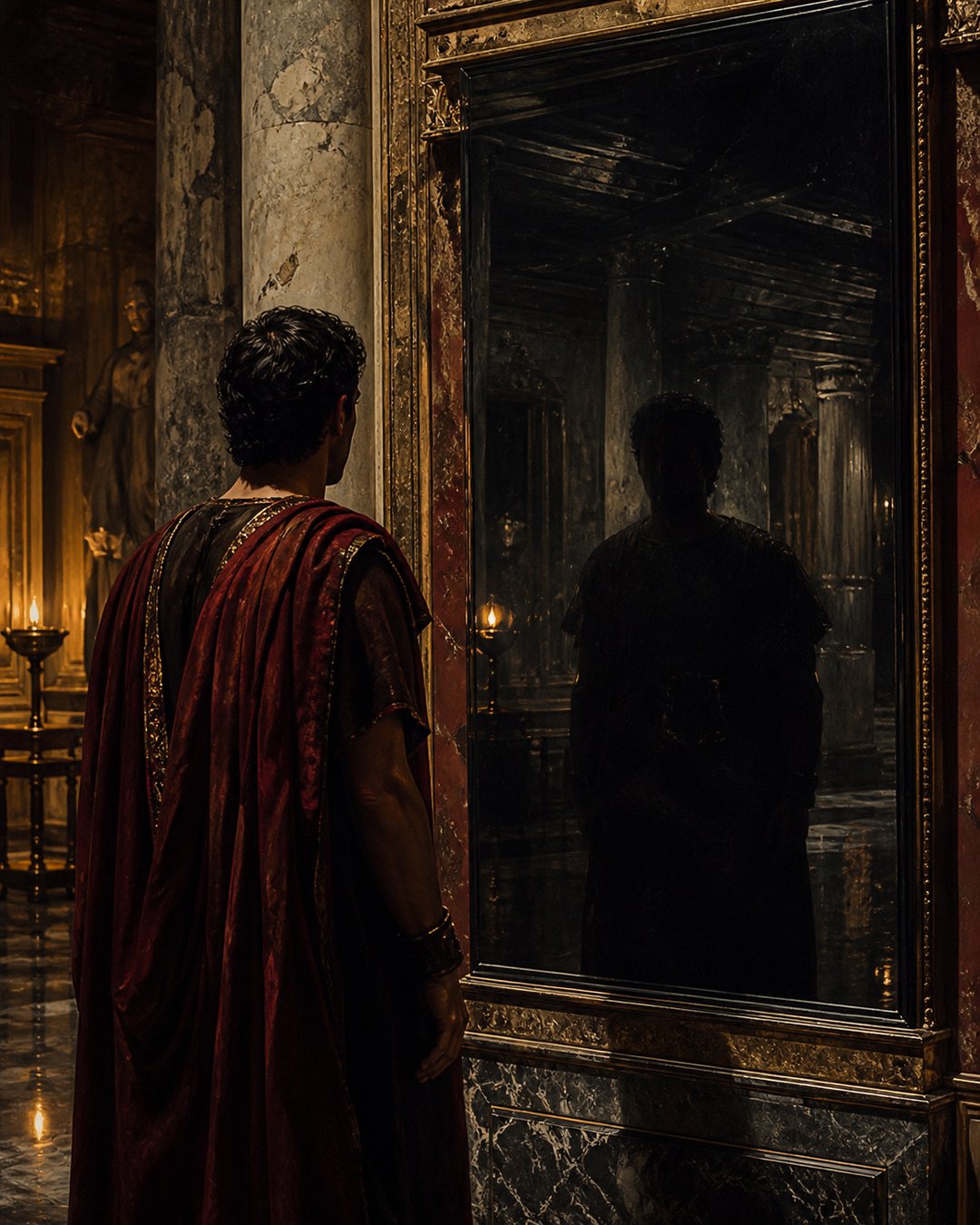
A polished Roman wall could return a face as a shadow. Pliny the Elder describes obsidian as very dark and sometimes translucent, but cloudier than glass. When attached to walls as a mirror, he says, it reflected shadows rather than images. The surface announced a viewer’s presence without surrendering clear features.
That imperfection did not make the material a failure. Pliny places obsidian inside his discussion of glass because resemblance mattered as much as origin. Natural stone could look glassy; manufactured glass could be coloured to look like obsidian. Between those categories stood gems, wall panels, tableware and statues large enough for emperors to dedicate.
The story moves from an uncertain discoverer named Obsius to Augustus’s four elephants, a statue of Menelaus restored by Tiberius, and artificial black glass on Roman tables. Obsidian’s darkness became a resource. It could obscure, imitate, monumentalize and turn reflection into atmosphere rather than faithful portraiture.
A Stone Entered Pliny’s Catalogue Through Resemblance
Pliny calls the ware “obsian” and says its name came from resemblance to a stone found in Ethiopia by Obsius. The passage has helped carry a Roman personal name into the modern word “obsidian,” though Pliny’s geography and attribution should be read as his report, not as a complete history of volcanic glass.
He begins by classifying rather than quarrying. Obsidian belongs in a glass discussion because it looks and behaves enough like glass to confuse categories. It is stone in origin but glassy in fracture and shine. For a Roman viewer, those perceptible qualities could matter more immediately than the geological process that produced them.
The dark colour was not absolute. Pliny says the stone could be translucent, but remained cloudier than glass. Light entered or crossed the surface imperfectly. That degree of passage—neither opaque black nor transparent window—gave the material a visual depth ordinary painted darkness could not reproduce.
Roman craftspeople repeatedly exploited materials that changed with light. the Lycurgus Cup shifts colour with illumination; obsidian’s trick was quieter. It withheld detail, allowing only a dim relation between the viewer, the polished face and the space behind it.
The Wall Mirror Returned Presence Without Portrait
Pliny’s phrase about wall mirrors is exact and strange: they reflected shadows rather than images. A modern silvered mirror is judged by clarity. The obsidian panel offered something different, a dark echo that registered movement and outline while dissolving the face.
Attached to a wall, the stone would also change the room. A polished black plane creates apparent depth even when it does not produce a crisp duplicate. Firelight or daylight could pick out a silhouette, then lose it as the person moved. The surface was both decoration and unstable visual event.
We should not turn Pliny’s sentence into proof that every Roman obsidian slab served as a mirror. He identifies a use, not a universal installation practice. Nor does he describe frame dimensions, room type or owner. What survives is the criterion by which the object impressed him: not accurate reflection, but the conversion of bodies into shadows.
That effect suited a culture saturated with portraiture while offering its opposite. Marble, wax and painted panels fixed identifiable faces. Obsidian refused the stable likeness. It made the living viewer temporary and anonymous, present only as darkness moving across darkness.
Augustus Found Monumental Scale Inside Black Stone
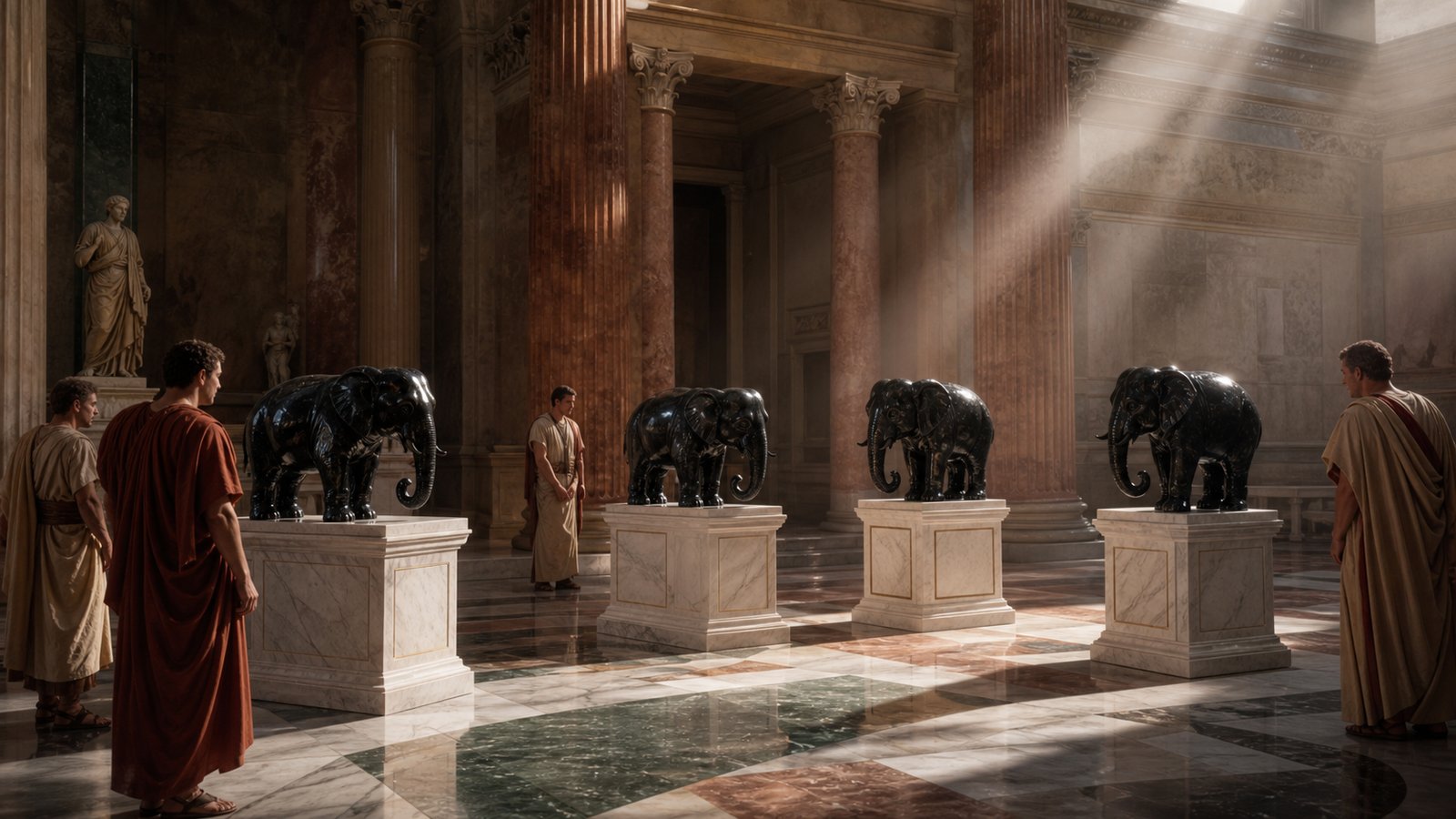
Obsidian could be cut into gems, but Pliny emphasizes that it also yielded pieces large enough for sculpture. He says he had seen solid obsidian statues of the deified Augustus. The statement shifts the material from intimate ornament to the scale of an imperial body.
Augustus himself, Pliny adds, dedicated four obsidian elephants in the Temple of Concord. Their black surfaces, exotic animal forms and placement in a civic-religious setting would have turned geological rarity into public imperial display. The objects were curiosities, but curiosities with a carefully chosen home.
Concord was a powerful frame. Four matching elephants suggested abundance, distance and control, while their material linked Ethiopia in Pliny’s account to a Roman temple. The dedication compressed faraway origin and metropolitan authority into objects that visitors could circle and inspect.
The elephants also complicate the mirror. The same substance that blurred a face could hold a massive animal silhouette. Poor reflection did not mean poor form. In three dimensions, darkness could sharpen the outline while swallowing small surface details, making bulk and contour carry the image.
Tiberius Returned Menelaus to the Sun
Pliny’s next imperial object had an older religious life. Tiberius restored an obsidian statue of Menelaus to the cult of the Sun at Heliopolis. The emperor had found it in a legacy from a man named Scius, formerly governor of Egypt.
The chain is unusually specific: cult, statue, legacy, governor and emperor. An object connected with a Sun sanctuary had entered private possession or inheritance, then moved back through imperial action. Tiberius’s role was not to commission a new black figure but to restore an existing one.
For Pliny, the statue proved that obsidian use was older than current fashions suggested. He complains that the stone’s origin was being misrepresented because it resembled glass. Menelaus at Heliopolis became evidence in a material argument: the object’s history resisted claims built merely from appearance.
The Sun cult adds another visual tension. A dark, cloudy stone stood inside a sanctuary defined by light. We need not invent the statue’s exact placement to see why Pliny’s pairing is memorable. Obsidian did not simply absorb illumination; polishing let light find its edges and surface while the body remained black.
A Geography of Claims Followed the Imperial Objects
Pliny cites Xenocrates for additional sources of obsidian. The stone, he says, was found in India, in Italy among the Samnites and in Spain near the Atlantic shore. The list multiplies origin points after the opening claim about Ethiopia.
This is not a modern distribution map. It is a record of places attached to the material in Pliny’s sources. The spread itself matters because it undermines the idea of one simple exotic route. Obsidian could be made rare and imperial in Rome even while authors located it in several regions.
Different origins may also have produced pieces with different appearance and usefulness, but Pliny does not give a comparative catalogue here. He groups them through the name. The reader moves from elephants and Menelaus to a set of possible landscapes, each capable of supplying dark stone that looked enough like glass to invite confusion.
Roman luxury often depended on such chains of attribution. the Portland Vase reveals the labour hidden in cameo glass; Pliny’s obsidian reveals the interpretive labour required before anyone could agree whether a black object was natural stone, old cult image or coloured glass.
Artificial Black Glass Made Nature Imitable
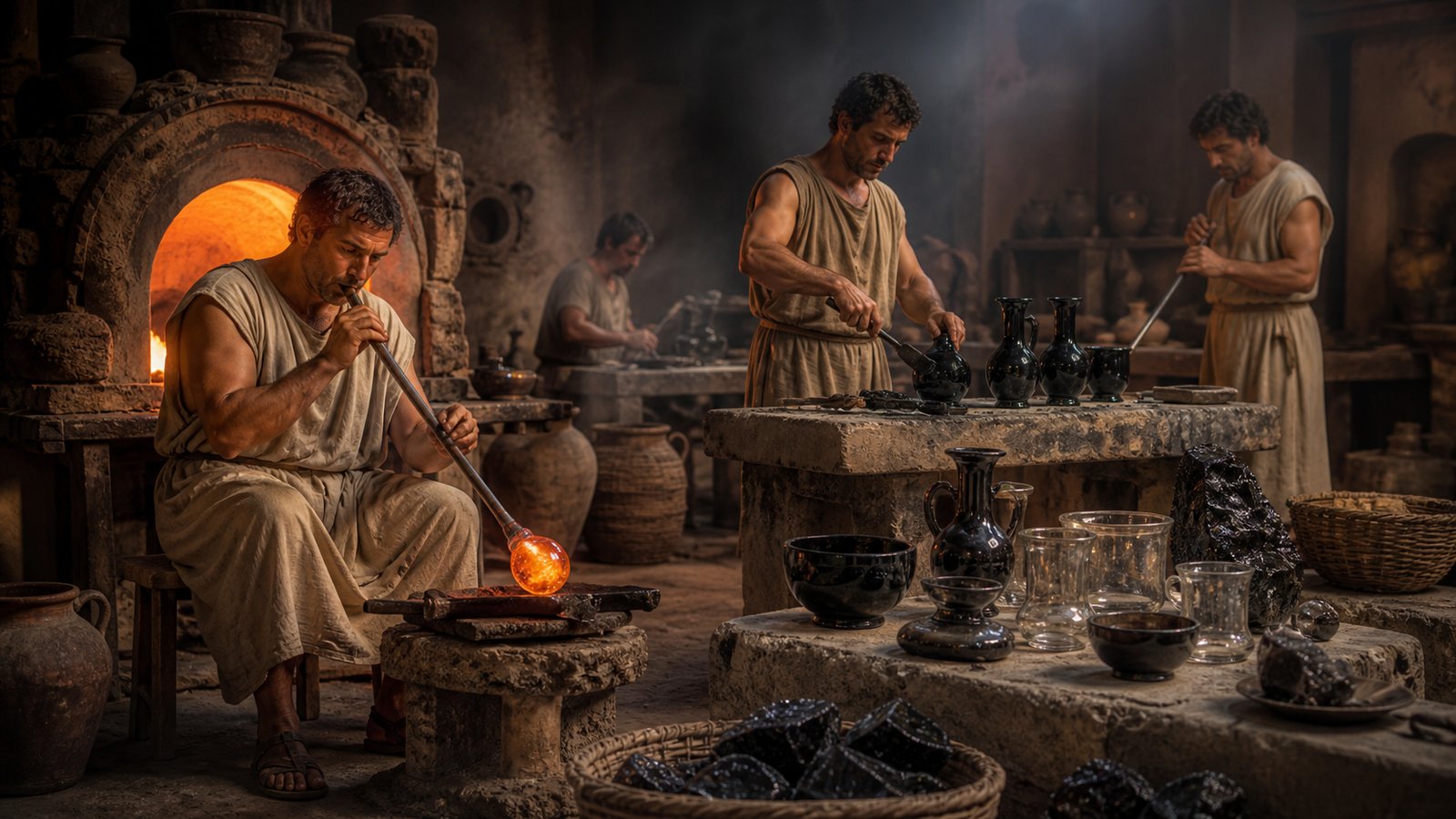
After natural obsidian, Pliny introduces artificial “obsian” glass made by colouring. He lists other opaque colours too: blood-red, white and glass imitating fluorspar, sapphire or lapis lazuli. Glass could reproduce a whole cabinet of prized substances through controlled appearance.
That adaptability changed the status of blackness. A dark table vessel might invoke natural obsidian without requiring a piece of volcanic glass shaped at the quarry’s limit. Manufacture made the look more pliable. The prestige of the stone could migrate into a material designed for repeated forms.
Pliny then turns to a different ideal. Although glass had displaced gold and silver for drinking vessels, the most valued glass was colourless and transparent, resembling rock crystal as closely as possible. Obsidian imitation and crystal imitation sat at opposite ends of the same craft: one cultivated darkness, the other tried to make material disappear.
The shadow mirror explains why the dark end remained compelling. Obsidian did not offer transparent perfection. It offered controlled refusal. A wall received silhouettes, an elephant became a polished mass, Menelaus stood black in a Sun cult, and coloured glass carried the effect to the table. Rome valued the material not despite its cloudy reflection, but partly because a shadow could do visual work that a clear face could not.