
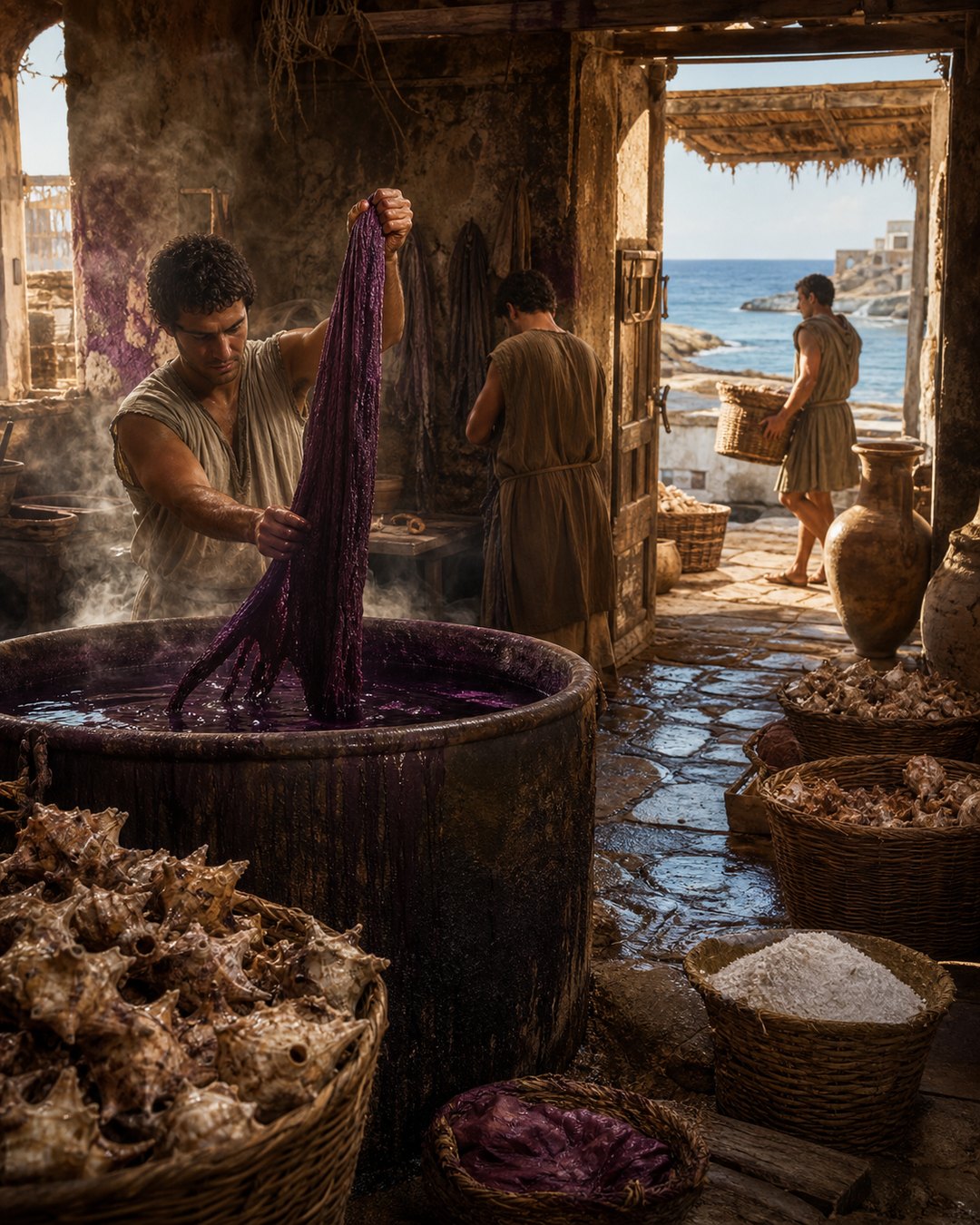
The color did not emerge from the sea as purple cloth. It began as a pale fluid in a shellfish’s body, removed with the animal’s tissue, mixed with salt and left for three days. The mass then went into a lead vessel over controlled heat. Flesh was skimmed away. Only after repeated reduction did a worker dip cleaned wool into the liquor to discover what color the workshop had actually made.
Pliny the Elder’s account of purple dye is famous for luxury prices, but its most revealing details belong to labour. He distinguishes shellfish, seasons, extraction methods, weights, vessels, heating, testing and the order of dye baths. A senator’s border or an emperor’s robe began as a coastal process that smelled, spoiled and failed if time or temperature went wrong.
The prized result therefore depended on more than rarity. Shellfish supplied the raw secretion; people created the color through sequence. Three days in salt, days of heating and a trial on wool converted marine flesh into a durable social signal.
The Best Catch Had a Season and a Tiny Vein
Pliny separates the shellfish used for purple into different kinds, especially the creature he calls the purple and the trumpet shell. Their liquids did not produce identical effects. One supplied depth and darkness; the other could contribute a redder tone. Workshops combined their properties rather than treating every shell from the shore as interchangeable.
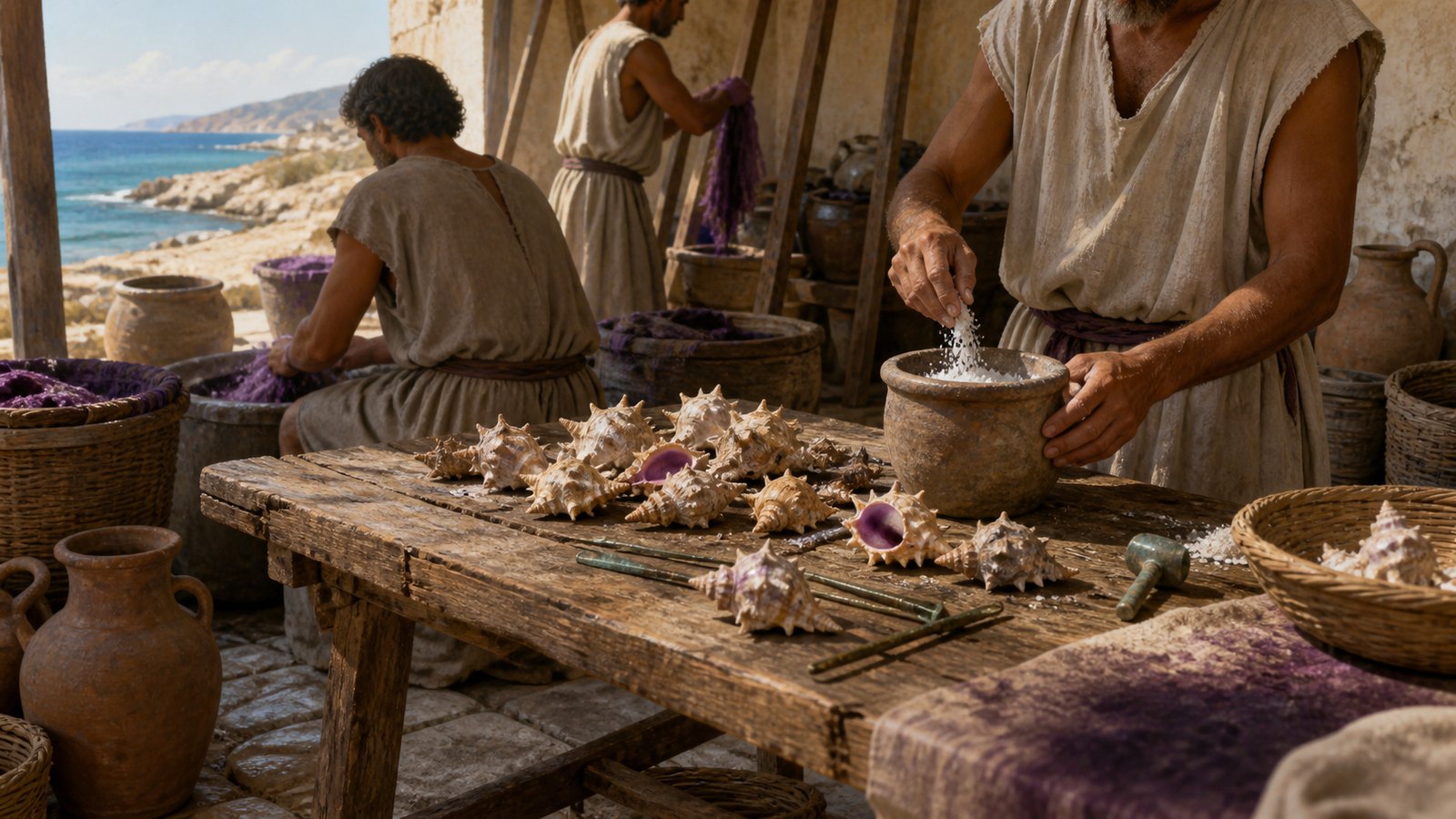
The valuable material occupied a small part of the animal. Pliny describes a vein associated with the throat, containing the fluid wanted by dyers. In larger shellfish, workers removed this part after breaking the shell. Smaller specimens could be crushed together because separating each tiny piece would consume too much time.
Gathering season affected quality. Pliny warns that shellfish had less useful liquor after they had discharged their waxy reproductive matter. He places favored collection around periods when the material was fullest. The workshop’s schedule therefore began before the vat, with knowledge of the animal’s annual cycle.
Freshness imposed another clock. A shell gathered on the coast was not an inert mineral. Its tissues began changing immediately. The dyer needed enough catch to make a batch, but delay risked losing the very substance that justified collecting thousands of animals.
This biological starting point differs from the mineral fibers woven into Rome’s fire-resistant luxury cloth. Asbestos entered production because it endured heat. Purple entered it because a perishable marine fluid could be transformed before decay destroyed its usefulness.
Salt Held the Raw Mass for Three Days
After extraction, Pliny says workers added salt to the material. He gives a proportion for the batch and a resting period of three days. The instruction turns waiting into a production stage. The mixture was not rushed straight from broken shells to boiling water.
Salt did several kinds of work in ancient food and craft settings: it drew moisture, slowed some forms of spoilage and altered organic tissue. Pliny does not offer a modern chemical explanation for the purple vat, so the article should not invent one. What he preserves is the operational rule. The dyer measured, mixed and waited.
The three-day pause also tied the workshop to storage capacity. Fresh shellfish arrived unevenly, but a vat required a coherent batch. Containers, shade, labour and salt allowed the catch to enter the next stage together. The calendar was part of the equipment.
Pliny’s quantities suggest production larger than a household experiment. The process handled substantial weights of material and water. That scale magnified every mistake. Too little salt, an extra day, dirty wool or uncontrolled fire did not ruin one shell; it threatened the accumulated yield of a large catch.
The raw mixture would not have resembled the finished status color. Ancient authors and later experiments alike emphasize the startling transformation of the secretion through air, light and processing. Pliny keeps his eye on the workshop test: the color mattered when it could be judged on fiber.
Lead Vats, Gentle Heat and Skimming Concentrated the Liquor
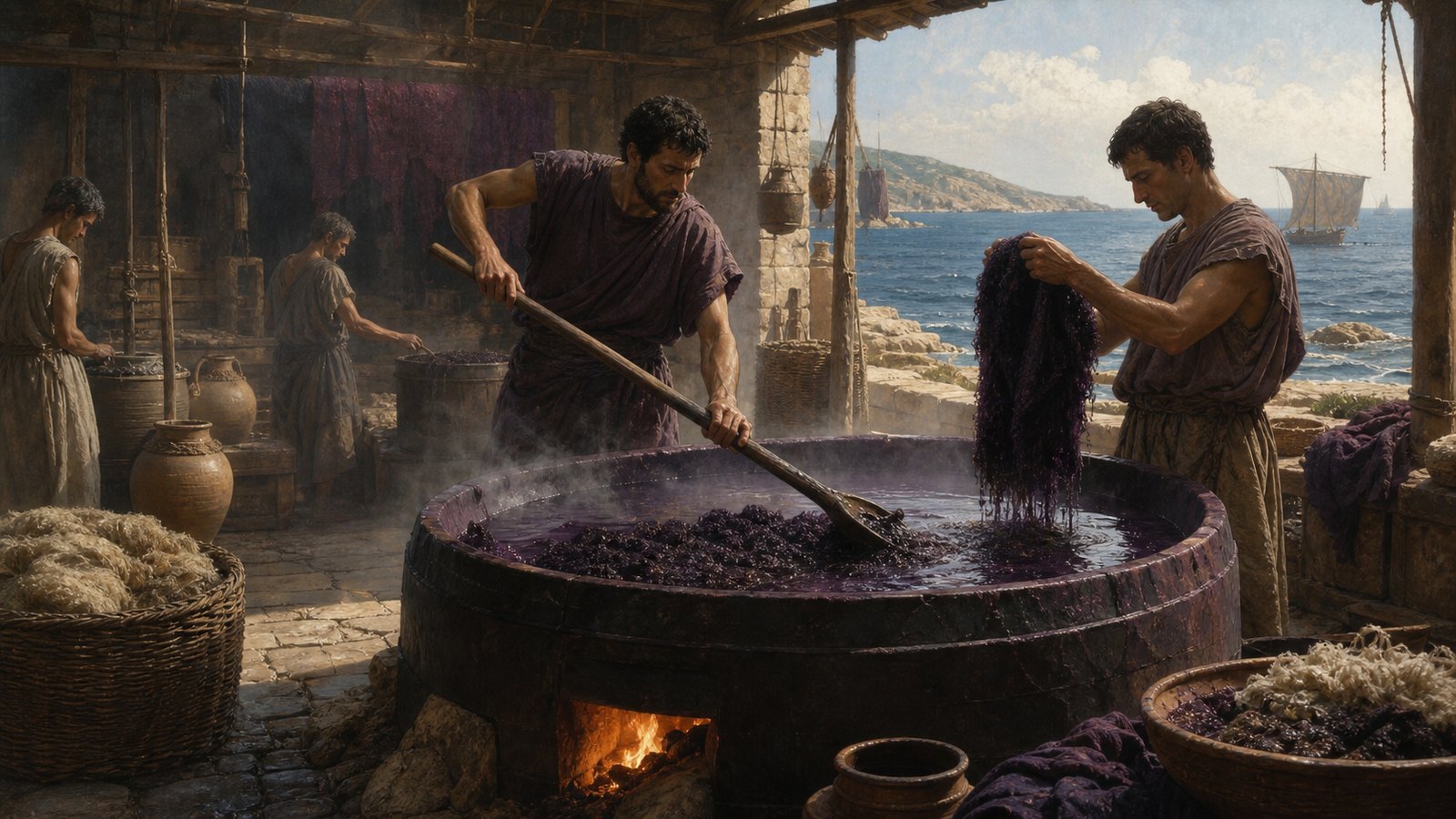
Pliny places the salted material in a lead vessel with water. The choice of metal belongs to his recipe, not to modern safety advice. Lead could be formed into large containers and heated, and Roman craftspeople used it widely in plumbing, construction and industrial settings despite the risks now associated with it.
The fire had to be managed. Pliny describes heating over a moderate or gentle flame while workers skimmed off the flesh that separated from the useful liquid. The vat demanded attention: heat concentrated the dye, but the organic mass could scorch or boil badly if left uncontrolled.
His account gives a long reduction period, extending through days rather than minutes. The workshop removed bulk while preserving the liquor that carried the color. Skimming was not decorative cleanliness. It separated unwanted tissue from a bath intended to penetrate prepared wool.
Workers tested the result with wool that had been cleaned. A sample went into the liquid, came out for inspection and could be returned if the bath had not reached the desired strength. The fleece was an instrument. Its fibers translated an uncertain liquid into the visible outcome the buyer would recognize.
That test separates recipe from blind obedience. Even if a worker followed the stated days and proportions, shellfish varied. Season, species, freshness, fire and batch size altered the result. Dipping wool created a decision point between further reduction and the final dyeing.
Pliny’s material attention resembles the story of a metalworker testing supposedly unbreakable glass before Tiberius, but the narrative engine is opposite. The glass tale turns on one astonishing demonstration and an emperor’s reaction. Purple production depended on repeated tests inside an ordinary workshop, long before elite viewers saw the cloth.
Two Dye Baths Made the Most Prized Purple
Not every purple was one color. Pliny discusses shades produced by different shellfish and by different sequences. The famous double-dyed cloth passed through more than one bath. A first treatment established one foundation; another altered its depth and tone.
The order mattered because the liquids behaved differently. A trumpet-shell dye used alone could be less stable or less admired, yet in combination it helped create the rich result Roman consumers prized. The workshop treated species as components in a controlled palette.
Pliny compares the favored double dye to dark, coagulated blood: blackish when viewed straight on, but shining when held toward the light. The description resists the bright synthetic violet often used in modern images of Rome. Prestige purple could be deep, almost black, with red emerging through reflection.
This optical quality explains why finished cloth mattered more than a sample of liquid. Fold, nap, daylight and movement changed what the viewer saw. The dyer had to produce a color that survived washing and wear while also performing across shadow and light.
Cost accumulated at every step. Many shellfish yielded little fluid. Gathering followed season and coast. Extraction was slow or destructive. Salt and vessels supported a multi-day batch. Fuel maintained heat. Workers skimmed, tested and sometimes dyed wool twice. The price paid for concentrated labour as well as a scarce animal source.
The process also connected distant environments. Coastal collectors knew beds and seasons. Workshop crews managed perishable material. Textile specialists prepared wool. Merchants moved dyed cloth toward consumers who might never see the shells, vats or stained hands behind the color.
By the time purple reached a toga border, its origin had been hidden by success. Nothing in a polished garment showed the broken shells, three days of salt or the long reduction over a lead vat. That disappearance was part of luxury: difficult production condensed into an apparently effortless stripe.
Pliny’s recipe restores the missing workshop. Purple was not simply found. It was timed, heated, skimmed, tested and layered. The shellfish made the secretion, but Roman craft made the signal.
Sources
Pliny the Elder, Natural History 9.60–65.
John Bostock and H. T. Riley’s translation of Pliny, Book IX.