
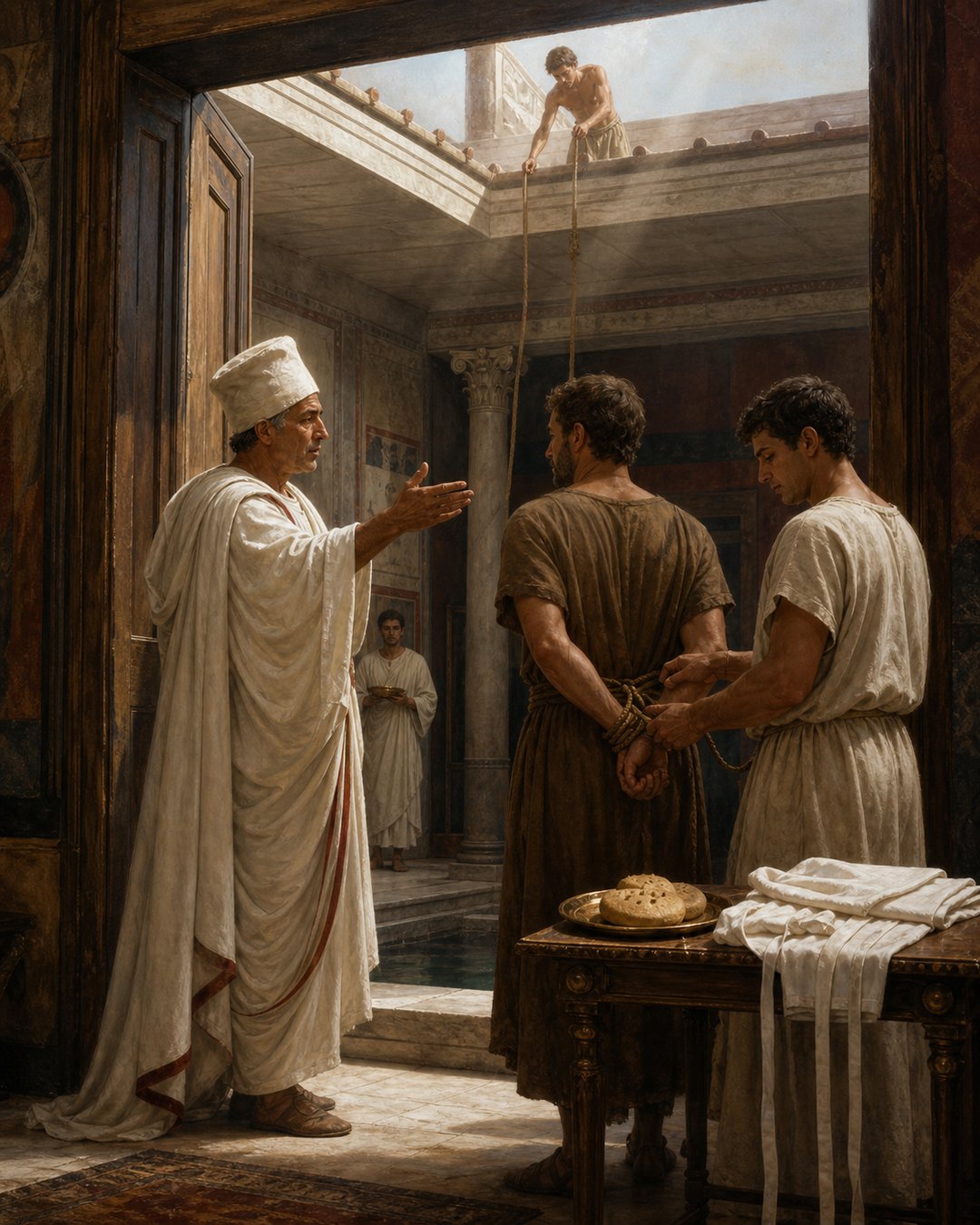
If a person in fetters entered the house of Jupiter’s priest, the bonds had to come off. The restraints were then pulled upward through the opening in the roof and lowered into the street. The same priest could have no knot in his cap, belt or any other part of his clothing.
Aulus Gellius records these rules in the second century AD, drawing on earlier priestly law and named antiquarian authorities. His catalogue of the Flamen Dialis—the priest attached to Jupiter—moves from public office to tiny physical details. Horseback riding, oaths, rings, haircuts, raw meat, ivy, beans, a bed, a cap and a marriage all appear inside one dense chapter.
The list can look like a cabinet of Roman curiosities. Read together, however, the restrictions repeatedly govern binding, exposure, death, absence and bodily completeness. They made the priest recognizable not only when he performed a sacrifice but while he walked, slept, dressed and received people at home.
Fetters Had to Leave the House by the Roof
Gellius says a bound person entering the Flamen Dialis’s house had to be released. The bonds did not simply remain on the floor. They were drawn up through the impluvium opening to the roof and let down from there into the street. Release acquired a route of its own.
The rule matches the prohibition on knots in the priest’s clothing. A knot fixes one part around another; fetters fix a body against free movement. The catalogue does not supply a philosophical explanation joining every clause, so certainty would be false. Yet their proximity makes a shared concern with binding difficult to ignore.
Even the priest’s ring had to be perforated and without a gem. Gellius does not say that every closed circle was banned, and the surviving wording should not be expanded into a universal theory. It does show that an ordinary sign of status could be worn only in a qualified form.
The house itself participated in priestly condition. Fire could not be taken from the Flaminia, the household of the Flamen, except for sacred use. A suppliant brought to the priest’s feet on the way to flogging could not be beaten that day. Crossing the threshold altered what could happen to fire, bonds and punishment.
That domestic reach distinguishes the office from a ritual costume put on for occasional ceremonies. The priest’s home was not a neutral refuge between public duties. It extended the restrictions into architecture, servants, visitors and the opening in the roof.
The Priest Could Not Look Like a General
The Flamen Dialis could not ride a horse. Gellius also says he was forbidden to see the Roman forces drawn up outside the sacred city boundary. He links this to political consequence: the priest was rarely made consul because consuls were entrusted with wars.
That explanation places religious office against a central expectation of elite male command. A consul might lead an army beyond Rome’s civic boundary. Jupiter’s priest carried restrictions that obstructed precisely that movement and vision. The rule did not make him powerless; it made one kind of power incompatible with another.
He could not swear an oath. The praetor’s standing edict, quoted later in the chapter, said neither the Flamen of Jupiter nor a Vestal priestess would be compelled to take one within the praetor’s jurisdiction. Gellius therefore presents the exemption as something recognized by public procedure, not merely private scruple.
The Flamen’s priority appeared at dinner too. No one could take a place above him except the rex sacrificulus, another priestly office whose title preserved the language of kingship. Seating converted sacred hierarchy into a visible arrangement of bodies.
These details offer a useful contrast with the institutional protections surrounding Rome’s Vestal Virgins. Both priesthoods received legal exemptions and carried public expectations into daily life, but the Flamen’s catalogue ties a male office especially tightly to avoiding military command, oaths and absence.
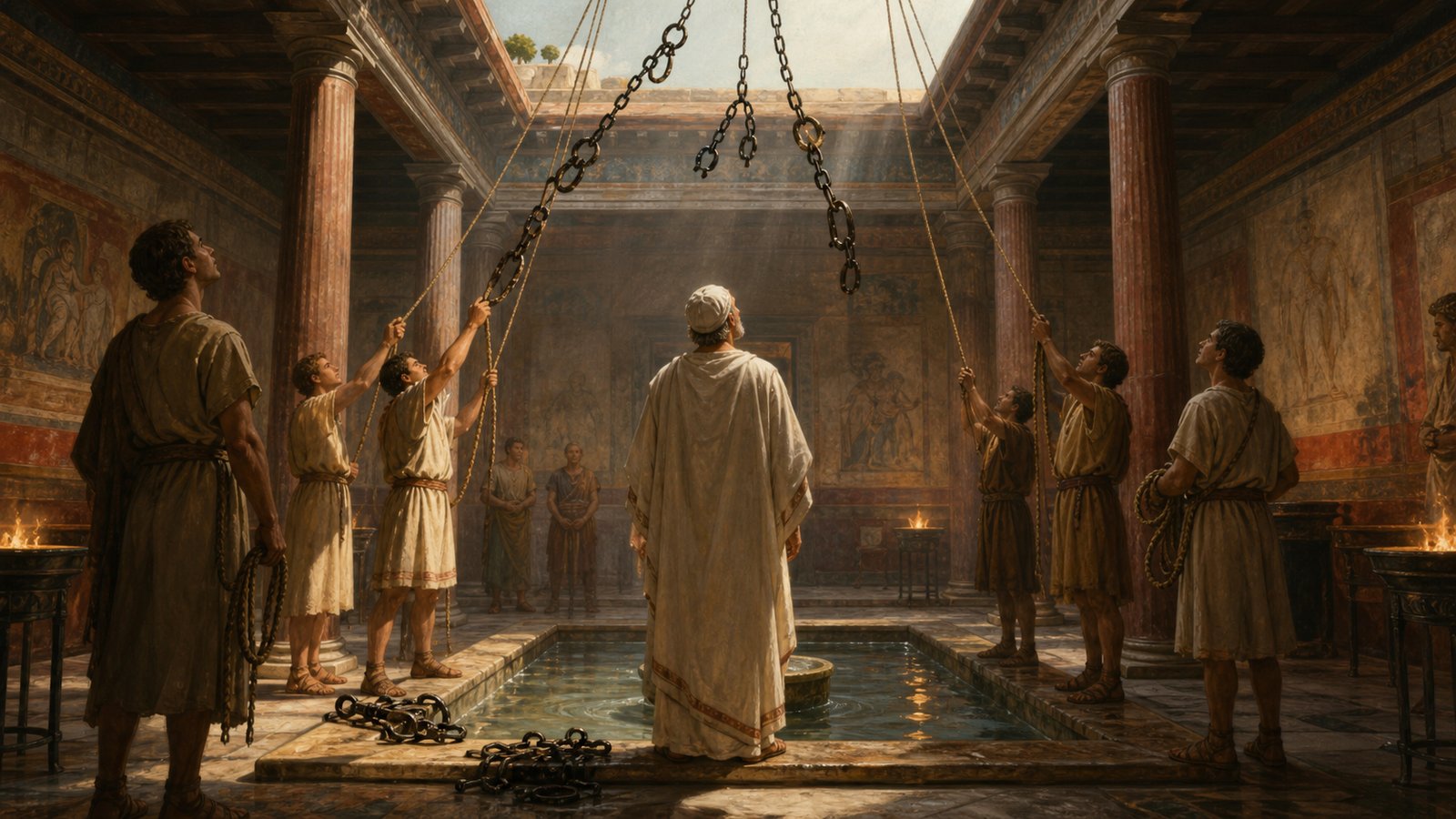
A Cap Kept Him Beneath Jupiter’s Eye
Gellius says every day was holy for the Flamen Dialis. The sentence explains why the restrictions do not settle into a calendar of occasional festivals. The priest’s body had to remain in an appropriate condition continuously.
He could not be outdoors without his distinctive cap. Gellius reports that the pontiffs had only recently decided he might go without it inside the house, according to the jurist Masurius Sabinus. That note proves the rules were not frozen memories. Priestly authorities could interpret and relax their application.
The inner tunic could be removed only under cover. Gellius explains this as preventing the priest from being naked in the open air, as though under Jupiter’s eye. The image made the sky itself part of ritual supervision. Walls and roof created a lawful zone for bodily exposure.
Hair and nails also received controlled treatment. Only a free man could cut the priest’s hair. The cuttings from hair and nails had to be buried beneath a fruitful tree. What left the priest’s body did not become ordinary rubbish; status followed it into the soil.
His contact with food and plants was selective. He was not to touch or even name a she-goat, raw flesh, ivy or beans. He could not touch bread leavened with yeast, and he could not pass beneath an arbour of vines. Gellius preserves the prohibitions but not one reliable master key for all of them. Their historical value lies partly in refusing easy simplification.
Three Nights Away Threatened the Daily Office
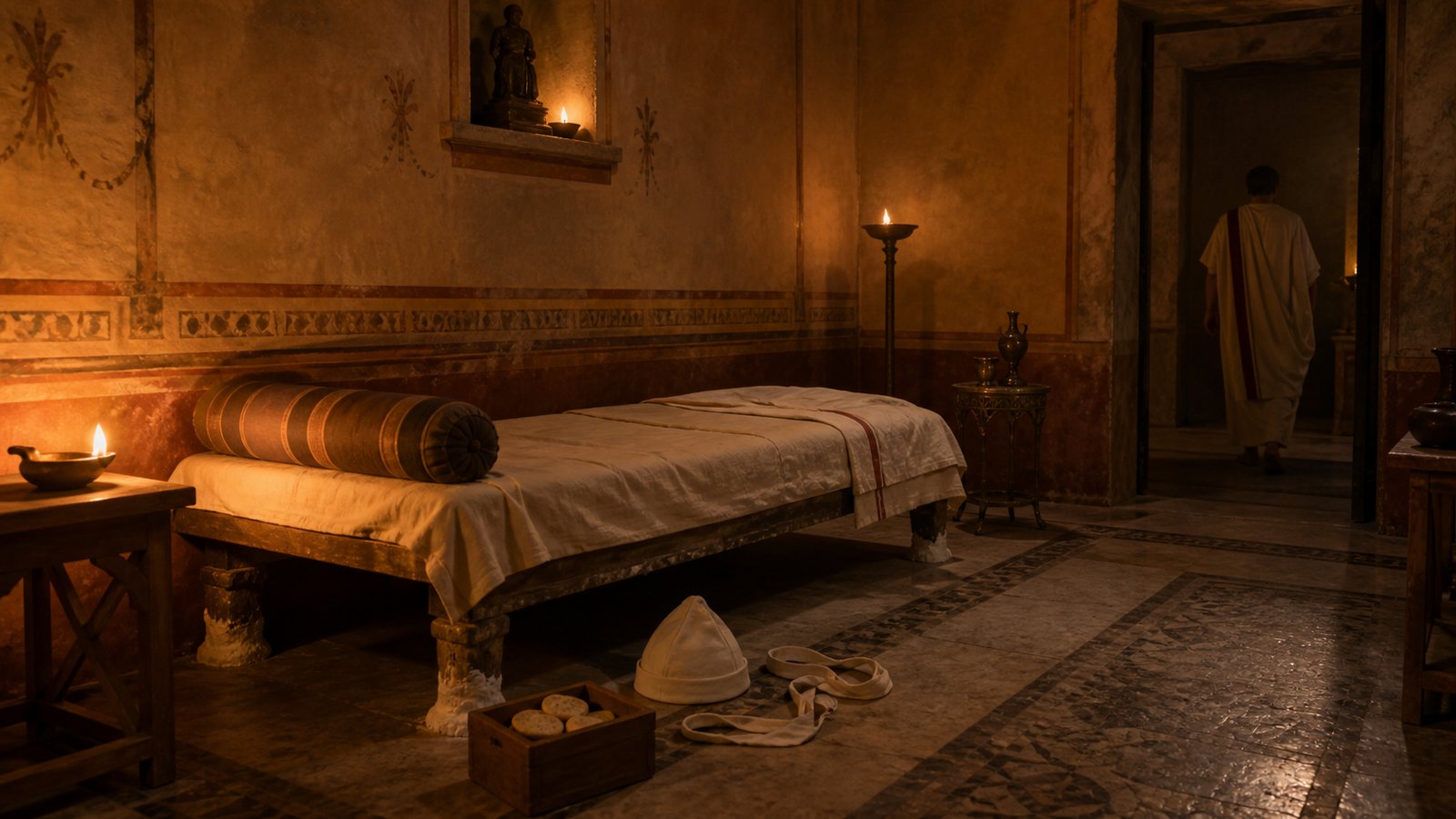
The priest’s bed had feet coated with a thin layer of clay. At its foot stood a box containing sacrificial cakes. No other person could sleep there. The place of rest remained prepared around the requirements of office.
Most strikingly, the Flamen could not sleep away from that bed for three consecutive nights. The number created a narrow allowance without permitting a durable separation. He might be absent, but absence had a limit measured by returning to one designated couch.
The rule transformed travel into a scheduling problem. An elite Roman could normally move between town houses, villas, estates and official destinations. Jupiter’s priest had to calculate the third night. His sacred availability depended on a repeated physical return.
Gellius’s chapter never says the bed worked like a magical battery. It makes a practical association among priest, house, sacrificial cakes and nightly presence. The office was anchored spatially. The same man who could not view an army beyond the pomerium also could not let ordinary travel detach him from his bed for too long.
Continuous offices required mundane systems. The Arval Brothers preserved priestly performance through a college and an inherited hymn. The Flamen Dialis rules used another method: they wrote continuity into one person’s sleeping place, clothing and permitted movements.
Marriage Held the Priesthood Together
If the Flamen’s wife died, he had to resign. Gellius says the marriage could not be dissolved except by death. The priesthood therefore rested on a pair even though its title names the man.
The Flaminica, Jupiter’s priestess and the Flamen’s wife, observed broadly similar ceremonies and additional rules of her own. Gellius says she wore a dyed robe and placed a twig from a fruitful tree in her head-dress. Her movement on ladders was restricted, and on the occasion of the Argei rites she neither combed nor dressed her hair.
These details prevent the household from being treated as background support. The marriage was a condition of the male priest’s tenure; the wife bore visible and bodily obligations. Death did not merely change his private life. It ended his capacity to occupy the office.
The source leaves many questions unanswered. We do not know how consistently every restriction was followed across centuries, and Gellius himself notes that some ceremonies had been relaxed. He writes as an antiquarian gathering material from Fabius Pictor, Masurius Sabinus, Varro and priestly law, not as an observer recording one complete day.
That layered transmission is precisely why attribution matters. Some clauses may preserve early practice; others reflect later interpretation. The chapter shows Romans continuing to debate what Jupiter’s priest could wear, touch and do, rather than simply repeating an unchanging prehistoric code.
Its most vivid rules all narrow the distance between person and office. A knot in a belt, a third night away, a dead body, an uncovered head or the loss of a wife could disturb the condition. Jupiter’s priest did not leave religion at the temple door. The door, bed, roof opening, clothing and marriage had become parts of the priesthood.
Sources
Aulus Gellius, Attic Nights 10.15.
Fabius Pictor, Masurius Sabinus and Varro as cited by Gellius.