
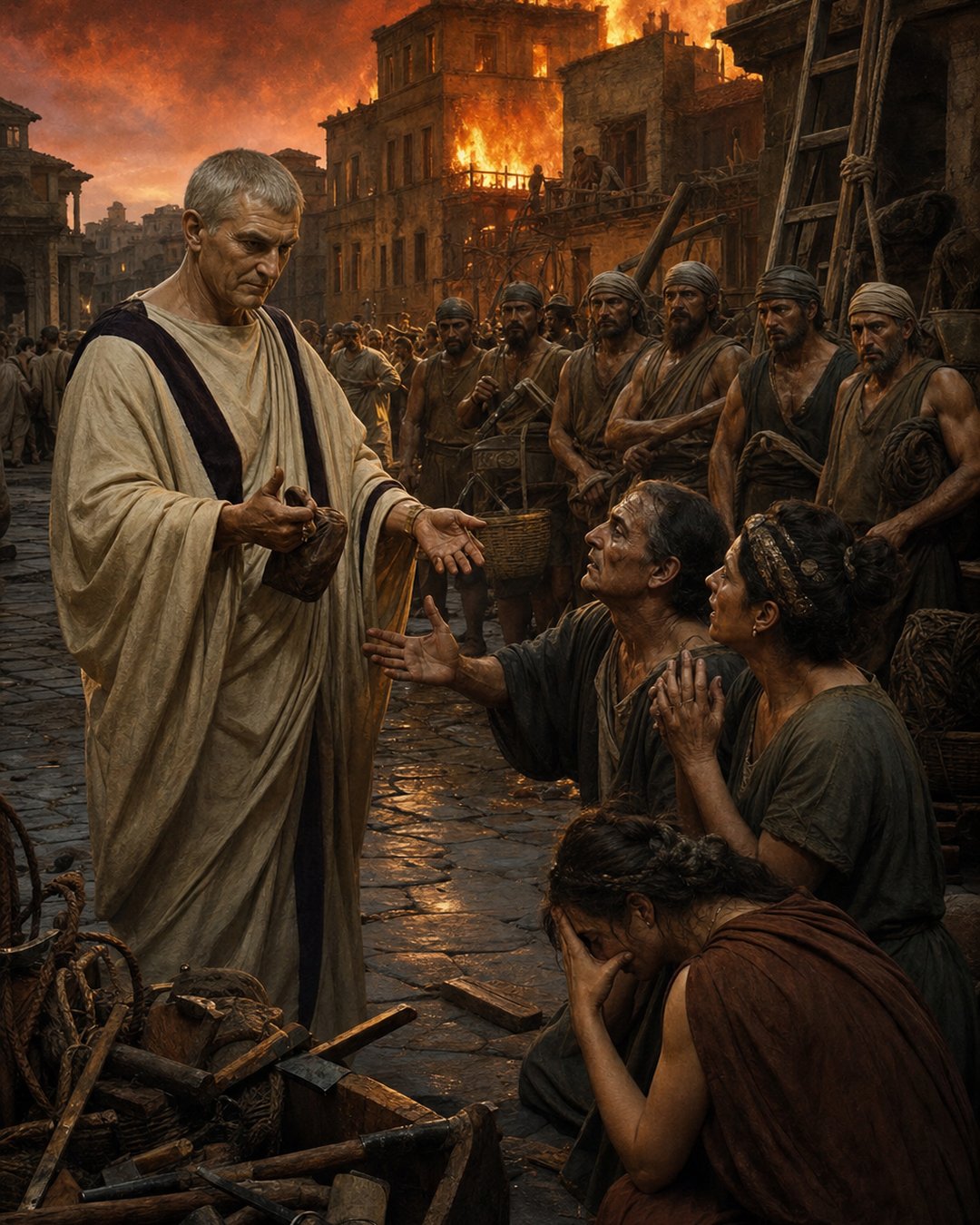
Marcus Licinius Crassus watched Rome burn with a buyer’s patience. When a building caught fire, Plutarch says, he purchased the endangered property and the houses beside it while their owners were frightened and uncertain. The prices were trifling. Waiting behind the bargain was a workforce of more than five hundred enslaved architects and builders.
The familiar version calls this a private fire brigade. That phrase is too neat. Plutarch does not describe a public rescue service racing from alarm to alarm, nor does he say that Crassus’s workers withheld water until a deed changed hands. What he preserves is colder and more revealing: recurrent fires and collapses created distressed sellers, while a concentrated body of trained labor gave one wealthy man unusual confidence in damaged property.
Crassus converted calamity into an urban acquisition system. The flames produced fear, fear reduced prices, and the builders made ruined or threatened houses useful again. His advantage lay not only in ready money but in controlling the human skill needed after the sale.
Rome Supplied the Emergency Again and Again
Plutarch begins with the city rather than with an isolated accident. Conflagrations and building collapses were, he says, natural and familiar at Rome because structures were massive and crowded closely together. The wording turns catastrophe into a recurring condition of urban life.
Dense construction let danger travel. Fire could move between roofs, upper floors and shared walls; a compromised building could threaten its neighbor even before flame reached it. Owners therefore had to price more than the damage visible at one doorway. They faced smoke, falling fabric and the possibility that the next structure would follow.
The built environment behind that risk appears in the pressures inside Rome’s apartment blocks. Crassus did not invent those pressures. He recognized that they repeatedly produced moments when ordinary expectations about value broke down.
Plutarch names two classes of purchase: houses already on fire and houses adjoining them. The second category matters. Crassus was buying projected danger, not merely collecting blackened remains after an event. An owner beside the blaze could not know whether a wall, wind shift or shower of sparks would erase the value still standing.
Uncertainty gave cash a different force. A buyer willing to accept the structural risk could demand a discount from someone desperate to escape it. Crassus’s fortune grew in the interval between the first alarm and confidence that a property could survive or be rebuilt.
More Than Five Hundred Workers Changed the Bargain
Before describing the purchases, Plutarch says Crassus acquired enslaved people who were architects and builders. Their number exceeded five hundred. This was not an incidental household staff but a deep pool of technical labor held under one owner.
The source does not provide a roster. It does not separate surveyors from masons, carpenters or supervisors, and it gives no deployment plan for a particular fire. We should not turn one ancient paragraph into a detailed emergency manual. The surviving facts still establish the essential asymmetry: Crassus controlled trained people on a scale that frightened sellers did not.
A damaged house is not simply cheap land. Someone must judge walls, shore unstable sections, salvage timber and stone, arrange demolition, and direct rebuilding. Roman tools could make each task precise, as the plumb line made a wall’s vertical visible. Possessing many trained workers reduced the gap between purchase and productive use.
Those workers were themselves wealth. Plutarch later lists readers, secretaries, silversmiths, stewards and table servants among Crassus’s enslaved household. He says Crassus directed their education and treated care for enslaved people as a master’s central duty. The praise belongs to an ancient moral frame; it does not soften the coercion by which one man owned their bodies and expertise.
In the fire purchases, their knowledge became leverage over free owners. Crassus could tolerate damage because he had already gathered the labor needed to assess and reverse it. The sellers confronted one emergency. He had built an organization designed to profit from emergencies as a class.
The Sale Happened Under Fear, Not in a Calm Market
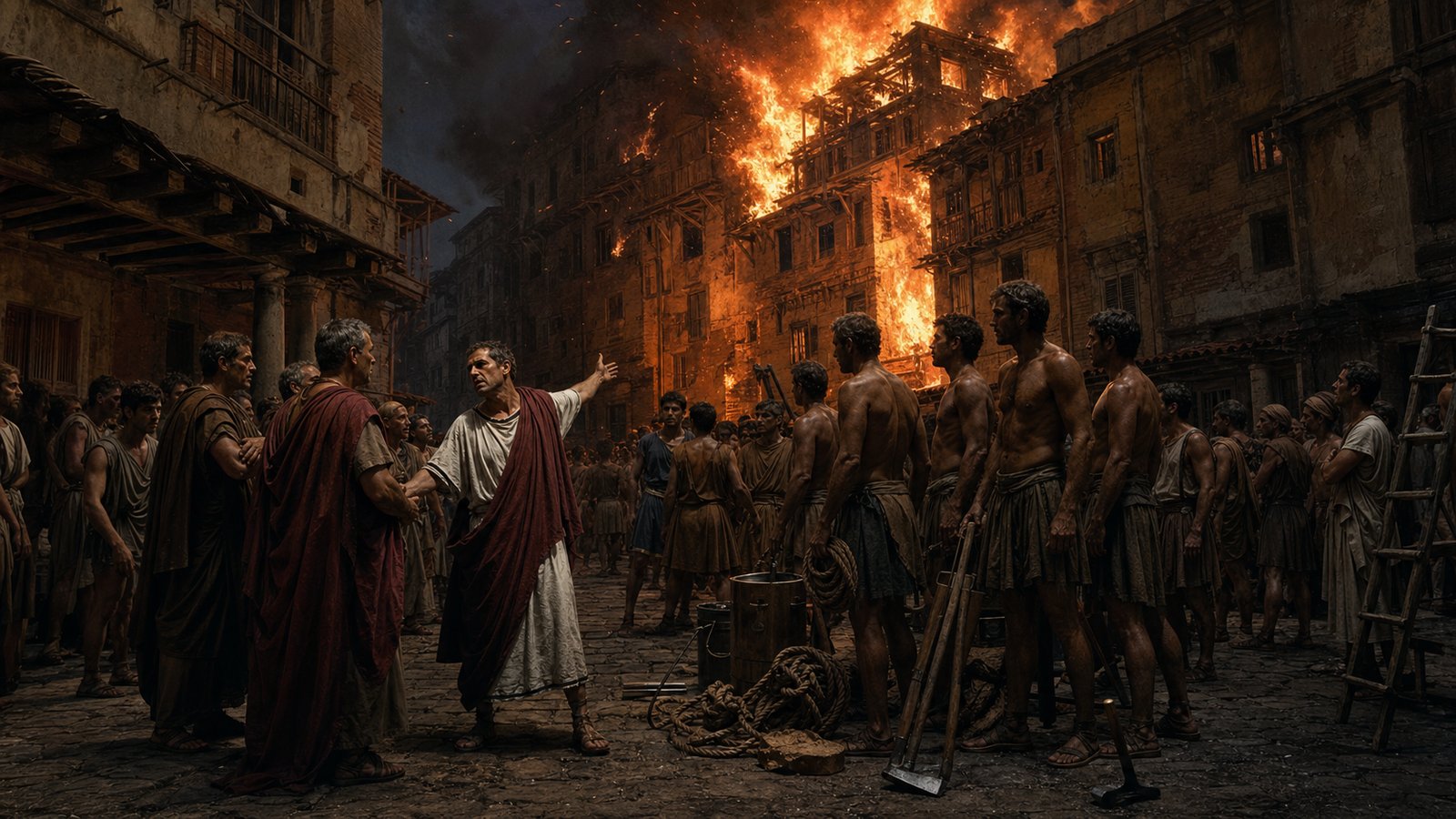
Plutarch explains the low prices directly: owners let properties go because of fear and uncertainty. There is no need to invent a theatrical ultimatum. The fire supplied the pressure.
Imagine only what the source permits. One building is burning; another shares its crowded street. An owner must decide before the outcome is known. Keeping the house preserves a chance of recovery but also the chance of total loss. Selling locks in a smaller sum and transfers the danger to someone equipped to carry it.
Crassus purchased both the visible emergency and the surrounding anxiety. That distinction explains why the scheme could enlarge a portfolio rather than merely accumulate ruins. Adjacent houses might survive. If they did, the discount became immediate gain; if they did not, trained builders and the underlying site still remained.
The story also exposes how unequal access to time can shape value. A frightened owner needed certainty now. Crassus could wait through cooling walls, inspection and reconstruction. His money purchased not only masonry but the right to outlast another person’s panic.
Rome eventually confronted urban fire through other arrangements. Trajan’s exchange with Pliny about a proposed corps of 150 firefighters at Nicomedia belongs to a later city and political problem. Crassus’s operation was different: private acquisition, not municipal protection, organized around the moment property became vulnerable.
Fire Was Only One Door into the Fortune
Plutarch places the houses inside a wider indictment. Crassus began, he says, with no more than three hundred talents. Before the Parthian expedition, his own inventory valued the fortune at seventy-one hundred talents, even after major public spending.
The biographer attributes much of that accumulation to “fire and war.” War meant Sulla’s victory, proscriptions and sales of confiscated property. Crassus repeatedly accepted or purchased assets treated as spoils. Urban fires offered another setting in which disaster loosened ownership and lowered resistance.
The pairing is important because it prevents the builders from becoming a clever business anecdote detached from politics. Crassus prospered where ordinary protections had failed: in a city reshaped by civil violence and in streets where physical structures failed. His readiness to buy connected liquid wealth to other people’s emergencies.
Plutarch’s numbers serve a moral portrait rather than a modern audited balance sheet. Even so, the contrast between three hundred and seventy-one hundred talents conveys the scale the author wanted readers to confront. Crassus’s riches were not explained by rent collection alone. Their origin was part of their meaning.
He reportedly claimed that no one was rich unless he could support an army from his own resources. That definition turned wealth into independent capacity. The five hundred builders expressed the same principle on an urban scale: money became power when it commanded an organized body of people capable of acting where others could not.
The Builders, Not the Flames, Completed the System
Crassus did not respond to his property empire by constantly building grand residences for himself. Plutarch says he owned no house beyond the one in which he lived and joked that men fond of building could ruin themselves without enemies. The remark distinguishes speculative control of buildings from personal architectural display.
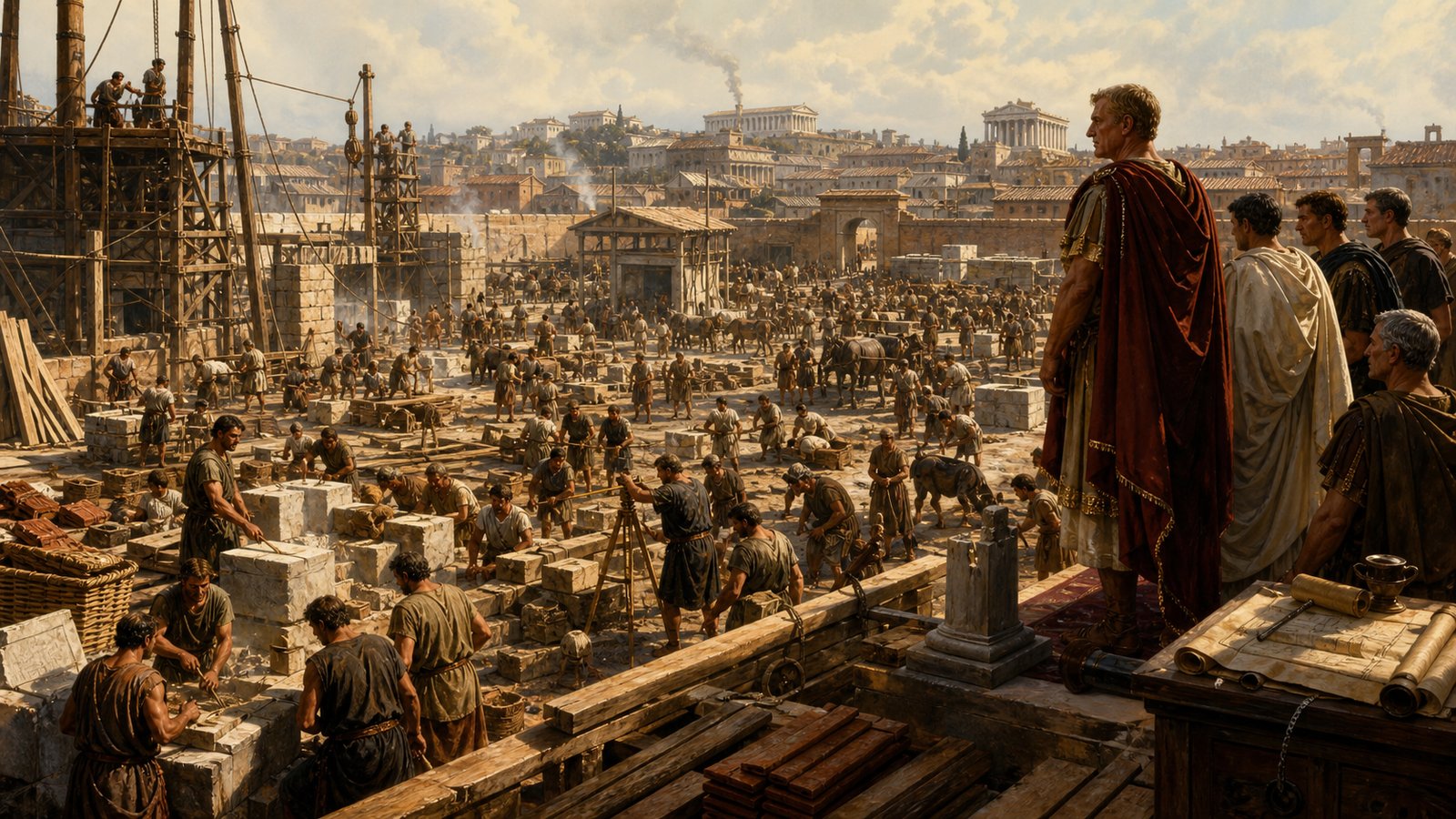
His builders mattered because they could return damaged assets to use. Without them, buying a burning house might be only a wager on land beneath debris. With them, acquisition, stabilization and reconstruction belonged to one controlled chain.
That chain depended on slavery. Calling it entrepreneurial ingenuity without naming the workers’ status would hide the mechanism Plutarch actually records. Crassus owned the expertise. The people whose judgment lowered his risk could not take their knowledge elsewhere or negotiate as an independent firm.
The owners who sold also disappear from the account as individuals. We do not learn their names, household losses or later fortunes. Plutarch compresses them into fear and uncertainty because his subject is Crassus. Yet those emotions are the economic engine of the passage. His gain required someone else to believe that holding on had become more dangerous than accepting a trifling price.
Rome’s fires did not automatically make Crassus rich. The decisive conversion occurred after flame exposed weakness: capital bought under pressure, coerced skill absorbed the damage, and property returned under one owner’s command. More than five hundred builders stood between disaster and profit. They were the hidden architecture of the fortune.
Sources
Plutarch, Life of Crassus 2.