
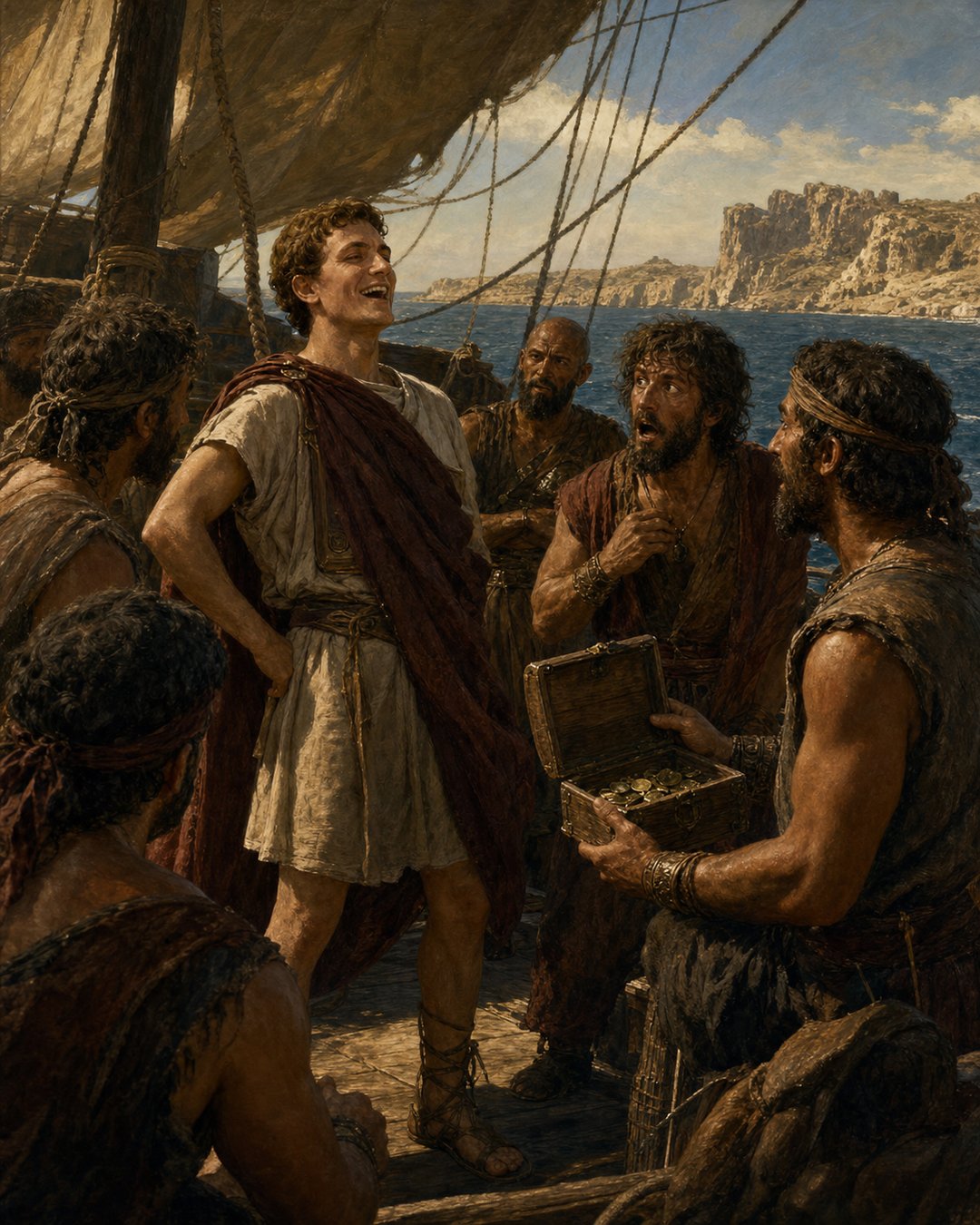
Pirates captured Julius Caesar near the island of Pharmacusa and demanded twenty talents for his release. Caesar laughed. They did not understand whom they had taken, he said, and he volunteered to pay fifty.
Plutarch’s story is not a simple tale of courage. Caesar remained a captive for thirty-eight days while followers searched cities for the money. Yet he behaved as though the pirates were a disorderly bodyguard, ordering them quiet when he slept, joining their exercises and reading them his speeches.
After payment, the performance became action. Caesar raised vessels at Miletus, returned before the pirates had dispersed, captured them at anchor and carried them to Pergamum. The man who doubled his own ransom then recovered the money and took control of punishment.
Twenty Talents Sounded Like an Insult
Caesar was sailing back from Bithynia when pirates seized him near Pharmacusa. Plutarch places the capture in a sea already dominated by large pirate armaments and many small craft. This was organized maritime power, not an accidental meeting with a few thieves.
The captors set the ransom at twenty talents. A talent was a large unit of weight and account; the demand represented serious wealth. Caesar’s reaction nevertheless turned valuation into insult. He laughed and offered fifty.
That choice did not make him free. It increased the sum his companions had to find and extended the scale of the transaction. Its immediate effect was social: Caesar declared that the captors had underestimated the person in front of them.
Ransom usually lets captors assign a captive’s price. Caesar seized that language and revised the number upward. He could not command the ship or leave the island, but he could refuse the pirates’ interpretation of his status.
The Mediterranean setting also matters. Pompey’s later command against piracy would treat the problem at extraordinary geographic scale. Caesar’s encounter shows the personal vulnerability that helped make pirate control politically explosive.
Thirty-Eight Days Reversed the Household
Caesar sent followers to different cities to raise the ransom. Plutarch says he remained with one friend and two attendants among the Cilicians. For thirty-eight days, he shared the pirates’ sports and exercises with striking unconcern.
When he wanted sleep, he sent orders telling them to stop talking. The detail is comic because command runs in the wrong direction. The armed men controlled his movement, yet the captive regulated their noise.
He also wrote poems and speeches, read them aloud and called listeners illiterate barbarians when they failed to admire the work. Plutarch makes literary judgment another arena in which Caesar refused dependence.
The pirates interpreted his manner as simplicity and youthful joking. That response preserved the unstable arrangement. Caesar’s threats could be treated as entertainment while everyone waited for the money.
Plutarch says Caesar often warned, laughing, that he would hang them all. The later outcome makes the line ominous, but during captivity the men did not hear it as an executable order. Their mistake was not failing to understand the words; it was misjudging whether the captive would soon possess the means to act on them.
Release Began the Pursuit Instead of Ending the Story
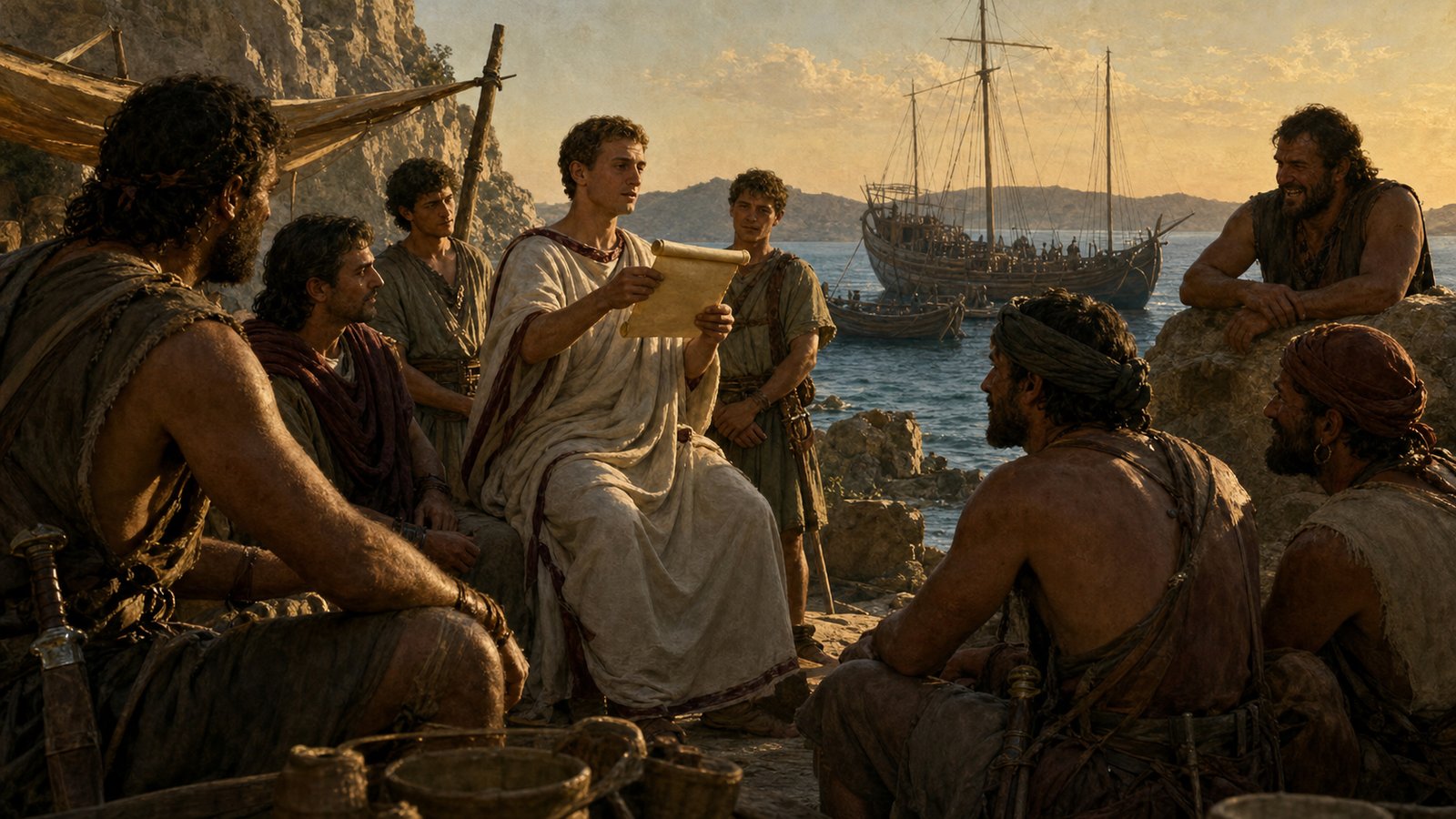
The ransom arrived from Miletus. Caesar paid and was released. A conventional hostage story could end there, with freedom purchased and the captors moving on before retaliation.
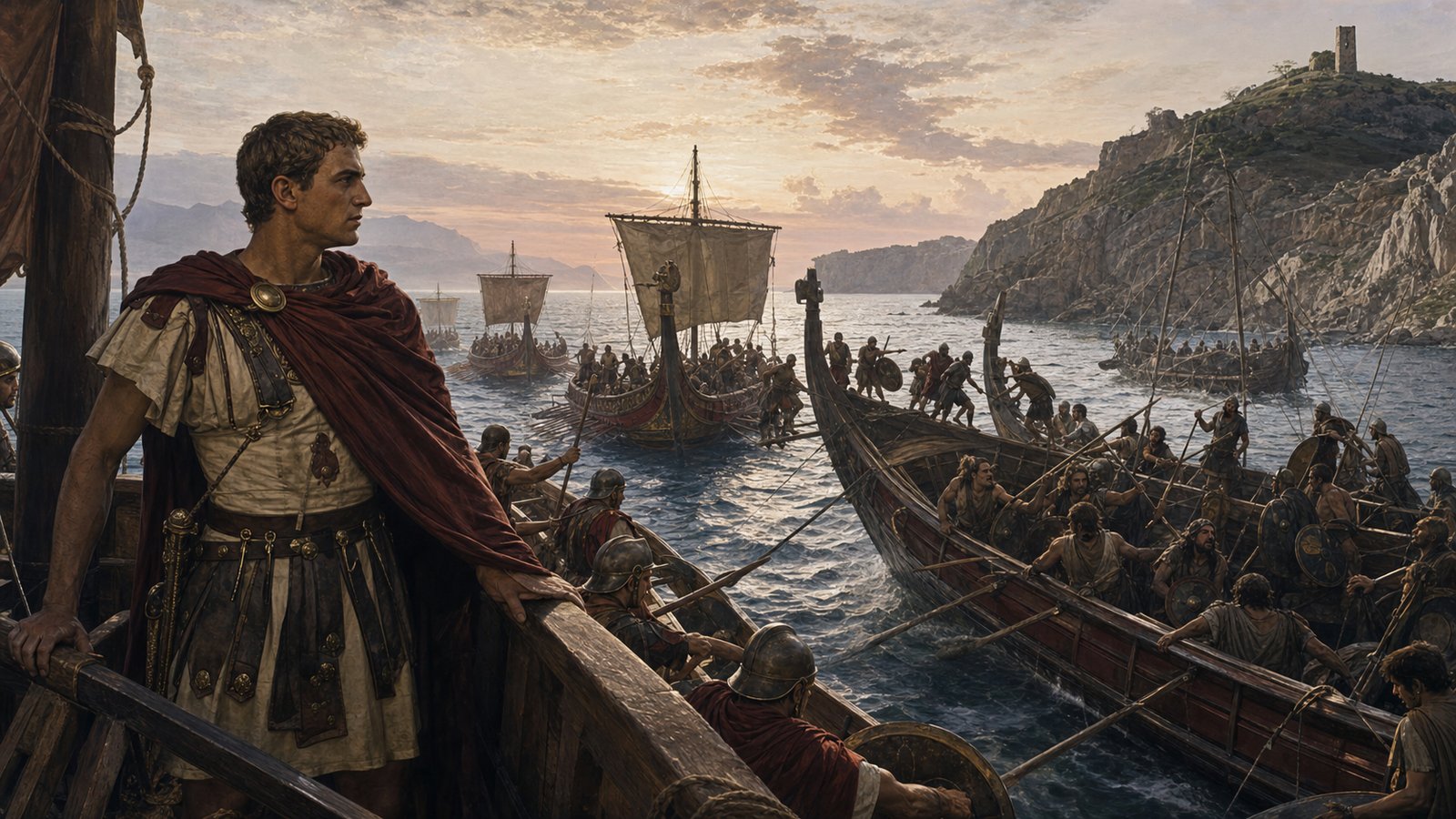
Caesar instead went to the harbor at Miletus, manned vessels and put back to sea. Speed was essential. The pirates were still lying at anchor near the island when he reached them.
Plutarch does not give a detailed battle. He says Caesar caught the robbers and got most into his power. The brevity keeps attention on reversal: the former captive returned with ships before his former guards had converted ransom into safe distance.
The money became booty. Caesar therefore reversed both sides of the exchange. He regained freedom by payment, then regained the payment by capture.
The return also depended on the pirates remaining where Caesar had left them. They had accepted ransom as the end of their control over one captive, but had not yet treated his release as the beginning of pursuit. Their anchorage gave Caesar the narrow window his rapid preparation needed.
Miletus was more than the place from which payment arrived. It became the hinge between the two halves of the episode: first a source of ransom, then a harbor for retaliation. Money and vessels came through the same city, allowing Caesar to change roles without a long return to Rome.
Ancient maritime risk often redistributed losses among merchants and owners, as Rome’s rule for sacrificed cargo shows. This was not a shared commercial loss. Caesar treated ransom as property taken by enemies and recoverable through force.
A Governor Looked at the Money and Delayed
Caesar lodged the captives in the prison at Pergamum and went to Junius, governor of Asia. Provincial office mattered because punishment formally belonged to the governor as praetor.
Junius did not immediately deliver the result Caesar wanted. Plutarch says he looked longingly at the captured money and said he would consider the prisoners’ case at leisure.
The account presents delay as compromised by appetite. We have only Plutarch’s hostile framing, not Junius’s defense or an administrative record. Still, the narrative contrast is sharp: Caesar had pursued at speed, while the governor proposed time.
Caesar refused to wait. He returned to Pergamum, removed the prisoners and imposed the punishment he had repeatedly announced during captivity.
This was not orderly deference to provincial process. The episode celebrates decisiveness by showing Caesar override a magistrate whose hesitation the biographer portrays as greed. The same confidence that made him correct the ransom now made him correct official delay.
The Joke Became a Claim About Future Power
Plutarch tells the story near the beginning of Caesar’s life. Its position invites readers to see later supremacy in an early captive: he behaves like a commander before he controls the situation.
That literary shaping deserves caution. Every detail serves the recognizable Caesar—bold, theatrical, literate, impatient and willing to turn personal intention into action. The pirates become an audience that laughs at a future ruler because it cannot recognize him.
The number fifty is central. Caesar’s self-valuation was not modest survival talk; it made captivity a scene of rank. Yet the money mattered only because other people travelled and assembled it. His confidence depended on a network capable of answering the larger demand.
Plutarch leaves those fundraisers largely outside the spotlight. Scattered followers had to reach cities, persuade lenders or allies, and bring an exceptional sum back through pirate-controlled waters. The captive’s famous laugh became feasible because less theatrical work continued beyond the island.
The thirty-eight-day interval also made Caesar’s conduct sustainable rather than momentary. One bold reply at capture might be impulse. Repeatedly sleeping, exercising, writing, insulting his audience and announcing punishment required him to maintain the same hierarchy for more than five weeks.
Likewise, his revenge depended on Miletus providing ships and crews, Pergamum providing custody, and provincial structures existing even when he bypassed their governor. The story of individual audacity rests on institutions and helpers it does not name fully.
For thirty-eight days, Caesar could only speak as though power belonged to him. Release tested whether that speech was performance or plan. He returned before the pirates sailed, recovered the ransom and made his repeated warning real. Raising twenty talents to fifty had been the first move in taking authorship of the entire captivity.
Sources
Plutarch, Life of Caesar 1–2.