
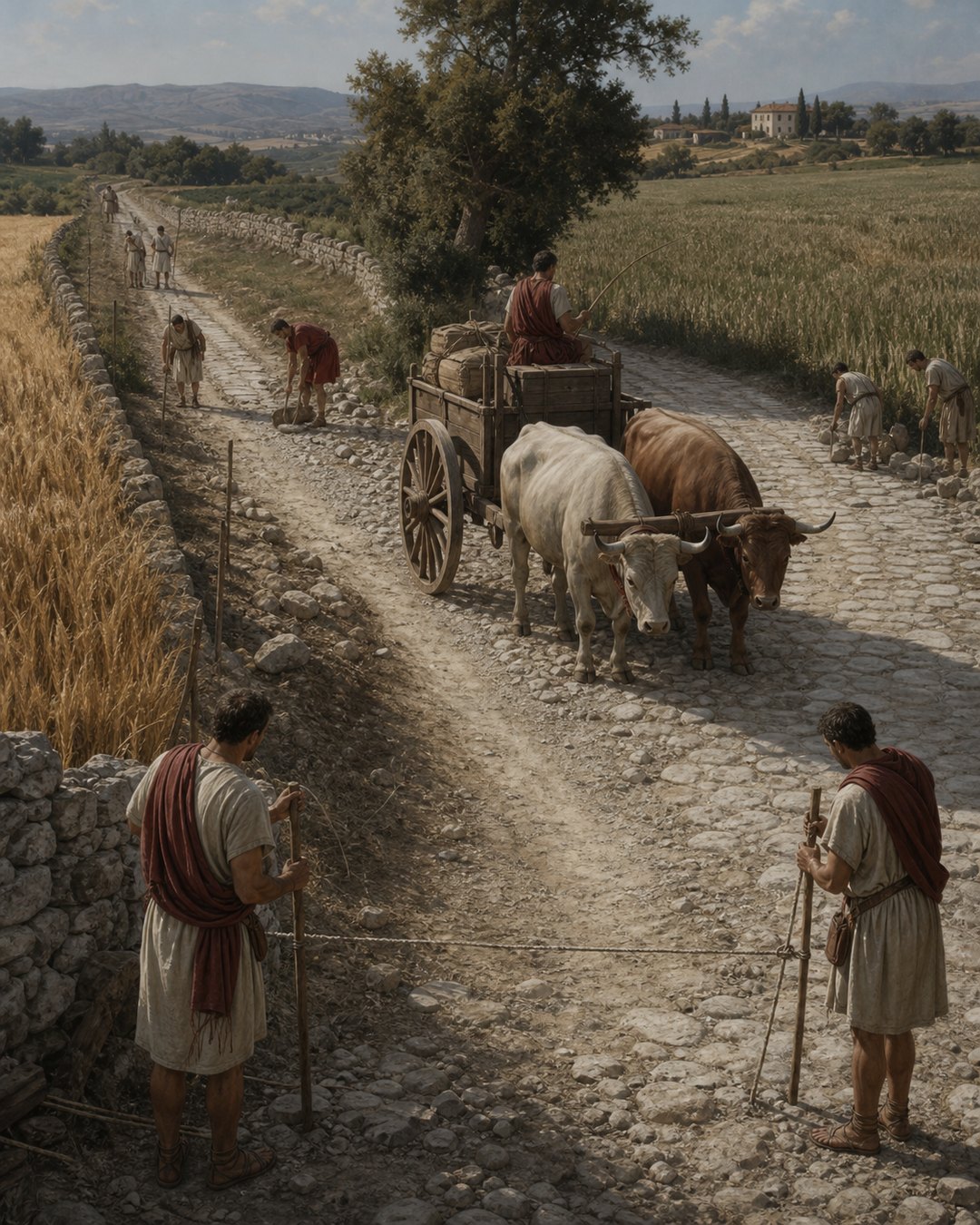
A straight road required eight feet. At a bend, it required sixteen.
The paired measurements preserved under Table VII of the Twelve Tables are brief enough to sound like a surveyor’s note. Yet the difference captures a physical truth that law had to recognize: a carriage can follow a narrow line until it turns. Wheels, axle and animals then sweep across more ground.
The next rule supplied the pressure behind the geometry. Those responsible were to build and repair the road and keep it free from stones. If they did not, a traveller could drive a beast or carriage where they wished.
That consequence tied an abstract width to neighboring land. A marked corridor meant little when blockage made it unusable. Maintenance failure could release traffic from the line and place the burden on the ground beside it.
The road rule was therefore not only about measurement. It was a compact system of space, duty and remedy.
The bend received twice the room of the straight
The reconstructed text gives two numbers rather than one universal road width. Eight feet governed a straight stretch; sixteen governed a bend. We should be careful about turning fragmentary legal wording into a complete engineering manual. The surviving provision does not tell us every detail of drainage, surfacing, gradient or vehicle design.
What it does preserve is functional differentiation. A straight vehicle occupies something close to its body and wheel track. During a turn, its animals change direction first, the pole pivots, the axle follows a wider arc and the rear of the load cuts across the inside. A corridor adequate on the straight can pinch the same vehicle at the corner.
Doubling the legal space did not prescribe one perfect curve. It created tolerance where movement demanded it. The bend was treated as a different piece of infrastructure because it produced a different conflict between passage and adjacent land.
This was not the same work performed by the milestones that made distance visible along Roman routes. A milestone located travellers within a network. The Table VII measurement defined how much ground the road itself could claim at a particular place.
The numbers also reduced argument. Without a standard, the owner beside a corner could insist that traffic stay inside an unrealistically narrow line, while a driver could claim whatever sweep seemed convenient. Eight and sixteen feet gave arbiters, neighbors and road users a shared starting point.
Stones turned maintenance failure into a boundary problem
The following provision moves from width to condition. The road had to be built and repaired, and the surviving wording singles out stones. Loose or piled stone could narrow a route, overturn a wheel, injure an animal or make a loaded carriage seek firmer ground.
A road can remain perfectly measurable while becoming practically impassable. That distinction explains the remedy. If the responsible people failed to keep it free, the traveller could drive a beast or carriage where desired. The rule did not pretend that a blocked legal strip still provided access simply because its edges could be surveyed.
The threat gave maintenance an immediate consequence. Neglect no longer imposed all of its cost on the person trying to pass. The land around the obstruction could lose its ordinary protection from wheels and hooves. A neighboring holder who disliked that risk had a reason to care whether the route remained usable.
Exactly how the remedy operated in every dispute is not preserved by the short reconstruction. “Where one wishes” should not be inflated into a permanent confiscation of fields or an unlimited license to damage crops. It describes self-help around a failed road, not the disappearance of property.
Its force came from temporary uncertainty. Clear the stones and traffic returned to the defined corridor. Leave them, and the corridor no longer confined movement. The law made access and boundary protection conditional on the same act of maintenance.
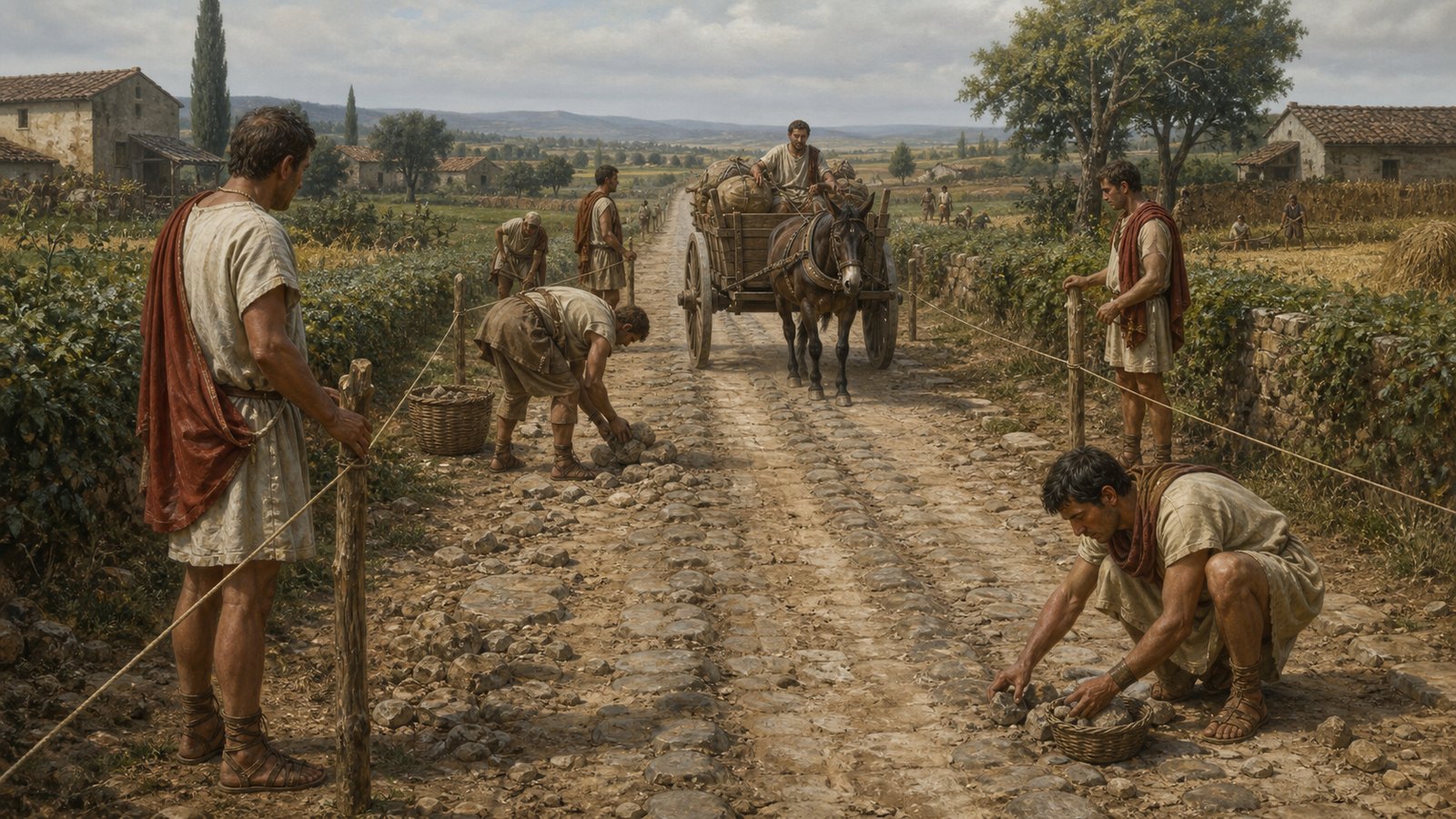
Table VII placed roads among neighboring hazards
The surrounding rules help explain the road provision’s setting. Table VII collects reconstructed fragments concerning real property and boundaries. It mentions three arbiters for a boundary disagreement. It addresses rainwater and a watercourse that damages private property. Branches were to be pruned to a height of fifteen feet, and an owner could seek removal when a neighbor’s tree was blown onto a farm.
These are not grand constitutional formulas. They concern things that cross lines: wheels, water, branches, trunks and fallen fruit. A boundary is never only a marker in soil. It must handle movement and intrusion from one holding or corridor into another.
That gives the road widths a legal context. The eight-foot strip was not an isolated engineering dimension. It helped organize where passage ended and neighboring control began. The sixteen-foot bend acknowledged that movement could not obey the same narrow edge while changing direction.
The relationship belongs beside Roman boundary stones and the authority attached to land division. Stones made a line durable and visible. Table VII’s road rule addressed what happened when bodies and vehicles had to move along or beyond such lines.
The tree and water provisions also reveal that causes mattered less than effects in certain practical disputes. Wind could fell a neighbor’s tree; rain could send damaging water; poor maintenance could deflect a carriage. Law offered ways to remove, restrain or redirect the result.
That does not make every fragment one unified theory. The Twelve Tables survive through quotation and reconstruction, and modern layouts use ellipses where wording is missing. The grouping is evidence to interpret cautiously, not a complete original page found intact.
A usable corridor mattered more than a line on paper
The road rule’s economy is its strength. Measurement defines the expected space. The bend modifies it for turning. Maintenance keeps the space usable. A remedy answers failure. Each piece solves a different part of the same passage problem.
Imagine the scene without the final provision. A traveller reaches a road legally eight feet wide, but a heap of stones fills half of it. The adjoining owner points to the formal boundary and forbids the carriage to leave it. The traveller points to the obstruction. Width alone cannot settle the collision because both claims can be true: the road has a legal dimension and no practical route.
Permission to drive around the blockage breaks that stalemate. It treats access as the purpose of the corridor and makes the people responsible for its condition bear some risk from failing that purpose.
The rule also reminds us that Roman roads were maintained objects, not permanent ribbons that survived by virtue of being Roman. Stones shifted. Edges collapsed. Vegetation and water interfered. Traffic damaged surfaces. Whatever administration or local obligation lay behind a particular stretch, somebody had to clear it repeatedly.
Eight feet and sixteen feet are memorable because they are concrete. The more revealing clause is the one that follows. It recognizes that infrastructure fails at the moment a user cannot use it, not only when a survey says it has vanished.
A straight corridor, a turning corridor and the ground beside them formed one legal mechanism. Keep the route open, and wheels stayed within the measured space. Block it, and the boundary had to yield to passage.
Fragmentary as the text is, its logic remains physical. Law watched the axle turn.

Sources
The Twelve Tables, Table VII
Avalon Project edition of the Twelve Tables
Roman Law Library edition of the Twelve Tables