

The woman did not deny the poison. Before Gnaeus Dolabella, Rome’s proconsul in Asia, she admitted killing her husband and her son at the same time.
That confession should have simplified the case. Instead, it made the difficulty visible. The two victims, she said, had treacherously killed another son of hers, a blameless young man from an earlier marriage. Aulus Gellius adds that the truth of this prior killing was not disputed.
Dolabella’s council now faced two facts that pulled judgment in opposite directions. A confessed poisoning seemed to demand punishment. Yet the dead men had themselves escaped formal punishment for a murder and had received it from the woman they had wronged. No adviser would decide.
The governor sent the question to the Areopagus at Athens. Those judges heard it and ordered both the woman and her accuser to return after one hundred years. The date did not resolve the contradiction. It preserved it so completely that neither acquittal nor condemnation had to be pronounced.
The confession removed doubt but not the dilemma
Gellius sets the episode in the Roman province of Asia and names the accused as a woman of Smyrna. He does not give her name, a date for the hearing, the identity of the accuser or a procedural transcript. His short account concentrates on the arrangement of facts presented to Dolabella.
The woman had secretly administered poison to two people at once: her husband and a son. She confessed. Her explanation reached backward to another household. The husband and the son she killed had treacherously put to death her son by a former husband, whom Gellius calls excellent and blameless.
The source’s claim that this earlier murder was undisputed is crucial to the story’s machinery. Dolabella was not being asked to choose between incompatible witness accounts. If the earlier killing had remained uncertain, the council could have treated motive as an unproven defense. Gellius removes that route.
He also removes the route of factual innocence. The woman does not contest the poison or attribute the deaths to accident. The tribunal therefore knows who killed whom in both stages of the sequence. What it lacks is a judgment that can acknowledge the first wrong without authorizing the second.
This makes the case unlike the missing corpse that trapped the widow of Ephesus, where physical absence and a changed body created the story’s pressure. In Smyrna, the difficulty survives because the decisive acts are accepted rather than hidden.
Gellius’s language also warns against turning the episode into a modern doctrine. He provides no statute, no formal plea of self-defense and no legal formula for provocation. The supported claim is that confession appeared to call for punishment while the victims’ prior crime made punishment morally hard for the council to impose.
Dolabella’s council refused a clean answer
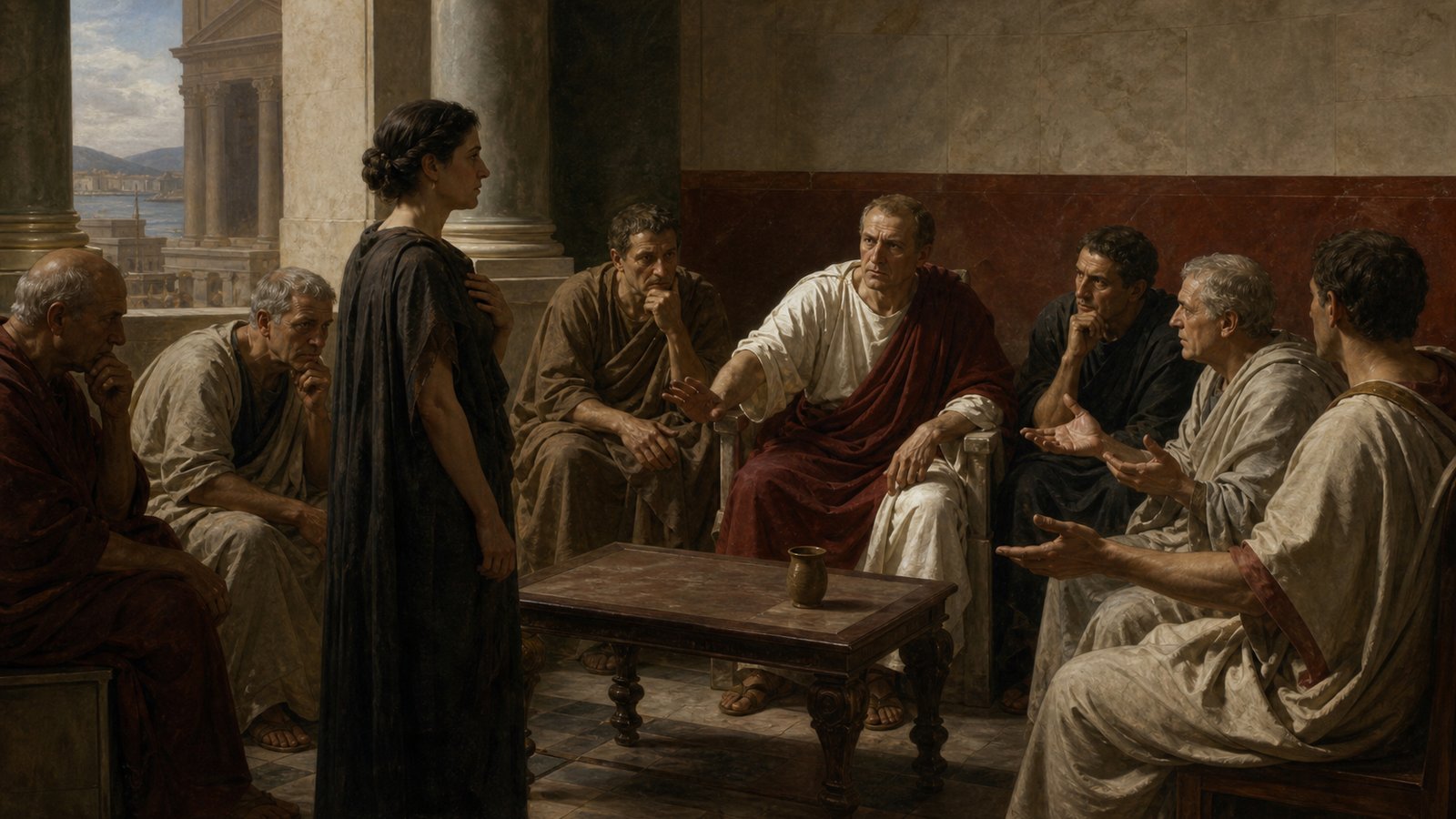
The governor did not decide alone. He referred the matter to his council, bringing advisers into the act of judgment. Gellius says no member ventured to render a decision in so difficult a case. Their hesitation is not presented as ignorance of the events but as recognition that every available verdict would flatten one side of them.
Condemnation would treat the admitted poison as legally decisive. That path preserved the rule against private killing but risked seeming to ignore the undisputed murder of the woman’s earlier son. Acquittal would recognize the provocation but could appear to condone an intentional double poisoning.
Gellius describes the dead husband and son as wicked men who had received a just penalty. That is the narrator’s moral framing, not evidence of a prior sentence against them. The council confronts a punishment already carried out by a private person rather than one assigned through provincial authority.
The gap between moral desert and authorized process gives the anecdote its force. A reader may understand why the woman acted without being able to say that the tribunal should approve the act. Sympathy does not erase confession, and confession does not erase the first murder.
Roman legal stories often attach a later boundary to memorable conduct. Afrania’s courtroom voice became one such boundary in another transmitted account. Dolabella’s council does something different: it refuses to manufacture a rule from a singular conflict and seeks a forum with greater inherited prestige.
Refusal here is still an institutional action. By declining to decide, the advisers shape what Dolabella does next. The case leaves the provincial council not because its facts require more investigation, but because its accepted facts have produced an answer none of its members will own.
A Roman governor moved the question to an Athenian court
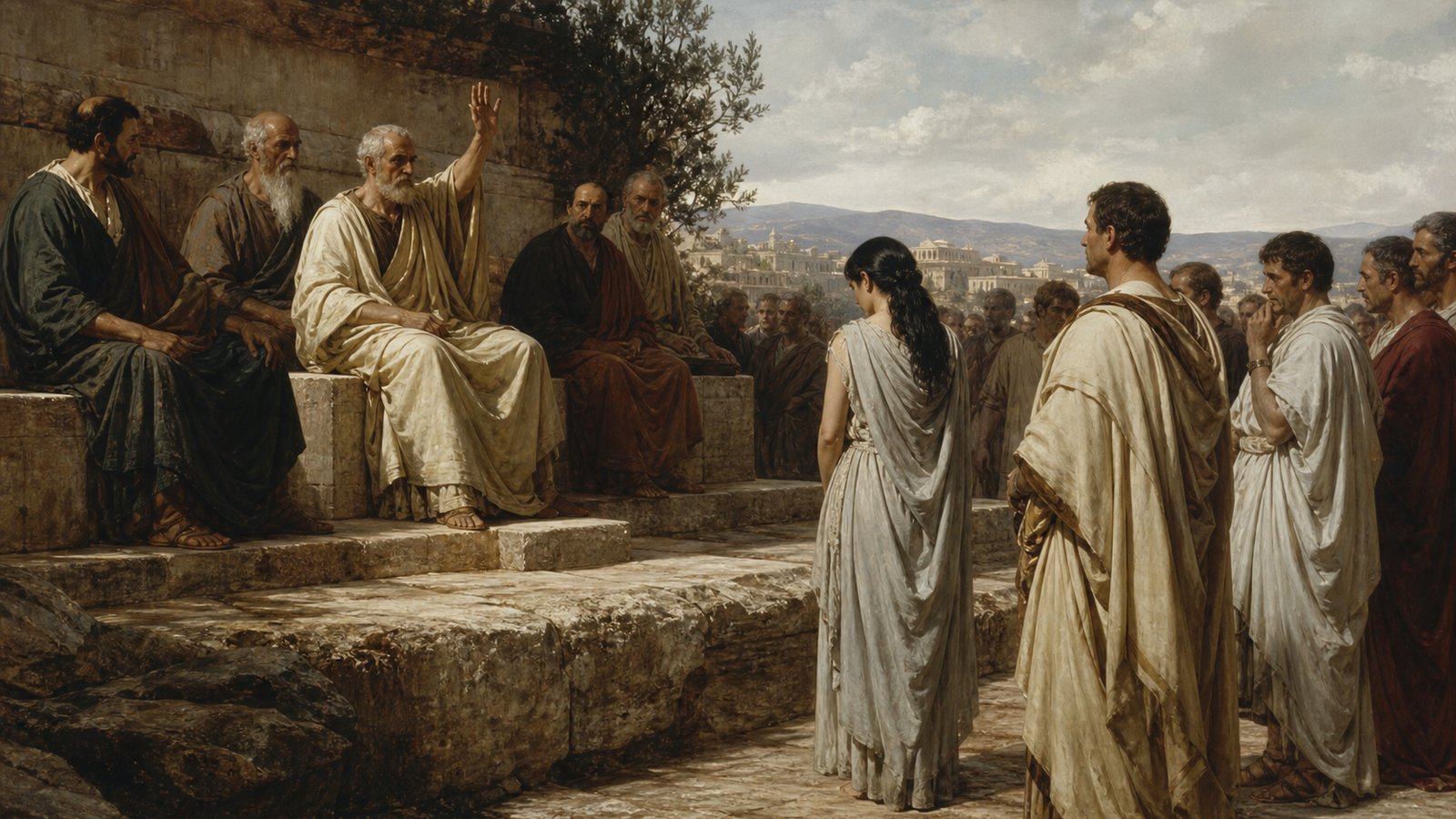
Dolabella sends the matter to the Areopagites at Athens. Gellius calls them judges of greater authority and experience. The transfer changes place, tribunal and political tradition: a Roman provincial governor turns to an ancient Athenian court for a judgment his own council will not make.
The source does not describe the travel, documents or jurisdictional procedure behind that referral. It gives only the hierarchy imagined by the story. Dolabella recognizes a problem beyond ordinary counsel and seeks a body whose reputation can carry the burden of answering it.
Athens is therefore not decorative scenery. The Areopagus supplies institutional age and distance. The case arrives already compressed into its contradiction: the woman is guilty of poisoning, the victims were guilty of an earlier killing, and neither truth cancels the other.
The judges hear the case. Gellius does not say that they discover new evidence, disagree about the facts or propose a proportionate sentence. Their response works on time instead. They summon the woman and her accuser to appear again after one hundred years.
That order sounds precise. It names both parties and supplies an interval. Yet the precision makes compliance impossible within a human lifespan. The court does not say “never,” close the accusation, or announce that law has no answer. It retains the form of another hearing while placing that hearing beyond the parties’ reach.
Roman rules could use measured shares and deadlines to direct conduct, as the inheritance rule that reserved a quarter for heirs shows in a different legal setting. The hundred-year interval in Gellius does not calibrate an ordinary process. Its extravagant length suspends one.
One hundred years preserved both accusation and mercy
Gellius explains the result through two negatives. The woman’s crime was not condoned, because the laws did not permit that. She was also not condemned and punished for what he calls a pardonable offence. The delayed return keeps both propositions standing.
An acquittal might have converted understandable vengeance into approved conduct. A conviction might have erased the moral weight of the victims’ prior act. The Areopagites avoid endorsing either simplification. The accusation remains alive in form, but immediate punishment disappears in practice.
The mechanism is procedural rather than supernatural. No oracle intervenes, and no missing evidence promises a later solution. Time becomes the court’s instrument. By selecting an interval longer than the litigants can survive, the judges create a verdict-shaped absence.
That does not make the outcome neutral. Delay favors the accused woman by preventing punishment in her lifetime, while withholding the public vindication an acquittal would offer. It also denies the accuser a completed judgment. Every party receives less than a decision.
The anecdote survives through layers. Gellius says Valerius Maximus also told it, while his own reference to that work is corrected by the modern editor. Those transmission details counsel restraint. The episode should not be treated as a complete dossier proving how Roman provincial referrals normally worked.
As a legal story, however, it isolates a durable problem. Courts must sometimes judge conduct whose factual clarity exceeds the moral clarity of the available outcomes. Gellius’s Dolabella cannot solve that problem by asking what happened. He already knows.
The route from Smyrna to Dolabella’s council and onward to Athens is a route away from premature certainty. At its end, the Areopagus offers an appointment rather than a sentence. One hundred years gives the law a future date and the defendants no future hearing—the most exact way the story can imagine refusing a false choice.
Sources
Aulus Gellius, Attic Nights 12.7