
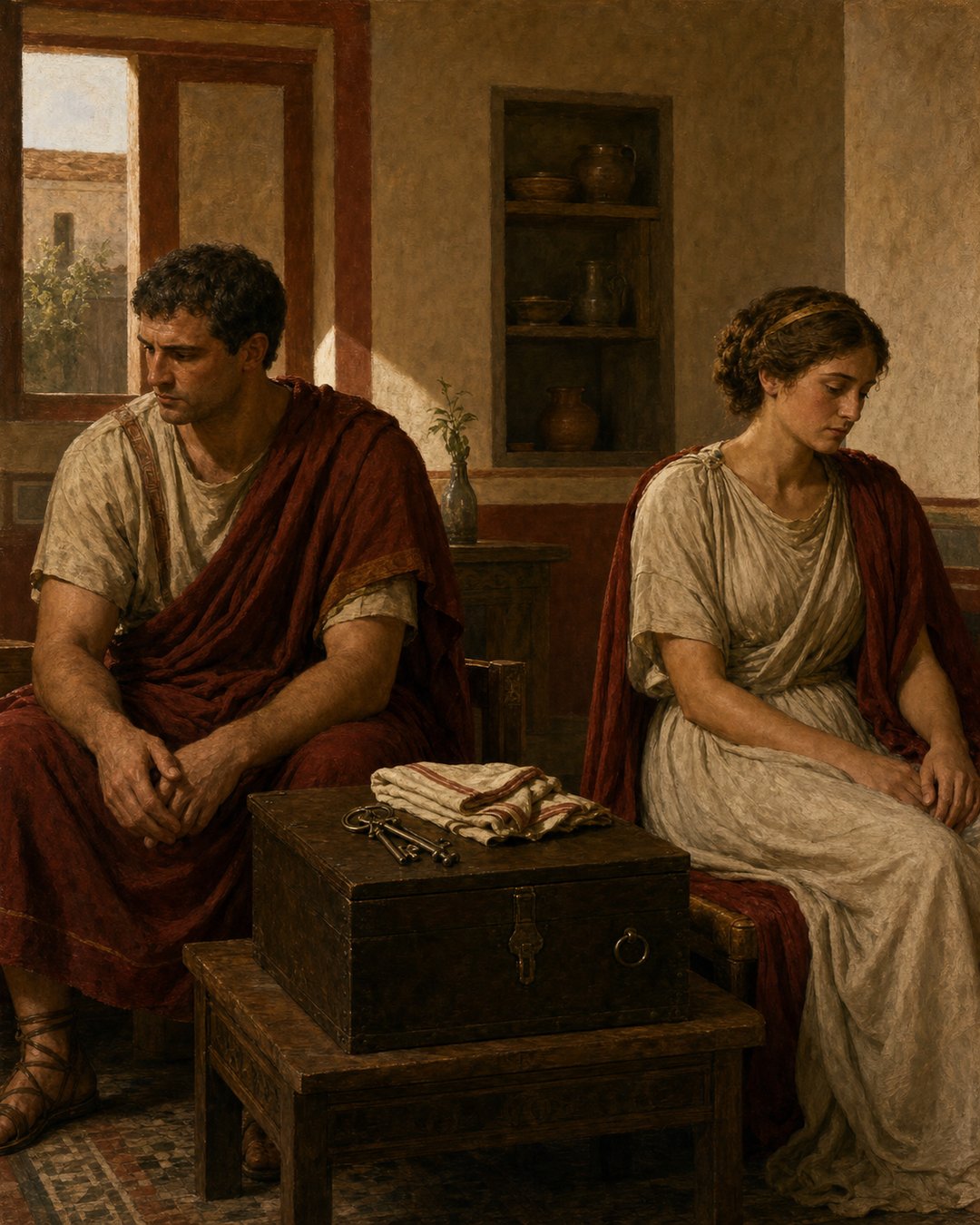
Spurius Carvilius reportedly loved his wife. The marriage ended anyway.
Aulus Gellius says a physical condition prevented children from being born from her. Carvilius, a man of rank, had sworn before the censors that he married for the purpose of begetting children. He placed that oath above affection and sent his wife away.
Gellius presents the case as a turning point. For nearly five centuries after Rome’s foundation, he says, there had been no lawsuits or formal guarantees concerning a wife’s dowry because marriages were not annulled. Once separation became thinkable, property placed inside marriage required protection outside its promised permanence.
The report should not be read as a complete history of Roman divorce. It is a juristic memory transmitted through Servius Sulpicius and Gellius, with all the neatness that “first” stories carry. Its value lies in the mechanism it preserves: public oath, private childlessness, emotional conflict and financial law became parts of the same rupture.
Permanent marriage had made dowry security seem unnecessary
Gellius begins not with Carvilius’s feelings but with litigation. He says Rome and Latium went for nearly five hundred years without lawsuits and warranties connected to a wife’s dowry. Such arrangements, in his explanation, were not required because marriages were not dissolved.
A dowry moved wealth into a marital household. If the union lasted until death, custom and inheritance could govern what happened to that property. Separation created a different question: what could a woman or her original household recover when the marriage ended while both spouses lived?
The absence of old lawsuits is not proof that every early marriage was harmonious or that no woman ever left a husband. Gellius is reporting a legal tradition about recorded annulment and financial guarantees. Silence in the surviving account should not be expanded into a perfect domestic world.
The story nevertheless captures an important relationship between expectation and paperwork. Legal protections often become visible when an assumption fails. As long as permanence was treated as certain, a promise to restore property looked redundant. Once permanence broke, the missing promise mattered.
Confarreatio used witnesses and sacred spelt to make one form of Roman marriage publicly legible. Carvilius’s case looks at the other boundary: what legal machinery appeared when a union recognized by society no longer held.
A censorial oath entered the marriage
Servius Sulpicius, as quoted by Gellius, names Spurius Carvilius Ruga. He was a man of standing and had taken an oath compelled by the censors. The formula declared that he would marry for the purpose of producing children.
The oath turned reproduction into more than a private hope. It connected marriage to citizen classification, household continuity and the expectations of Roman public authority. Childlessness could therefore be experienced as failure to fulfil a statement made before magistrates.
Gellius attributes the absence of children to a physical defect of the wife. That is the source’s framing, not a diagnosis modern readers can verify. It places responsibility on her body and gives no account of her voice, health or understanding of the marriage.
Carvilius’s decision is made to look morally painful rather than opportunistic. He dearly loved his wife and valued her character. The account insists that affection existed so that the hierarchy of obligations becomes sharper. He did not leave because love was absent; he subordinated love to the oath.
This is not evidence that every Roman interpreted such an oath identically. Gellius preserves one exemplary collision. Its force depends on presenting Carvilius as a man trapped between duties rather than someone casually discarding a partner.
Public language thus entered a private household with delayed effect. The censors did not stand in the room when the separation occurred, but their formula supplied the reason by which Carvilius later justified it. A sentence spoken for civic registration became an instrument of domestic change.

The first separation produced a new financial risk
Gellius cites Servius Sulpicius’s book On Dowries for the claim that security first appeared necessary in connection with this divorce. The legal innovation followed the practical problem. If a wife could be put away, her dowry could no longer rely solely on continuation of the marriage.
A guarantee did not repair the emotional loss or equalize power between spouses. It addressed a narrower danger: wealth transferred because of marriage might remain in the husband’s household after the relationship that justified the transfer had ended.
The article on Roman market lawyers arguing over disclosure shows jurists converting an awkward transaction into rules about responsibility. Dowry security performed a related conversion. The unprecedented or newly remembered event exposed a gap, and legal thought supplied a structure for future cases.
Gellius says the event occurred in Rome’s 523rd year, under the consuls Marcus Atilius and Publius Valerius. The accompanying modern note identifies 231 BCE. The dating gives the story administrative precision, even though the tradition was written down and transmitted much later.
“First” should therefore be handled carefully. It may mean the earliest divorce recognized by the legal authorities Gellius followed, the first associated with dowry guarantees, or a traditional marker in Roman legal memory. It does not let us inspect every household in earlier centuries.
What the tradition clearly wants to explain is sequence. No annulment, no perceived need for security; a prominent annulment, then a requirement for protection. The case is remembered not only because a marriage ended, but because law changed its assumptions afterward.
Affection survived in the story because law alone was not enough
If Carvilius had hated his wife, the anecdote would be simpler. By preserving his love and respect for her character, Gellius makes the decision a contest between goods: attachment to a person and fidelity to a civic oath.
The wife remains the least audible figure. Her body is assigned the cause, her dowry supplies the legal issue, and her husband’s feelings receive narration. The imbalance is evidence of whose perspective ancient legal memory privileged.
That silence should stop modern readers from praising Carvilius too easily as dutiful. The oath may explain his reasoning, but it did not distribute the cost evenly. He retained the authority to end the union; she became the person put away because the marriage had not produced children.
At the same time, the report does not allow a cheerful picture of Roman patriarchy in which affection and institution naturally aligned. They collided. The fact that love had to be mentioned suggests that contemporaries or later jurists recognized a moral injury even while explaining the public logic.
Gellius proceeds from this chapter into other marriage vocabulary and customs, treating words, pledges and household status as legal history. Carvilius’s separation belongs in that larger interest: language creates categories, but unexpected acts reveal what those categories fail to secure.
The deepest consequence was not that Rome discovered divorce in one morning. It was that permanence could no longer do all the legal work. Once a respected man invoked a civic oath to end a loved marriage, dowry needed its own promise. Property law began where confidence in the union stopped.
The case survives as a harsh equation—children, oath, affection, separation, security—but its human remainder resists the equation. Gellius can explain why Carvilius acted and why jurists responded. He cannot tell us what the wife said when public duty arrived at her door.
The legal memory also distinguishes a dowry from a simple gift. Wealth moved because a particular relationship had been formed, and its fate remained tied to that relationship’s condition. Once the union could be terminated, possession and entitlement diverged. A husband might physically hold the property while the reason for his household to retain it had disappeared.
That divergence made advance planning rational. A guarantee written or spoken before conflict could define recovery when affection, fertility expectations and civic obligation later pulled apart. The safeguard did not predict which marriage would fail. It admitted that Roman law could no longer treat failure as impossible.

Sources
Aulus Gellius, Attic Nights 4.3.1–2