
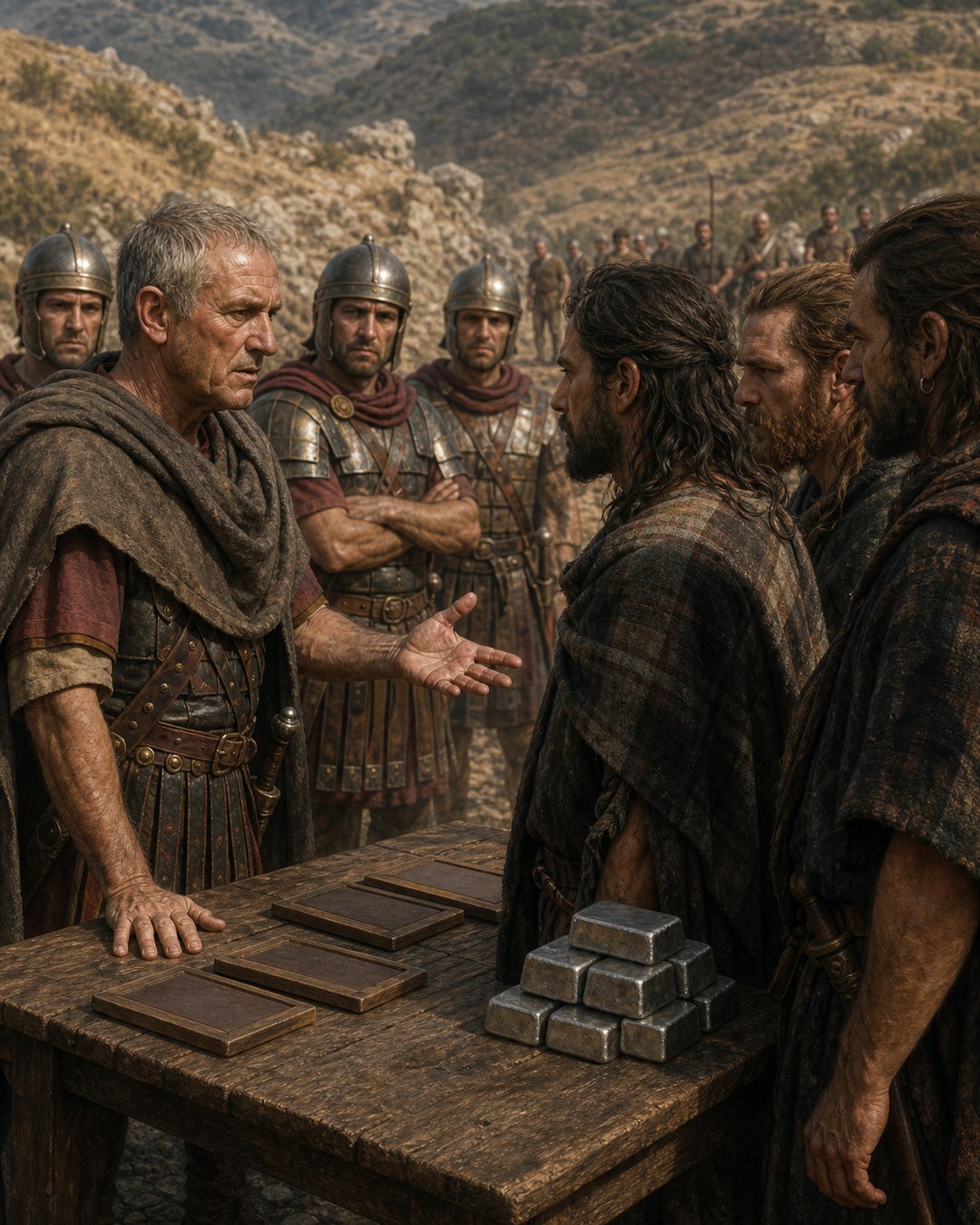
Two hundred talents stood between Cato and the allies he needed. His officers heard humiliation in the price. Cato heard a bargain whose risk could be postponed until after battle.
A large force threatened to drive him from his Spanish province. He asked neighbouring Celtiberians for help. They did not answer with sentimental loyalty to Rome. They demanded payment.
Cato’s reply was brutally compact. If the coalition won, the Romans could pay the agreed sum from enemy spoils rather than their own purse. If it lost, nobody would remain either to pay or to demand payment.
The line sounds like confidence, but its real power lies in timing. Cato did not deny the cost. He changed the condition under which it became payable and identified victory itself as the source of funds.
A threatened commander needed manpower more than wounded pride
Plutarch places the bargain inside a difficult Spanish campaign. Cato was subduing some communities and winning others through diplomacy when a large hostile force gathered against him. The danger was not abstract. The biographer says it threatened to drive him disgracefully out of the province.
That word matters because Roman commanders operated under political scrutiny as well as military pressure. Loss could destroy an army, surrender territory and become ammunition for rivals at home. Yet fear of appearing weak could also prevent a commander from buying the help that made survival possible.
The neighbouring Celtiberians possessed what Cato lacked at that moment: additional fighters familiar with the region and available before the enemy’s threat matured. They also understood their leverage. Assistance offered under urgency commands a different price from friendship discussed in safety.
Cato’s officers focused on status. Plutarch says they found it intolerable that Romans should pay people they described as barbarians for assistance. The objection treated hierarchy as if it should determine the contract: Rome ought to receive support without appearing dependent.
But battlefield need had already made the dependence real. Refusing to name it would not create more troops. Cato’s calculation accepted the practical imbalance while looking for a way to protect Roman resources and authority after the crisis.
Two hundred talents became contingent rather than immediate
A talent was a large unit of weight and account, so two hundred represented a serious commitment rather than a token gift. Plutarch does not provide a surviving contract, payment schedule or list of recipients. The number’s narrative function is still clear: it was large enough to alarm Roman officers.
Cato answered by separating promise from present cash. The allies could join now. Payment would follow a successful battle. This moved the financial burden to the moment when the coalition had produced a pool of captured wealth.
The structure aligned incentives without making them identical. Romans needed victory to preserve their army and command. Celtiberians needed victory to make collection possible. Both parties now had a reason to ensure that the enemy’s wealth, not Rome’s existing treasury, financed the alliance.
The bleak second half closed the remaining objection. If the Romans were destroyed, unpaid debt would be meaningless because no solvent military community survived on that field. Cato framed defeat not as a costly alternative but as the end of the accounting relationship.
This was rhetoric, not a legal proof against every possible claim. Survivors, governments or later commanders could still dispute obligations. Plutarch’s Cato speaks at the scale of immediate battle. His point is that refusing help to avoid a bill makes little sense when defeat would destroy the party protecting its purse.
Coalition warfare turned victory into a source of credit
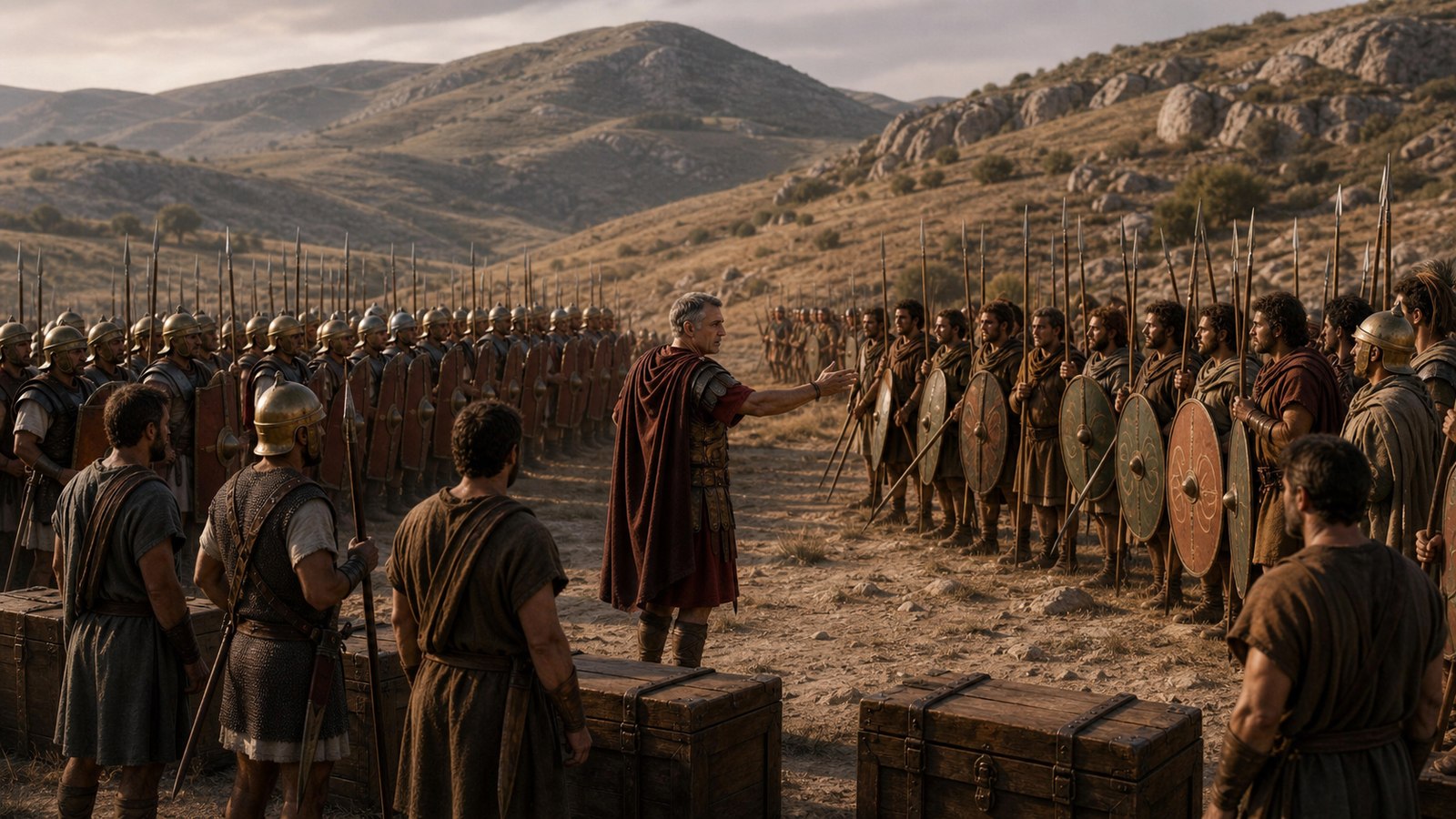
The bargain exposes how Roman armies depended on relationships beyond formally Roman units. Allies could provide numbers, local knowledge and political reach. Their participation was negotiated through status, reward, fear and opportunity rather than produced automatically by a Roman command.
Payment after victory resembles credit because value moves before settlement. The Celtiberians supplied military capacity on the expectation that the combined force would create enough spoils to honour the promise. Cato supplied his reputation and prospective access to captured wealth.
The arrangement also shifted risk toward the allies. They would fight before receiving the full price. If the campaign failed catastrophically, their claim might die with the Roman force. The high figure can be read partly as compensation for that uncertainty.
Roman commanders frequently presented booty as the natural fruit of courage. Here it had already been assigned a job before it existed. Future captured value secured present cooperation. The battle was therefore preceded by a financial architecture, however briefly Plutarch describes it.
The account of war booty financing monuments in Rome follows captured wealth after victory into public display. Cato’s bargain points in the other direction. Expected booty reached backward, helping assemble the force that might win it.
Victory paid soldiers broadly while Cato refused a private share
Plutarch says the battle ended in complete victory and the remainder of the campaign succeeded brilliantly. He then surrounds Cato with enormous claims: walls of many cities beyond the Baetis demolished in one day, more cities taken than days spent in Spain and a total of four hundred.
Those figures belong to triumphal memory and should not be treated as an uncontested operational diary. Plutarch attributes one claim to Polybius and another to Cato himself. The scale tells us how later accounts represented the campaign’s speed and domination.
Booty was not imaginary within that representation. The soldiers obtained a large amount, and Cato gave each a pound of silver. He defended broad distribution with another pointed contrast: better for many Romans to go home with silver in their pockets than for a few to return with gold.
The statement turns allocation into political morality. Concentrated wealth would reward officers or favourites. A smaller share spread through the ranks let many participants carry a visible result of victory home.
Cato claimed no private portion beyond what he ate and drank. That self-portrait matches the economy seen in his refusal to charge Rome for transporting his campaign horse, but the moral problem differs. Here restraint supports a claim that allied and ordinary soldiers should receive value before the commander enriched himself.
The clever answer concealed a hard distribution of danger
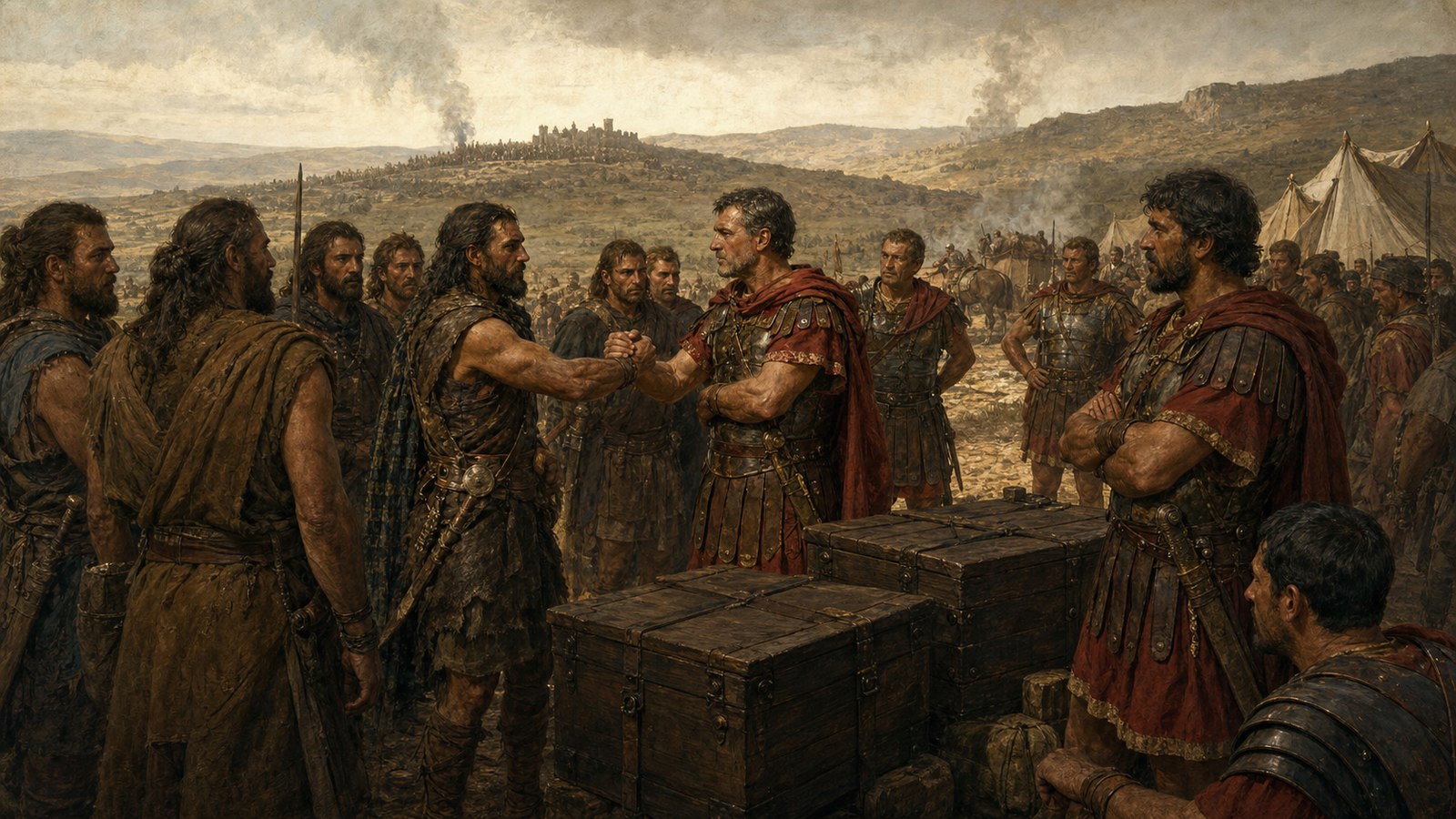
Cato’s officers saw two hundred talents and imagined Roman dignity being sold. Cato saw a force at risk and asked which outcome could make the bill matter. His answer replaced prestige with conditional logic.
That does not make the bargain fair in every direction. The Celtiberians risked bodies before payment. The enemy population supplied the spoils. Cities later faced demolition, and captives entered a violent economy from which silver could be distributed. A neat contract at headquarters depended on coercion beyond it.
Plutarch’s anecdote nevertheless captures a genuine command problem. Coalitions are built before their success is known. Partners bring different motives, and the value promised to them may not yet exist. Leadership consists partly in arranging those uncertainties so action can begin.
The two-hundred-talent demand made dependence visible. Cato’s achievement was not pretending Rome stood alone. He accepted help while preserving a story of Roman prudence: the allies would be paid, but victory would pay them.
His line about defeat is darker. It works because it treats annihilation as accounting finality. Officers worried that Rome might lose money or face shame; Cato reminded them that an army destroyed while protecting its purse had solved the wrong problem.
The battle turned the promise into a successful wager in Plutarch’s narrative. Yet the anecdote survives because its reasoning can be understood before the result. When present survival depends on costly cooperation, the decisive question is not simply “How much?” It is “Payable when, from whose resources, and only if what happens?”
Sources
- Plutarch passage at LacusCurtius
- Plutarch in the Project Gutenberg translation
Plutarch, Life of Cato the Elder 10.1–4.