
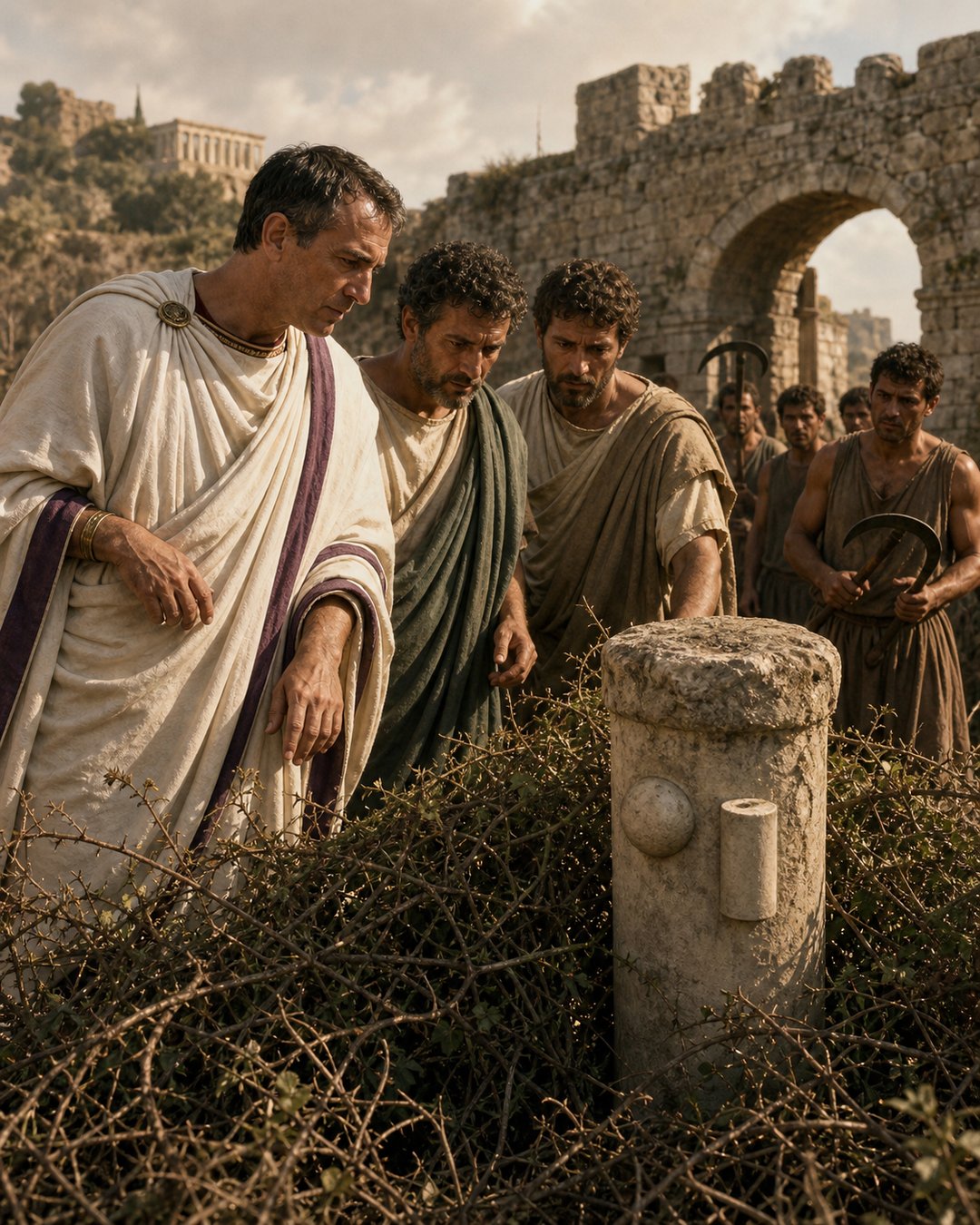
Syracuse’s leading men told Cicero there was no tomb to find. Archimedes had been the city’s greatest mathematician, yet the monument had dropped out of local memory. Cicero did not arrive with a map or an official register. He carried a few remembered verses and one visual clue: a sphere with a cylinder.
During his quaestorship in Sicily, he walked among the many graves outside the gate of Achradina. Briars covered the ground. Then a small column rose just above the thorns, and the two geometric solids appeared on it. Men with scythes cut an approach. Beneath the growth, the damaged ends of an inscription confirmed that memory had led to stone.
Cicero tells the episode as a rebuke to Syracuse, but it is also a compact lesson in recovering a lost place. Text, image, terrain, and manual labour had to meet. The tomb survived not because every generation guarded it, but because Archimedes had chosen an emblem specific enough to be recognized when almost everything else had been forgotten.
A Quaestor Searched Where the City Had Stopped Looking
Cicero introduces Archimedes as a humble and obscure mathematician from the same city that had produced the tyrant Dionysius. The contrast belongs to a philosophical argument about the best life. Political splendour and fear stand on one side; disciplined thought and the pleasures of understanding stand on the other. The neglected grave gives that contrast a physical setting.
His official position mattered. A Roman quaestor in Sicily could move with local notables and ask a Greek city to examine its own past. Yet office alone could not supply the answer. The Syracusans who accompanied him did not point out the monument. According to Cicero, they knew nothing about it and even denied that any such tomb remained.
The denial sharpened the problem. Cicero was not choosing among several accepted locations. He was testing a literary memory against the city’s confidence that there was nothing left to see. That made his next step closer to fieldwork than ceremony: he inspected the monuments rather than accepting civic recollection as final.
Outside the gate of Achradina stood many tombs. A crowded funerary landscape could hide one more effectively than an empty field. Columns, pedestals, vegetation, and damaged inscriptions competed for attention. Cicero needed a feature that separated Archimedes’s marker from the rest.
Two Solids Became a Search Key
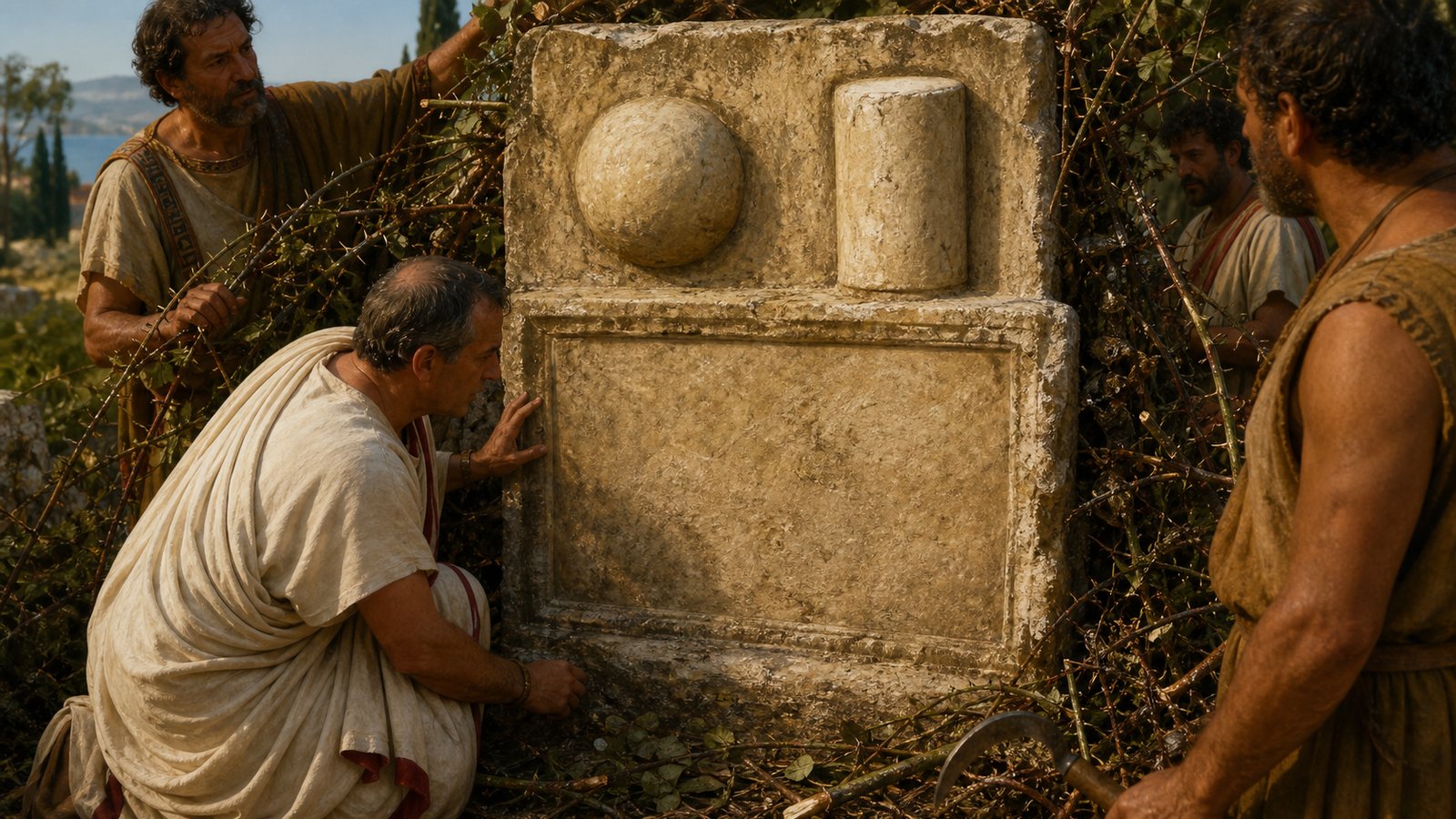
The remembered verses supplied that feature. Cicero had been informed that Archimedes’s monument carried a sphere and cylinder at its top. The clue was simple enough to hold in memory and rare enough to guide a search. It did not require the inscription to remain readable from a distance.
Plutarch explains why those forms belonged together. Archimedes, he says, asked his friends and kinsmen to put a cylinder enclosing a sphere above his grave. An inscription would state the proportion by which the containing solid exceeded the contained one. The monument was meant to carry a mathematical relationship, not merely a generic badge of learning.
That specificity gave the emblem unusual durability. Names can weather away letter by letter. A portrait can lose its face. A sphere paired with a cylinder can remain identifiable even when edges soften and context disappears. Cicero needed no claim that the sculpture was untouched. He needed only enough form to match the description he remembered.
The device resembles a physical index. Readers looking for related mechanisms can follow the weights and hidden air behind Archytas’s wooden dove; Cicero followed geometry into a burial ground. In each case an abstract reputation becomes legible through a deliberately constructed object.
The Briars Had Hidden a Monument, Not Erased It
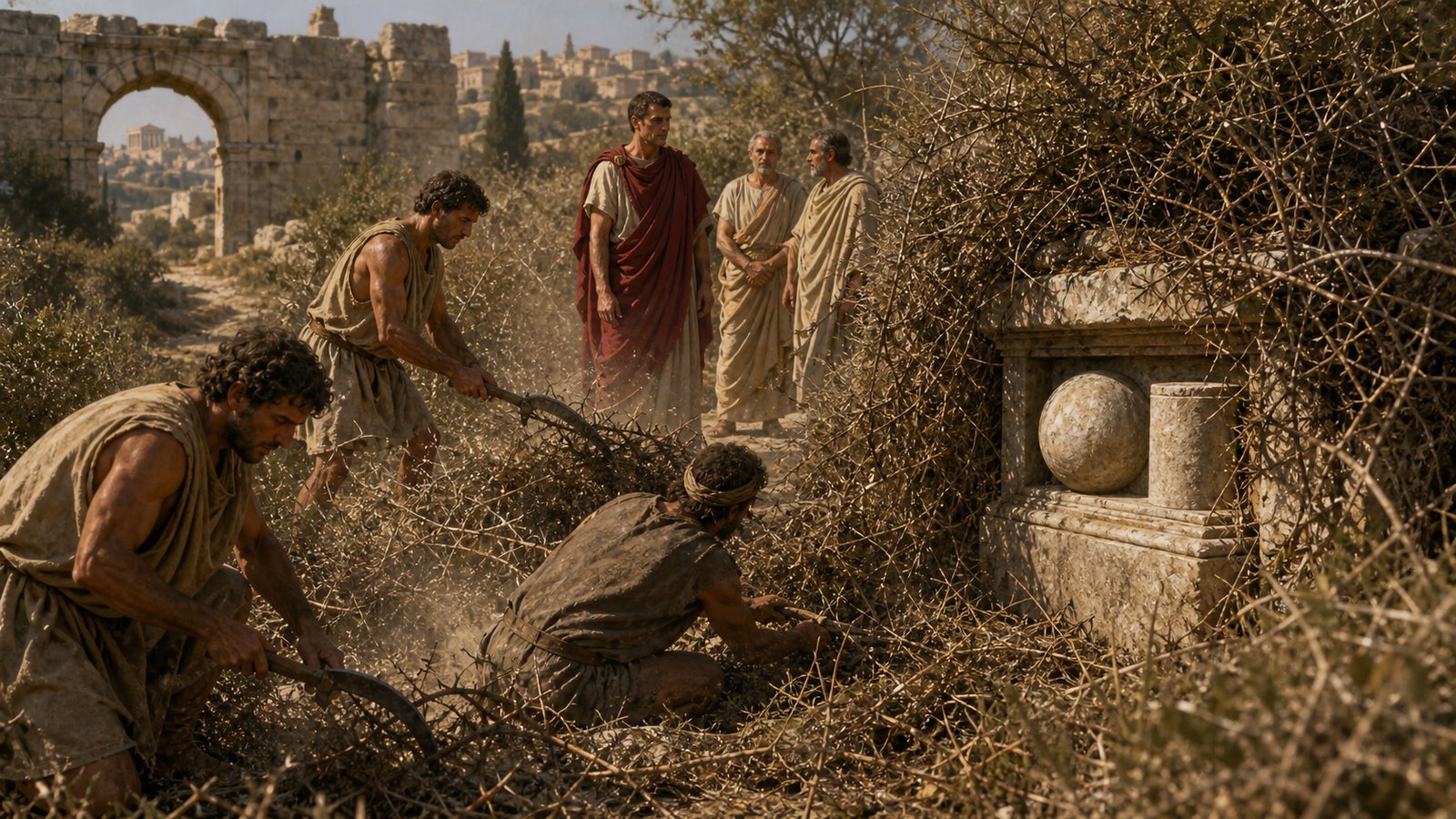
Cicero says a small column stood out a little above the briars. That detail controls the scene. The tomb was not majestically waiting to be admired, and it had not vanished below the earth. It occupied the narrow condition between visibility and disappearance. One recognisable fragment remained exposed to the right observer.
Some of Syracuse’s principal men were with Cicero when he identified it. He told them that the column was probably what he had been seeking. Only then did several men go in with scythes. They cut the vegetation, cleared a path, and made an opening through which the group could approach.
The discovery therefore had two stages. Recognition came first: shape matched remembered description. Access came second: bodies and blades altered the overgrown site enough to test the match. Without the first stage, clearing would have been aimless. Without the second, the geometric clue would have remained an attractive guess glimpsed through thorns.
At the front of the pedestal, Cicero found the inscription. The ends of its verses were almost half effaced. The damaged text did not independently announce itself from afar; it became useful after image and location had narrowed the search. Archaeological evidence here works as a bundle whose parts compensate for one another.
Archimedes Had Chosen the Memory He Wanted
Plutarch’s portrait makes the grave design feel personal. He describes Archimedes as absorbed by geometry to the point of forgetting meals and neglecting his appearance. When others dragged him to bathing and anointing, he traced figures in ashes and drew lines in the oil on his body. The anecdote is literary, but its purpose is clear: geometry occupied his attention even in ordinary physical routines.
The requested sphere and cylinder continued that self-definition after death. Archimedes had built engines that defended Syracuse, but Plutarch insists that he regarded such machines as accessories to a higher geometry. The grave did not advertise a claw lifting a ship or a stone-thrower on the wall. It selected a theorem.
That choice shaped what Cicero could recover. A military emblem might have merged with Syracuse’s broader memory of siege. A portrait might have required a surviving name. The paired solids carried the mathematician’s priorities in a form that a reader of old verses could connect with one neglected monument.
Other Roman public objects also turned knowledge into material form. Bronze vessels that tuned a stone theatre made acoustic theory part of architecture. The sphere and cylinder did something quieter: they made a theorem into a durable signature.
Cicero Turned Recovery into a Contest over Memory
Cicero ends with a pointed boast. One of Greece’s noblest cities, once celebrated for learning, knew nothing of its greatest genius’s monument until a man from Arpinum showed it to them. The line elevates Cicero as a learned Roman while embarrassing Syracuse for neglecting a citizen it should have remembered.
That rhetoric warns against reading the scene as a neutral excavation report. Cicero is the narrator, discoverer, and beneficiary of the story. The Syracusans’ failure makes his memory look sharper. The ruined inscription makes his literary education look practical. Even the foreignness of Arpinum helps him argue that cultivated attention can outrank inherited proximity.
Yet the boast depends on cooperation. Local principal men accompanied him. Workers with scythes opened the route. A monument commissioned by Archimedes’s circle supplied the symbol. Earlier informants had preserved the verses Cicero recalled. No single person carried the whole chain, although Cicero places himself at its decisive link.
The tomb story survives because it gives memory a visible mechanism. A theorem became a relief; a relief became a clue; a clue directed cutting; cutting exposed an inscription; and the inscription became part of Cicero’s argument about a thoughtful life. Forgetting was real, but it was not complete.
Sources
Cicero, Tusculan Disputations, Book 5, sections 64–66. Plutarch, Life of Marcellus, chapter 17.