
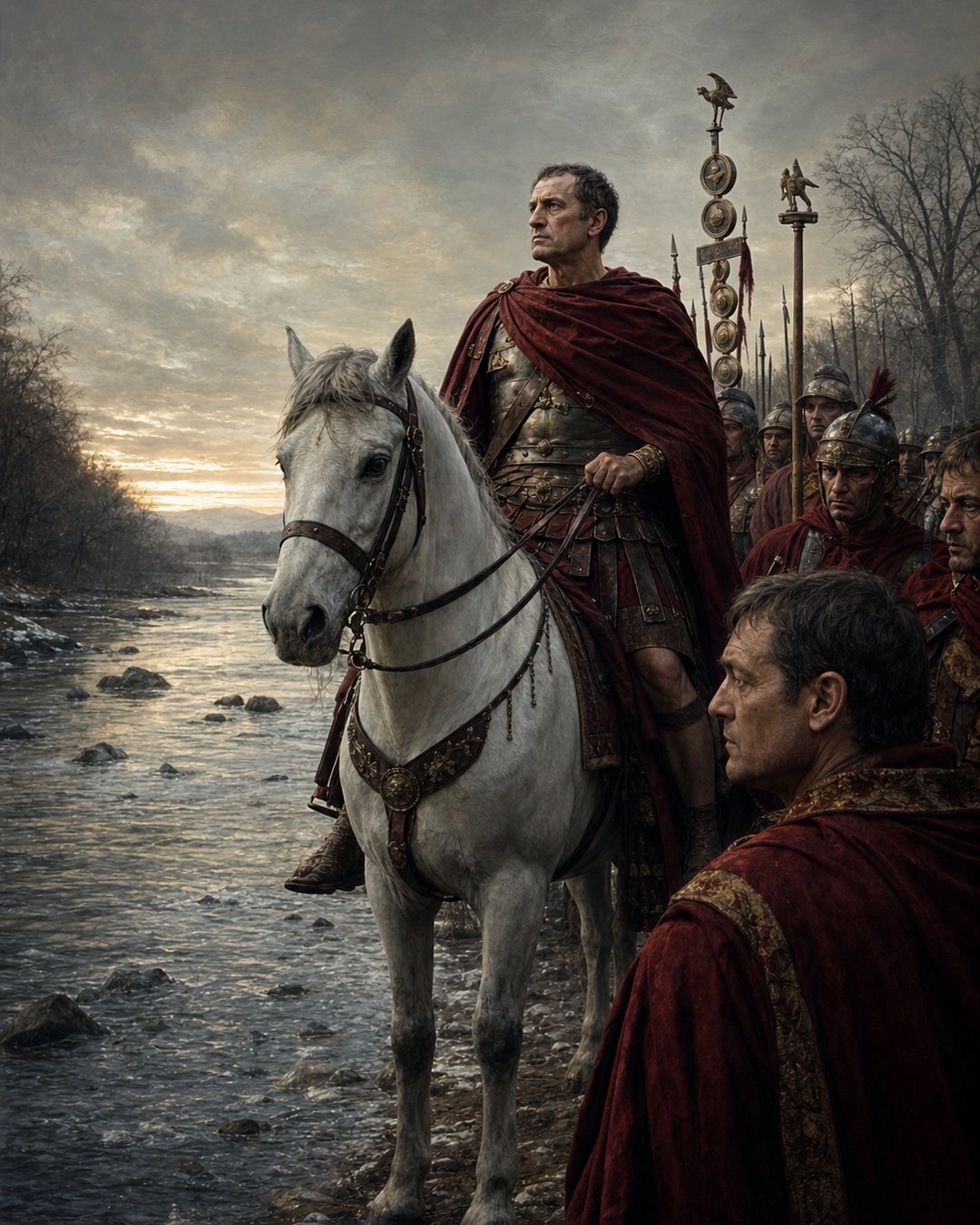
The Rubicon was not impressive because of its width. It was impressive because of what Romans had made it mean. In 49 BC, Julius Caesar stood at the edge of a boundary between his provincial command and Italy. On one side, he was a victorious commander with loyal troops and a political case. On the other, he would become a man bringing an army into the homeland against the will of his enemies. The water was small. The line was enormous.
That is why the crossing survives as more than a dramatic travel scene. Caesar did not merely move soldiers from one bank to another. He turned a dispute over command, immunity, honor, and political survival into an irreversible military act. Before the crossing, negotiation could still pretend to exist. After it, every Roman had to decide what kind of illegality frightened him more: Caesar’s armed advance, or the senatorial pressure that Caesar said had left him no safe return.
The river marked a legal edge
The Rubicon mattered because it marked the boundary between Caesar’s province and Italy. Roman commanders were not supposed to bring armies into Italy without authorization. That rule was not a technicality. It protected the city from generals who might use provincial troops as private political weapons. Rome had learned to fear successful commanders who returned with men more loyal to them than to the Senate’s procedures.
Caesar’s Gallic command had made him rich in victories, reputation, and soldiers’ loyalty. It also made his return dangerous. If he came back as a private citizen without office or protection, enemies could prosecute him. If he kept command, he remained politically armed. The crisis formed around that knot: Caesar wanted security and honor; his opponents wanted him disarmed before he reentered ordinary politics.
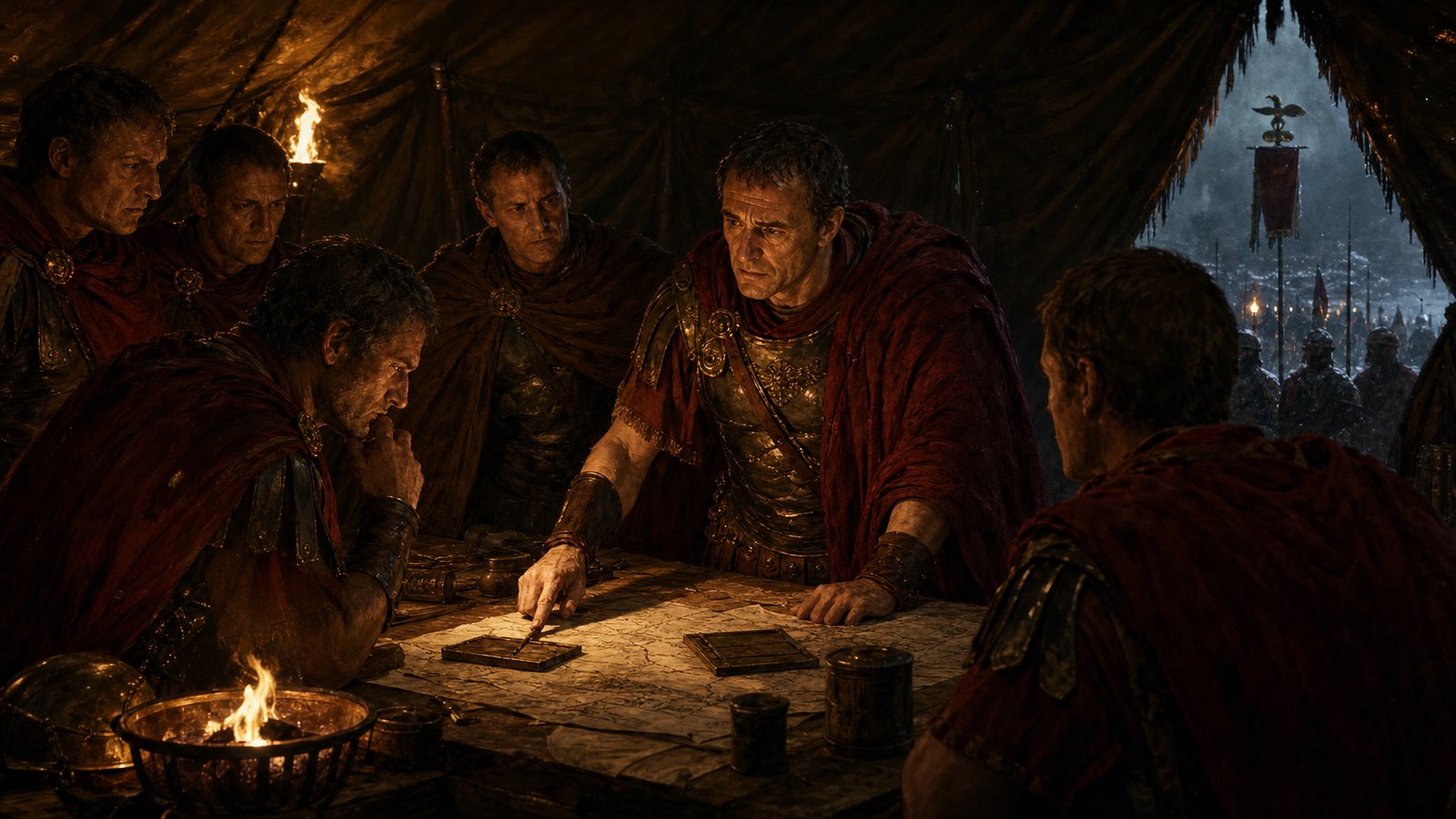
A small crossing made private loyalty public
The act of crossing exposed the real power of Caesar’s army. Soldiers who had followed him in Gaul now followed him toward Italy. Their movement told the Senate that Caesar’s political position was not only an argument in letters and speeches. It had feet, standards, swords, and a chain of command.
That public movement mattered more than any slogan. A commander could claim to defend his dignity. Opponents could claim to defend the Republic. But once troops crossed the line, the argument acquired weight. Towns, magistrates, and rival leaders had to respond to facts on the road. Caesar had converted uncertainty into momentum.
Ancient writers remembered hesitation
Plutarch describes Caesar reflecting at the river before deciding. Suetonius preserves the phrase that the die was cast. Whether the exact words were spoken as later remembered matters less than the scene those writers wanted readers to see: a commander understanding that he was passing beyond easy recall.
The pause is important because it keeps the story from becoming simple ambition. Caesar risked condemnation as a rebel, defeat by Pompey, ruin for his supporters, and the possibility that his own soldiers might hesitate once the political meaning of the march became clear. He also risked forcing Rome into a war from which no faction could emerge innocent.
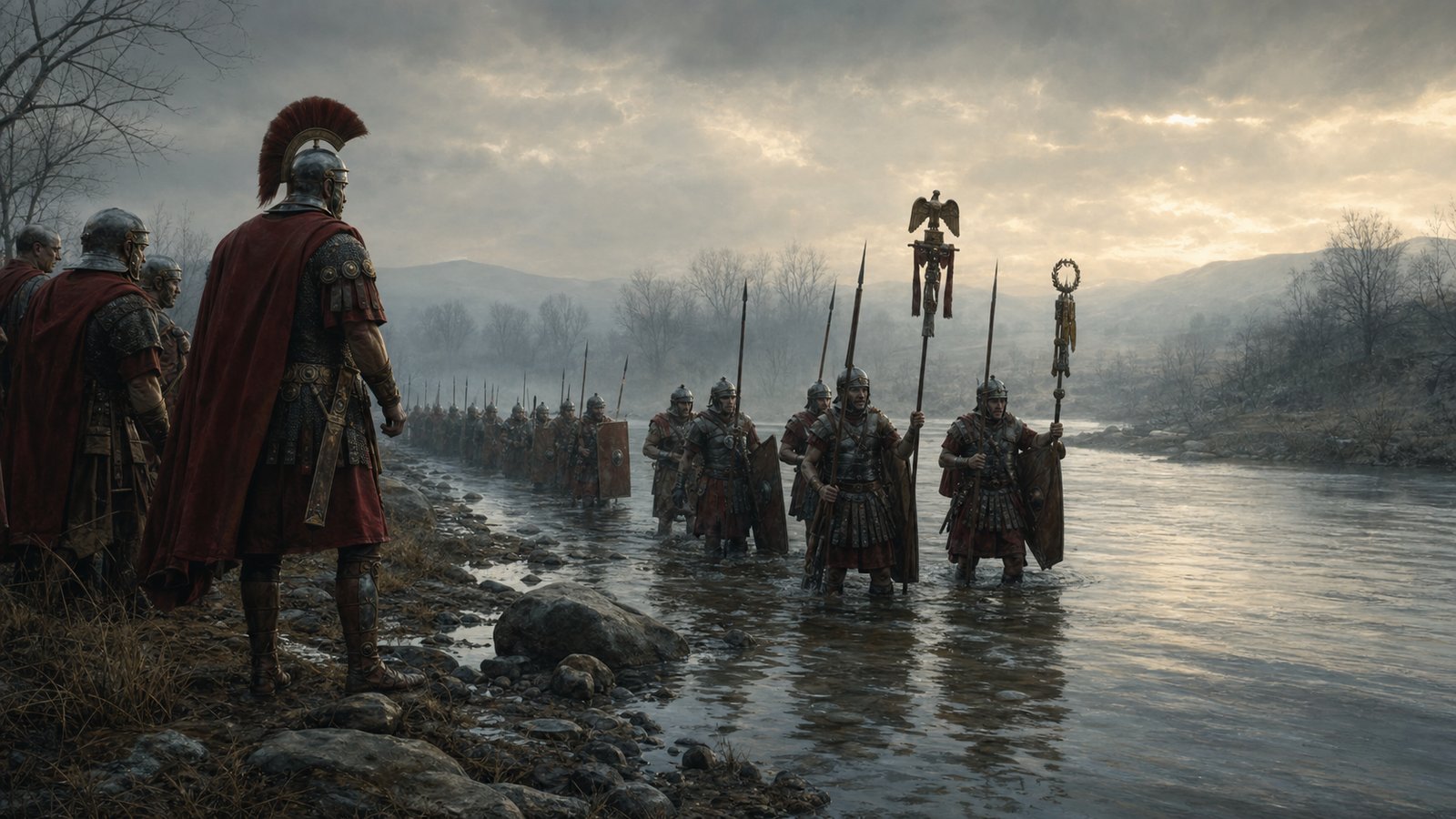
Pompey made the risk larger
Caesar’s rival was not an ordinary senator. Pompey had been the great commander of the previous generation, a man with military prestige, clients, and authority across the Roman world. A conflict with Pompey meant that Caesar was not simply bullying a frightened committee. He was challenging another giant of late Republican power.
That is why the Rubicon belongs to a wider collapse. The Republic had produced commanders too large for its political habits. It relied on law and custom, but it rewarded men who gathered armies, wealth, and personal loyalty on Rome’s frontiers. When those men returned to political conflict, the old rules could look fragile beside the reality of command.
The real risk was making return impossible
Caesar risked more than his life. He risked defining himself in a way that could not be undone. If he won, he would have shown that a general could force a settlement by marching. If he lost, he would be remembered as a criminal enemy of the state. If Rome survived the war, it would survive with the memory that law had needed armies to interpret it.
That is why a modest river became one of history’s strongest metaphors. The Rubicon was not a magical stream. It was a line where political language gave way to military fact. Caesar’s gamble was that speed, loyalty, and necessity would matter more than the accusation of illegality. Once he crossed, Rome could still argue about who was right. It could no longer pretend the argument was peaceful.
The gamble depended on speed as well as courage
Once Caesar crossed, delay became dangerous. His advantage lay in turning a political shock into movement before opponents could organize a calm answer. Roads, messengers, town loyalties, and the reputation of his veterans now mattered as much as arguments in Rome. The crossing did not win the civil war by itself, but it seized the first narrative: Caesar was coming, and everyone had to respond.
The legal problem therefore became a psychological problem. Men who might have preferred compromise had to choose under pressure. Pompey and the senatorial leaders could not treat the matter as a normal dispute once a commander was moving through Italy. Caesar had risked being named a public enemy, but he had also forced his enemies to reveal whether their authority could command obedience without the same speed.
That is why ancient writers made the moment so theatrical. The pause, the river, and the phrase about the die all show a man crossing from argument into consequence. Whether the exact words were remembered correctly, the shape of the story is historically true. Caesar’s decision made retreat harder for everyone, including Caesar himself.
Why the detail still matters
The article’s central point depends on concrete evidence rather than a modern slogan. A named person, a dated reign or crisis, a physical setting, and an ancient-source detail give the story its weight. Without those anchors, Roman history turns into a parade of familiar legends. With them, the legend becomes a clue to how Romans explained power, fear, status, and memory.
That is also why the surviving ancient sources must be used with caution rather than discarded. Suetonius, Tacitus, Plutarch, Cassius Dio, and Appian often wrote with moral purpose, political memory, or hindsight. Their anecdotes may sharpen a scene, but the sharpening itself tells us what later Romans thought the scene meant. The safest reading keeps both truths in view: the exact detail needs scrutiny, and the fact that Romans preserved it still reveals the pressure points of their political world. For readers, the payoff is a firmer kind of curiosity: not whether the story is simply true or false, but why this particular story became the one Romans remembered. It also keeps the writing honest: the article can be vivid only where the fact sheet has supplied real names, dates, places, institutions, and sourceable scenes.
Sources & Further Reading
- Britannica, Julius Caesar
- Britannica, Rubicon
- Plutarch, Life of Caesar, 32
- Suetonius, Julius Caesar, 32
- Britannica, Pompey the Great
- Appian, Civil Wars, 2.35