
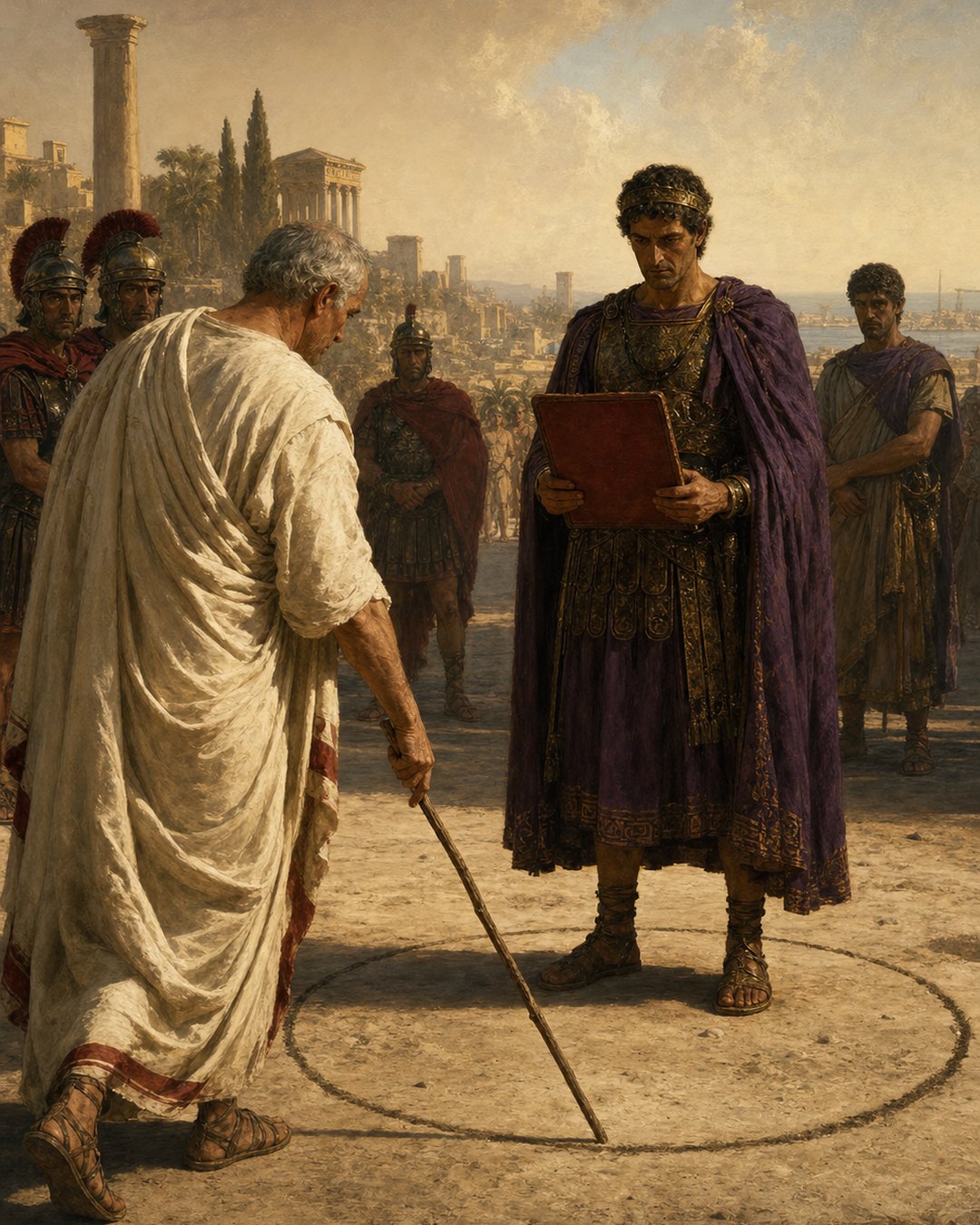
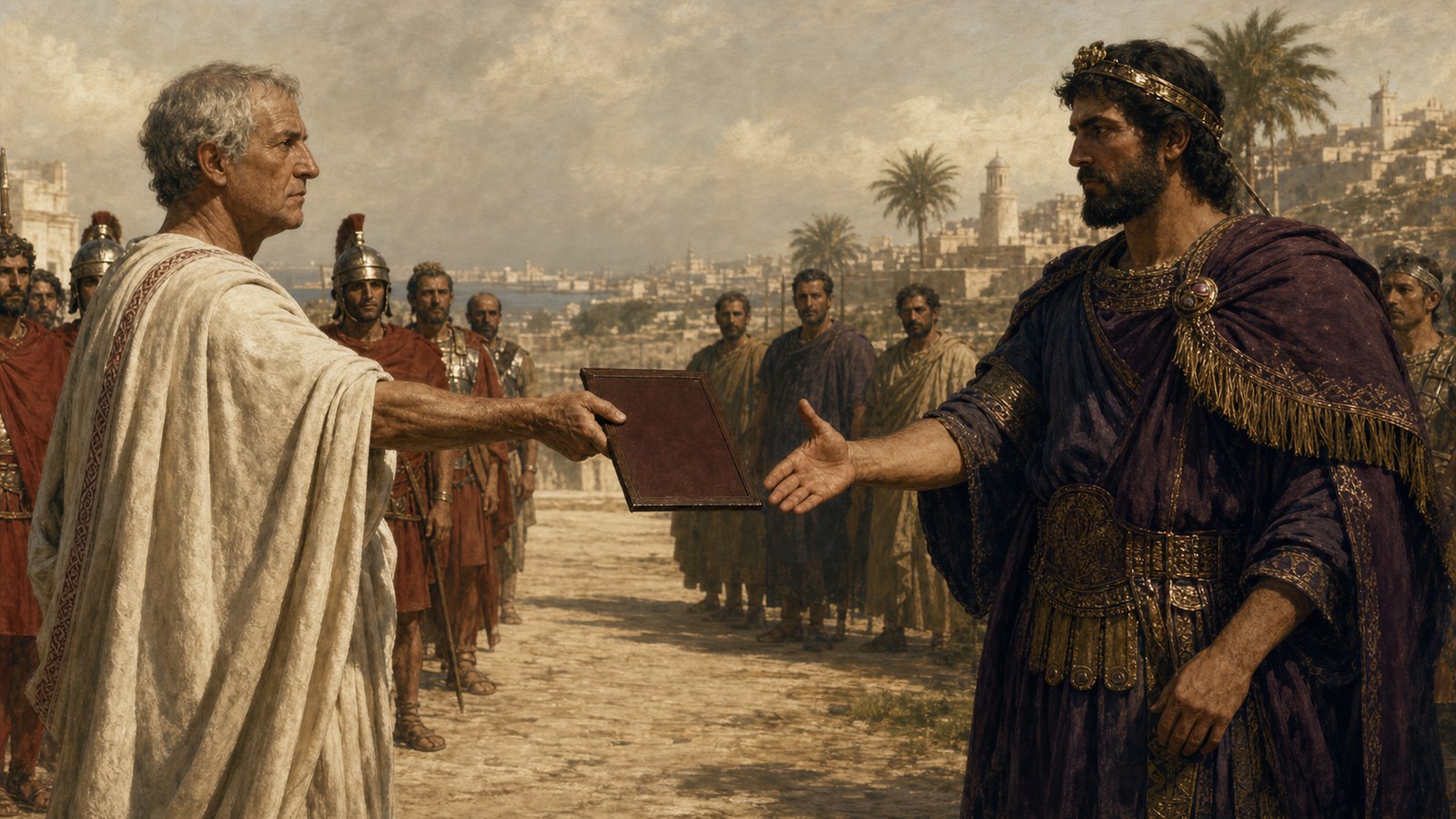
Antiochus IV approached the Roman delegation as a king close to possessing Egypt. Near Eleusis, four miles from Alexandria in Livy’s account, he greeted the envoys and extended his right hand to Gaius Popilius Laenas. The Roman did not take it. Instead, he put a written decree of the Senate into the king’s hand and told him to read.
The order demanded an end to the war with Ptolemy. Antiochus asked to consult his friends. Popilius answered with a vine stick. He scored a circle around the king in the dust and required a decision before Antiochus stepped outside it. After a pause, the king agreed to obey. Only then did the Romans clasp his hand and greet him as a friend.
The scene is remembered as a line in the sand, but its force did not come from the line alone. Paper, gesture, distance and timing worked together. Rome’s envoy suspended friendship, enclosed delay within a physical boundary, and made compliance the condition for restoring ordinary diplomatic courtesy.
The first refusal happened at the handshake
Antiochus’s offered hand was not a casual movement. It proposed the conventional sign of friendship before the Roman demand had been heard. Polybius explains Popilius’s reasoning: the envoy did not think it proper to exchange that sign until he knew whether the king’s intentions were friendly or hostile.
That turned greeting into a test. If Popilius had taken the hand first, the two men would have acknowledged friendship and then begun arguing about the decree. By withholding his own hand, the Roman rearranged the encounter. Antiochus had to receive the Senate’s words before he received the Senate’s courtesy.
The written tablet was therefore more than a message carrier. It occupied the place where the king expected a hand. Livy and Polybius preserve the same sharp sequence: approach, offered right hand, document delivered, reading required. The interruption announced that personal warmth could not soften the public instruction.
Roman treaty making could surround agreement with objects and prescribed acts, as in the oath sealed with a flint stone and a sacrificed pig. At Eleusis the object was plainer, but the logic was comparable. Conduct became visible through a small ordered performance that separated the friendly party from the potential enemy.
The Senate’s decree arrived behind a Macedonian victory
The embassy was not operating in a vacuum. Polybius first says the Senate sent Popilius after hearing that Antiochus had mastered Egypt and nearly Alexandria. The task was to terminate the war and inspect the position. By the time of the confrontation, however, the wider balance had changed decisively.
Rome’s war against Perseus of Macedon had been decided. Polybius explicitly argues that Antiochus would not have obeyed had he not been certain of Perseus’s fate. That judgment explains why a few Roman envoys could issue a demand without an army visibly deployed around the Seleucid king. The military force behind the words was elsewhere, but its result had reached the meeting.
The circle did not magically create Roman power. It concentrated news of that power. Antiochus had advanced through Egypt toward Alexandria, and his own troops remained the immediate armed presence. Yet resistance now meant challenging a republic that had just removed a major Macedonian opponent. The king’s calculation had altered before Popilius touched the ground.
This distinction matters because the anecdote can otherwise shrink strategy into personal audacity. Popilius behaved with extraordinary bluntness, and Polybius calls the act offensive and exceedingly arrogant. Still, the gesture worked because Antiochus understood the consequences beyond the dust. The stick supplied form; Macedonia supplied credibility.
A request for consultation became a bounded delay
After reading, Antiochus did not reject the decree. He asked to communicate with his friends. Consultation was a reasonable royal response to a demand involving an army, conquered territory and relations with another dynasty. It also postponed commitment and moved the decision away from the envoy’s immediate control.
Popilius’s circle denied that movement. Polybius says the envoy used a stick cut from a vine; Livy calls it the wand he held. With it, he drew around Antiochus and required an answer before the king left. The boundary converted an open-ended discussion into a choice that had to occur on the spot.
No wall held Antiochus. He could physically cross the line. What made the circle binding was the meaning Popilius attached to crossing without an answer. Stepping out would no longer be neutral movement toward advisers. It would be a visible refusal to satisfy Rome’s representative while standing before witnesses.
The device was effective because it was simple enough for everyone present to understand. A long diplomatic exchange might distribute responsibility across interpreters, counselors and revised formulas. The circle left one body inside and one decision pending. It made the king himself the location of the answer.
Friendship returned only after submission
Antiochus hesitated. Polybius says he was astonished by the authoritative proceeding; Livy calls the command peremptory. After that pause, he declared that he would do what the Romans demanded. The response satisfied the condition Popilius had built into the encounter.
Then the withheld greeting returned. Popilius and his suite grasped the king’s hand and greeted him warmly. This second handshake cannot be separated from the first refusal. Before the decree, friendship was uncertain. After compliance, it was ceremonially restored. The same gesture that had been denied now marked Antiochus as an ally rather than an adversary.
The choreography resembles other Roman stories in which status is staged through the body. Tiridates’s kneeling submission before Nero made settlement legible through posture, costume and audience. At Eleusis the king did not kneel, but the delayed handclasp likewise translated a geopolitical outcome into an action that observers could remember.
Polybius’s discomfort remains important. He does not present the envoy’s conduct as gracious. Calling it arrogant keeps the reader from mistaking success for tact. Rome offered Antiochus a friendship whose immediate price was obedience, and Popilius made the price impossible to discuss at leisure.
The small circle redirected armies beyond Egypt
The answer produced movement on a much larger scale. Polybius says the decree ordered the war ended at once and that Antiochus received a fixed number of days. Hurt and complaining, he led his army back toward Syria. Livy likewise records withdrawal on the appointed day.
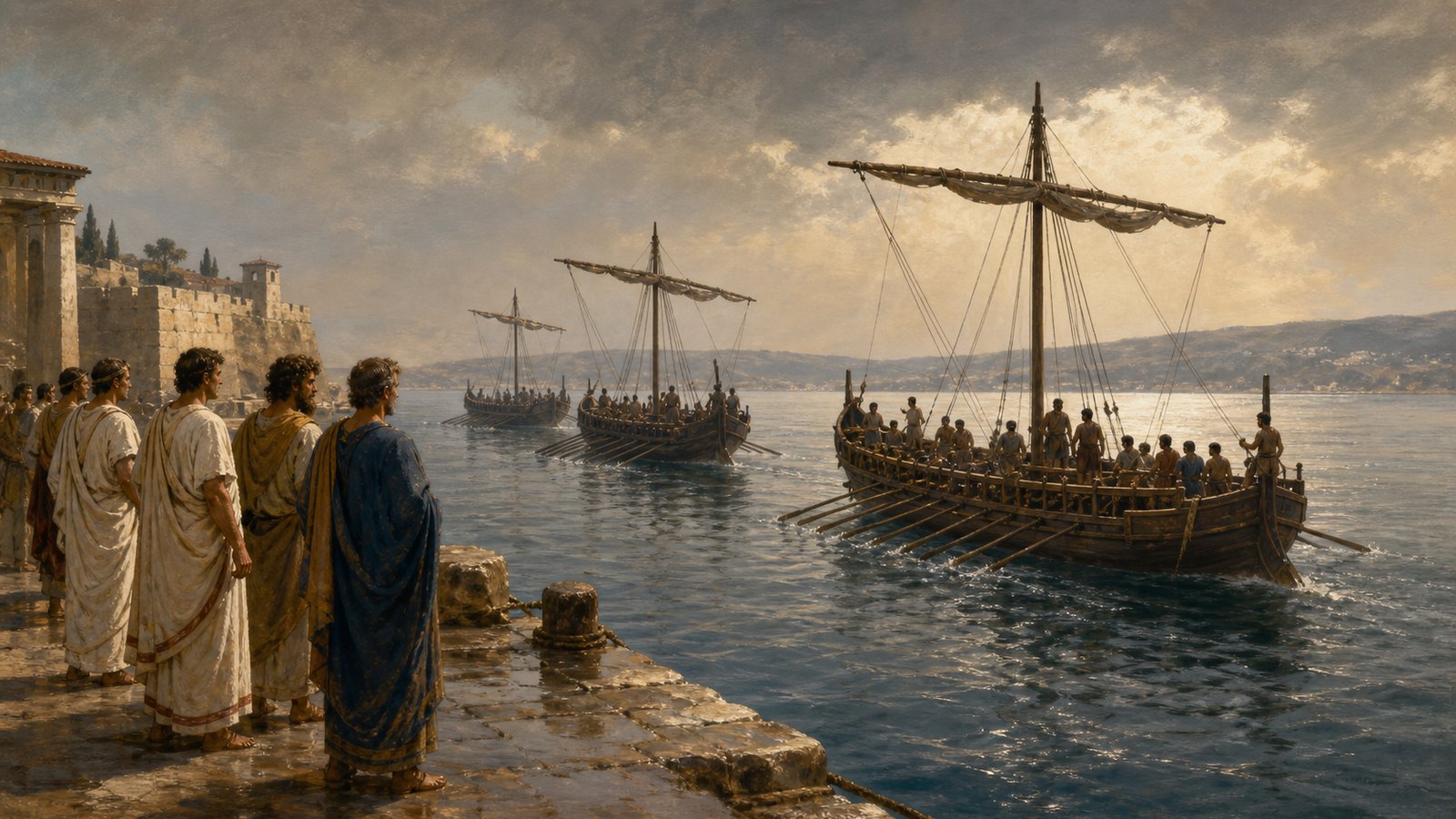
The envoys did not stop at the meeting. They helped confirm arrangements between the Ptolemaic brothers and then sailed to Cyprus. There, according to the sources, they compelled or supervised the departure of Seleucid forces and ships. The settlement reached from the road near Alexandria across the eastern Mediterranean.
Livy describes the Egyptian concord as unfinished until Roman influence reinforced it. Cyprus was not an ornamental sequel either: Antiochus’s fleet had defeated an Egyptian force there, and the ambassadors remained until the Seleucid presence departed. The diplomatic answer demanded from one king thus became a monitored withdrawal at two connected fronts, not merely a promise accepted beside a road.
That aftermath shows why the encounter was not merely an insult exchanged by two proud men. The document contained operational demands, the king accepted them, and Roman agents followed through in another theater. The circle’s memorable shape can obscure the administrative tail: deadlines, troop withdrawal, dynastic settlement and the evacuation of Cyprus.
Popilius had drawn no new frontier. His mark lasted only in dust, but it clarified a political boundary. Antiochus could remain Rome’s friend only by ending the campaign that had brought him close to Alexandria. The king crossed out of the circle after answering, while his army soon crossed out of Egypt. A vine stick did not conquer the territory; it made Rome’s terms impossible to leave unanswered.
Sources
Polybius, Histories, 29.2 and 29.27.
Livy, History of Rome, 45.12.