
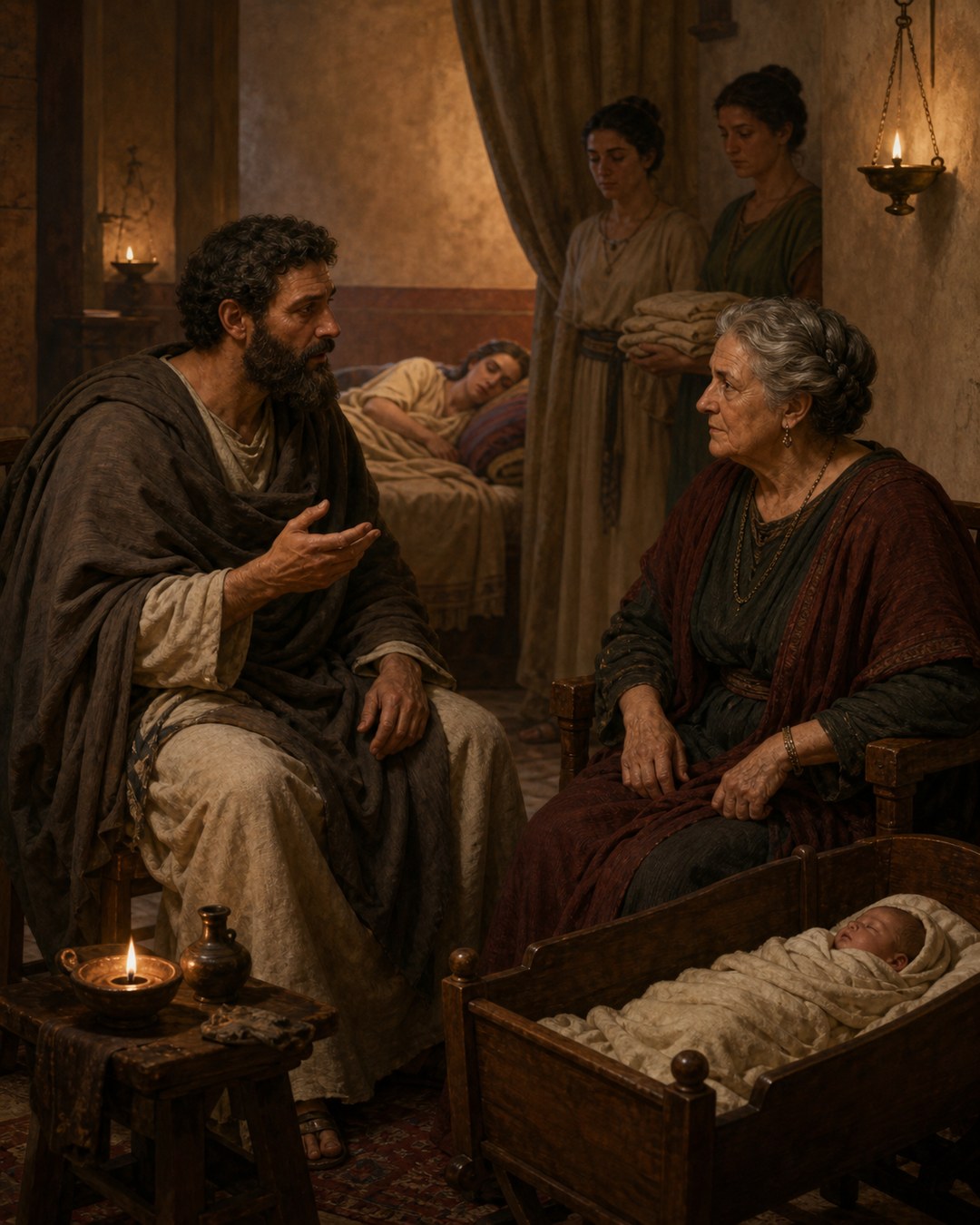
A young mother slept after a long, difficult labor. In another part of the house, the philosopher Favorinus asked whether she would nurse her newborn son herself. Her own mother answered for her: the daughter had suffered enough, and wet nurses should take over the additional work.
Aulus Gellius says he stood among the visitors. The father was a senator from a highly noble family; the baby was a boy; the woman was exhausted by fatigue and wakefulness. Favorinus then delivered a long argument about milk, nature, character and affection. The sleeping woman receives no line in the scene.
This is not a transparent record of Roman medical consensus. It is a crafted chapter in Attic Nights, preserving a celebrated speaker’s Greek address through Gellius’s Latin. Read carefully, it shows several systems meeting beside one cradle: postpartum recovery, elite household resources, philosophical rhetoric, ancient physiology and prejudice about the people hired or compelled to perform intimate care.
The visit began with congratulations to the father
News of the birth reached Favorinus while Gellius was present. The woman was married to one of the philosopher’s auditors and disciples. Favorinus proposed that they go see the child and congratulate the father, and the group followed him to the house.
Gellius marks the household’s rank before the debate starts. The father belonged to the senate and to a family of high nobility. That detail explains why multiple nursing arrangements were imaginable. The family could provide other women to feed and care for the newborn rather than treating the mother’s labor as the only available resource.
Favorinus embraced and congratulated the father on entering, then sat down. He asked how long the labor had lasted and how difficult it had been. The answer established the mother’s condition: fatigue and lost sleep had overcome her, and she was resting.
The sequence makes her absence concrete rather than accidental. The visitors know the cost of the birth and know why she cannot join them. Yet knowledge about her exhaustion becomes the preface to a discussion over what work her body should perform next.
A grandmother made the argument for recovery
Favorinus announced that he had no doubt the mother would nurse her son herself. The young woman’s mother resisted. Her daughter should be spared, she said, and nurses should be found so the painful labor of childbirth would not be followed by the wearisome difficulty of nursing.
That reply is the chapter’s shortest practical case. It begins from bodily depletion and treats feeding as labor rather than instinctive symbolism. The grandmother does not deny attachment to the baby. She asks the household to use its resources so recovery from childbirth is not immediately loaded with another demanding task.
The scene sits just beyond the work described in the archive’s article on Roman midwives. Birth does not end the allocation of care. Once the immediate danger has passed, the household still has to decide who feeds, watches and physically attends the infant.
Gellius does not tell us whether the grandmother had nursed her own children, employed nurses or been overruled in similar circumstances. Her stated reason is enough: she uses the daughter’s recent suffering as evidence. Favorinus answers by changing the scale of the argument from recovery to the moral meaning of motherhood.
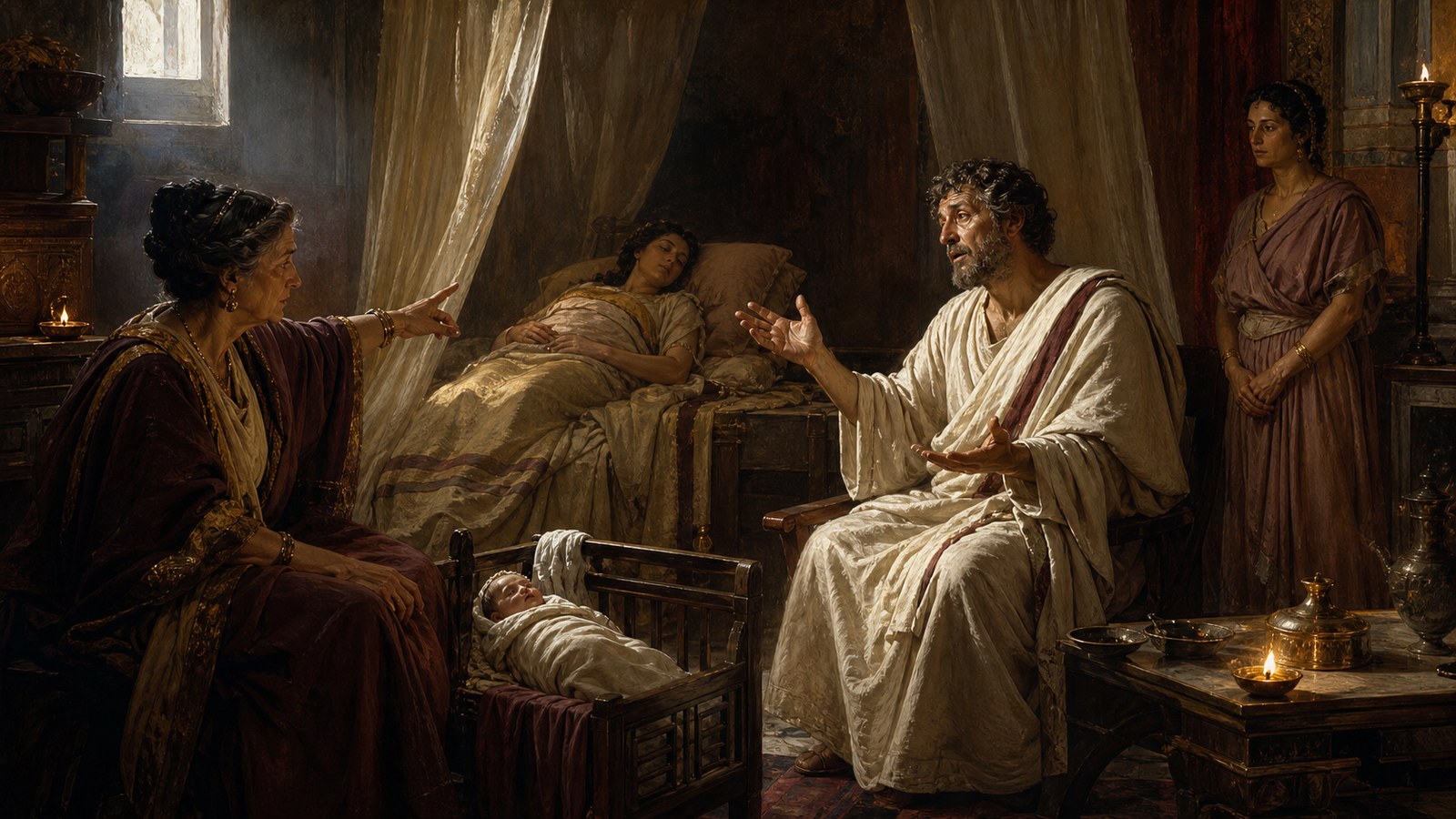
Favorinus turned feeding into a test of complete motherhood
The philosopher asks the grandmother to let her daughter be wholly and entirely the child’s mother. He treats birth without maternal nursing as an incomplete continuation: a woman has nourished an unseen child in the womb, so he argues that she should feed the visible newborn with her own milk.
His language is deliberately forceful. It invokes bodily purpose, condemns women who suppress lactation for beauty and compares the refusal to nurse with ending a pregnancy. Those are Favorinus’s claims inside Gellius’s literary presentation, not conclusions established by the narrator through medical evidence.
The rhetoric works by narrowing choice. The grandmother’s proposal is a response to fatigue; Favorinus reframes it as a question of whether the woman will accept full motherhood. Once the issue is defined in those moral terms, rest can be made to look like rejection and delegated care like a defect of character.
There is an important asymmetry here. The grandmother must justify protecting the exhausted woman. Favorinus does not have to explain why a visiting philosopher should define another household’s maternal obligations. Eloquence itself supplies authority, and Gellius devotes most of the chapter to preserving that performance.
Ancient physiology carried class prejudice into the nursery
Favorinus supports his case with a theory of the body. He says the blood that formed the fetus moves upward after birth, changes color through air and becomes milk. He then argues that milk can shape body and mind in something like the way seed shapes the developing child.
Animals and plants become his analogies. Kids fed by ewes and lambs fed by goats allegedly change the qualities of hair and wool. Trees and grain, he says, can be altered more by nourishing water and soil than by their original seed. These comparisons present feeding as a second formation rather than simple sustenance.
Modern readers should not mistake the analogy for established physiology. Its historical value lies in what Favorinus could make it do. If milk transmits disposition, selecting a nurse becomes a judgment about the nurse’s whole person. The speech then moves openly into elite stereotypes about enslaved status, foreign origin, appearance, sexuality and drinking.
Those insults reveal the social hierarchy behind the recommendation. Wet nursing could shift intimate labor away from an elite mother, but Favorinus imagines the other woman as a contaminating influence. The nurse is essential enough to provoke anxiety yet denied a neutral body. Her milk becomes a vehicle for fears about class and belonging.
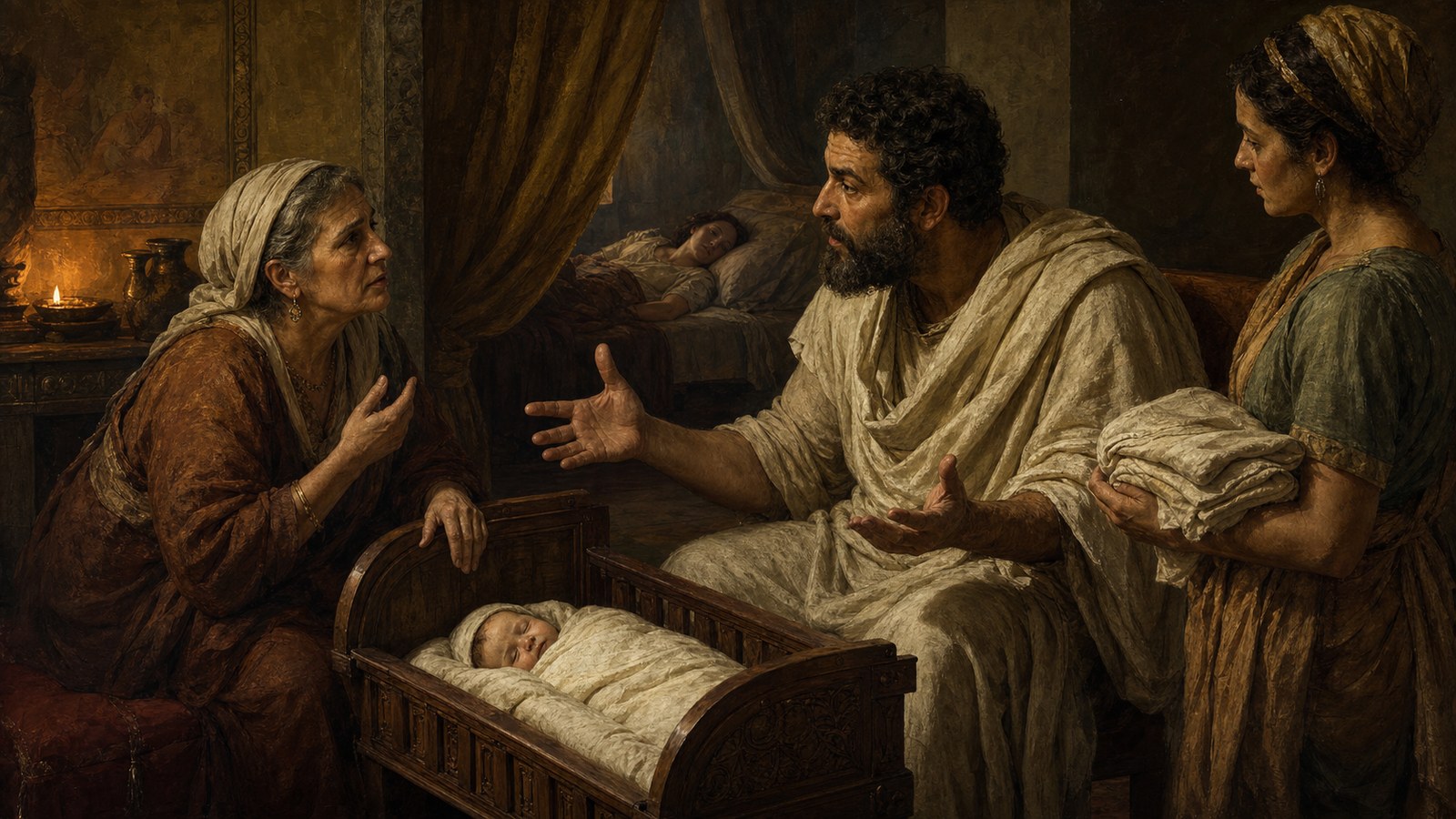
Gellius preserved the speech and exposed its imbalance
Favorinus ends by claiming that nursing creates affection in both directions. A mother who sends the child away may lose ardor through distance, while the infant attaches to the person providing daily nourishment. The argument recognizes that repeated care builds intimacy, even as it uses that recognition to condemn delegation.
That claim can be separated from the speech’s physiological and social prejudices. Care does create time, touch and familiarity. Roman households could organize those experiences through mothers, wet nurses, enslaved carers and wider kin. The legal reorganization of family in Roman adoption offers another reminder that parenthood was never only a biological fact.
At the chapter’s close, Gellius tells us that he heard Favorinus speak in Greek. He reproduced the ideas in Latin, he says, but could not match the original’s elegance, abundance and richness. The disclaimer places another layer between the room and the reader: remembered speech, translated and shaped for a literary collection.
We never hear the young woman wake. Gellius does not record whether she agreed, objected, nursed, used nurses or combined arrangements. That silence cannot tell us what she thought, but it does tell us how the story distributes attention. The philosopher’s voice fills pages; the grandmother gets a practical objection; the mother’s exhaustion is described by others.
The chapter therefore preserves more than advice about infant feeding. It shows how care became a subject on which status, gender and philosophy claimed authority. Beside the cradle, one woman argued that a body needed recovery, while a celebrated man turned that body into a moral and biological theory. The most important absence is not evidence to fill with invention. It is the boundary of the source.
Sources
Aulus Gellius, Attic Nights, 12.1.