
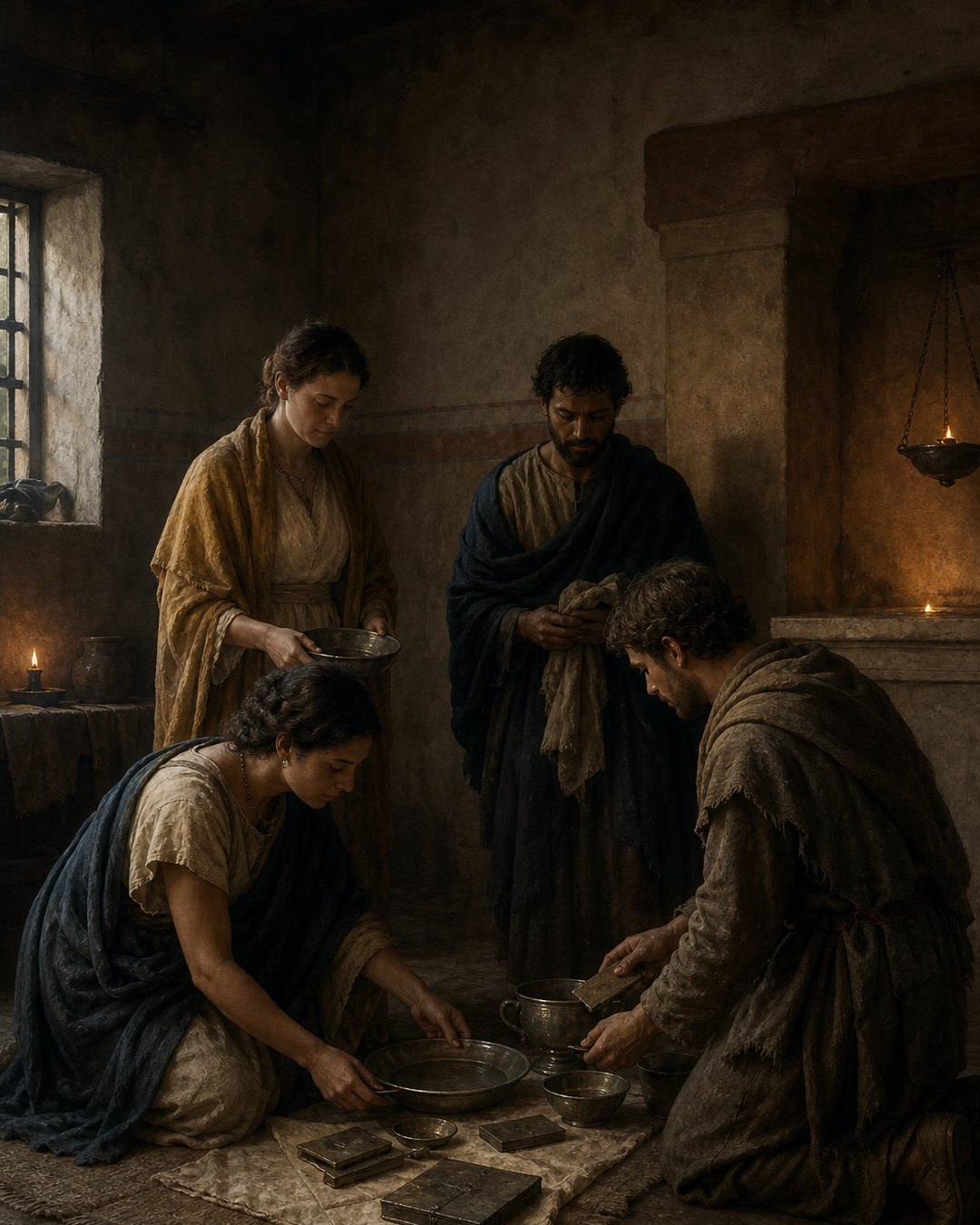
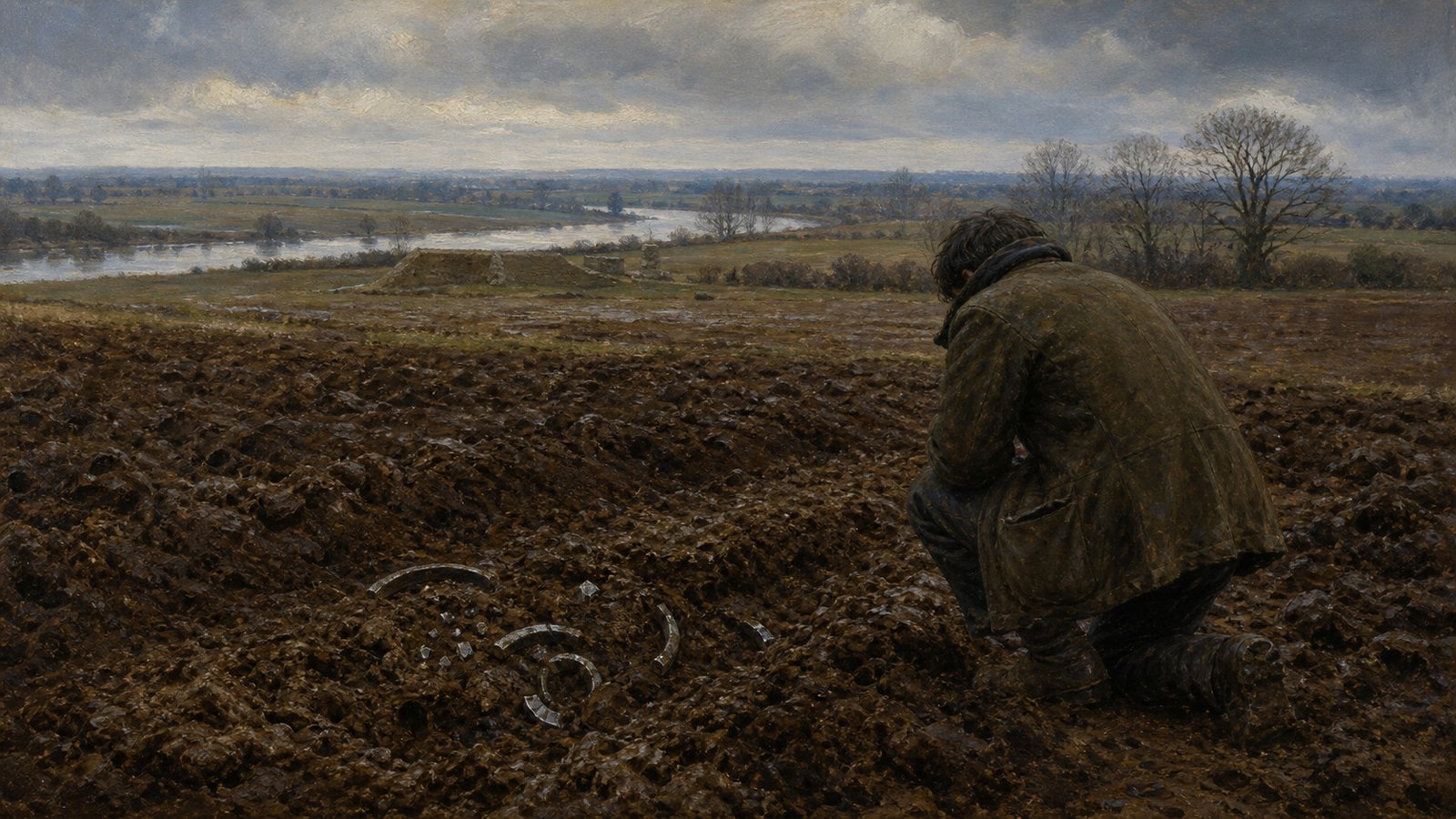
A plough moved through a field beside the River Nene in February 1975 and struck the remains of a Roman community’s precious metal. The first pieces did not gleam. Darkened, bent and damaged by agriculture, they could be mistaken for lead or pewter. They proved to be silver, part of a deposit hidden within the lost town of Durobrivae.
The group now called the Water Newton Treasure contains twenty-seven silver objects and one small gold disc. Nine vessels sit beside thin votive plaques and fragments. Christian signs recur across the metal, but the most intimate evidence is alphabetical: Publianus, Innocentia, Viventia and Amcilla. Four people who left no biographies survive through offerings.
The hoard therefore changes scale twice. It pulls late Roman Christianity out of imperial policy and into one British town, then pulls that town out of abstraction and into named acts. Yet the deposit also demands restraint. Christian ownership is clear; the exact use of every cup and bowl is not. The strongest history begins where certainty and uncertainty separate cleanly.
A Plough Broke the Silence Above a Roman Town
Durobrivae lay near Water Newton, about seven kilometres west of modern Peterborough. Ermine Street crossed the River Nene nearby, placing the settlement within routes of movement and exchange. Pottery production made the surrounding landscape economically important, even though the remains now sit largely beneath fields rather than a living street plan.
In February 1975, Alan Holmes noticed dark metal after ploughing disturbed the site. Some pieces had already been bent or broken by agricultural work. He kept the material together and did not clean it aggressively. That decision protected associations and surfaces that could have been erased by an attempt to make the objects immediately attractive.
Local archaeological involvement and examination at the British Museum established that the pieces belonged together as one ancient deposit. Their arrangement offered another clue. Objects had been placed in or around a large shallow silver dish, suggesting deliberate assembly rather than centuries of random loss.
Burial still resists a final explanation. A crisis may have prompted concealment, or a community may have put sacred property away for another reason. No surviving note records whether anyone intended to return. Archaeology can identify the group and its religious language without inventing the last night on which hands lowered it into the ground.
Twenty-Seven Silver Objects Did Not Perform One Obvious Job
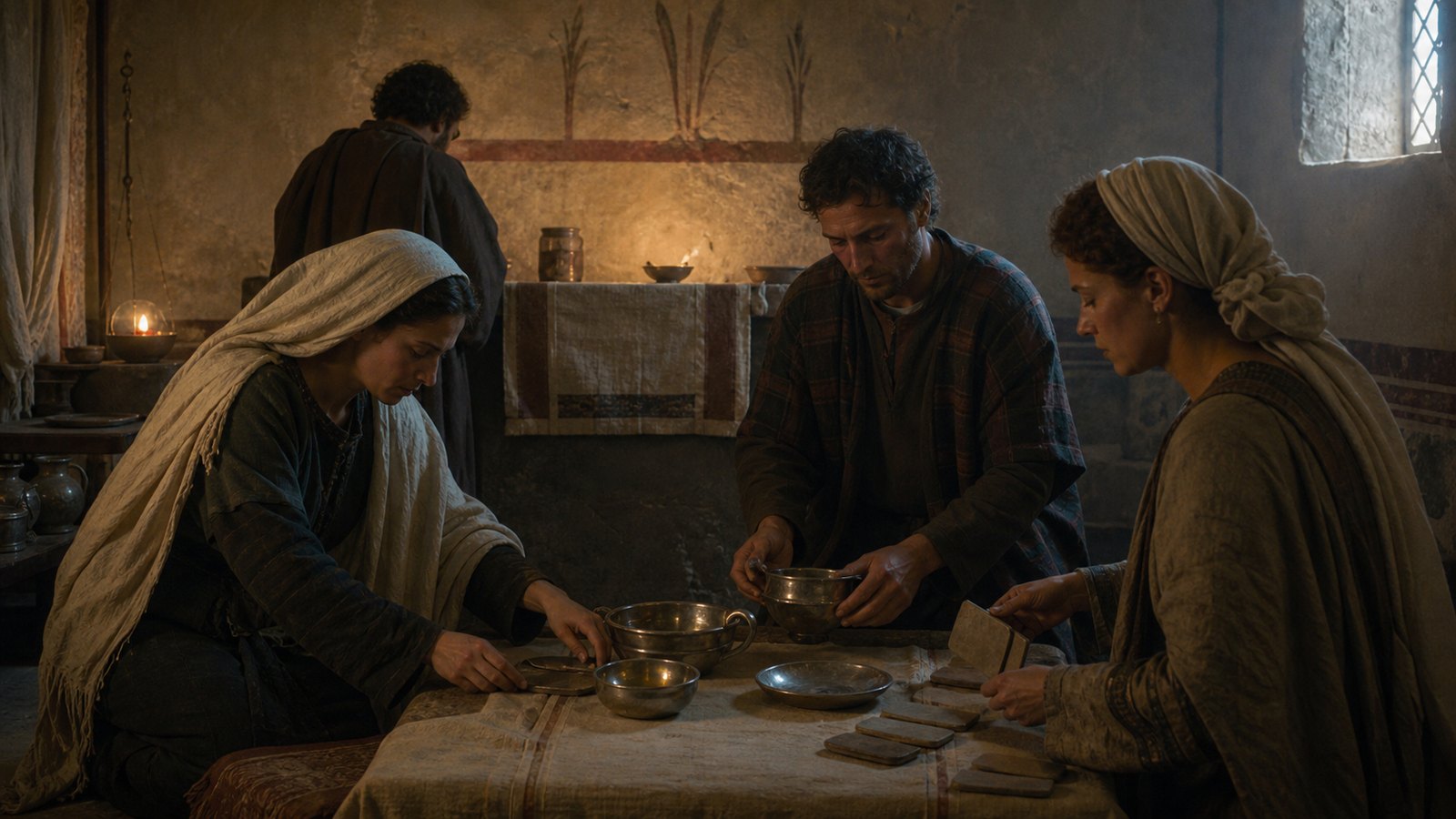
The hoard’s tableware element includes nine vessels: bowls, dishes, jugs, a strainer and a distinctive two-handled cup. Beside them lay thin plaques and fragments, plus the single gold disc. The mixture joins objects capable of serving food or drink with pieces more clearly shaped as offerings.
Several vessels resemble forms later associated with Christian worship. That resemblance is suggestive, not decisive. A bowl can serve at a household meal before being dedicated, and a two-handled cup is not automatically a chalice. The deposit does not authorize us to assign a separate ritual name to every silhouette.
The plaques provide firmer religious evidence. Their thin metal form belongs to an older Roman habit of making votive gifts. Similar leaves could be offered to deities such as Mars, Minerva or Jupiter. Christians at Water Newton appear to have redirected a familiar material practice toward their own God rather than inventing an entirely new type of precious offering.
That continuity can be set beside the named vows deposited at Bath’s sacred spring. The religious language differs, but the physical logic is comparable: a promise or request gained durable form in metal, entered a sacred setting and preserved a personal name long after the surrounding ritual community disappeared.
Chi-Rho Marks Made Ownership Clearer Than Function
The repeated sign is the Chi-Rho, formed from the first two Greek letters of Christos. Some Water Newton pieces combine it with alpha and omega, a pairing that expressed Christ as beginning and end. These marks sharply reduce doubt about the community’s Christian identity.
The craftsmanship is not uniformly polished. Some Greek characters are reversed or imperfectly formed. That physical irregularity is valuable evidence. It suggests makers or patrons who understood the sign’s religious force without necessarily possessing fluent Greek or a perfectly standardized model.
Faith did not require epigraphic elegance. A plaque could carry a malformed letter and still communicate to the people who offered and received it. The sign worked because a local group recognized it. Its imperfections bring us closer to actual transmission: symbols moved through workshops, memories and copied patterns, acquiring local hands along the way.
At the same time, Christian marks do not turn every object into specialised church equipment. They establish association and dedication. Exact use requires additional evidence. The Water Newton group is strongest when read collectively—symbols, inscriptions, vows and precious vessels together—rather than when one isolated cup is made to carry an entire reconstruction of worship.
Four Names Stand Where the Church Building Does Not
Publianus appears beneath one of the large silver bowls. Its inscription addresses a holy altar and presents his act as honour. The wording implies a sacred place important enough to receive valuable silver, although archaeology has not identified the building itself.
Another object names Innocentia with Viventia in connection with an offering. A plaque preserves Amcilla and the fulfilment of a vow. These names are not attached to emperors, bishops famous from councils or soldiers celebrated in histories. They are local participants whose religious choices became legible because metal outlasted both memory and architecture.
The names also complicate any picture of conversion descending neatly from the palace. Imperial patronage after Constantine made Christian symbols increasingly public, but a community existed through people who gave objects, handled vessels, commissioned inscriptions and gathered around an altar. Policy created conditions; repeated local acts made a religion inhabit a town.
The fifty-four singers of Augustus’s Secular Games preserve a state ceremony designed for Rome’s public memory. Water Newton offers the inverse scale. Its altar is lost, its gathering place uncertain, and its participants ordinary enough to vanish from literature. Four names on silver still recover the human frame.
Burial Preserved Evidence Without Preserving an Explanation
The deposit was valuable enough to attract recovery. Silver vessels and a gold disc could be melted, divided or sold. Whoever assembled them nevertheless placed the group in the ground and never successfully reclaimed it. That absence produced the archaeological survival we now study.
Tempting explanations crowd the gap: invasion, persecution, theft, ritual closure or simple safekeeping. None can be selected merely because it makes a dramatic ending. The objects may differ in date and original function. They could have accumulated across years before one final act brought them together.
The hoard was declared Treasure Trove and acquired by the British Museum in 1975. Removal from the soil did not end interpretation. Conservation separated corrosion from surface, inscriptions were read, forms compared and the findspot placed within Durobrivae’s wider landscape. Each step recovered information while also revealing questions that material alone cannot answer.
The evidence boundary is not a weakness. It is the central lesson. We can say that Christian symbols recur, that named people made offerings, that one inscription honoured a holy altar, and that precious objects were deliberately grouped. We cannot name the building, reconstruct every rite or know why the collection stayed buried.
Water Newton makes late Roman Christianity visible without making it simple. Old votive forms carried new signs. Domestic-looking vessels entered a Christian collection. Imperfect Greek letters expressed a faith understood locally, while four names put individuals beside an altar that has left no walls. The silver survived not as a complete church service with instructions, but as a community’s interrupted set of actions.
Sources
Peterborough in Objects, “The Water Newton Treasure”; British Museum, Water Newton collection records.