
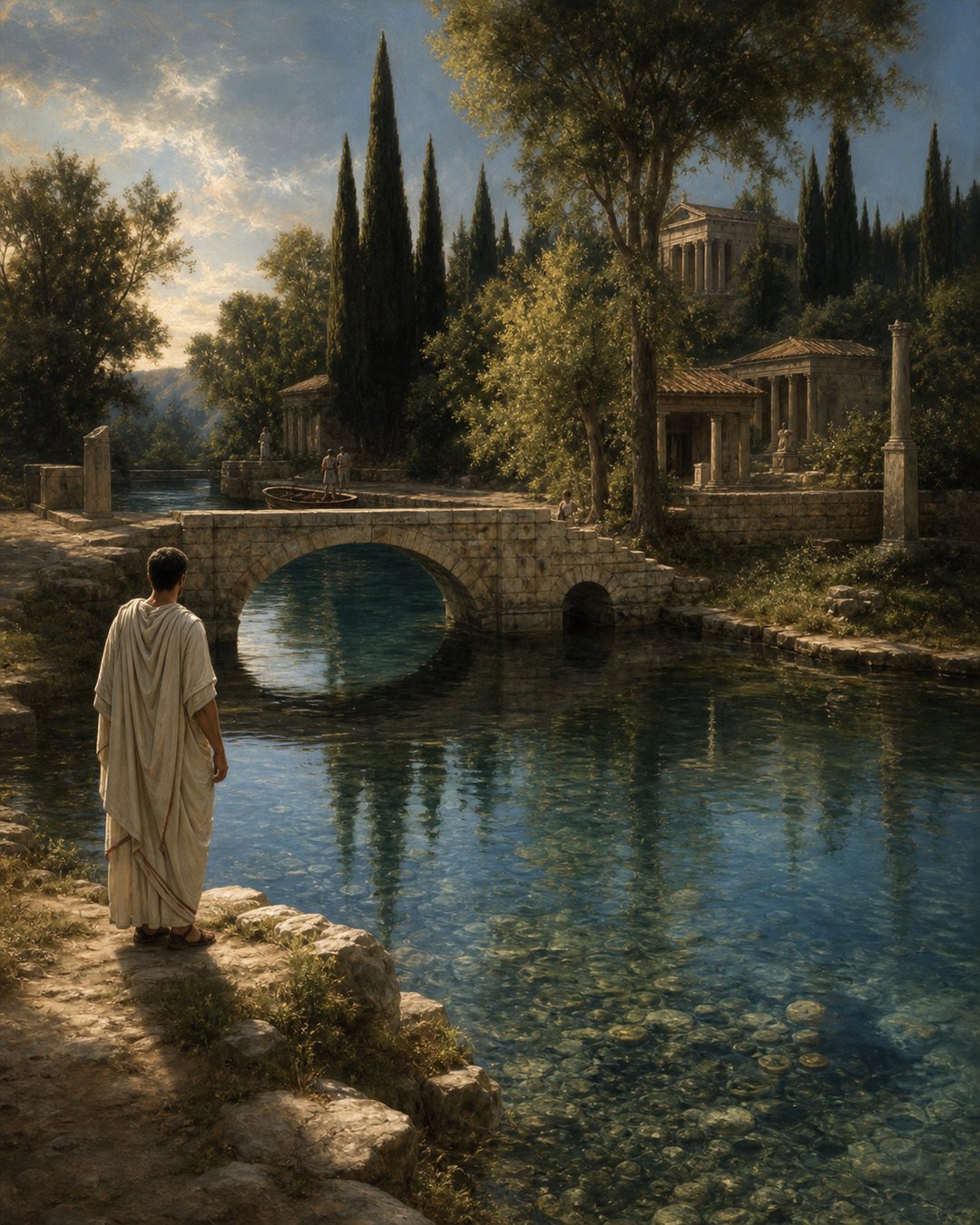
Pliny the Younger reached Clitumnus and immediately regretted arriving so late in life. He urged his correspondent Romanus to make the same journey. Beneath a hill thick with old cypresses, water broke from several channels, gathered in a small whirlpool and widened into a pool so clear that coins and pebbles could be counted on the bottom.
The spring did not remain a spring for long. Its volume drove it forward into a river deep enough for boats. Downstream, the current made oars almost unnecessary; upstream, rowers and poles barely overcame it. Ash and poplar trees appeared doubled in the transparent water, while the cold struck Pliny as sharply as snow.
It sounds like a landscape letter, and it is one. Yet its decisive detail is built from stone. A bridge divided the upper sacred water from the lower public reach. Boats could pass above it, but swimmers could enter only below. Clitumnus became intelligible through that boundary: a sanctuary, transport route, pleasure ground and civic amenity occupied one current because people changed their conduct when they crossed the bridge.
The Spring Became a River Before Pliny Finished Looking
Pliny organizes his visit as a sequence of enlargements. First comes the wooded rise, then several unequal outlets, then a pool, and finally a navigable river. The description makes the reader experience scale changing underfoot. What begins as water emerging from darkness acquires enough force to carry vessels across level country.
Clarity supplies the first marvel. Visitors had thrown small coins into the pool, acts that may have carried religious or commemorative meaning, but Pliny does not explain individual intentions. What he records is visibility. The offerings and ordinary pebbles remained countable beneath the surface, turning depth into something the eye believed it could master.
The current complicated that calm appearance. A boat pointed downstream seemed almost idle. Turn it around and the same level channel demanded coordinated rowing and poling. Pleasure came from alternating between effort and release. The river offered a physical demonstration of force without rapids, steep banks or dramatic falls.
Pliny’s account of drifting islands at Lake Vadimon likewise turns an Italian outing into a study of water that refuses to behave as a visitor expects. Clitumnus differs because human rules are as important as natural surprise. The current moves every boat, while the bridge decides what bodies may do.
Jupiter Clitumnus Occupied a Managed Sacred Landscape
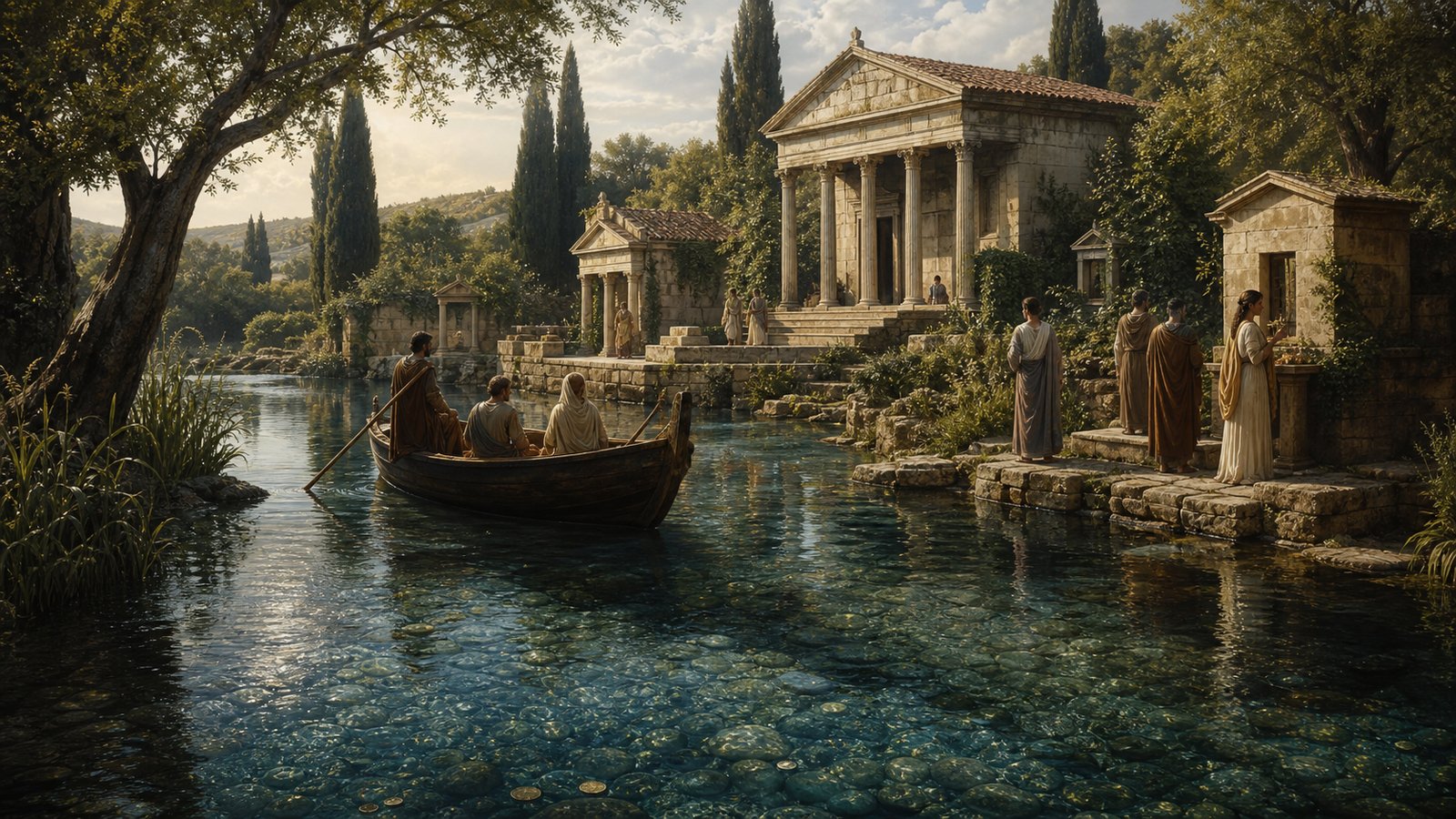
Near the source stood an old sanctuary of Jupiter Clitumnus. Pliny describes the divine image wearing the bordered toga associated with Roman public rank. He also reports oracular responses as proof, within the cult’s own logic, that the god inhabited the place and foretold events.
The sanctuary was not a single isolated building. Smaller chapels stood around it, each with a particular divine name and cult. Lesser springs had their own sacred associations before their waters joined the principal flow. The religious landscape therefore resembled the hydrology: multiple sources and identities gathered without becoming indistinguishable.
Pliny does not preserve the wording of an oracle, identify a priest or narrate a sacrifice during his visit. Restraint matters here. The letter allows us to reconstruct an arrangement of temple, chapels, images and water, but not a complete ritual calendar. His purpose is to make Romanus see why the place deserves attention, not to write its cult manual.
The toga on Jupiter’s statue placed divine presence inside a recognizably Roman visual language. Yet the spring was not sacred merely because an image stood nearby. The entire upper reach carried a special rule. Holiness was distributed through water, buildings and permitted movement.
A Bridge Turned Religious Status into Everyday Conduct
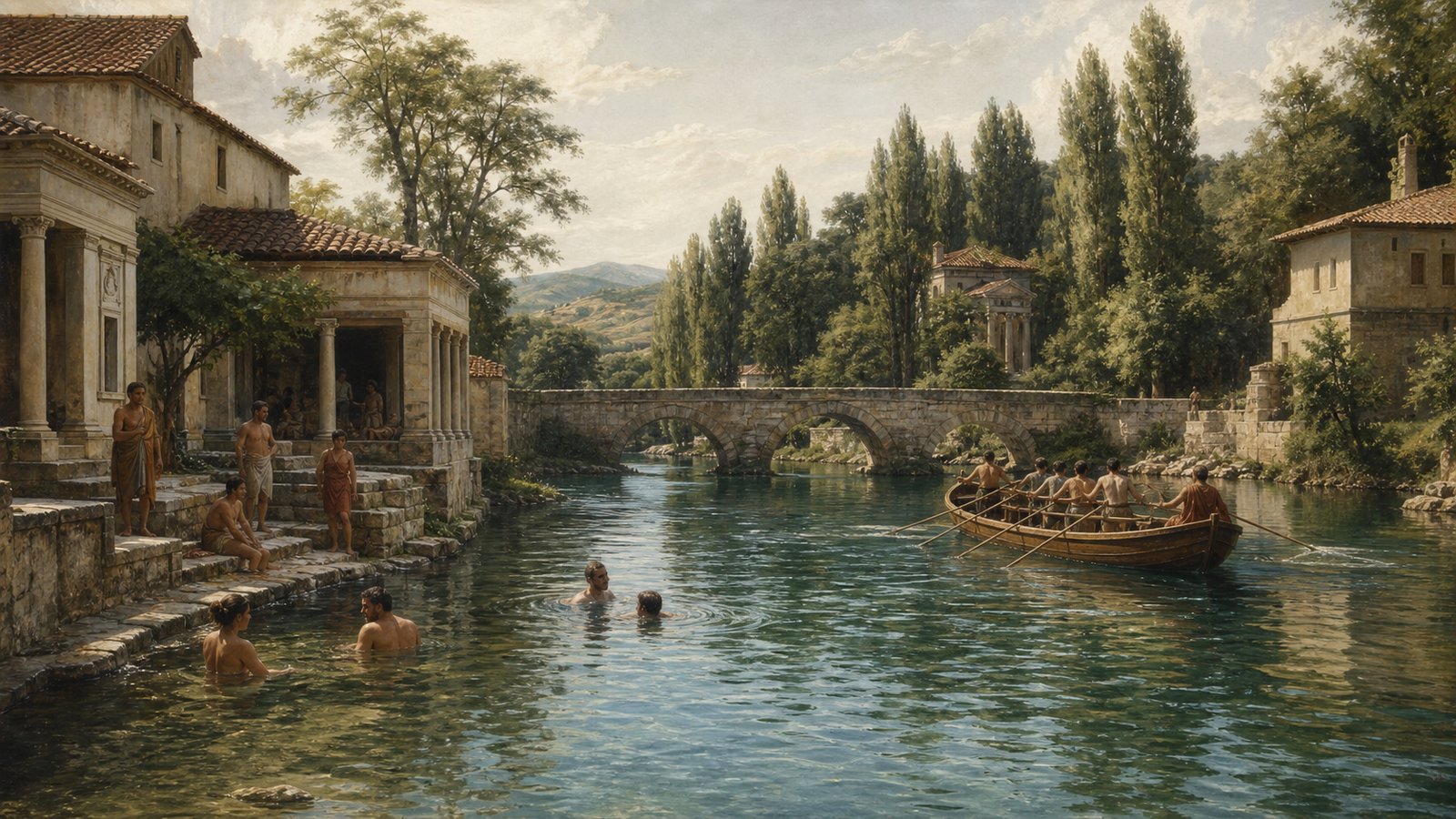
The bridge is the letter’s quiet piece of legal technology. Water does not change composition as it flows beneath the arch. No wall stops the river. Instead, the structure marks where one behavioral regime ends and another begins: in the upper section boating alone was allowed; the lower section admitted swimmers too.
That distinction protected the source without making it inaccessible. Visitors could enter the sacred reach in vessels, observe its clarity and move among the shrines. What they could not do was treat it like an unrestricted bathing place. The rule separated forms of contact rather than banishing people entirely.
Rome repeatedly made ritual boundaries tangible through objects and procedures. the pointed vessel used for the Vestals’ water joined shape to sacred handling: it discouraged ordinary storage by refusing to stand. At Clitumnus, architecture performed a comparable task at landscape scale. A traveler did not need to memorize an invisible line; the bridge supplied it.
Such boundaries worked only if communities recognized them. Pliny writes as though the distinction is established and legible. He does not describe guards chasing swimmers upstream. The absence cannot prove effortless compliance, but it shows the ideal: sacred order embedded in the route itself.
Hispellum Joined Baths and Lodging to the Sanctuary
The people of Hispellum, Pliny says, had received the place as a gift from Augustus. They supplied a public bath and accommodation, while private villas occupied attractive positions along the bank. The destination had infrastructure for staying, washing and enjoying the river rather than serving only a momentary act of worship.
Baths beside sacred water need not signal contradiction. The bridge assigned bathing to the public side. Municipal provision could support visitors while maintaining the privileged upper zone. The arrangement converted a potentially competing set of uses into a sequence: approach the source, respect its boundary, then enter the civic landscape downstream.
Villas added another audience. Owners wanted the same coolness, reflections and motion that Pliny praised. Their presence reminds us that admired scenery also attracted property and status. The letter celebrates access without asking who controlled the best bank or how permanent residents experienced visitors.
The surviving Clitunno Tempietto belongs to a later historical landscape and is now part of a UNESCO serial property on Lombard Italy. It should not be presented as Pliny’s temple left untouched. The continuity lies more safely in the attraction of the place and its name, not in an unsupported one-to-one identification of every wall.
Pliny Made the Crossing the Point of the Visit
Pliny closes by wondering why Romanus has not already described Clitumnus to him. The friendly reproach turns travel into literary exchange. A remarkable place deserves not only a visit but an account precise enough that someone else can imagine its channels, current and rules.
His precision prevents the spring from dissolving into generic beauty. We know what could be counted below the surface, which trees appeared in reflection, how a boat behaved when turned, and where swimmers had to stop. These are operational details. They let landscape, ritual and municipal management occupy the same frame.
The strongest contrast is not sacred nature against profane construction. The bridge helps create the sacred geography visitors experience. Shrines name the gods, the current carries the boats, and the boundary assigns conduct. Human intervention does not merely intrude on holiness; it gives holiness a practical edge.
The unequal channels at the source make that achievement more striking. Pliny does not describe one pipe-like outlet feeding a neatly planned precinct. Water arrives through several openings, lesser sacred springs retain separate identities, and all eventually join. The built boundary does not simplify the landscape into one origin; it gives a shared downstream course to a place whose holiness began in plurality.
Coins visible on the bottom add a final limit to interpretation. They show that visitors placed objects in the spring, but the letter supplies no names, values or spoken vows. Calling every coin a payment for prophecy would exceed the evidence. Their importance here is physical: offerings remained inside the protected water while still visible to travelers passing over it.
Clitumnus mattered because many activities could meet without becoming one activity. Oracle, outing, navigation, bathing and residence all touched the river. Pliny’s bridge held those uses together by dividing them. A visitor crossed a few stones and entered another rule, while the water itself continued on.
Sources
Pliny the Younger, Letters, 8.8; UNESCO World Heritage Centre, “The Longobards in Italy.”