
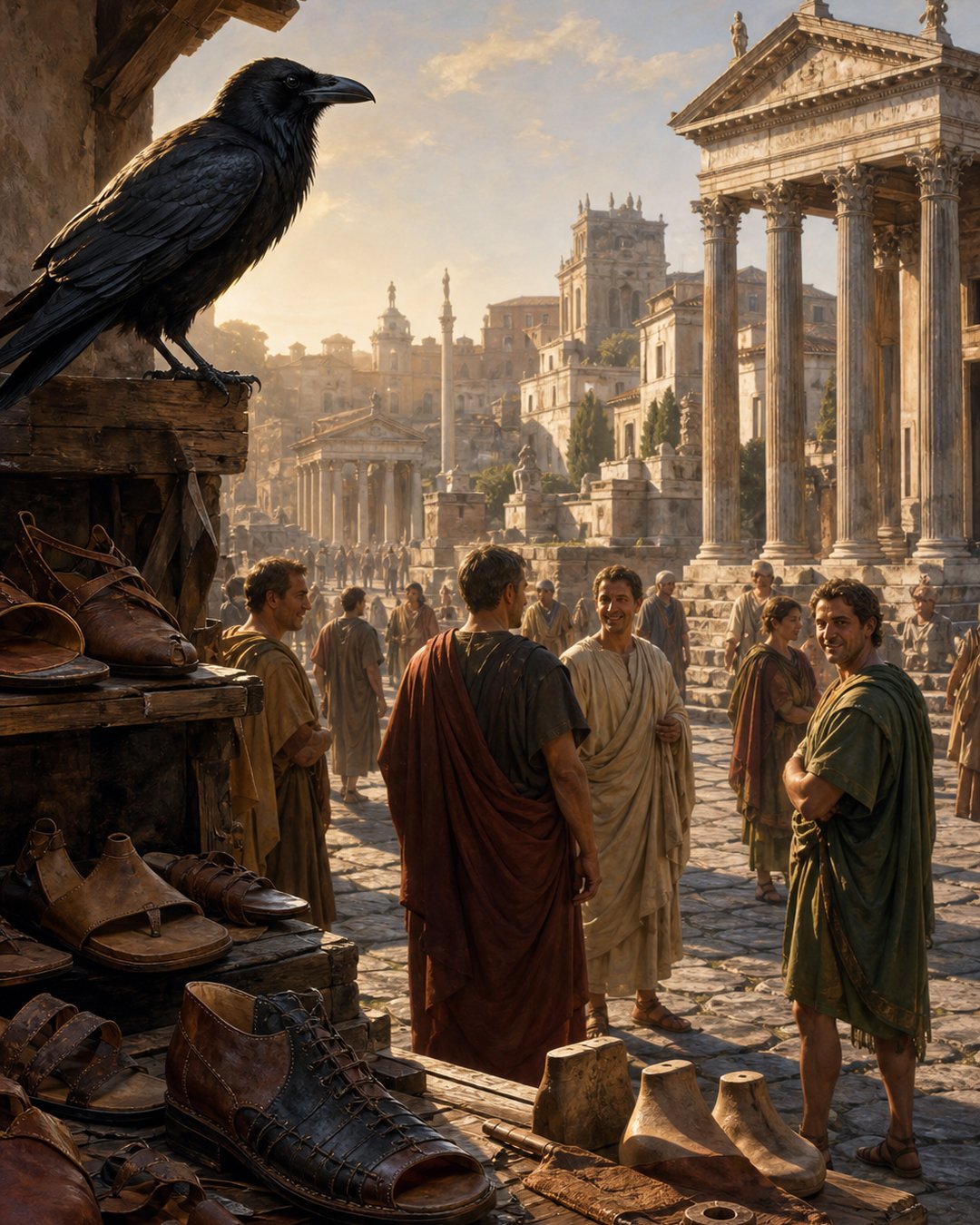
Every morning in the reign of Tiberius, a raven left a shoemaker’s shop and flew into the Roman Forum. It settled at the Rostra, greeted Tiberius, then Germanicus and Drusus by name, acknowledged the passing Roman people and returned to the workshop. Pliny says the attendance continued with remarkable consistency for several years.
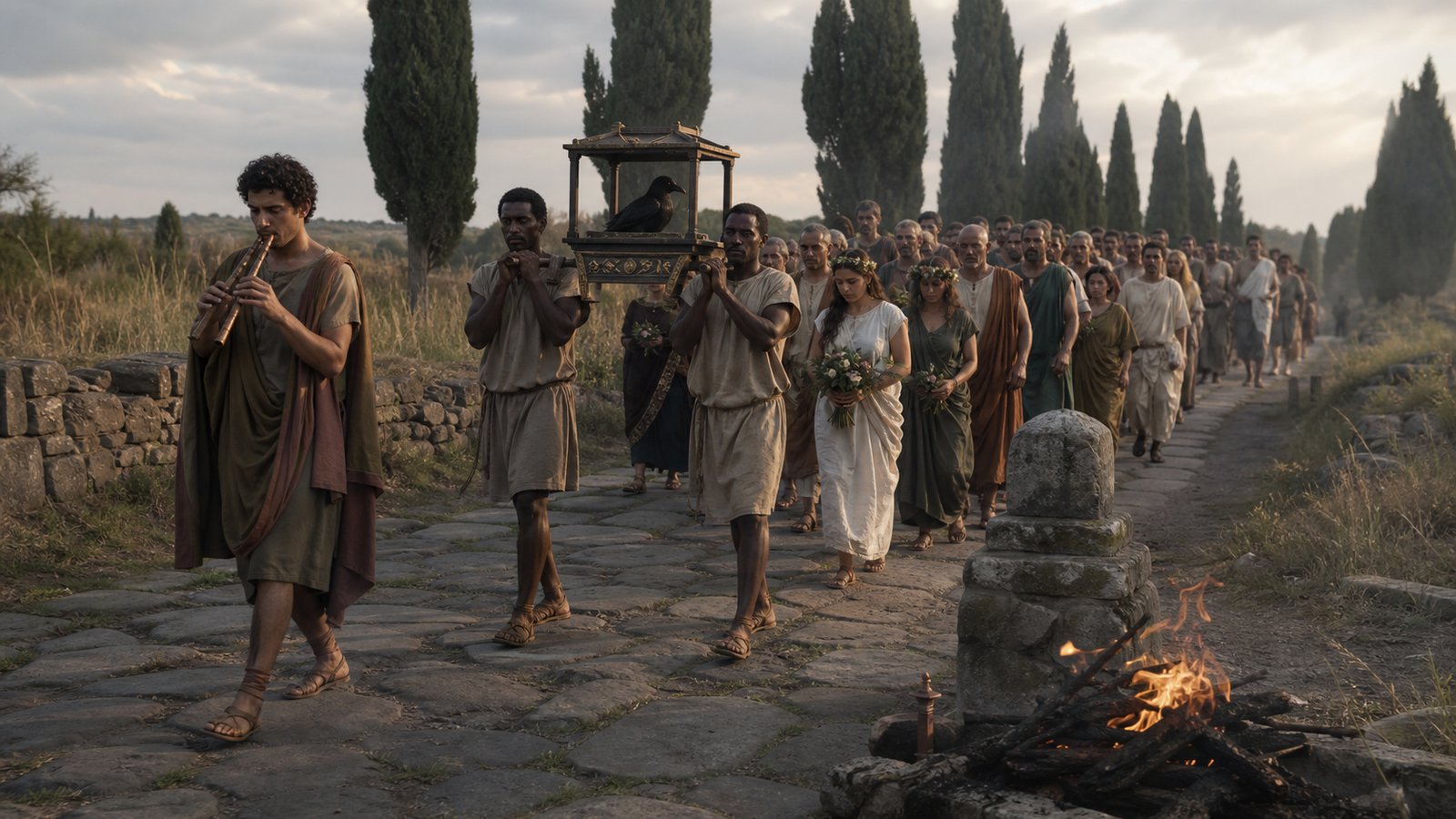
A neighbouring cobbler killed the bird. He claimed its droppings had soiled some shoes. The crowd drove him from the district, and he was soon put to death. Then Rome gave the raven a funeral: a small litter on the shoulders of two Ethiopian bearers, a piper in front, garlands around it and a pyre beside the Appian Way at the second milestone.
Pliny tells the episode as proof of a raven’s merit and Roman indignation. Its force lies in the distance between cause and ceremony. A trained workshop bird had no office, family or legal rank. Repeated speech gave it a public role, and the crowd answered its death by borrowing the forms through which Rome normally made human status visible.
The Temple Roof Gave a Workshop Bird a Sacred Introduction
The raven came from a brood that nested on the Temple of Castor. From that roof it flew into a shoemaker’s premises directly opposite. The owner did not see only a stray young bird. Pliny says religious feeling made the temple origin a second recommendation in its favour.
That association did not automatically produce the later fame. The shoemaker trained the raven to speak while it was young. Sacred proximity opened the door; human teaching supplied the ability that would keep the bird in public attention.
The workshop matters. Leather, lasts, awls and customers formed the raven’s home base, not an imperial aviary. After appearing before Rome’s political centre, it returned to an ordinary commercial space. Its daily route tied temple, shop and Rostra together.
Roman birds could become signs in military stories, as when a raven helped Valerius in single combat. This bird acquired meaning differently. It did not arrive once at a crisis. Familiarity grew through recurrence, and the marvel became part of a street’s expectation.
Pliny’s phrase about religious veneration should not be inflated into a formal cult. He names no priesthood, altar or authorized rite for the raven. What survives is the owner’s regard for a bird associated with a temple and the public career built from that beginning.
The Rostra Turned Learned Speech into a Daily Civic Performance
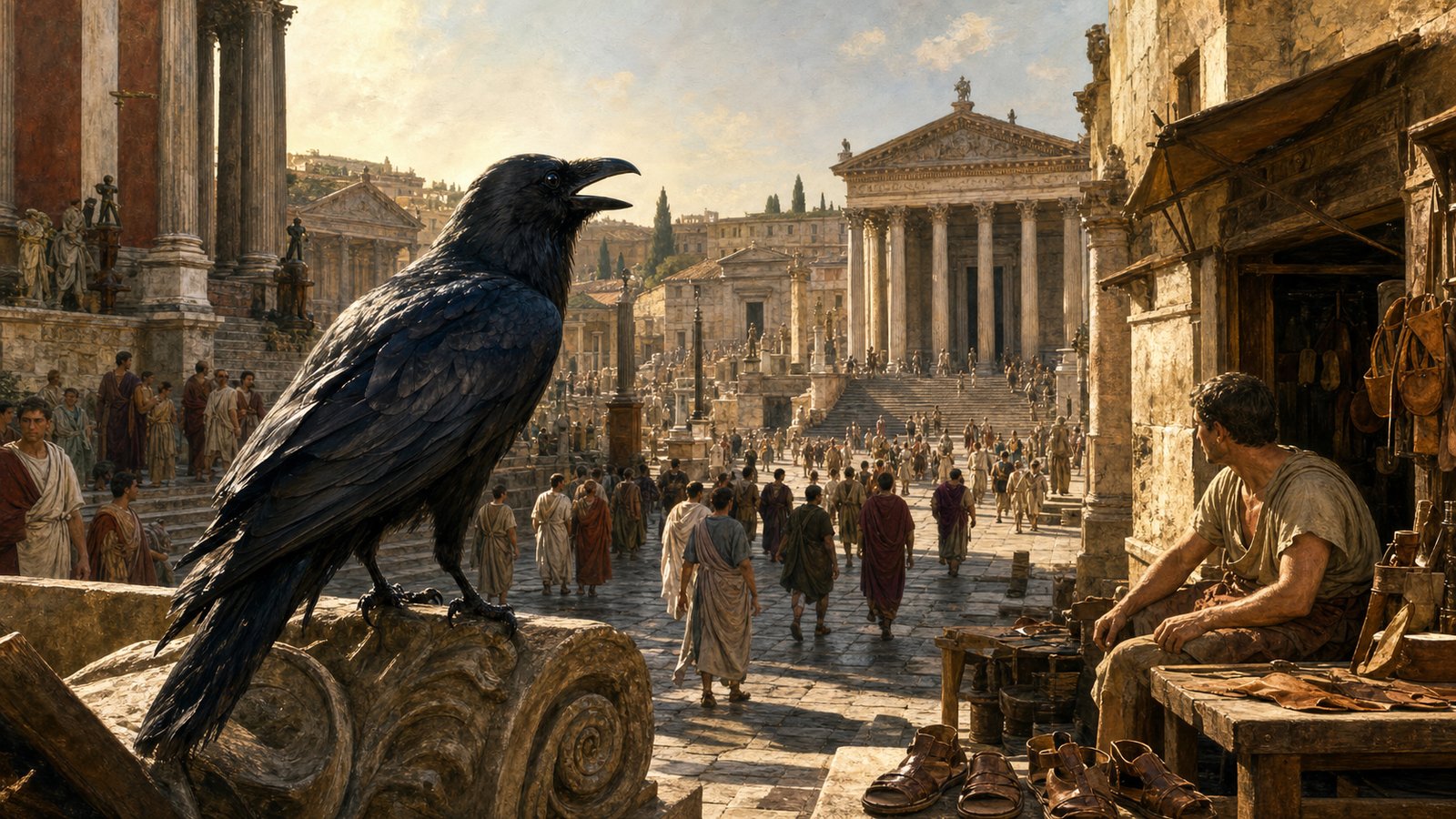
The raven flew to the Rostra, the speaking platform facing the Forum. Its location made the greeting political before the words are even considered. This was where Roman public speech, decrees, advocacy and memory met an audience. A bird repeating names there transformed training into civic theatre.
The order of salutations mattered. Tiberius came first, followed by the Caesars Germanicus and Drusus. Only then did the raven greet Roman passers-by. The sequence reproduced hierarchy while including the crowd. Emperor, dynastic figures and populace all received a place in a brief vocal ceremony.
Pliny says the bird addressed each by name. The claim belongs to his testimony about trained animal speech; it does not provide a transcript or explain how many formulas the raven could distinguish. The concrete point is that listeners heard recognizable names and understood the routine.
Constancy changed novelty into institution. A single speaking performance might be a curiosity. Morning after morning for years, the flight became a public clock: the bird leaves the shop, appears at the Rostra, offers greetings and returns. People did not need an announcement to know what the performance meant.
Rome also used official records to make daily business public, and Caesar’s publication of daily proceedings gave information a durable civic surface. The raven’s contribution was lighter and oral. It published no decision, yet it made the imperial order audible in an animal voice.
One Killing Converted Familiarity into Collective Judgment
The killer owned another shoemaker’s shop nearby. Pliny attributes the act to sudden anger and adds the man’s stated cause: the raven had fouled shoes with droppings. The trivial complaint sharpened the outrage because citizens valued the bird for something larger than cleanliness around merchandise.
The crowd drove him from that part of Rome. Pliny then says he was soon put to death. The text does not preserve a charge, trial record or execution procedure, so it would be unsafe to invent one. What Pliny emphasizes is popular fury moving from neighbourhood expulsion to a fatal outcome.
His framing invites comparison between the worth of animal and citizen. Rome punished a Roman for killing a raven. The reversal is deliberately provocative, and Pliny heightens it by comparing the crowd with the neglect of distinguished men.
The episode shows that public belonging could grow outside law. The bird had become recognizable through a route and voice. Its killer interrupted a shared morning ritual. People reacted not only to cruelty but to the destruction of something they considered part of the Forum’s common life.
The shoemaker who trained the raven had converted private labour into public attachment without owning the result in any simple sense. Once thousands knew the bird, its death no longer concerned only two shops. The crowd claimed an interest in what the street had taught itself to expect.
The Funeral Rebuilt Human Honour Around a Small Body
The raven’s body was placed on a litter. Two Ethiopian men carried it, a piper walked before it and garlands accompanied the procession. The details made the event legible as funeral honour. Music, bearers, flowers and movement through the city supplied dignity beyond ordinary disposal of an animal.
The two bearers are described through an ancient ethnic label in Pliny’s text. We do not know their names, legal status or reason for selection. Their presence should be reported without turning them into decorative spectacle. They performed the physical act that raised the bird above street level and carried public feeling toward the pyre.
The destination was equally specific. The pile stood on the right side of the Appian Way at the second milestone in a field called Rediculus. The procession moved from the Forum’s compact political space to a road lined with memories and monuments. Distance gave the obsequies duration; the city could join and be seen joining.
Roman funeral law could limit display, including the number of musicians, and ten flute players marked one old boundary. Pliny does not claim that the raven copied a complete elite funeral. He lists enough elements to show extraordinary translation of human form onto an animal death.
His final comparison is intentionally severe. Pliny says no distinguished man had attracted such crowds and invokes the unavenged death of Scipio Aemilianus, conqueror of Carthage and Numantia. The claim serves his rhetoric of inversion: speech and routine won an animal the public devotion that greatness did not guarantee a statesman.
Pliny dates the funeral precisely to 28 March under the consuls Marcus Servilius and Gaius Cestius. Exact dating turns the wonder into an urban event, not timeless fable. Still, the story reaches us through an author eager to prove animal intelligence, and his crowd comparisons belong to that purpose.
The raven’s public career was made from borrowed things: a temple roof, a shopkeeper’s training, imperial names, the Rostra’s authority and funeral customs designed for people. None diminished the attachment. Together they show Rome producing civic memory through repetition. The bird greeted the city until the city recognized the greeting as partly its own.
Sources
Pliny the Elder, Natural History, 10.60.