

Pliny was already running when the second message found him. Corellius Rufus had refused food through a second, third and fourth day. His wife Hispulla had sent a mutual friend to say that family pleas had failed and that Pliny might be the one person still able to call him back to life. Pliny set out at once.
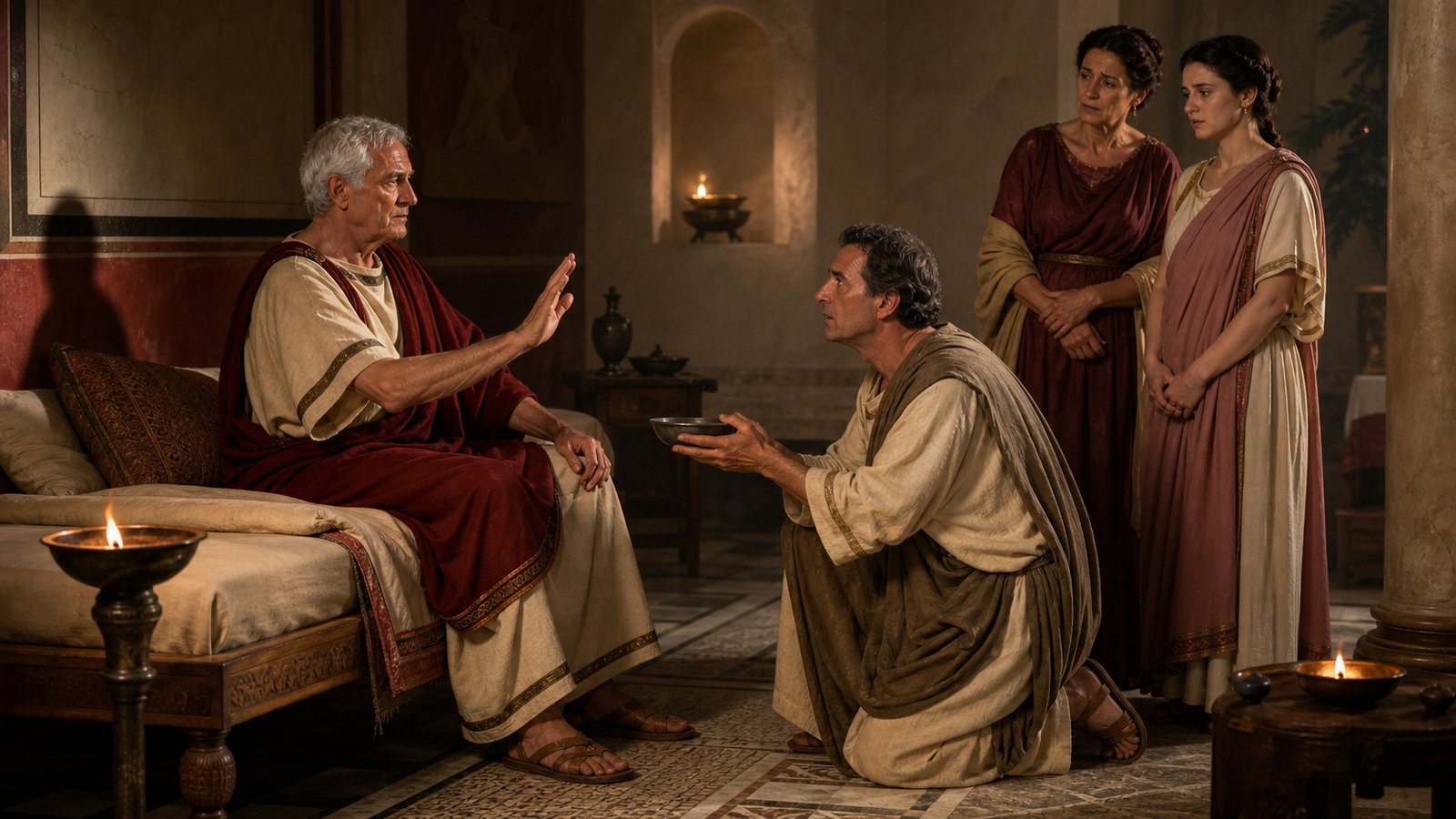
He nearly reached the villa. Then Julius Atticus arrived with Hispulla’s new report: even Pliny would obtain nothing now. Corellius’s decision had hardened. When a physician offered nourishment, the patient answered with one Greek word, kekrika—“I have decided.”
The scene comes from Pliny’s letter to Calestrius Tiro, not from a physician’s notes. It is shaped by grief, friendship and admiration. Yet its sequence is unusually physical. One messenger sends Pliny into motion; another stops him short. Family, friends and medicine gather around the bed, but the journey ends before the friend can make his appeal.
A Household Counted the Days by Refused Meals
Pliny begins by calling Corellius’s death a devastating loss and then explaining why it hurt differently: Corellius had chosen it. To Pliny, a death attributed to disease carried the consolation of necessity. A chosen death left survivors imagining that more life had remained possible.
That possibility was not empty. Pliny lists the ties around Corellius with care. He had a respected conscience and reputation, public authority, a wife, a daughter, a grandson, sisters and true friends. These were not decorative compliments. They identify the people and obligations against which the final decision was weighed.
Hispulla and the daughter did not passively witness the refusal of food. They pleaded with him. When those appeals failed, Hispulla widened the circle by sending Gaius Geminius to Pliny. Her message gave Pliny a role of last resort: the remaining friend whose voice might succeed where the household’s voices had not.
The counting of days made an inward intention visible. A statement could be reconsidered; untouched meals accumulated into evidence. By the fourth day, everyone around Corellius could see that the decision was continuing despite hunger, family and time. The physician’s offered food became another test, answered not with a long explanation but with the claim that judgment had already occurred.
Thirty-Three Marked the Beginning of the Pain
Pliny says Corellius had told him that pain first seized his feet when he was thirty-three. He regarded the condition as inherited, one of the qualities passed through a family. While Corellius was younger, strict habits and abstinence kept it under control. Age changed the balance.
The pain eventually spread beyond the feet through all his limbs. Pliny describes severe, prolonged suffering and emphasizes endurance rather than a sudden crisis. Corellius first tried to govern the illness through regimen; later, he bore what regimen no longer contained through force of mind.
We should not turn Pliny’s language into a modern diagnosis more precise than the letter permits. He names pain of the feet and inherited illness, and translators commonly render the condition as gout. He does not supply the measurements, treatments or examination that a clinical record would require. His concern is how long suffering altered a deliberate person’s reasons for continuing.
The restraint is important because Pliny is not simply praising an impulsive escape. He presents Corellius as someone who had endured for years while reasons to live outweighed reasons to die. The later refusal of food appears as the end of that long calculation, at least as the grieving friend understood it.
One Day Beyond Domitian Had Once Been Enough
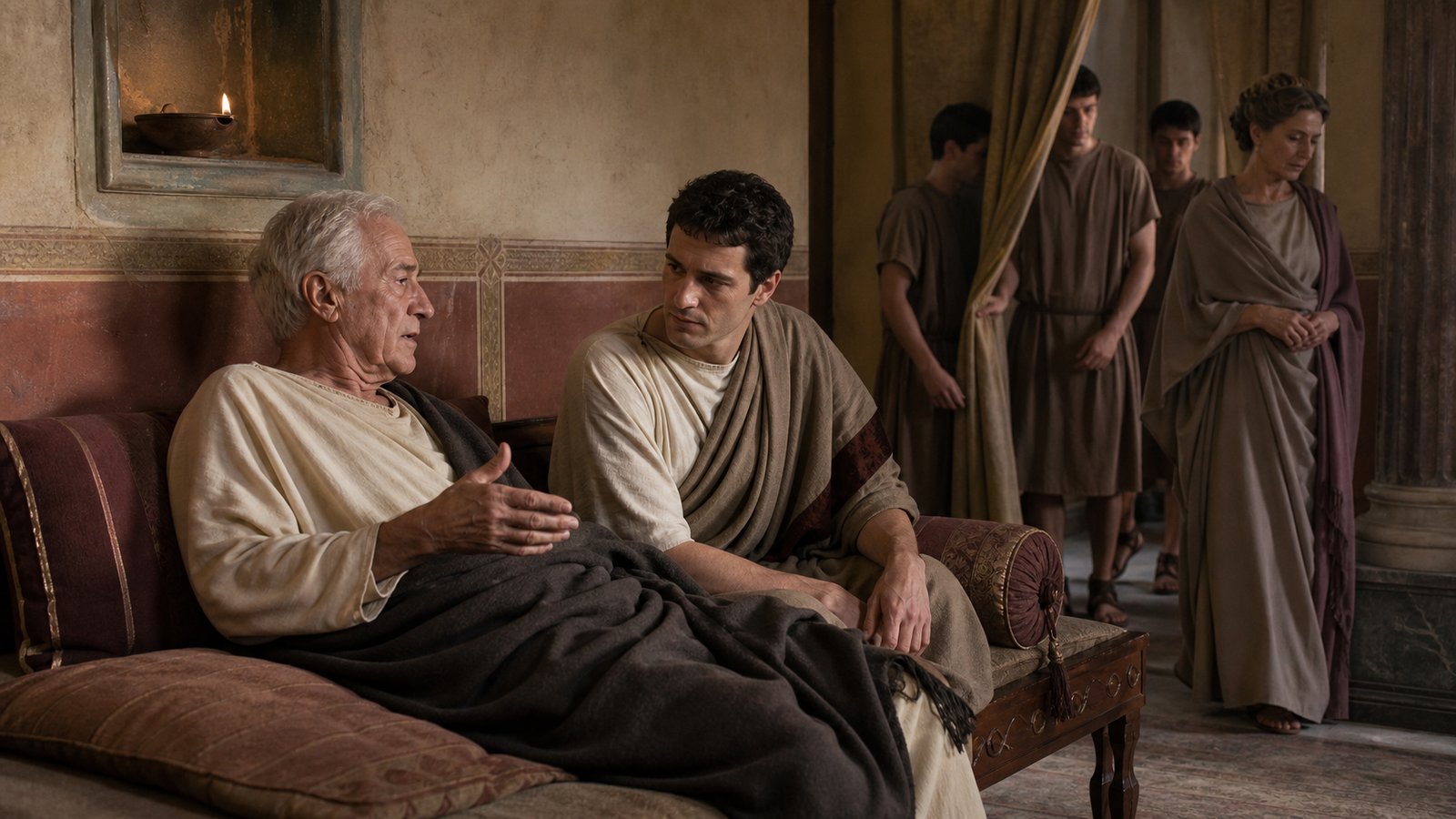
Pliny reaches back to an earlier visit during Domitian’s reign. Corellius lay at his suburban villa. When a trusted friend entered, servants withdrew from the chamber. Even Corellius’s wife left, although Pliny describes her as entirely capable of holding a secret.
The emptying room created a private political scene. Corellius looked around and asked why Pliny thought he had borne such pain for so long. His answer was that he wanted to outlive Domitian—whom he called a robber—by even a single day. Survival itself had become an act aimed at a future beyond the emperor.
This was not public defiance delivered in the Senate. It was a sentence spoken in a cleared bedchamber, protected by household routine. That privacy belongs to the same world in which Domitian’s commands could reach ordinary cultivation while criticism of the ruler demanded caution.
Domitian did die first. Pliny says that once Corellius could regard himself as safe and free, he broke the remaining bonds to life. The emperor’s death did not cause the illness, but it removed one stated reason for enduring it. A body that had served as a private calendar of political survival no longer had that day to wait for.
Two Messengers Turned Friendship into a Failed Rescue
The letter’s emotional engine is not only Corellius’s settled answer. It is Pliny’s failure to arrive before the answer became immovable. Hispulla’s first messenger created urgency and hope. She believed Pliny’s friendship still possessed leverage. Pliny’s “I ran” is one of the shortest and most active moments in the account.
Julius Atticus, carrying the second message, reversed that motion. He did not report that Corellius had already died. He reported that persuasion was no longer possible. The crucial threshold was therefore a decision, not the final breath. Pliny was close to the villa but already too late for the task assigned to him.
The physician’s approach completes the ring of attempted intervention. Wife, daughter, mutual friend, intimate friend and doctor each occupied a different relationship to Corellius. None could alter the answer. Pliny does not quote the family’s pleas, and he does not invent a final conversation for himself. Absence is the point.
That attention to listeners and intermediaries also appears in Pliny’s account of Calpurnia hearing his recitations from behind a curtain. In both letters, a household is not mere background. Doors, curtains, messengers and degrees of access determine who hears, who speaks and who can influence what happens inside.
Pliny Asked for Words He Had Never Heard
After the narrative, Pliny tries the ordinary consolations on himself. Corellius was old; he had escaped a lasting illness; his family survived him; the state he valued was prospering. Pliny knows every argument. None answers the personal loss.
He calls Corellius the witness, guide and teacher of his life. The missing friend had not merely shared memories; he had helped regulate Pliny’s conduct. Pliny tells Tiro that he fears he will now live less carefully. Grief becomes anxiety about the survivor’s future character.
That final concern makes the letter different from the disciplined schedule preserved in Pliny’s description of a reader accompanying work, exercise and meals. There, time could be organized into useful intervals. Here, four counted days and a nearly completed journey expose the limit of organization. Pliny can move quickly and still not arrive at the moment when his words might matter.
He ends by asking Tiro not to repeat that Corellius was old and ill. Pliny has already read and heard such consolations, and grief defeats them. He wants something new and powerful, though the request itself admits how unlikely that is.
The letter preserves no triumphant last debate and no successful rescue. It preserves a friend on the road, a household exhausting its claims, and a decision compressed to one word. Corellius had once made continued life serve a political purpose: one day beyond Domitian. When that purpose and the body’s remaining endurance were gone, Pliny could record the choice, but he could not reach the room in time to contest it.
Sources
Pliny the Younger, Letters 1.12.