
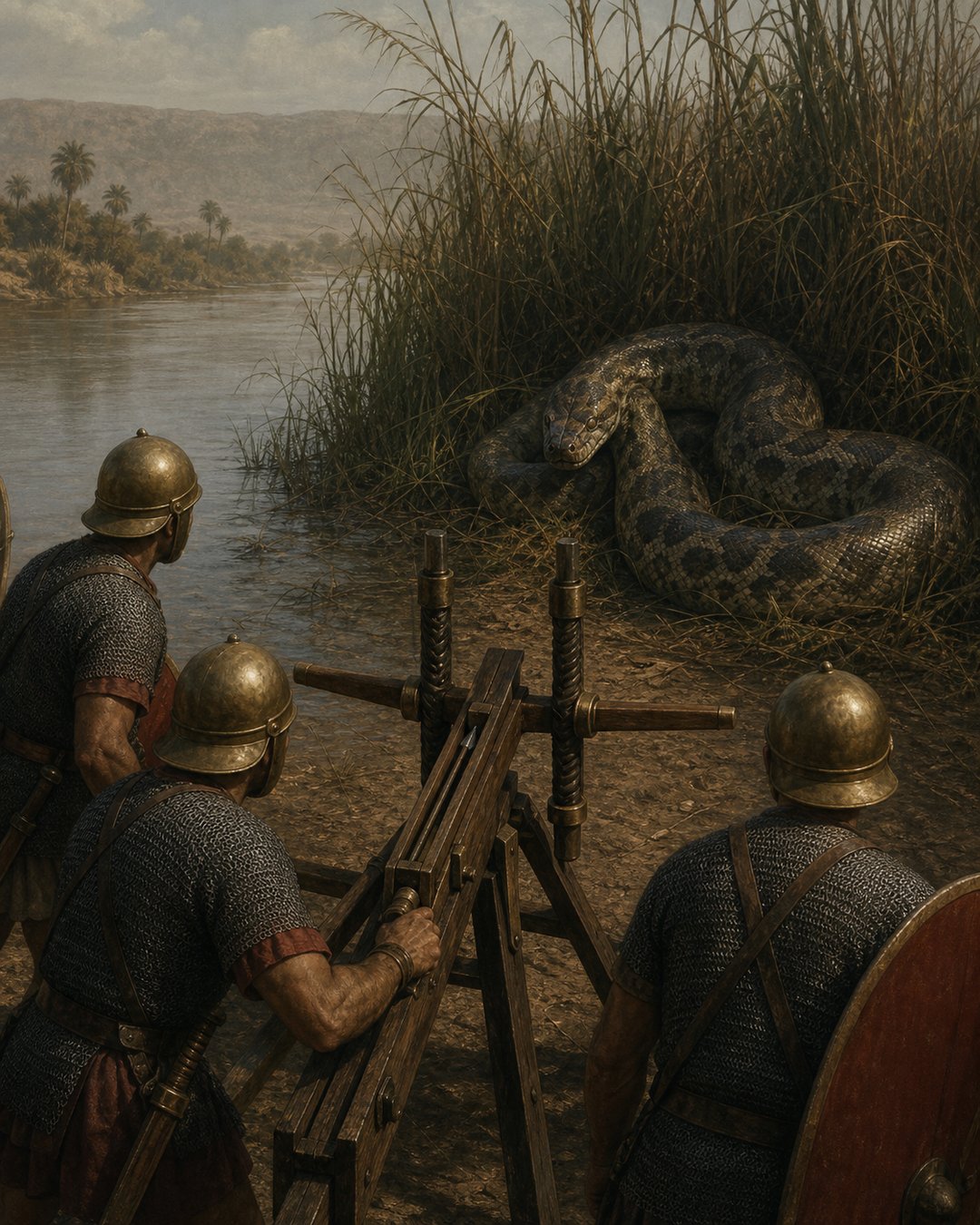
Roman soldiers had crossed into Africa to fight Carthage. On the bank of the Bagradas, however, their weapons turned toward something the campaign plan could not have listed. Pliny the Elder says a serpent blocked them, and he describes the response in the language of siege warfare.
General Marcus Atilius Regulus used ordnance and catapults, “just as if storming a town.” The reported animal measured 120 Roman feet. Its skin and jawbones were carried away and displayed in a temple at Rome, where Pliny says they remained until the Numantine War.
No surviving field report lets us verify an animal of that scale. What survives is a Roman story with unusually material stages: soldiers lost, artillery deployed, a body measured, remains transported and a trophy preserved. The serpent became durable because Rome treated it less like a beast than a captured enemy position.
The African Campaign Met a Second Enemy
Livy’s surviving summary places the episode inside the First Punic War. Regulus had crossed to Africa after Rome defeated the Carthaginians in the great naval battle off Cape Ecnomus. The year attached to the serpent encounter is 255 BCE, when the consul’s expedition was operating on hostile ground far from Italy.
The summary is short because Livy’s full Book 18 has been lost. It says Regulus killed a serpent of portentous size and suffered heavy losses among his soldiers. The sentence does not pause to separate deaths caused by the animal from losses around the wider operation, but it binds the two in the memory of the campaign.
That placement matters. The story was not filed as a traveler’s isolated marvel. It stood amid battles, requests for reinforcement and the reversal of a commander’s fortune. Regulus could defeat an impossible-looking animal and still remain exposed to human strategy.
The expedition’s distance resembles the logistical trap that later kept Surena’s archers supplied at Carrhae, but here Roman memory focuses on an interruption rather than an enemy supply system. A riverbank encounter consumed men and military effort before the Carthaginian campaign had reached its conclusion.
Catapults Changed an Animal into a Fortification
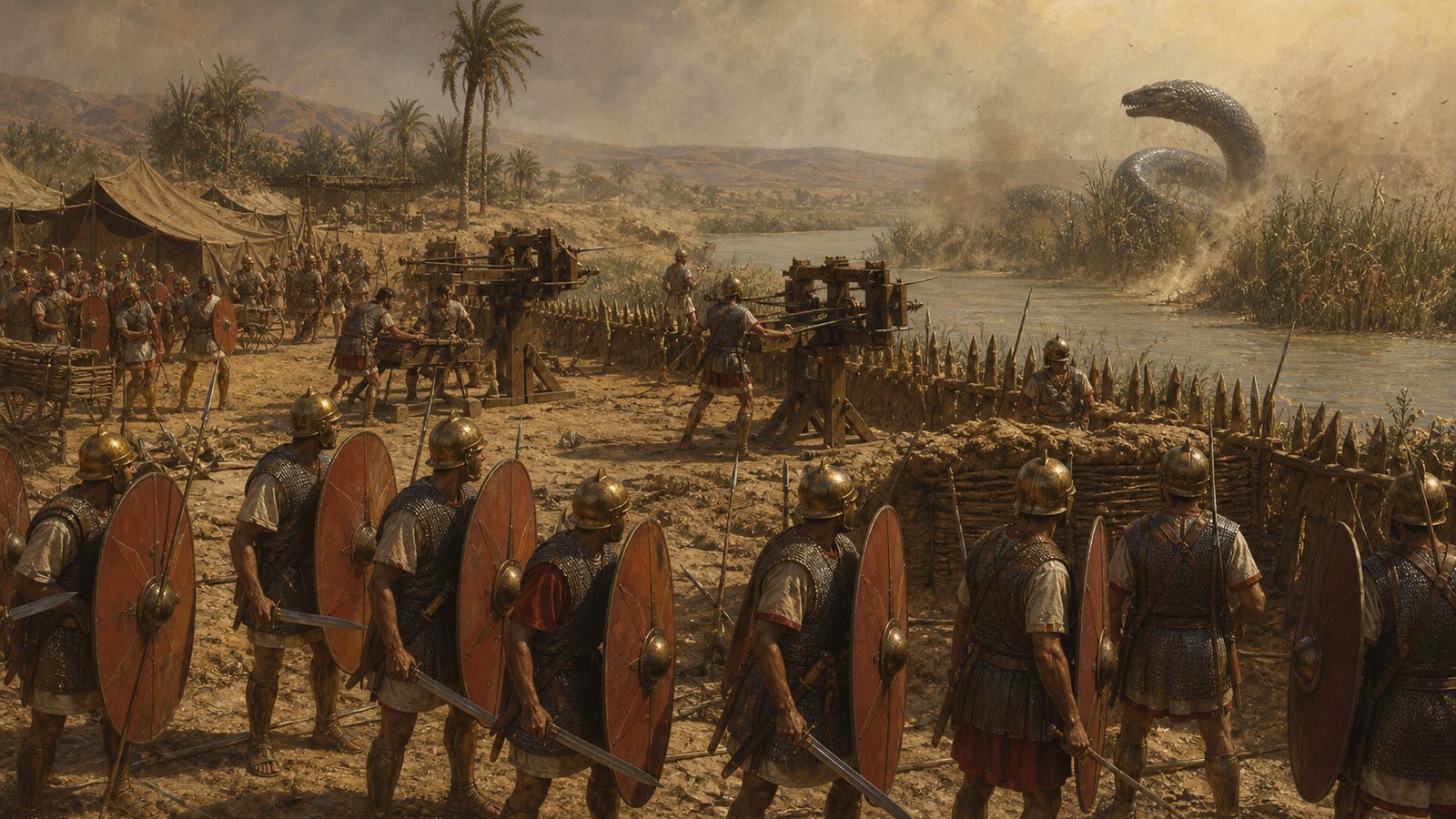
Pliny provides the details Livy’s epitome lacks. He names the Bagradas River, gives the serpent a length of 120 feet and says Regulus’s force used tormenta and catapults. The machinery normally associated with walls and formations was turned against one moving body.
His comparison is explicit: the Romans attacked as if they were storming a town. That sentence is the engine of the story. It scales the serpent through military procedure rather than through adjectives alone. Readers do not merely hear that it was huge; they watch an army classify it as a siege problem.
Roman torsion artillery stored force in tightly twisted cordage and released it through throwing arms. The ancient passage does not identify the exact machine, projectile or number of shots, so a reconstruction should stop there. Pliny’s claim is narrower and stranger: the force Regulus commanded judged artillery necessary.
This differs from the workshop mechanics that made Roman artillery repeatable. On the Bagradas, machinery designed for organized war becomes the measure of disorder. The more familiar the weapon, the more extraordinary its target appears.
A 120-Foot Skin Made the Claim Portable
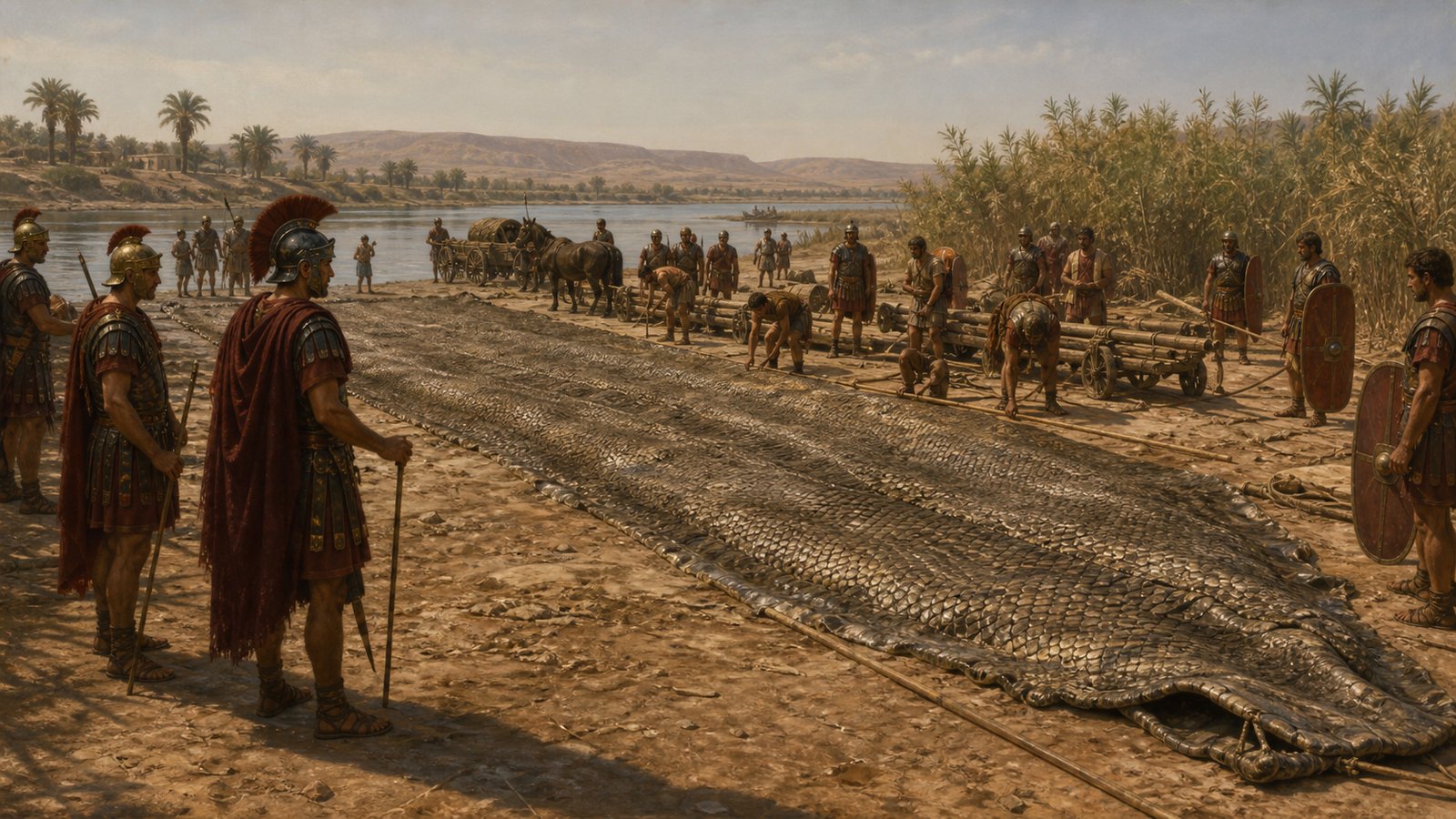
After the killing, the story did not remain beside the river. Pliny says the skin and jawbones reached Rome and were kept in a temple. Transport transformed a dangerous encounter into an object that citizens could inspect after every participant had gone.
The reported measurement of 120 feet is essential to that transformation. Numbers promise control. A creature too large for ordinary weapons could be laid out, counted and assigned a length. Measurement turned fear into evidence, even if modern readers cannot establish what animal, condition or process lay behind the ancient figure.
The remains also worked as a trophy. Roman temples held more than devotional objects; they could accumulate the material memory of victory. Skin and jawbones placed an African marvel inside civic space, where the public could encounter Regulus’s campaign without crossing the sea.
Pliny says the display survived until the Numantine War, more than a century after Regulus. His wording does not explain whether the remains decayed, were removed or simply dropped out of record. It gives the object a long public afterlife and then a boundary beyond which his source could no longer follow it.
Pliny Built Credibility by Comparison
Pliny knew the dimensions demanded belief. He introduces reports that Indian snakes swallowed stags and bulls and that serpents near the Rhyndacus took birds in flight. The Bagradas animal joins a catalogue of scale at the edge of ordinary experience.
He then tries to anchor those distant reports closer to home. Italian snakes called boas, he argues, grew large enough to lend credibility to the stories. He adds an alarming report from Claudius’s principate about a child found inside one killed on the Vatican Hill.
This is ancient natural-history reasoning, not modern zoological verification. Pliny moves from testimony to displayed remains and then to analogy with a creature his Roman audience might accept. Each step reduces distance without eliminating the extraordinary claim.
The method resembles Pliny’s account of an orca trapped in Claudius’s harbor works. In both cases military power confronts an animal through a landscape already altered by Roman action. Yet the Bagradas story goes further by preserving part of the body as a civic exhibit.
Regulus’s Victory Sat Beside His Reversal
Livy’s epitome does not let the serpent become the campaign’s ending. It immediately recalls that Regulus won several battles but failed to receive a successor from the Senate. He wrote home and compared his request to farmland abandoned by its workers, a glimpse of strain beneath the victories.
The next item reverses his fortune. Xanthippus, a Spartan commander invited to aid Carthage, defeated and captured him. Roman memory could therefore hold two versions of scale together: a commander whose artillery overcame a 120-foot monster and the same commander brought down by a better-organized human enemy.
That sequence discourages a simple heroic reading. Killing the serpent did not prove invincibility. If anything, its preservation made later defeat more dramatic. The man who had supposedly stormed a living wall could not force the Senate, terrain and enemy army to obey the same logic.
The trophy in Rome outlasted the success of the expedition that produced it. Visitors could see skin and jaws without seeing the losses, the unanswered request or Xanthippus’s counterstroke. Objects preserve selectively. They make one danger present while political context must be restored by narrative.
For modern readers, the safest conclusion is not that North Africa certainly held a serpent exactly 120 Roman feet long. It is that at least two Roman textual traditions remembered Regulus fighting an enormous serpent, that Pliny supplied siege machinery and displayed remains, and that Romans found those details worth carrying across centuries.
The story survived because every stage converted uncertainty into a familiar form. Fear became a military target. The target became a measurement. The measurement became a transported skin. The skin became a temple trophy. The trophy became a sentence in natural history after the trophy itself had disappeared.
Sources
Livy, Periochae 17.7, 18.1–2.
Pliny the Elder, Natural History 8.14–15.