
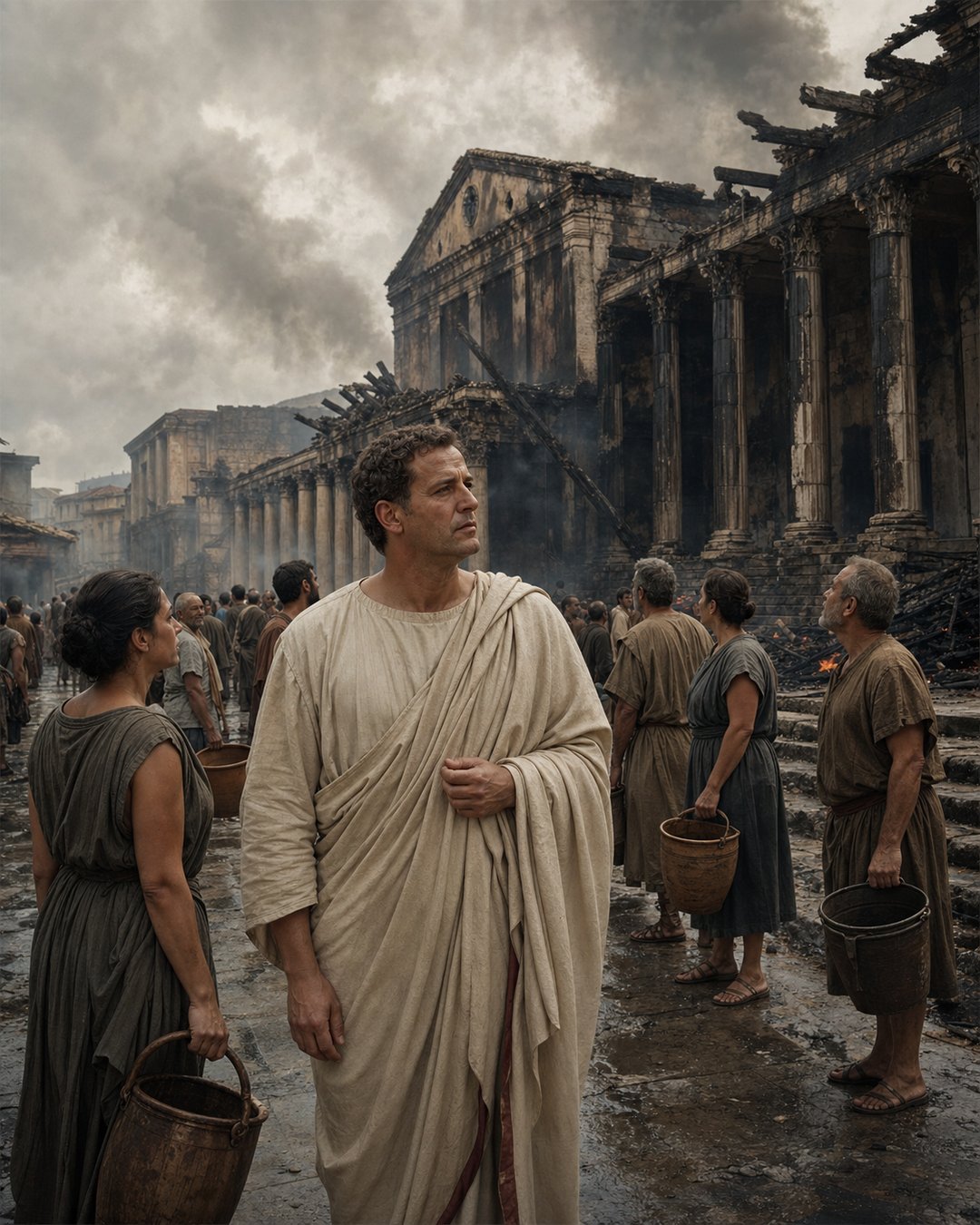
A broad road separated two public buildings in Nicomedia, but it did not save either of them. Fire consumed private houses, the city’s Gerusia and a temple of Isis. Pliny the Younger, governing Bithynia-Pontus for Emperor Trajan, blamed a violent wind. He also blamed the people who watched without helping and a city that possessed neither a fire engine, buckets nor other useful apparatus.
Pliny’s proposed repair was precise: create a company of no more than 150 firemen, admit only real craftsmen and keep the group under close observation. Trajan refused. His answer did not deny the need for fire equipment. It rejected the permanent body of men that Pliny wanted to organize around it.
The two letters expose a fault line in Roman provincial government. A city needed trained coordination before the next flame crossed a street. An emperor who distrusted associations saw the same coordination as a possible political club. Nicomedia’s problem was therefore not only water, wind or tools. It was the difficulty of building civic capacity without building an independent group.
The Road Failed as a Firebreak
Pliny called the fire very extensive. Many private houses burned, but the most revealing losses were public. The Gerusia and the temple of Isis stood on opposite sides of a road. Both were destroyed. That detail gives the letter a physical scene: open space existed, yet heat, wind and unmanaged fire crossed it.
The Gerusia was a civic institution as well as a building. The temple belonged to the city’s religious landscape. Their destruction placed municipal administration, neighborhood property and worship inside the same emergency. Flames did not respect the categories by which officials normally sorted public and private responsibility.
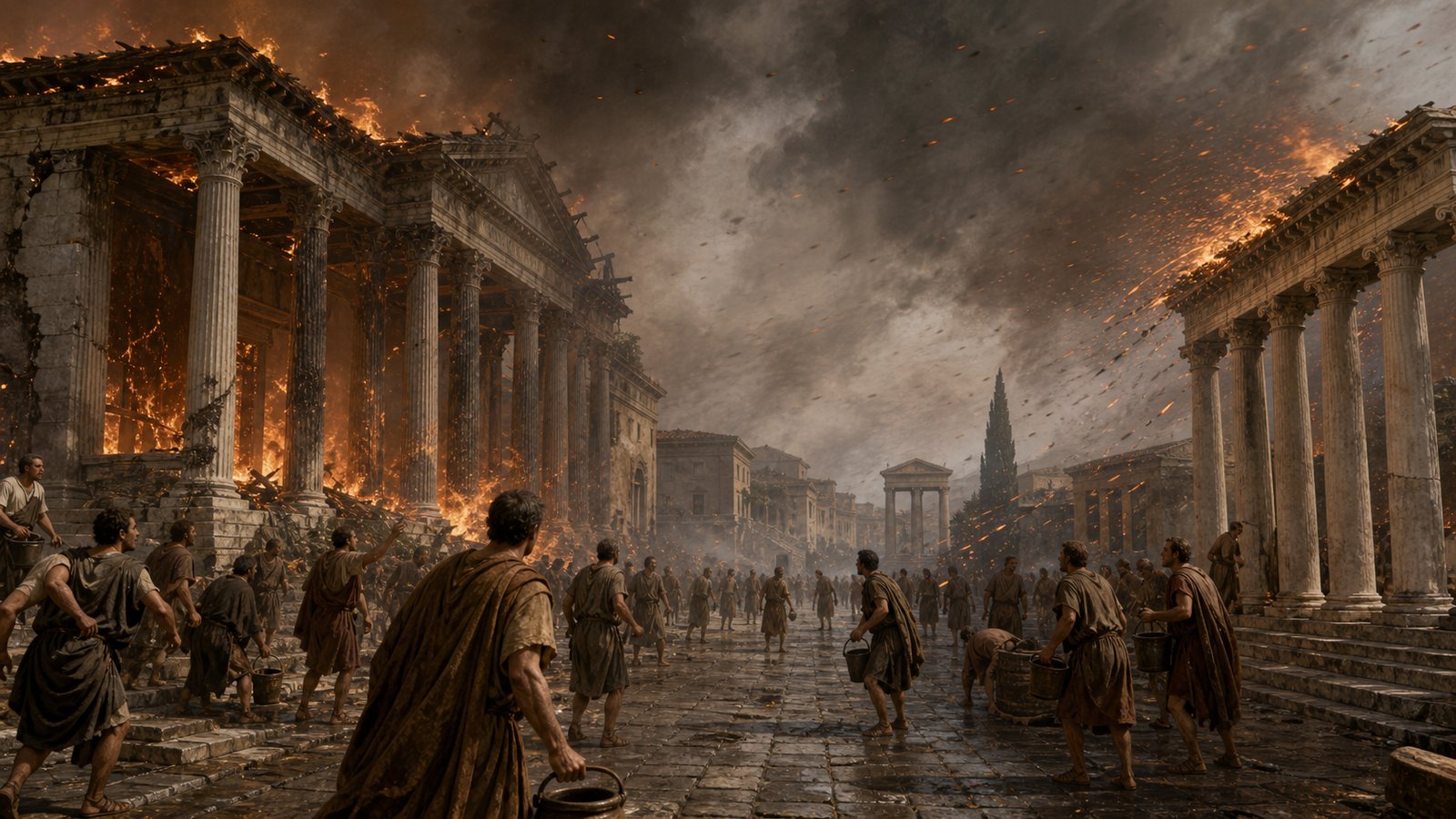
Pliny identified wind as one cause of the spread. Strong wind could carry sparks, bend flames and make an apparently useful gap unreliable. Yet he did not let nature absorb all responsibility. The people stood watching. No organized response converted the available crowd into labor, and no stocked equipment gave that labor an immediate task.
The episode belongs beside Nicomedia’s abandoned aqueducts, another case in which the governor confronted an expensive gap between civic ambition and functioning infrastructure. An aqueduct could consume money without delivering water. A road could exist without stopping fire. Roman public works mattered only when institutions made them perform.
Pliny Counted the Missing Things
The governor’s diagnosis moved quickly from behavior to inventory. Nicomedia had no fire engine. It lacked buckets and the other apparatus needed to fight a blaze. People who might have helped had no rehearsed chain of command and no tools waiting for their hands. Idleness and scarcity reinforced one another.
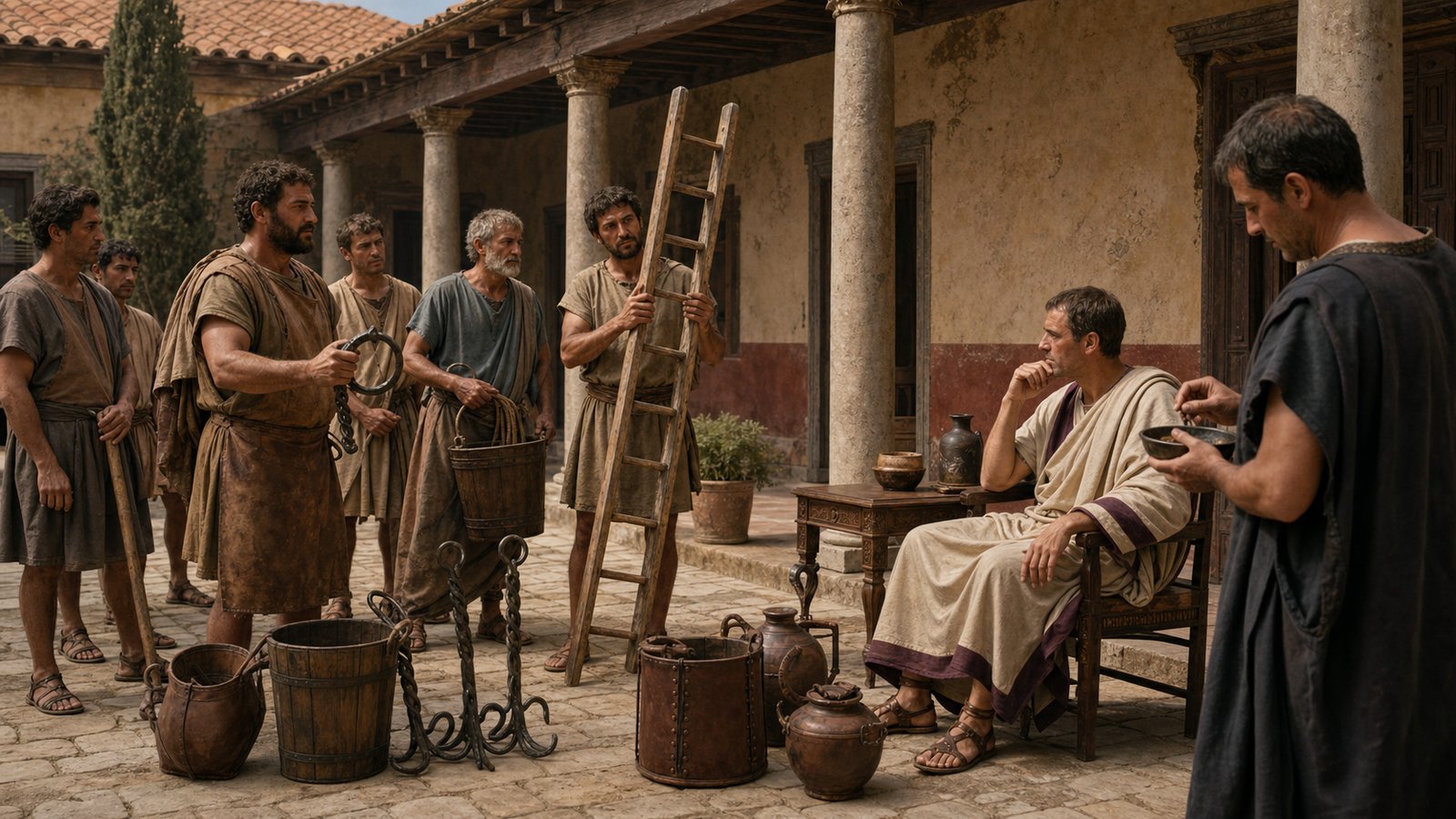
That list matters because it prevents the exchange from becoming a vague story about Roman backwardness. Pliny understood that an emergency response needed material prepared in advance. Containers had to move water. Tools had to pull apart dangerous structures or clear access. Someone had to know where the equipment was stored and who would use it.
In the account of a lamp warning well diggers about bad air, a small object converts invisible danger into a visible signal. Nicomedia lacked the equivalent operational bridge. The fire was visible to everyone, but visibility alone produced spectators. Equipment and assigned roles were needed to turn recognition into action.
Pliny did not ask for an unlimited organization. He proposed a cap of 150. The number acknowledged the city’s scale while reassuring the emperor that the corps would remain bounded. It was large enough to divide tasks but small enough, Pliny claimed, to supervise.
A Craft Corps Was Designed to Look Harmless
Membership would be restricted to actual craftsmen. That condition gave the company a practical identity: men chosen for useful skills rather than a mass of residents enrolled for prestige or politics. Pliny also promised that the group would not abuse the legal privileges attached to its corporate form.
Every part of the proposal answered an anticipated objection. The numerical limit controlled size. The craft test controlled membership. Close oversight controlled conduct. The promise about privileges controlled the legal boundary. Pliny was not merely asking whether a brigade could extinguish fire; he was designing one to appear administratively safe.
His language suggests that the danger of association was already understood between governor and emperor. Roman groups could collect dues, elect officers, meet repeatedly and cultivate loyalty. Those features made a body useful in an emergency. They also gave it continuity outside the moment when officials directly needed it.
The archive’s wider picture of Roman collegia and organized work shows why craft identity could be both reassuring and politically sensitive. Shared occupation made cooperation intelligible. Regular meetings and corporate solidarity could also create a constituency that did not begin or end with one imperial instruction.
Trajan Separated Equipment from Association
Trajan’s reply accepted half of Pliny’s diagnosis. Fire-fighting equipment should be provided. Property owners should use it, and the crowd could be called in to help. The emperor did not order Nicomedia to wait passively for another disaster. He substituted a different model of mobilization.
Under that model, tools were permanent but the organized workforce was not. Responsibility began with owners whose property was threatened. More people could be summoned when flames appeared. The crowd would form around an immediate official need and disperse afterward, rather than maintaining officers, membership and habits between emergencies.
That arrangement reduced the political life of the solution. It probably also reduced readiness. A temporary crowd had to discover its roles under pressure. Owners might protect their own houses before a neighbor’s. Equipment without a standing crew still required storage, access, practice and authority. Trajan’s answer addressed the risk he feared most, not every weakness Pliny had identified.
The contrast with Rome’s organized night watch and fire response is instructive. The capital could sustain a more durable public apparatus under closer imperial command. A provincial city with a history of faction presented another political calculation. Roman government did not apply one institutional answer everywhere.
The Safer Institution May Have Been the Slower One
Trajan explained the refusal through recent provincial disorder. Political societies had troubled Bithynia-Pontus, especially its cities. Associations, whatever purpose or name they adopted, tended in his view to become political clubs. A fire brigade was not judged only by its stated task; it was judged by what regular membership might become.
This was a conflict between two kinds of prevention. Pliny wanted to prevent the next physical catastrophe by creating a trained corps before it was needed. Trajan wanted to prevent political organization from hardening into faction. Each man saw future risk, but they ranked the risks differently.
The exchange also reveals the limits of an obedient governor’s local knowledge. Pliny had inspected the damage and could name the missing apparatus. He still sought permission to form the company. Trajan, at a distance, supplied the institutional boundary. Provincial expertise described the emergency; imperial authority decided which durable relationships were permissible.
No surviving sentence in the exchange tells us whether Nicomedia’s owners acquired enough buckets, whether crowds later drilled, or how the next fire ended. The letters preserve a decision rather than its outcome. That incompleteness is useful. It stops modern readers from pretending that equipment automatically solved coordination or that banning the corps automatically prevented faction.
Nicomedia’s burned road teaches a compact lesson about Roman administration. Material preparedness and political control could pull in different directions. Pliny’s 150 craftsmen offered skill, continuity and accountability. Trajan’s owners and summoned crowd offered looser organization under immediate need. The emperor chose the arrangement less likely to become a political body, even if it was also the arrangement that had to learn cooperation while the city burned.
Sources
Pliny the Younger, Letters 10.33–34.