
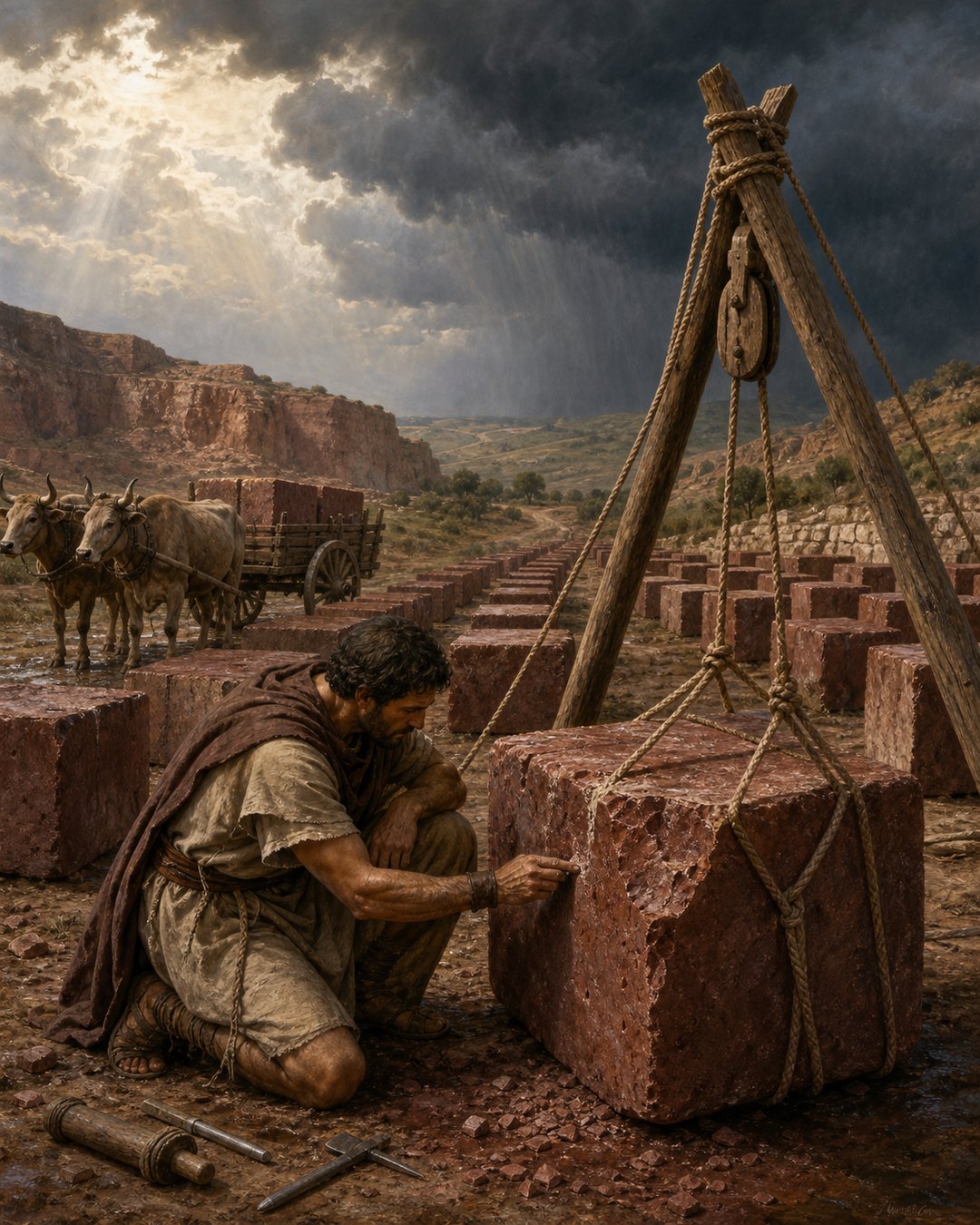
A Roman builder choosing stone near the capital faced an awkward bargain. Fresh red stone from nearby quarries was easy to cut. Under cover, it could serve well. Put the same material where frost, rain or salt reached it, however, and Vitruvius warned that it could become friable and crumble.
His answer was neither blind confidence nor a ban on the convenient local material. Quarry the stone in summer, two years before construction. Leave it outdoors through changing weather. When the building began, send pieces already damaged by exposure into the foundations and reserve the survivors for work above ground.
The prescription turned delay into evidence. Weather did not merely age the stone; it performed the test that a finished wall should not have to perform for the first time. Ease of cutting, transport distance and durability could then be treated as separate questions rather than collapsed into one judgment at the quarry face.
Fresh Stone Offered the Wrong Kind of Confidence
Vitruvius began his quarry discussion by stressing variation. Stone for squared blocks and rubble did not arrive with one universal character. Soft red varieties could be found near Rome in the territories he associated with the Pallienses, Fidenates and Albani. Other stones were moderately hard, while some approached flint.
The soft material had an immediate attraction. Recently removed from the quarry, it yielded to tools and could be shaped without the resistance of harder stone. That reduced effort at the moment when a foreman watched wedges, picks and dressing tools turn an irregular mass into usable building pieces.
But workability measured only what happened during extraction and dressing. It did not reveal how the same pores, grains and internal weaknesses would answer repeated wetting, frost or coastal salt. A clean arris cut in summer could therefore promise more than the material would deliver after installation.
This tension helps explain why Roman quarrying was more than the muscular movement described in the account of moving blocks from a quarry. Extraction created a candidate building material. Selection continued after the block had left the face.
Rain, Frost, Salt and Fire Asked Different Questions
Vitruvius did not rank every stone along a single line from weak to strong. Soft stone could work under a roof yet deteriorate outdoors. Tiburtine and related stones could resist great weights and ordinary weather but suffer badly in fire. The Anician stone he praised near the Volscinian lake and Statonia answered both frost and heat more successfully.
That comparison matters because “durable” depended on the threat. A lintel carrying weight, a seaward wall tasting salt, a façade exposed to rain and a structure facing flame did not ask the same thing from their material. Stone choice was an exercise in matching location to behavior.
Vitruvius offered visible evidence for one superior material. At Ferentinum he pointed to old monuments, large statues, smaller reliefs, acanthus leaves and flowers that still looked freshly carved. Those surviving details made time itself part of the recommendation. Fine edges that remained legible showed what the quarry’s stone could preserve.
The contrast with the larch tower that resisted fire is useful. Builders learned material behavior from different ordeals. Timber, limestone and tuff did not need to survive in the same way; each was judged against the conditions its place imposed.
Two Years Made the Stockpile Speak
Proximity still exerted pressure. A stone worthy of every building was less useful if transport made it impractical. Vitruvius acknowledged that necessity pushed builders toward red stone from quarries close to Rome. His test made that compromise manageable instead of pretending distance did not matter.
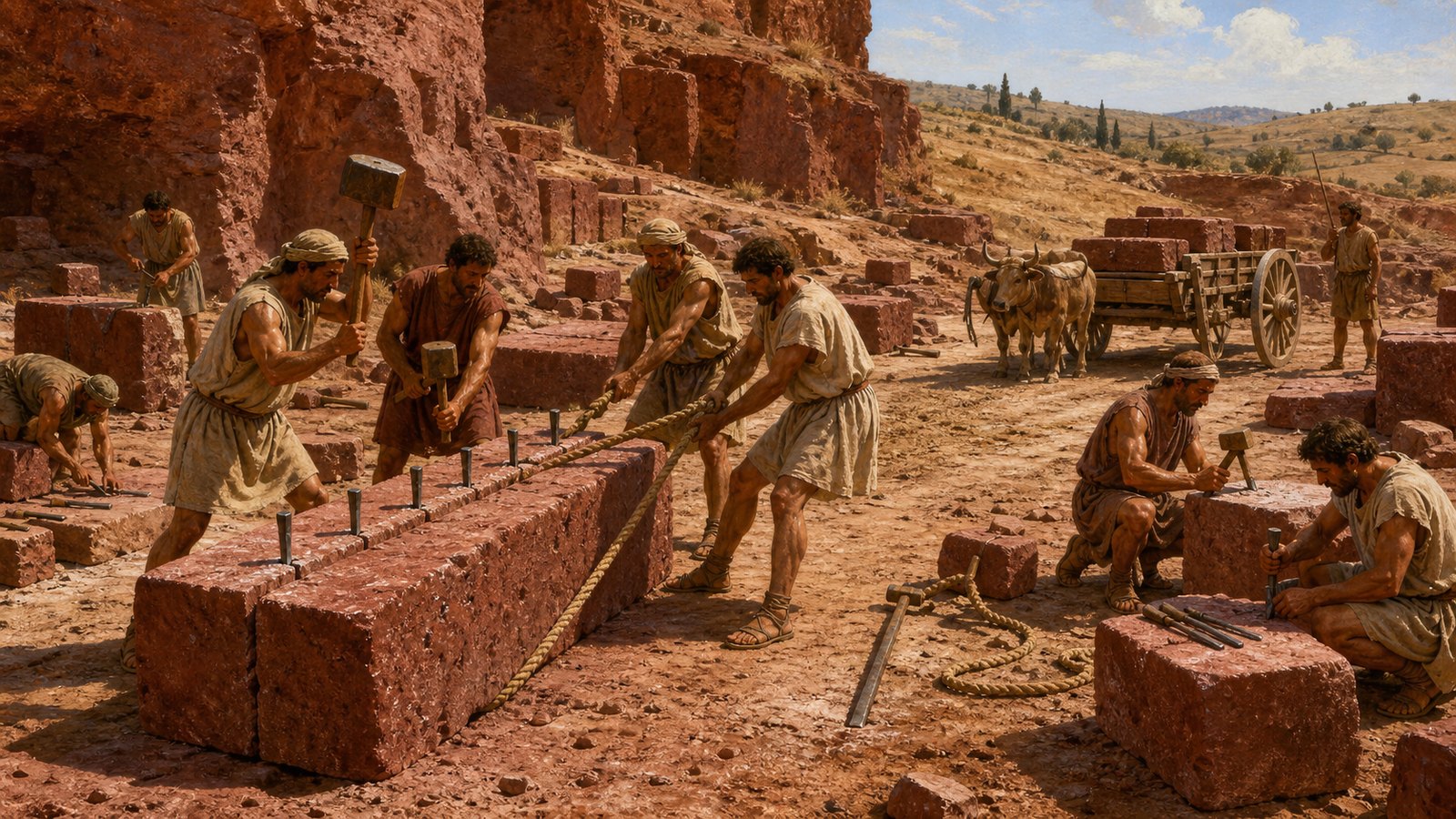
The sequence began before the project itself. Crews were to extract the stone two years before building and do the work in summer, explicitly not in winter. The schedule created a stockpile whose history was known. Each piece entered the yard at roughly the right season and remained available for the same long exposure.
Across that interval, sun dried the surfaces, rain entered weak zones and cold tested what moisture had reached. Vitruvius did not supply a modern laboratory protocol or a count of freeze-thaw cycles. He supplied a practical duration and an instruction to let ordinary weather expose defects at useful scale.
The wait resembles the patience behind Utica’s five-year rule for building bricks, but the narrative engine is different. The brick rule concerned a manufactured material proving itself over time. Here the yard became a sorting field for quarried stone, and failure determined where each piece could still serve.
A Damaged Block Was Reassigned, Not Automatically Wasted
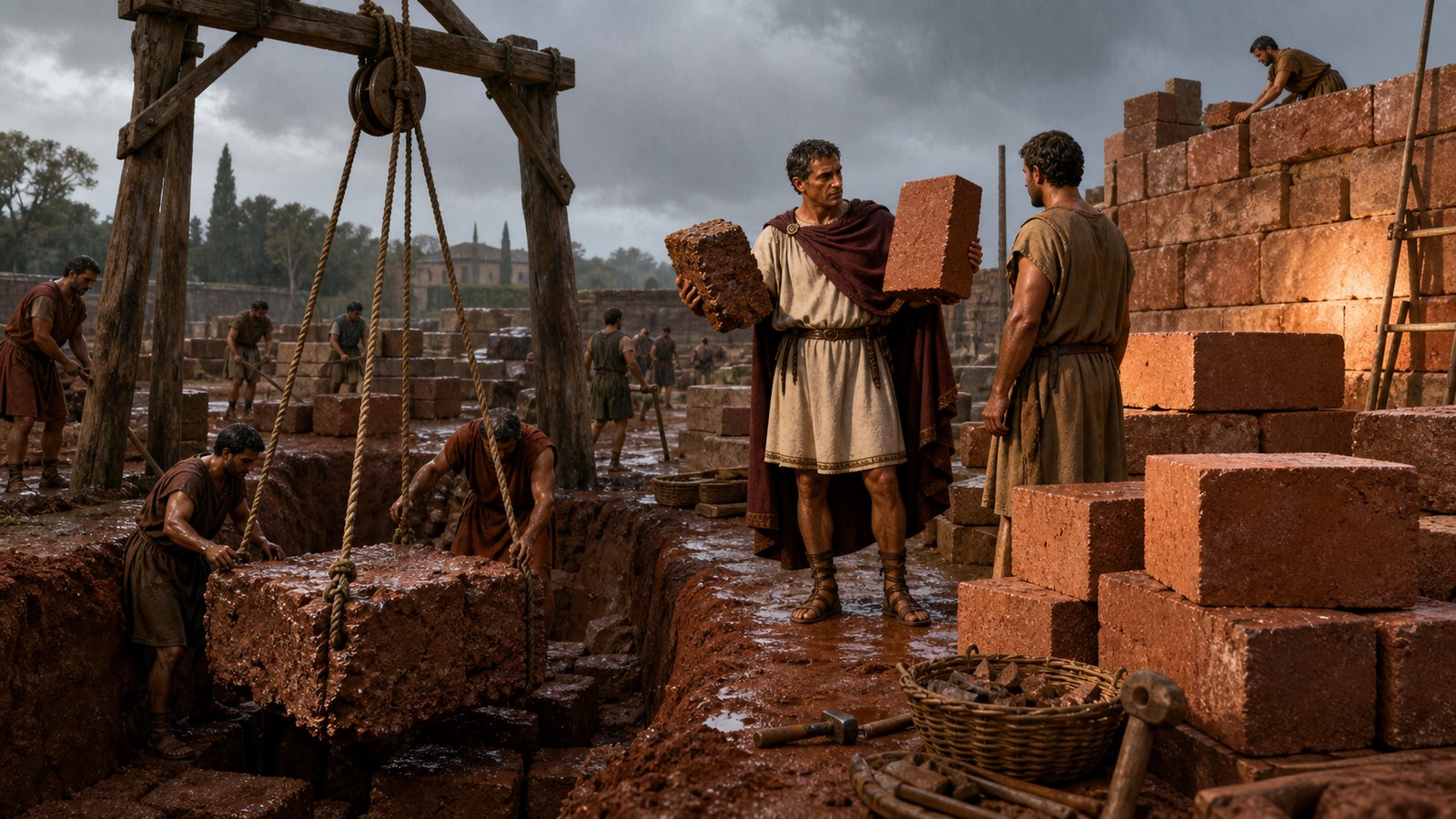
After two years, the builder read the stockpile. Pieces injured by weather did not qualify for exposed work. Vitruvius allowed them in foundations. Blocks that remained sound after the ordeal could be trusted in the parts above ground.
This was a hierarchy of exposure. A façade or other visible masonry would continue meeting weather, so its components had to survive the rehearsal. A foundation occupied another environment and carried another role. The damaged piece was not declared universally useless; it was denied the position whose conditions had already defeated it.
The distinction prevented one weak block from becoming an expensive public lesson. Once masonry rose, replacement meant dismantling work around the failure, finding new material and paying again for transport and labor. In a yard, reassignment required only recognition and control of the pile.
Vitruvius applied the rule to squared work and rubble alike. The principle did not depend on a prestigious dressed face. Irregular masonry could hide individual pieces, but hidden weakness still mattered. Testing belonged to the material flow before differences in finish divided one form of construction from another.
The Yard Linked Quarry Knowledge to Building Risk
A two-year exposure test needed organization. Quarrying had to begin well before the wall. Stock could not be consumed immediately by another job. Workers had to keep tested material distinguishable from fresh arrivals, notice flaking or decay, and send each group to the place for which it had qualified.
That organization joined several kinds of knowledge. Quarry crews knew how the stone broke under tools. Yard workers saw what weather did to it. Masons understood where the design would expose or shelter it. Whoever directed the project had to preserve those observations across time.
The process also balanced local economy against structural caution. Nearby stone saved haulage. The test did not erase its defects; it priced them into the schedule and reduced the chance that the worst pieces reached the most vulnerable locations. Roman construction could be pragmatic without being careless.
In the Ephesus rule that put an architect’s property behind an estimate, financial exposure forced professional judgment to carry consequences. Vitruvius’s stone yard imposed a material version of that discipline. The block faced its ordeal before the finished building carried the risk.
Two summers therefore did not transform poor stone into good stone. They separated performances that fresh appearance had concealed. The stones that crumbled had answered one question; the stones that stayed sound had answered another. By waiting, builders allowed frost and rain to make the first rejection while rejection was still cheap.
Sources
Vitruvius, On Architecture 2.7.1–5.