
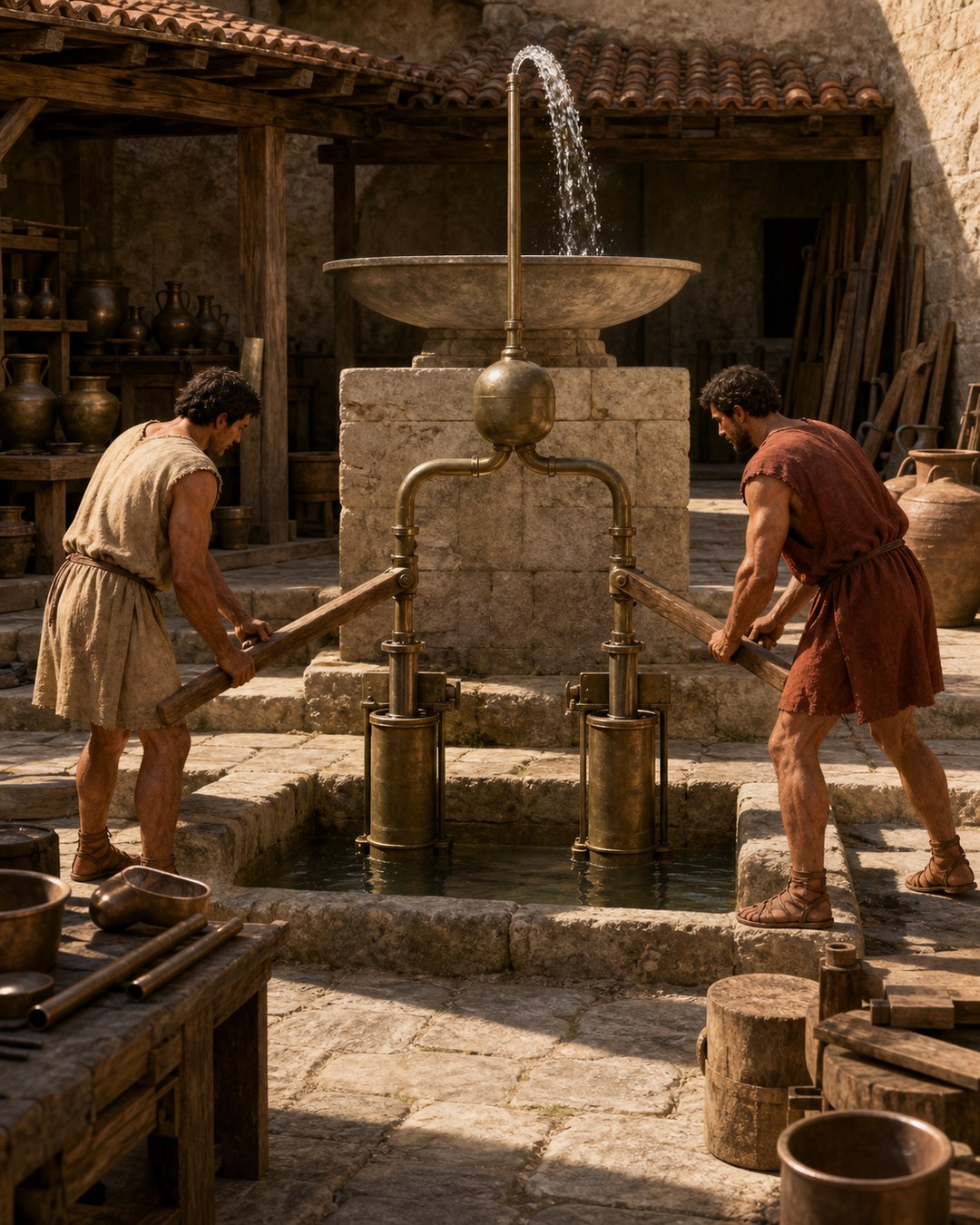
The fountain stood higher than its reservoir. Between them, two bronze cylinders sat a little apart, each with a piston entering from above. Rods and levers moved those pistons. Forked pipes carried their output toward a vessel in the middle, and a vertical pipe rose from its top. Nothing in this arrangement depended on water choosing to climb.
Vitruvius credits the machine to Ctesibius and describes its parts in the order pressure encountered them. Valves covered openings at the bottoms of the cylinders. More valves fitted accurately over the upper vents. An inverted-funnel cowl was wedged down against the force collecting beneath it. The outlet, called the trumpet, pointed upward.
The pump’s achievement was directional discipline. A piston could pull water into a cylinder, then press it toward the central chamber, because one set of valves admitted the charge and another kept the discharge from returning. Repeated strokes accumulated a one-way result. The jet above began with boundaries below.
A Pair of Cylinders Divided the Labour
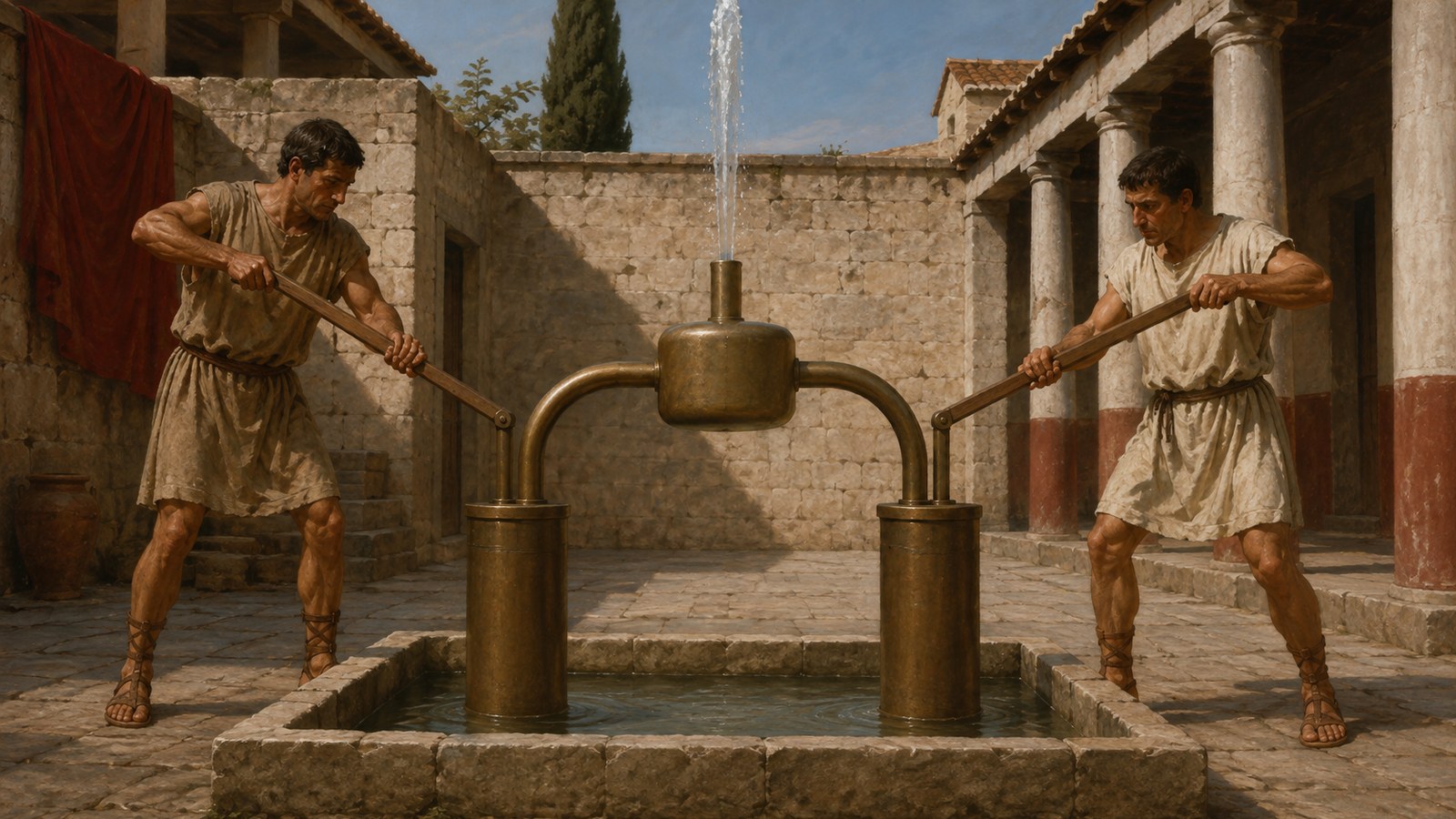
Vitruvius begins with two bronze cylinders rather than one. They stood at the bottom of the machine with a small space between them. Each had its own pipe, and those pipes rose side by side like the prongs of a fork before entering a vessel placed centrally between the cylinders.
The paired layout matters even though the surviving description does not provide dimensions, stroke length or a measured output. Two working chambers allowed the operator’s effort to be distributed across repeated actions. When the levers were handled in rhythm, one side could follow the other instead of making the entire delivery depend on a single isolated compression.
We should not draw a modern factory pump backward into the passage. Vitruvius does not specify a crankshaft, flywheel or automatic alternating linkage. He gives rods and levers. The secure reconstruction is a manually worked pair whose separate flows met in one receiving vessel.
This differs from the Roman water screw. A screw trapped water along a rotating inclined path and carried it upward through continuous turning. Ctesibius’s pump enclosed small charges in cylinders, changed their pressure and handed them through controlled openings. Both raised water, but their stories of motion were fundamentally different.
Oiled Pistons Made Pressure Repeatable
Inside each cylinder sat a smoothly turned piston. Vitruvius says the pistons were rubbed with oil before being inserted from above. That brief physical detail carries much of the device’s credibility. A rough, loose piston would let water and air slip around its edge. A close surface moved with less friction and reduced the escape route around the moving part.
The rods and levers connected human movement to the sealed space. Raising a piston expanded the chamber beneath it. Pressing it down reduced that space. Vitruvius speaks of the pistons working upon both air and water through repeated pressure and expansion, not of a single dramatic thrust.
Oil did not supply the lifting energy. The workers supplied that through the levers. Nor does the text let us identify a precise piston seal beyond the turned, oiled fit it names. What oil contributed was the possibility of continued movement against the cylinder wall without turning every stroke into destructive scraping.
The mechanism therefore transformed strength before it transformed height. A worker’s broad lever movement became the controlled travel of a fitted piston. The piston changed the volume of a confined chamber. Only then could valves make the changing pressure useful.
Four Valve Positions Gave Water a Direction
At the bottom of each cylinder, a valve covered the inlet opening. Above each cylinder, where its delivery pipe entered the central vessel, another valve fitted accurately over the vent. Across the pair, the description therefore establishes two lower positions and two upper positions, each guarding a different stage of the route.
During expansion, the pressure change could admit water through the lower opening. During compression, the lower valve had to stop that same water from being driven back into the reservoir. The charge then moved toward the upper pipe. Once it passed the accurately fitted upper valve, that barrier kept what had entered the central vessel from descending into the cylinder again.
Vitruvius states the anti-return purpose explicitly for the upper valves. The complementary action of the lower valves follows from their placement over the cylinder-bottom openings and from his account of repeated pressure and expansion. The important point is not an invented hinge design. It is the sequence of closures: entry must not become the route of escape, and delivery must not become the route of return.
The same concern with controlled water appears at a much larger civic scale in the work of Roman aqueduct inspectors. There, unauthorized pipes and neglected channels could redirect a public supply. Here, leakage across a small valve could erase a piston’s work. In both cases, water reached its intended destination only because routes were inspected, bounded and kept from becoming shortcuts elsewhere.
The Central Vessel Had to Hold the Gain
The forked pipes joined at a vessel between the cylinders. That chamber received the separate pulses and gave them one outlet. It also faced the accumulated force created below. Vitruvius’s fastening details show that the pressure was not a literary flourish: the top assembly had to be secured against it.
Over the vessel sat a cowl shaped like an inverted funnel. A wedge driven through a staple held the cowl down so the water forced inside could not lift it off. This is one of the chapter’s most vivid construction scenes. The pump advertised its internal force through a part designed not to move.
On top, a pipe named the trumpet stood vertically. The name describes the outlet rather than a musical effect. Water driven into the central vessel passed under the secured cowl and then upward through this pipe. A reservoir below could consequently supply a fountain above.
That shared chamber was more than a junction. It preserved the gain made by alternating cylinders. Upper valves protected it from backflow, the wedged cowl contained it, and the trumpet gave it only the intended direction of release. The visible water above was the last step in a chain of invisible refusals.
The Fountain Concealed a Workshop of Timing
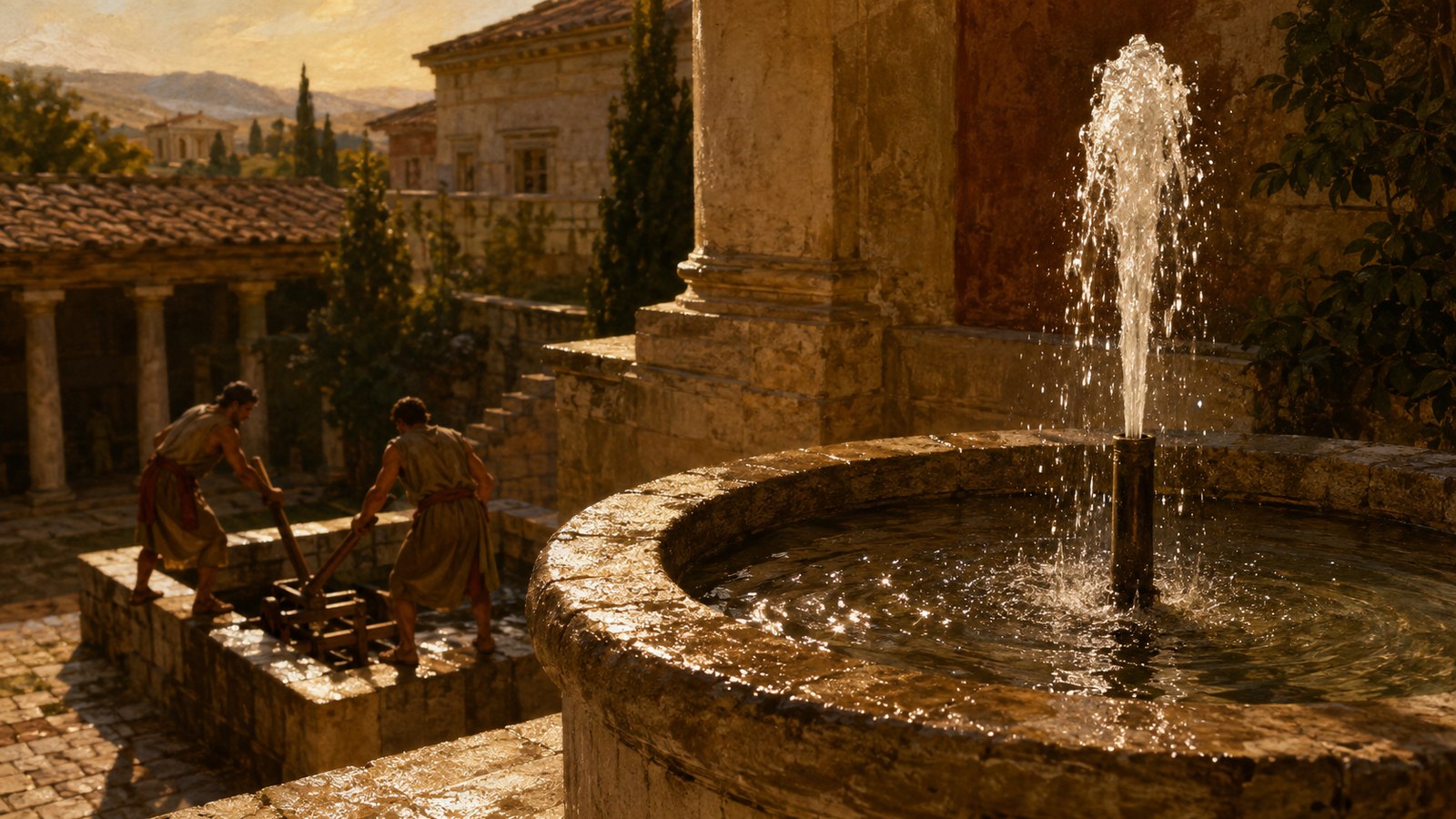
A visitor looking only at the outlet might see a graceful jet. Vitruvius asks the reader to look beneath it: bronze walls, polished pistons, oil, valve seats, forked pipes, a central vessel, a wedge and the hands moving levers. Height was produced by maintaining relationships among those parts.
The pump also clarifies why Ctesibius belongs beside more playful hydraulic inventions without being reduced to spectacle. Vitruvius says Ctesibius devised birds that sang by waterworks, moving and drinking figures, and other effects pleasing to eye and ear. Yet he chose the pump because it served a need. Pressure and compressed air could entertain, but they could also move a supply against gravity.
A related boundary between mechanism and performance survives in Aquincum’s water organ. The organ coordinated air, water, valves and keys to create sound. The force pump coordinated cylinders, water and valves to create elevation. Similar physical ideas entered different human experiences.
No surviving line in this chapter tells us how high every installation lifted, how many workers operated the levers or how steadily a fountain flowed. Those questions must remain open. Vitruvius gives something more durable than a performance claim: he gives the path through which failure could be understood. A piston could fit badly, a valve could leak, a joint could open, or the cowl could rise.
That diagnostic quality is the pump’s intellectual achievement. Each stroke temporarily changed pressure; each valve converted that temporary change into direction; the central chamber retained what the previous stroke had won. Repetition turned pulses into service. Water rose not because the machine made gravity disappear, but because it prevented gravity from undoing the same work twice.
Sources
Vitruvius, On Architecture 10.7.