
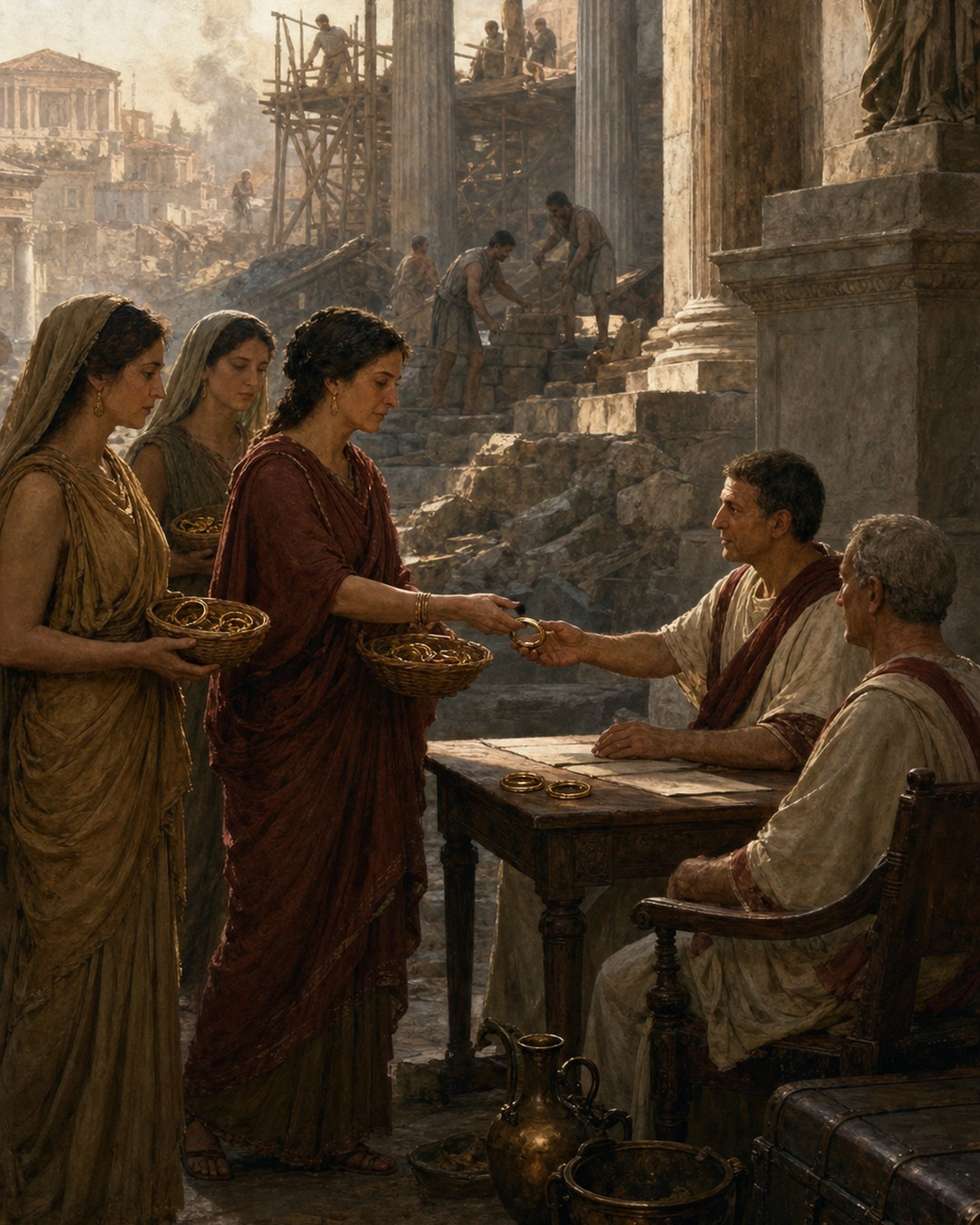
Rome had been recovered, but its gold could not simply be poured into one heap. Livy says that metal taken from temples had to return to sacred use. When the precise destination of some recovered pieces could no longer be traced, the Romans treated all of it as sacred and ordered it placed beneath Jupiter’s throne.
A public obligation still demanded payment. Gold was lacking to make up the ransom agreed with the Gauls. The city resolved the collision by accepting a contribution from its matrons. Their private ornaments entered the public fund so the protected temple reserve did not have to be touched.
The exchange did not end at the scales. Rome returned public thanks and added an honor: after death, women could receive funeral orations in the same manner as men. An emergency contribution had altered who could be praised as a civic actor. The donated gold disappeared into a ransom; its memory remained audible at later funerals.
The Sack Left Gold Without a Clear Address
Livy places the decision inside the religious cleanup after the Gallic occupation. Priests were to identify the sacred places damaged during the crisis, purify them and restore public worship. Recovery meant more than putting walls and roofs back into use. Objects and spaces had to regain the boundaries violence had disturbed.
Gold presented a special problem because some had originally been removed from temples. If every piece could have been matched securely to its sanctuary, restoration would have been simple. Livy says that traces were uncertain. The Romans answered uncertainty by expanding protection: all the disputed gold was judged sacred.
The order to place it beneath Jupiter’s throne gave that judgment a physical location. Wealth that might have looked available to a desperate treasury was moved into the custody of the chief god’s cult. The placement told future handlers that this was no ordinary reserve waiting for a convenient expense. That distinction turned damaged ritual inventory into an argument about authority.
That concern resembles the ritual care surrounding Juno Regina’s transfer from Veii. In each story, military success failed to erase a sacred claim. The victors needed a procedure that distinguished honorable custody from mere possession.
The Ransom Created a Competing Claim
At the same moment, Rome needed gold for public use. Livy names the obligation precisely enough to show why delay was dangerous: the city had to make up the amount agreed as ransom with the Gauls. A sacred reserve existed, but an urgent civic debt stood beside it.
The famous quarrel over Gallic weighing belongs to the larger drama of the sack. Yet the passage about the matrons turns away from heroic interruption and looks at the accounting problem. However later memory framed Camillus and the defeated invaders, Romans still had to explain how gold promised in the emergency had been assembled.
The sacred hoard offered an obvious solution and a religious violation at once. Using it would satisfy the agreement by crossing the boundary the cleanup had just rebuilt. Refusing to touch it protected the gods but left the treasury short. The city needed a third source.
Livy’s sequence therefore makes restraint financially visible. Sacredness was not merely a title pronounced over gold after every other need had been met. It mattered because Rome declined to spend that gold when spending it would have solved a live shortage.
Private Ornaments Became a Civic Reserve
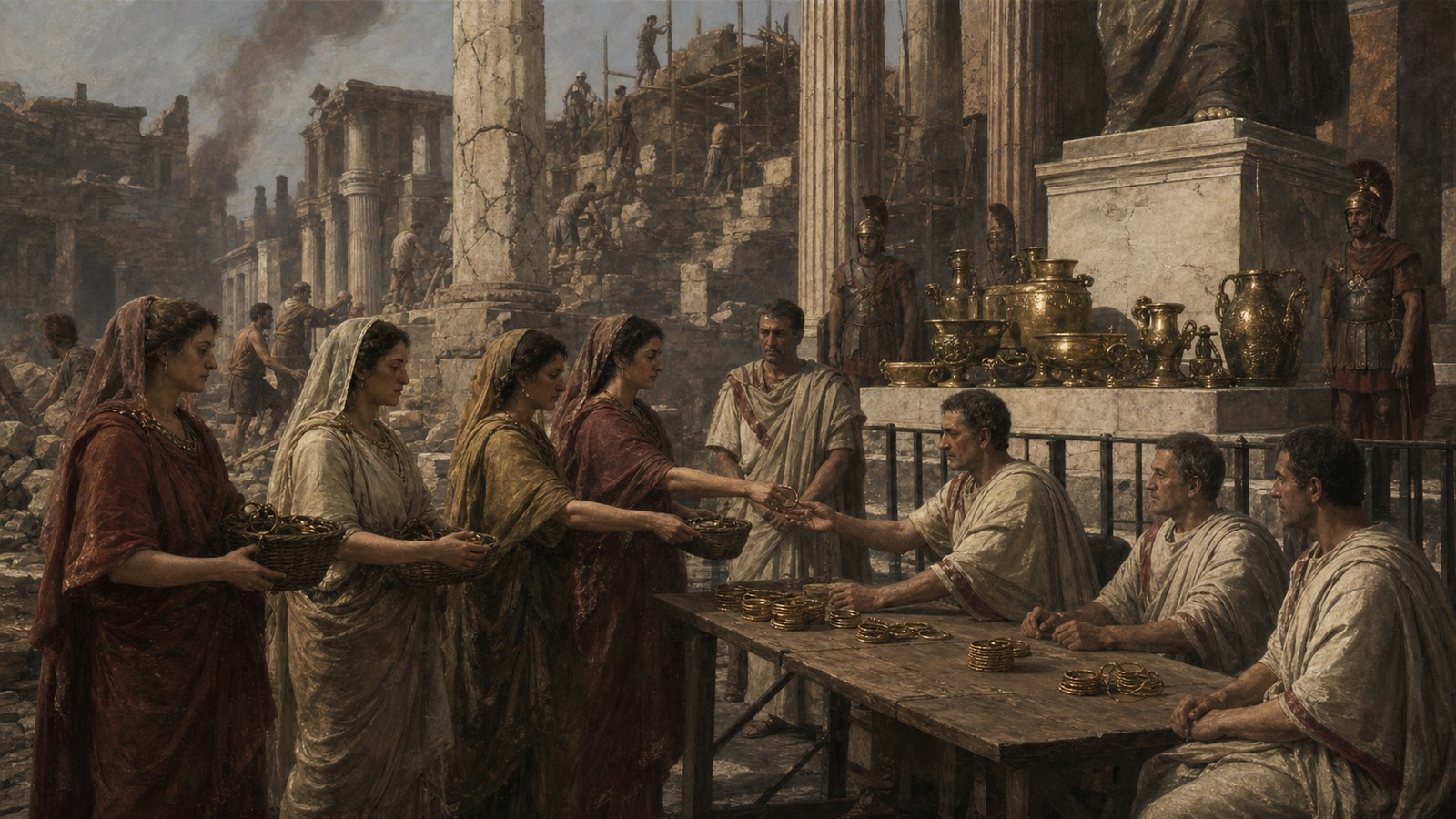
The matrons supplied the third source. Livy calls their contribution something the city accepted, presenting the transfer as voluntary rather than as a compulsory levy. The passage does not list individual donors, weights, ornaments or household negotiations. Those details cannot safely be invented.
What survives is the collective category. Matrons possessed portable wealth that could move quickly when public channels were constrained. Gold worn, stored or controlled within elite households became available for an obligation owed by the restored community.
The contribution’s meaning depended on what it prevented. The women did not simply add more metal to a large fund. Their gold stood between the ransom demand and the protected treasure beneath Jupiter’s throne. Every accepted piece reduced the pressure to turn sacred property into spendable bullion.
This was a different financing mechanism from the property levy that supported Rome’s first regular soldier pay. The levy converted assessed wealth into a recurring public burden. The matrons’ gold entered as an emergency collective gift whose significance lay in the reserve it spared.
Thanks Became a Right to Be Remembered
Public thanks acknowledged the act in the present. Livy then adds a reward that reached into the future: funeral orations could be pronounced for women after death as they were for men. The form of payment matched neither the material nor the timing of the gift.
A funeral oration was a public narrative. It placed a life before listeners and connected household memory with civic values. Granting access to that form meant that women’s actions could be described not only inside their families but before the community as examples worthy of collective attention.
The honor was also repeatable. Gold might be surrendered once, but the granted distinction could shape multiple later funerals. Each oration renewed the explanation that women had claims on public gratitude. The city transformed a finite contribution into an ongoing permission to speak about female merit.
That extension matters in a culture where the spectacle discussed in aristocratic funeral processions often made male office and ancestry physically visible. Livy’s comparison “in the same manner as the men” marks the difference being crossed. It does not make every woman politically equal; it identifies one prestigious civic language newly opened to them.

Religious Accounting Reshaped Civic Standing
Livy closes the religious measures before moving back to senatorial business and the argument over whether Rome should abandon its ruins for Veii. That order ties the matrons’ gift to the larger question of restoring the city where it stood. Temples, worship, treasure and public memory all had to be made Roman again after occupation.
The gold settlement succeeded because each class of wealth received a different destination. Uncertain temple gold went beneath Jupiter’s throne. Private gold from matrons met the public shortage. Thanks returned immediately to the donors, while funeral praise carried their contribution into the city’s future.
We should not treat Livy’s polished sequence as a surviving treasury ledger. He gives no total weight and no names of donors. His account tells us how Roman historical memory wanted the settlement understood: religious scruple was preserved, women acted voluntarily, and the community answered material help with public honor.
That memory also exposes the politics inside gratitude. Rome did not merely say the matrons had been generous. It changed the terms under which exemplary lives could be narrated. The contribution proved civic capacity in a moment when formal office belonged to men, and the funeral oration supplied a durable institution for recognizing it.
The result was a bargain across time. Sacred gold remained protected because private wealth moved during the emergency. In return, women’s public reputation could move beyond the emergency and beyond death. The scales balanced ransom metal once; the orations kept balancing civic memory afterward.
Sources
Livy, History of Rome 5.50–51.