
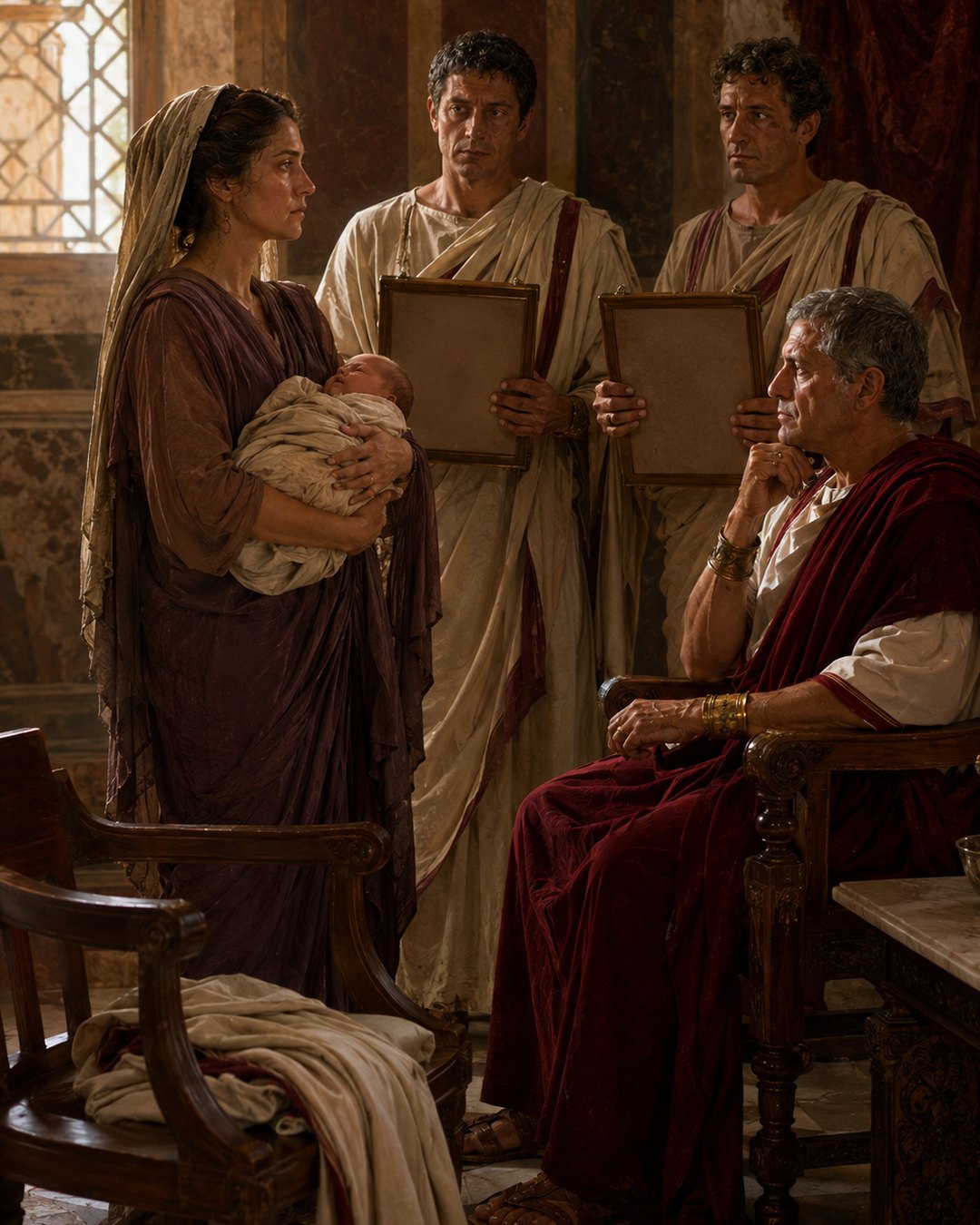
An unnamed Roman widow gave birth in the eleventh month after her husband’s death. The child arrived into a calculation before entering a family. Because an old decemviral formula spoke of birth in ten months and not the eleventh, the timing produced an accusation: the widow must have conceived after her husband died.
Aulus Gellius describes her as a woman of good and honorable character whose chastity was not otherwise in doubt. Hadrian heard the case. Instead of treating the old number as the last word, the emperor consulted what ancient philosophers and physicians had said about pregnancy and decided that birth could occur in the eleventh month.
Gellius says he personally read the decree. His report preserves no name for the woman or child, and it does not give us the complete pleadings. What survives is the collision that mattered: a legal clock produced certainty where the learned record admitted variation.
A Widow’s Reputation Was Counted in Months
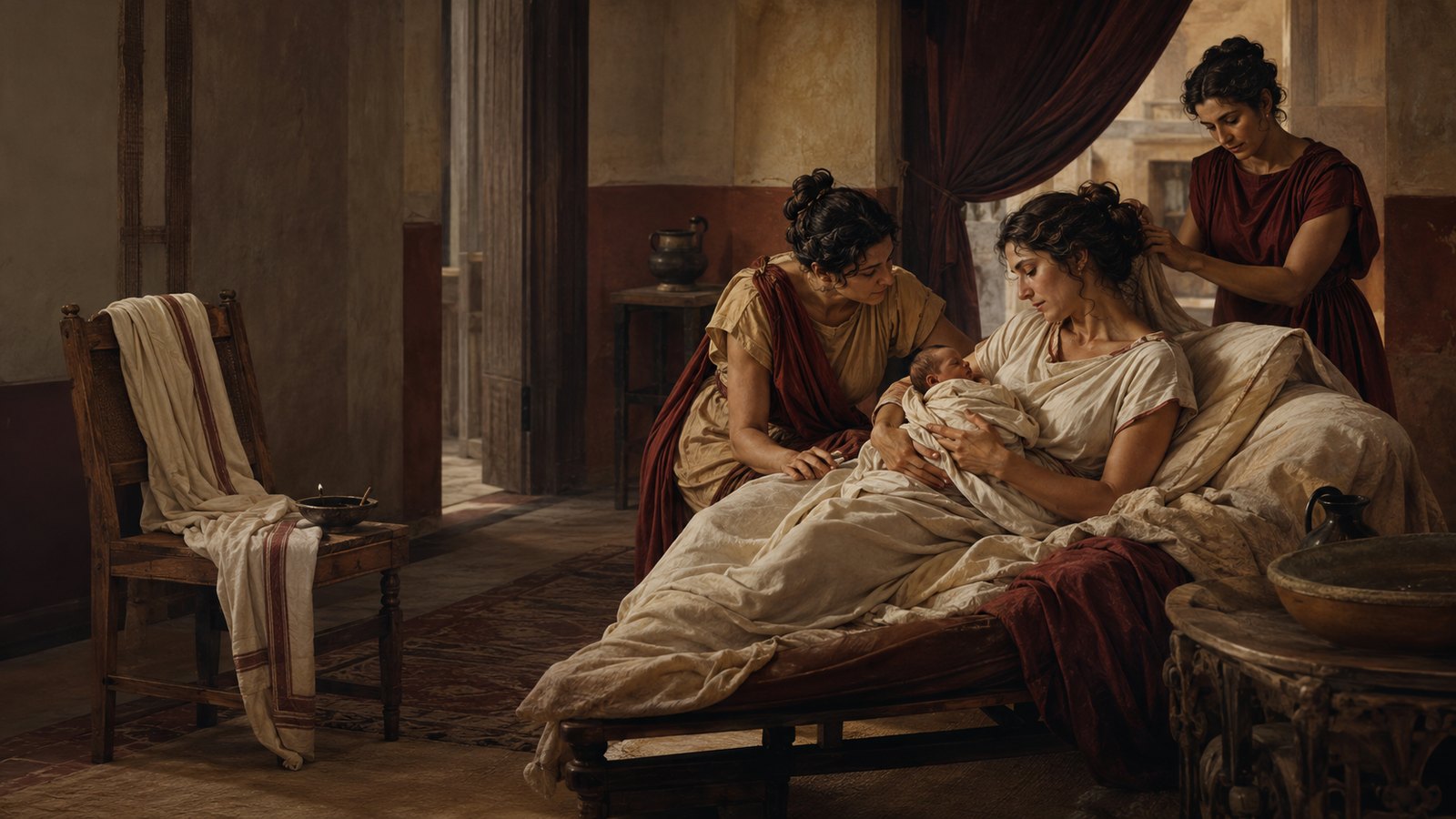
The case began after a death. A woman delivered a child eleven months after her husband was gone, and the interval invited people to place conception on the wrong side of bereavement. Calendar arithmetic became an accusation about sex, fidelity and the identity of the child’s father.
Gellius supplies a careful character note before stating the charge. The woman was respectable and of undoubted chastity. That description does not prove the biology of one pregnancy, but it shapes the legal problem he wants readers to see. A mechanical reading of time was contradicting a reputation that the surrounding community accepted.
The child’s interests sit quietly inside the dispute. Gellius later quotes a testamentary joke about equal rights for children born in ten and eleven months. That connection shows why timing was not only a matter of insult. Paternity and lawful birth could determine whether a child belonged within a line of succession and could take under a will.
Roman family status often depended on forms that turned relationships into enforceable categories. The same documentary instinct appears on a civic scale in the six bronze tablets that organized municipal government. Here, however, the category had to account for a body whose timetable did not behave like a bronze rule.
Ten Months Looked Like a Legal Wall
The accusation leaned on words Gellius attributed to the decemvirs: a child is born in ten months and not in the eleventh. He does not reproduce a complete statute or identify every procedural consequence. He gives the sentence because its apparent clarity created the case.
Numbers make powerful legal boundaries. They can be counted without asking anyone’s motive, and they promise equal treatment. Yet their precision can conceal a choice about what reality is allowed to count. If ten months were an absolute biological maximum, the widow’s story became impossible before any other evidence was considered.
Gellius’s chapter refuses that simplicity. He had already collected incompatible ancient opinions about gestation. Some writers admitted births in the eighth month. Varro cited Aristotle for both eighth- and eleventh-month deliveries. The traditions did not agree because ancient observers and theorists were trying to impose order on outcomes that varied and were imperfectly understood.
Even the way Romans counted months could differ from a modern reader’s assumptions about weeks from conception. Gellius does not provide the dates needed to reconstruct this pregnancy clinically. His concern is the range of authoritative claims available to a judge. The legal wall of “ten, not eleven” stood in a library full of disagreement.

Hadrian Asked Medicine to Complicate the Rule
Hadrian’s decision accepted the possibility of an eleventh-month birth. Gellius says the decree explicitly followed consultation of ancient philosophers and physicians. The emperor did not abandon authority; he widened the authorities relevant to interpreting the case.
That move matters because Gellius does not portray ancient medicine as unanimous. He quotes the Hippocratic sentence that eighth-month children “exist and do not exist,” then gives the physician Sabinus’s explanation. Such infants could appear alive after delivery but die afterward, so they existed briefly in appearance without surviving in reality. It is a grim example of experts trying to describe uncertain outcomes rather than offering a clean table of dates.
Varro’s antiquarian explanation added a different kind of evidence. Early Romans, he said, treated ninth- and tenth-month births as natural, and he connected those months to the names Nona and Decima among the Fates. Gellius records the etymology as part of a debate, not as a modern medical finding. Custom, language, philosophy and observation all entered the archive Hadrian could consult.
The decree therefore did not prove every eleven-month claim true. It prevented the number alone from making every such claim false. In this woman’s case, Hadrian allowed possibility to remain open long enough for law to avoid condemning her through an overconfident medical assumption.
A Will Turned the Exception into Equal Standing
Gellius reinforces the point with a line from a satire by Marcus Varro called The Will. Varro joked that if a son were born in the eleventh month “according to Aristotle,” he should enjoy the same rights under the will as a child born in ten. The wordplay is comic, but the legal consequence is serious: unusual timing need not create an inferior heir.
The satire helps explain why Gellius ranged so widely. He was not writing a case summary confined to Hadrian’s courtroom. He assembled medicine, antiquarian lore, poetry and testamentary language to show how a fixed limit had been questioned across genres. A strange birth date moved through every kind of text that tried to define normality.
Hadrian appears elsewhere in the archive as a ruler who could turn curiosity into administration. The pattern is visible from another angle in the questions used to test a temple proposal before construction. In the widow’s case, consultation tested not stone dimensions but the assumption behind a charge.
We should not turn the episode into a general claim that Roman law always deferred to medical expertise. Gellius preserves one decree and frames it within his own fascination with disputed learning. Its force lies in the specific correction: a child and mother could not be excluded merely because an inherited formula had made ten months sound like nature’s final boundary.
The Calendar Lost Its Power to Convict by Itself
The widow’s case survives because counting nearly erased context. Her husband’s death supplied one date, the birth another, and the interval seemed to tell a complete story. Gellius restored the missing uncertainty by showing that respected authorities had long disagreed about how far gestation could extend.
Hadrian’s answer did not make the months irrelevant. Timing still triggered the hearing and remained evidence. The decree changed what timing could accomplish on its own. Eleven months ceased to be automatic proof that conception occurred after the husband’s death.
That distinction protected more than reputation. It left room for the child’s lawful place in the household and for the rights that followed from that place. Varro’s joke about equal standing under a will makes the consequence visible even though Gellius does not state the final inheritance in the unnamed family.
A Roman legal rule met a difficult body and had to decide which would bend. In Gellius’s telling, Hadrian made the rule admit what its own intellectual world already knew: nature did not always keep the calendar with enough precision to convict a widow or disinherit a child.
Sources
Aulus Gellius, Attic Nights 3.16.