
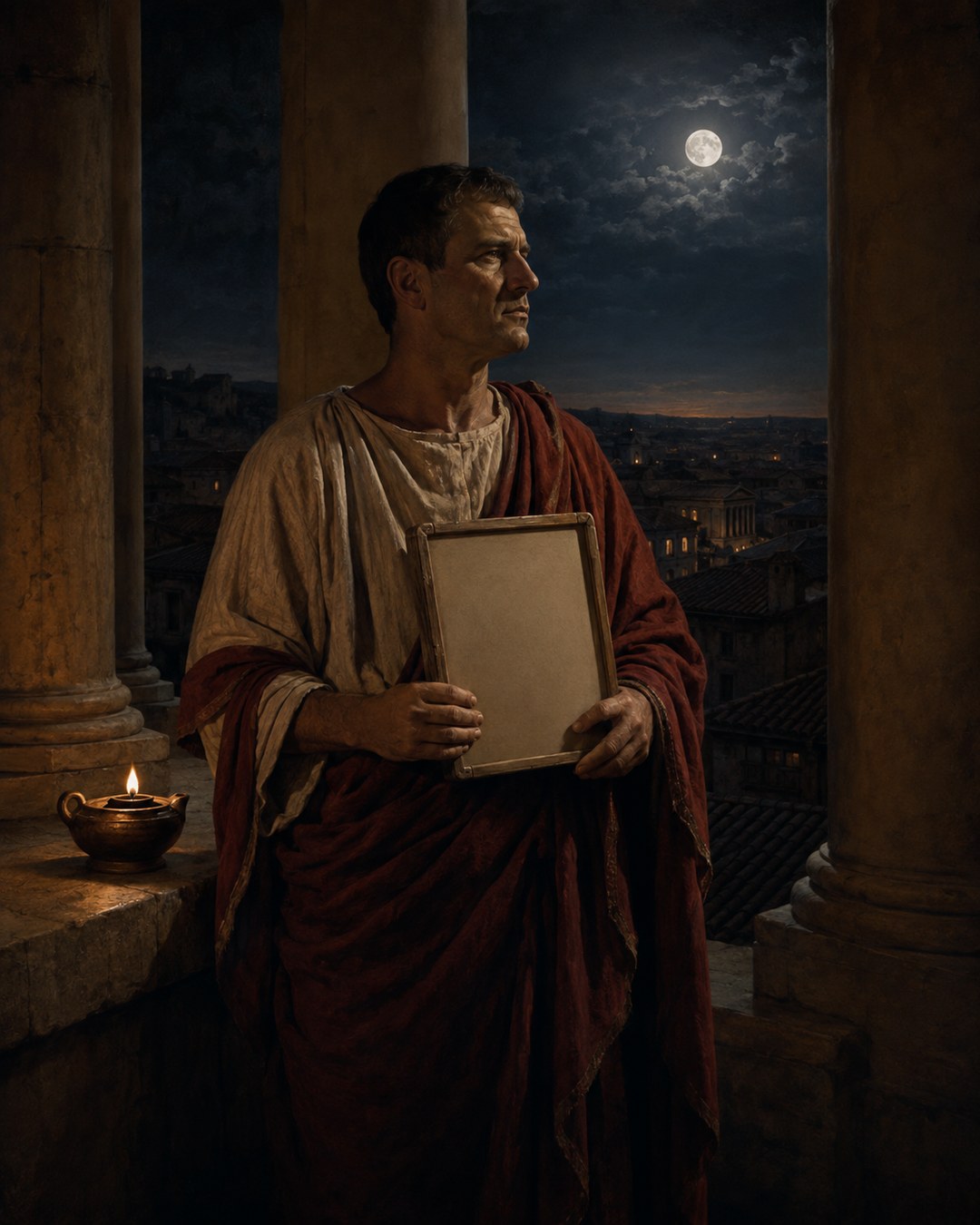
A child arrived after the lamps were lit but before the household slept. Which date belonged to the birth? For Aulus Gellius, the answer did not depend on whether darkness felt like the end of yesterday or the beginning of tomorrow. It depended on the invisible line Romans drew through the middle of the night.
In Attic Nights 3.2, Gellius gathers examples from Varro, ritual practice, magistrates, tribunes, jurists and Virgil. Together they define the Roman “civil day” as the twenty-four hours from one midnight to the next. That sounds familiar to a modern reader, yet his examples show how strange the rule could become when human activity ignored the boundary.
One night could contain two dates. A magistrate could take auspices under stars and act after noon without leaving the same legal day. A tribune could spend nearly all that interval outside Rome and still satisfy a rule against a whole day’s absence. In a marriage dispute, the last six hours of a third night fell into a new year and spoiled the calculation.
Midnight was therefore not merely a point on a clock. It was an administrative edge. By sorting births, rites, public acts and periods of absence, it made time available to law.
Four Communities Cut the Same Darkness at Different Places
Gellius begins with birthdays. If someone was born in the third or fourth hour of the night, should the birthday be assigned to the day before that night or the day after it? He turns to Marcus Varro’s Human Antiquities, specifically the book On Days, for the Roman answer.
Varro treated everyone born within the twenty-four hours between one midnight and the next as born on the same day. A birth after sunset but before midnight belonged to the date on which the night had begun. A birth during the last six hours of night belonged to the date that would appear with the following dawn. Darkness alone did not determine the date; midnight divided it.
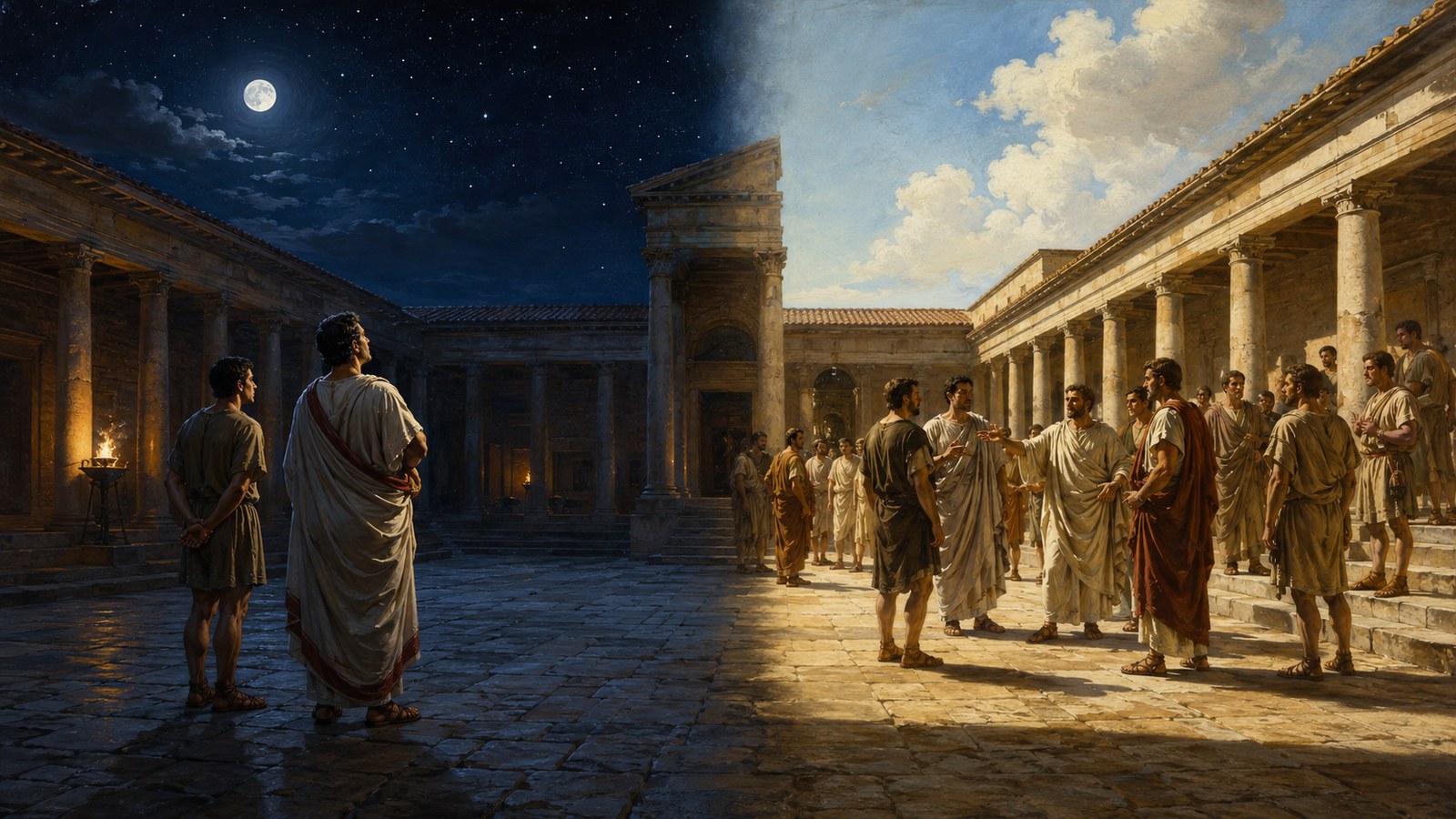
Varro then made the rule comparative. Athenians, he said, counted from sunset to sunset. Babylonians counted from sunrise to the next sunrise. In Umbria, many reportedly counted from midday to midday. All four systems enclosed a complete cycle, but each placed the seam at a different visible or conventional moment.
The Umbrian choice drew Varro’s mockery. A person born at midday on the first of the month would have a birthday made from the latter half of the first and the earlier half of the second. His objection exposes the problem every system had to solve: continuous time must be cut somewhere, and the chosen cut can make ordinary language about “the day” unexpectedly awkward.
Rome’s midnight boundary shared that artificial quality. Unlike sunrise or sunset, it did not announce itself across the city with a single obvious visual event. Its value came from consistency. The same dividing line could be carried from a birthday into ritual and law.
Night Rites Belonged to the Morning That Had Not Arrived
Gellius says abundant evidence confirmed that Romans counted from midnight to midnight. His first test is religious practice. Some ceremonies took place in daylight and others at night, yet nocturnal ceremonies were appointed for particular days rather than for separately named nights.
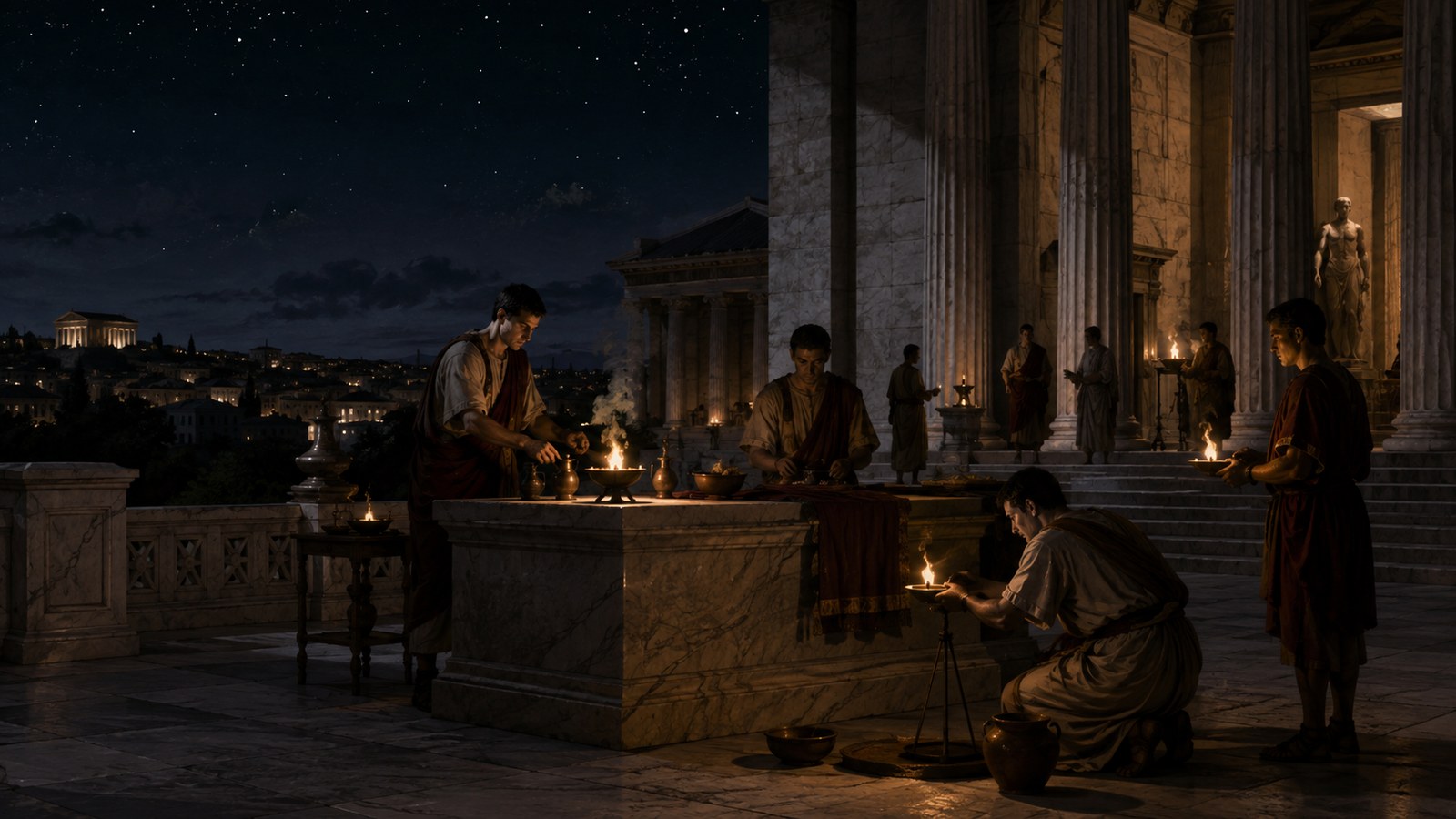
A rite performed in the final six hours of darkness was assigned to the day that dawned afterward. Participants could therefore be acting on Tuesday, in legal and ritual terms, while the street still looked like Monday night. The calendar had advanced before the sun did.
This mattered because ritual correctness relied on appointed time. Words, gestures, officiants and sequence could all be carefully controlled; the date was another part of the procedure. Midnight gave priests and magistrates a rule for deciding which named day enclosed an act performed before dawn.
The mechanism differs from the seasonal hours followed in Roman sundials. Daylight hours stretched and contracted with the season, describing portions of visible day. Gellius’s civil boundary performed a different task. It fixed the membership of an event within a date even when no sunlight was present to mark the change.
That distinction helps explain why civil time should not be imagined as a single ancient clock system. Romans could use variable daylight hours for daily rhythm while still using midnight as the seam between calendar days. One scheme measured the shape of light; the other assigned consequences.
Auspices Before Dawn and Business After Noon Remained One Act
The taking of auspices gave Gellius a civic example. When magistrates needed both to seek auspices and to transact the business authorized by them on the same day, they could take the auspices after midnight. They could then conduct the public business after midday, with the sun high, and both stages were said to occur on one day.
The interval could cross darkness, dawn and half the daylight hours without crossing a civil boundary. That made the day a container for a procedure. The signs observed at night and the action completed later remained joined because neither fell outside the same midnight-to-midnight frame.
Gellius does not say that every auspicial observation followed this timetable. His point is evidentiary: the accepted language of a same-day requirement makes sense under the Roman reckoning. Midnight provides enough room for observation before dawn, deliberation or preparation in the morning, and execution after noon.
The example also shows why sunrise would produce a different result. If the day began when the sun rose, auspices taken in the preceding darkness and business done after noon would straddle two days. The Roman boundary kept them together. A convention about time thus supported continuity between religious authorization and civic action.
This was time as public infrastructure. The system did not remove uncertainty about omens or political decisions. It established which acts could legally and ritually be described as belonging together.
A Tribune Could Leave Rome Without Completing a Day Away
Gellius next moves from official action to official presence. Tribunes of the commons were not permitted to remain away from Rome for a whole day. The wording invited a precise question: what counted as a whole day?
Under the midnight rule, a tribune could leave the city just after midnight. He might remain outside through daylight, return after lamps were first lit on the following evening, and still arrive before the next midnight. However long the journey felt, he had been present in Rome for some part of that civil day and had not completed an entire midnight-to-midnight absence.
The example reveals both the strictness and the flexibility of a boundary rule. The tribune could not appeal vaguely to having returned “at night.” He needed to return before the civil day closed. Yet by departing immediately after it opened, he could use almost its full duration.
That is not a trick imported by Gellius to entertain readers. It is evidence for how a constitutional restriction interacted with a calendar definition. Presence was converted into a yes-or-no question at the edges: Was the tribune in Rome at any point during the relevant civil day?
Time boundaries often become most visible when someone approaches them. A midday appointment rarely forces a definition of the day. A departure just after midnight and return just before it ends make the convention decisive.
Six Hours of a Third Night Changed a Marriage Calculation
The sharpest example comes from the jurist Quintus Mucius. Gellius describes a woman who entered a marriage relationship on the Kalends of January. To escape the form of marital control at issue, she left her husband on the fourth day before the next January Kalends, attempting to satisfy a rule from the Twelve Tables that required separation for three nights.
Mucius said she did not become independent. The difficulty lay in the last six hours of the third night. Once midnight passed, those hours belonged to January 1 and therefore to the new year. The attempted interruption had not completed the required three nights within the year being calculated.
The result makes midnight more than a tidy bookkeeping convention. A continuous absence through darkness could still be divided by law. Night, day and year did not share identical edges in ordinary perception, but the civil boundary assigned the latter half of that night to a new date and a new annual period.
The article on Hadrian’s eleventh-month inheritance decision follows another case where counting time changed family status. There, authorities disputed how long gestation could last. Here, the physical duration of three nights was not the only question; the placement of six hours on one side of New Year altered the legal reckoning.
Gellius closes by hearing the old rule in poetry. Virgil writes of dewy night wheeling far beyond its middle course and dawn’s horses approaching. Gellius takes the line as a veiled allusion to the civil day beginning after the sixth hour of night. Whether every reader would accept that interpretation is less important than the habit it reveals: for him, midnight was embedded deeply enough in Roman observance to illuminate a poetic line.
Across the chapter, the boundary never becomes visible, yet its effects accumulate. It assigns a birthday, names a rite, joins auspices to public business, measures a tribune’s absence and decides whether three nights satisfy a marital rule. Rome’s civil day began in darkness because law needed a seam that did not move with the season. Midnight supplied it.
Sources
Aulus Gellius, Attic Nights 3.2; Marcus Varro, Human Antiquities: On Days, as quoted by Gellius; the Twelve Tables, as discussed by Gellius and Quintus Mucius.