
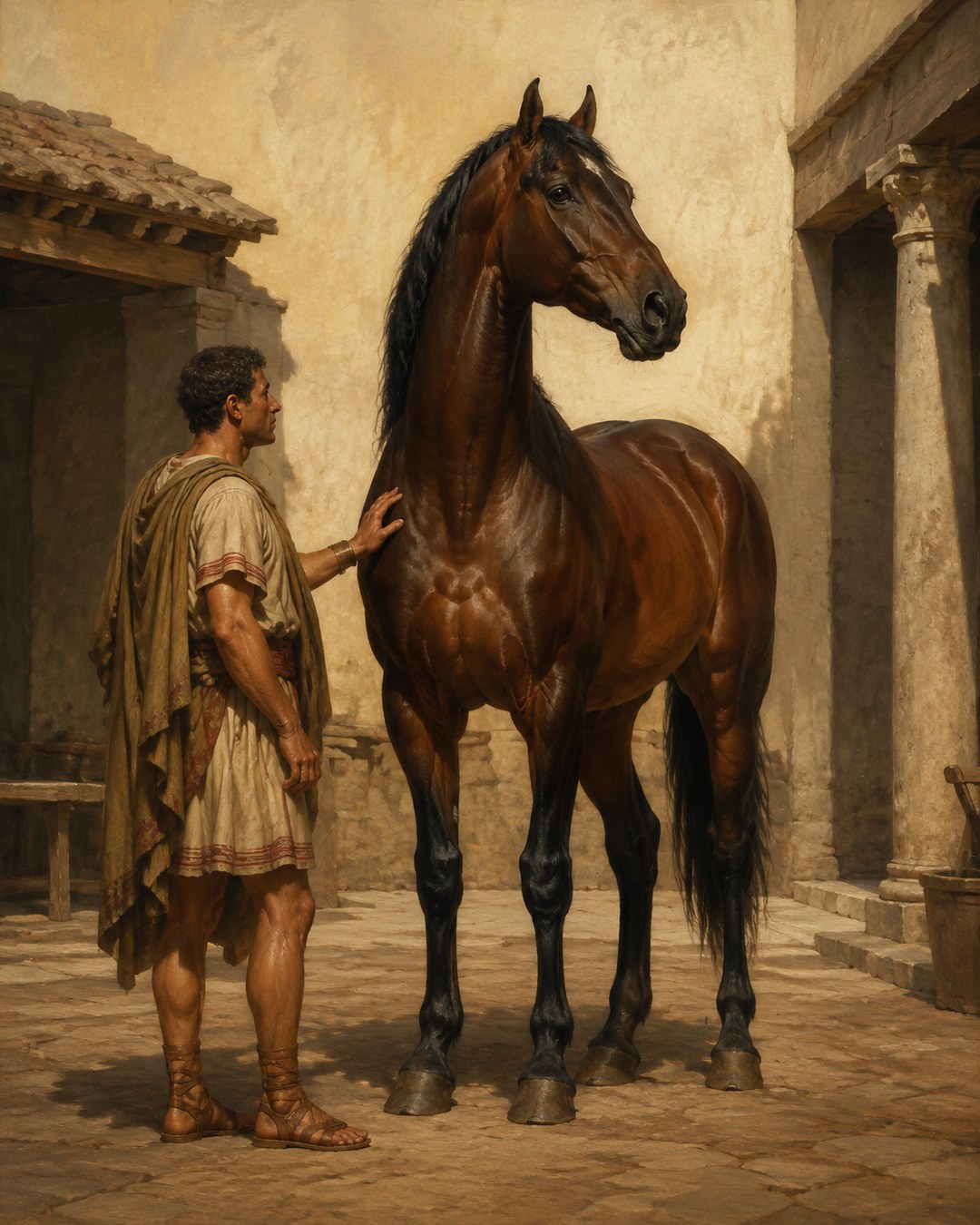
The horse stood at Argos with the qualities buyers wanted to exaggerate and witnesses wanted to remember: extraordinary size, a high neck, a thick shining mane and a rich bay coat. Cornelius Dolabella was travelling toward Syria when its fame pulled him off his route. He paid one hundred thousand sesterces for it.
Aulus Gellius tells the story in Attic Nights 3.9, drawing on Gavius Bassus and Julius Modestus. The animal passed from Gnaeus Seius to Dolabella, then to Cassius and Antony. Each man’s possession was followed by political, military or personal destruction.
By the end, Romans could point to an unlucky person and say, “That man has the horse of Seius.” The animal had become a proverb: something magnificent to acquire and disastrous to own.
The surviving account is not evidence that a horse caused the collapse of four men. It is evidence for how reputation fastened itself to an object. Beauty made the horse desirable, civil war moved it between winners, and hindsight turned every transfer into another link in a fatal chain.
Argos Gave the Animal Beauty and a Heroic Pedigree
Gellius begins with two authorities. Gavius Bassus included the history in his Commentaries, while Julius Modestus treated it in the second book of his Miscellaneous Questions. Their account named the first owner as Gnaeus Seius, a clerk, and placed the horse’s birth at Argos in Greece.
Argos supplied more than geography. A persistent tradition connected the animal to the horses of the Thracian Diomedes, the dangerous herd taken by Hercules after he killed their master and carried them from Thrace to Argos. The pedigree pushed an already exceptional horse into heroic time.
Gellius reports physical particulars before misfortune enters the story. The horse was remarkably large. Its neck rose high, its mane was dense and glossy, and its colour was a saturated bay. In all other measures of equine excellence, the account declared it superior.
Those details are essential to the mechanism of the tale. An ordinary animal could disappear when its owner fell. This one attracted notice, money and subsequent claimants. Its excellence kept it visible through changes of possession that would otherwise have looked like unrelated spoils of political conflict.
The mythical ancestry also offered a ready atmosphere of danger. Yet Gellius does not describe the horse attacking anyone or performing a supernatural act. Its body is praised, not blamed. The ominous quality emerges only when ownership and biography are placed side by side.
Seius Died, but the Famous Horse Remained Available
The first disaster belonged to Gnaeus Seius. He was condemned and suffered a cruel death at the hands of Marcus Antonius, the man later counted among the triumvirs charged with settling the state. The horse survived its owner and remained at Argos with its reputation intact.
That separation matters. If animal and master had vanished together, no chain could form. The horse was durable, identifiable and transferable. One man’s ruin returned a coveted possession to circulation.
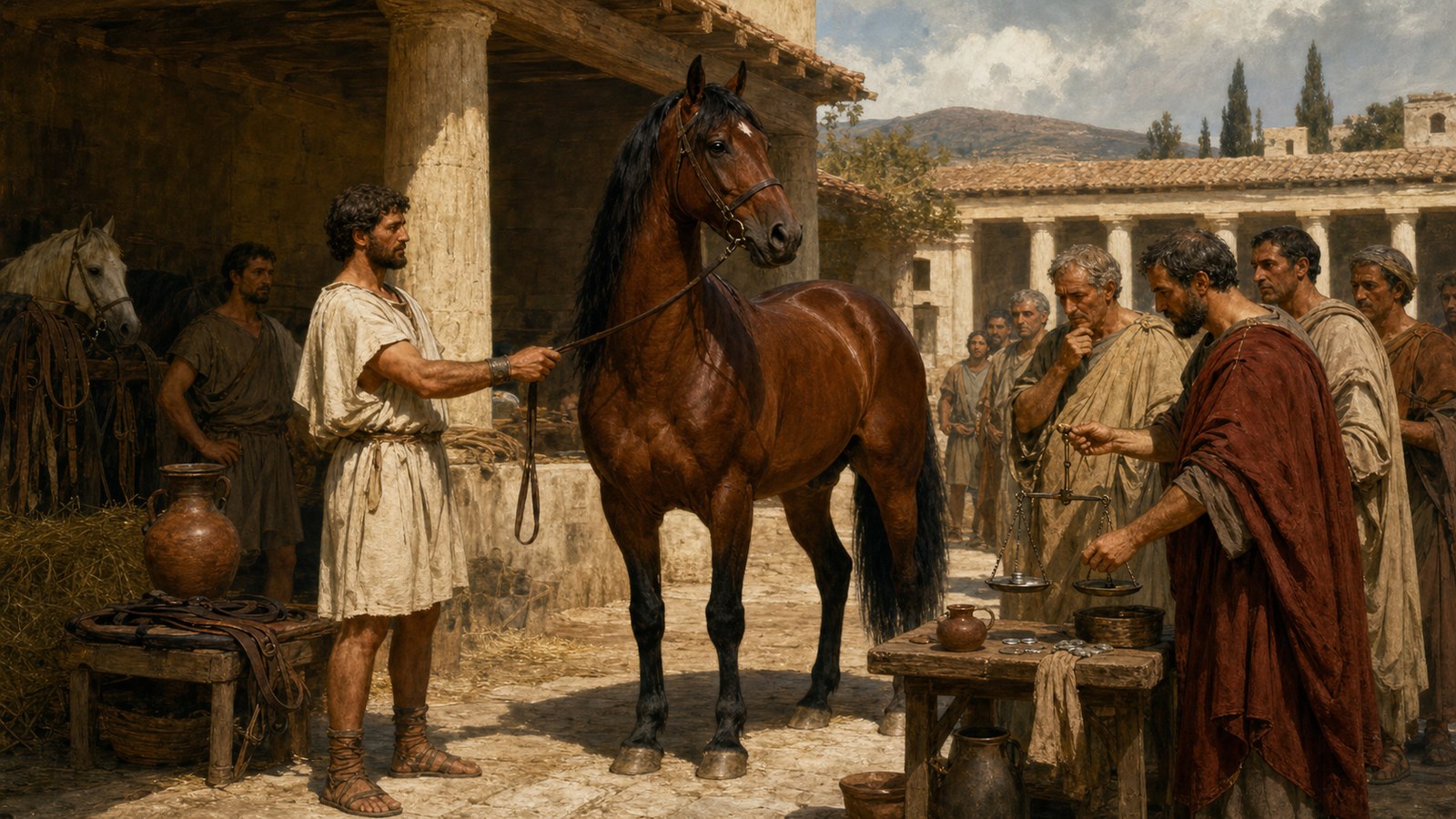
Dolabella heard enough of its fame to interrupt a journey toward Syria. Gellius says desire seized him when he turned aside to Argos. The price—one hundred thousand sesterces—measured more than usefulness. It showed the force of renown around an animal represented as unmatched in size, strength and appearance.
Buying it transformed Dolabella into the next test of the story. He was later besieged in Syria during civil war and killed. The account then allows a victorious enemy to take both the man’s position and his famous possession. Cassius, who had besieged Dolabella, carried off the horse.
The transaction and capture gave observers a sequence easy to retell. Seius possessed the horse and was destroyed. Dolabella paid an immense price and was destroyed. Cassius defeated Dolabella and inherited the object. The animal itself did nothing, but its unchanged presence made violent political turnover look patterned.
Every Victor Inherited the Previous Owner’s Place
Cassius did not finish the story. After his faction was defeated and his army routed, he too met what Gellius calls a wretched end. The horse again outlasted the man who had gained it through another owner’s fall.
Antony then sought the celebrated animal that had belonged to Cassius. This was not an accidental item swept into anonymous loot. Gellius says Antony looked for it and obtained it. Fame had survived three owners strongly enough to direct the next victor’s attention.
Antony was subsequently defeated and deserted, and he died in disgrace. Read backward, the ownership chain now looked complete: Seius, Dolabella, Cassius and Antony, each attached to ruin after possessing the same conspicuous horse.
Civil war made that chain possible. Men who defeated previous owners acquired their wealth, equipment and symbols. The horse moved not through a peaceful market after Dolabella’s purchase but through reversals of command. Each new owner seemed powerful at the moment of acquisition because he had survived or beaten the last. Later defeat converted that confidence into irony.
A separate Lost Eagles article on Caligula’s horse and the consulship claim shows political memory enlarging an animal story around imperial power. The horse of Seius followed a different engine. No emperor needed to stage a joke or insult. Repeated possession by losing leaders allowed a proverb to grow from coincidence and retrospective selection.
A Proverb Compressed Four Deaths into One Possession
Gellius gives the verbal outcome directly. People said of an unfortunate man, “That man has the horse of Seius.” A listener did not need to see the original animal. The phrase carried the ownership sequence into new situations.
Proverbs work by compression. The speaker omits Seius’s condemnation, Dolabella’s purchase and siege, Cassius’s defeat and Antony’s desertion. The horse stands in for all of them. To “have” it means to possess an apparent advantage carrying a history of disaster.
Gellius compares the saying to another old expression, “the gold of Tolosa.” In that tale, treasure was taken from temples when Quintus Caepio plundered the Gallic town, and those who touched the gold were said to die painfully. The comparison identifies a familiar narrative form: valuable material passes into human hands, then later suffering is read as the price of possession.
Neither proverb needed a demonstrated physical cause. Its force came from memorable association. People encounter many owners who fail and many valuables that change hands without incident. A named horse moving through famous civil-war figures offered a compact sequence that invited selection, repetition and moral interpretation.
This differs from the written malice examined in Roman curse tablets. A tablet records someone deliberately asking supernatural powers to harm a target. Gellius records no curse pronounced over the horse, no ritual and no hostile agent. The ominous pattern was assembled afterward from biographies.
An Eyewitness Claim Kept the Horse Physical
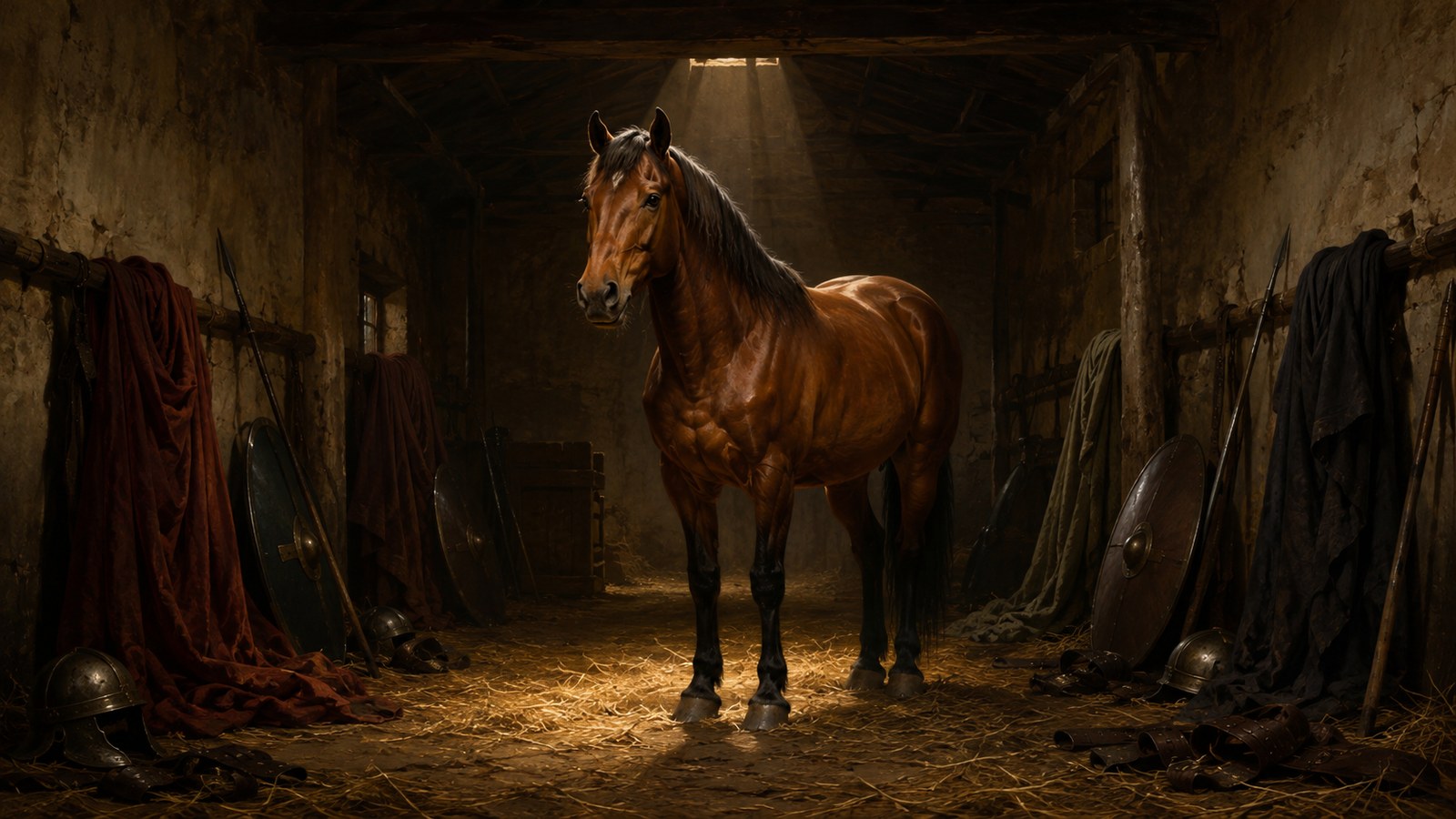
After tracing disaster, Gellius returns to appearance. Gavius Bassus said he had personally seen the horse at Argos and found it astonishingly beautiful and strong, with the richest possible colouring. That claim gives the tale an eyewitness anchor without proving its fatal interpretation.
It also protects the animal from becoming a vague symbol. Bassus presents a visible horse whose size, neck, mane and coat could be admired. The account’s colour discussion links Latin poeniceus with Greek words associated with the reddish-purple branch of a date palm. The lexical detail is almost luxuriant after the deaths.
Beauty and doom therefore remain in tension. If the horse had looked sickly or vicious, later ruin could be narrated as a warning ignored. Instead, everything observable recommended possession. The danger existed only in the story owners inherited along with the animal—and the later events that storytellers added.
That is why the hundred-thousand-sesterce purchase belongs at the center. Dolabella did not knowingly buy an obvious instrument of destruction. He responded to fame, rarity and quality. The greater the prize appeared, the sharper the irony became when its owner fell.
Gellius preserves both levels without forcing a verdict. There is a richly described Argive horse, reportedly seen by Bassus, and there is a pattern that made the horse proverbial. The animal’s excellence explains why it kept changing important hands. Human catastrophe explains why people stopped speaking of it as merely excellent.
By the time the phrase entered ordinary use, possession had replaced causation. No one needed to say the horse killed Seius, Dolabella, Cassius or Antony. It was enough that all had owned it before ruin. A calm bay in an Argive stable became Roman shorthand for the magnificent thing whose history should make a buyer hesitate.
Sources
Aulus Gellius, Attic Nights 3.9; Gavius Bassus, Commentaries, and Julius Modestus, Miscellaneous Questions, as cited by Gellius.