
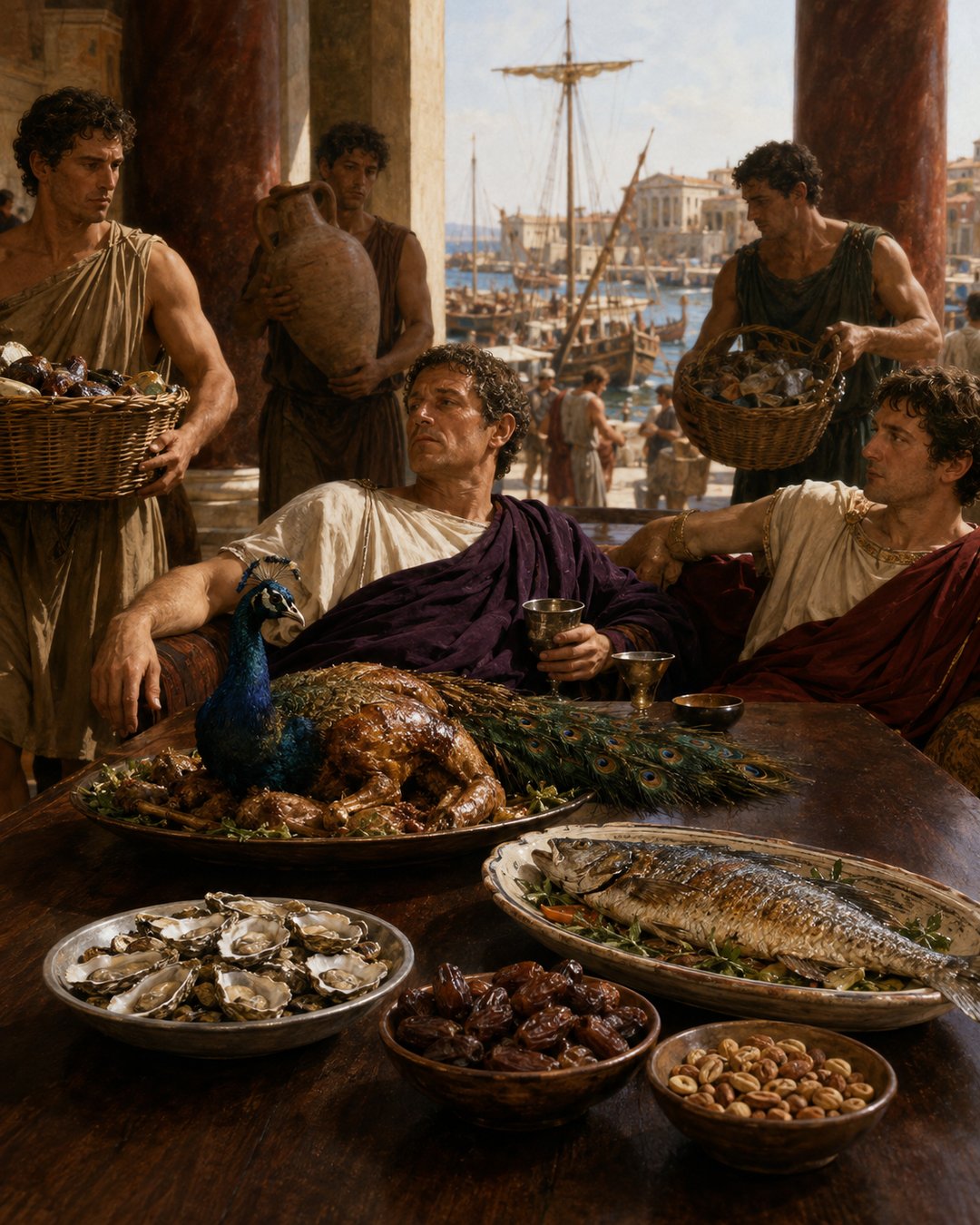
A peacock from Samos. A woodcock from Phrygia. Cranes from Media. By the time Marcus Varro’s remembered menu reaches oysters from Tarentum, dates from Egypt and acorns from Spain, dinner has become a tour of the known world.
Aulus Gellius preserves the list in Attic Nights 6.16, drawing it from Varro’s satire On Edibles. He does not reproduce the complete poem. He rebuilds its most memorable feature from memory: coveted foods paired with the places that supposedly produced their finest versions.
The catalogue is easy to read as evidence of appetite, but it also describes movement. Every famous origin implies a chain of fishermen, hunters, growers, merchants, ships, roads, markets and buyers. Luxury begins before the dining couch. It begins when an eater decides that the nearby bird, fish or nut will not do.
Varro’s satire makes geography part of flavor. Gellius then answers the wandering menu with Euripides: grain and cool water are at hand, yet satiety teaches people to search farther.
The Catalogue Gave Every Craving an Address
Gellius describes On Edibles as a witty treatment of refined banquets and dishes. Varro wrote in senarii, a verse form suited to the satirical movement of the list. The targets were not simply people who ate too much. They were discriminating consumers who hunted celebrated varieties on land and sea.
Place names do most of the work. The peacock must come from Samos, the woodcock from Phrygia and the cranes from Media. A kid is assigned to Ambracia and a young tunny to Chalcedon. Each pairing presents desire as precise knowledge. The eater has learned not merely to want a bird or fish, but to want the version attached to a particular destination.
That precision produces status. A host who could name and obtain the approved origin displayed reach as well as taste. The dish carried an invisible route to the table. Distance, difficulty and reputation entered the meal before the first bite.
Gellius says he is recalling the list from memory. That admission matters. The pairings were memorable enough to survive apart from Varro’s full verses, almost like a set of labels repeated by connoisseurs. The satire imitated the vocabulary by which luxury taught itself to recognize superiority.
The same appetite for a named marvel appears in the peach that cost thirty sesterces and lasted only two days. Price made that fruit notorious. Varro’s menu adds a second measure of distinction: origin.
Seafood Stretched the Table across the Mediterranean
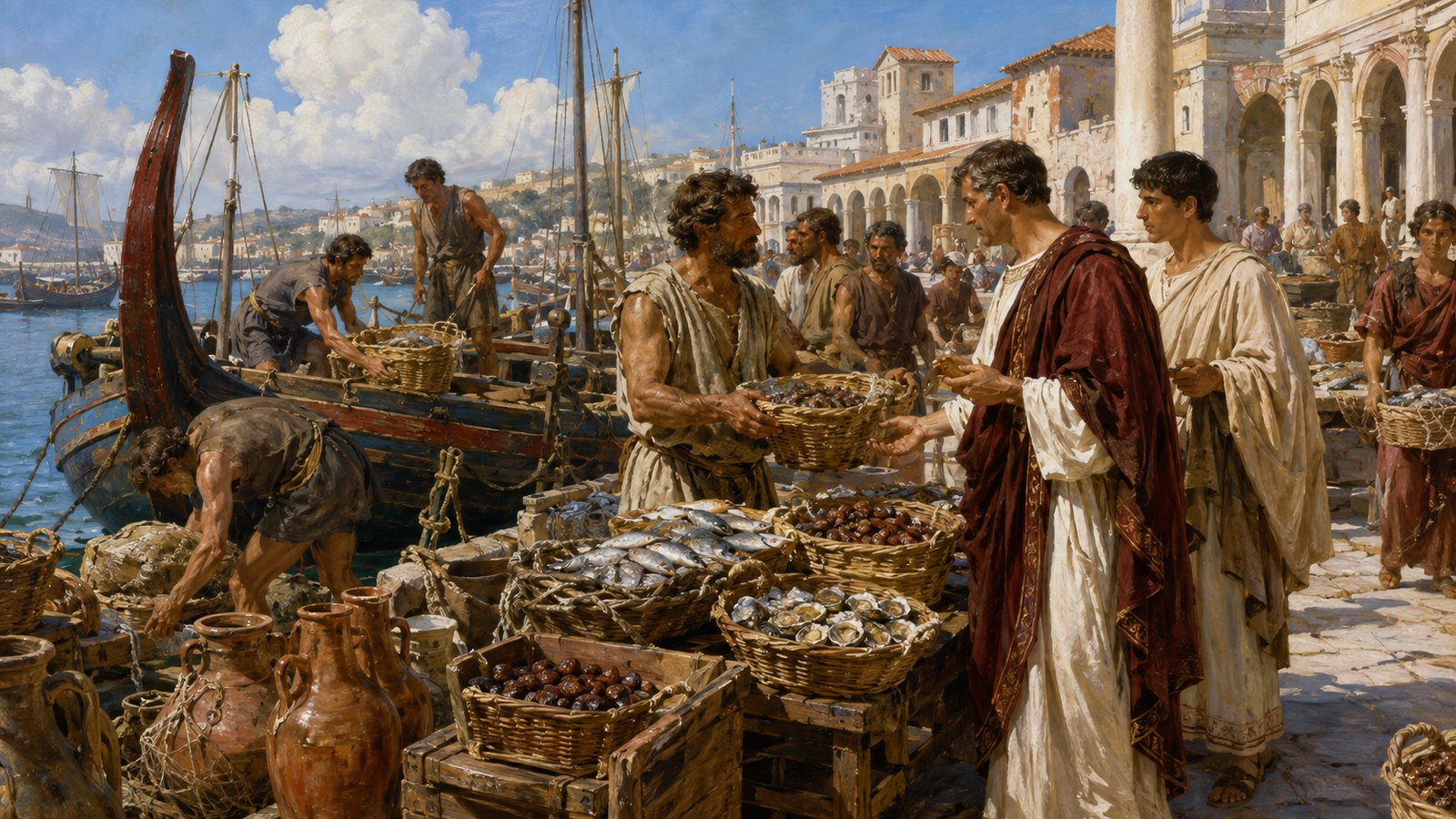
The middle of the catalogue is dominated by water. A lamprey comes from Tartessus, codfish from Pessinus, oysters from Tarentum and cockles from Sicily. Swordfish is linked to Rhodes and pike to Cilicia. The list crosses seas and coasts faster than any single cargo could.
Freshness, preservation and season are not explained in the surviving passage, so the precise logistics should not be invented. Yet the geographic claim is explicit. Varro’s eater evaluates seafood through distant points of origin, and Gellius presents that roaming demand as the symptom of an appetite unable to settle.
Some pairings may sound strange to modern ears, and the identification of ancient fish names is not always secure. The uncertainty does not erase the mechanism of the satire. Whether a translated fish is rendered as swordfish or another large species, the joke still depends on a consumer who knows which coast has prestige.
Tarentine oysters sit especially well beside Sergius Orata’s cultivation of oysters at Lake Lucrinus. Orata’s story shows production and reputation being built near Campania. Varro’s list shows the consumer-facing result: an oyster can become desirable because a place name travels with it.
The table therefore condensed maritime geography. Harbors and market stalls disappear from the dining-room view, but the named catch retains them in verbal form. Saying “from Rhodes” or “from Tarentum” allowed a meal to advertise the route that supplied it.
Birds, Goats, Nuts and Dates Filled the Inland Routes
The catalogue is not only a seafood itinerary. Birds connect the banquet to islands and inland regions. The Ambracian kid adds animal husbandry, while Thasian nuts, Egyptian dates and Spanish acorns extend desire into orchards, palms and woodland produce.
Acorns make the satire particularly sharp. They are humble beside peacock and swordfish, yet even they acquire a prestigious foreign address. The appetite Varro attacks can turn an ordinary category into a luxury by insisting on the remote specimen.
These foods also required different handling. A live bird, a young goat, shellfish, nuts and dried dates could not all move in the same way. Gellius does not describe crates or shipping contracts, but his catalogue implies a market capable of assembling products with different rhythms of capture, harvest and transport.
The variety mattered as much as sheer quantity. Luxury appears as refusal of repetition. One region supplies the bird, another the fish, another the shellfish and another the sweet fruit. The banquet becomes a collection whose pieces are valuable because they remain distinguishable.
Varro’s satirical target is thus a cultural habit of sorting the world into superior origins. Knowledge that might serve geography or trade becomes a dining-room credential. The eater demonstrates mastery by knowing where each pleasure ought to be sought.
Euripides Reduced Necessity to Two Things
Gellius does not let the list end in admiration. He calls the appetite tireless and wandering, always seeking new flavors. To sharpen the criticism, he recalls verses of Euripides that the philosopher Chrysippus often used.
The verses ask what mortals need beyond two things: the fruits of Ceres and the cooling spring. Grain and water are available and sufficient for nourishment. Human beings nevertheless hunt other foods because abundance has bred dissatisfaction with what is easy to obtain.
This answer changes the scale of the catalogue. Varro has named many regions and species; Euripides collapses necessity into field and spring. The contrast is not a nutritional survey. It is a moral geometry in which desire expands outward while need remains close.
Gellius attributes the search to satiety. Hunger accepts what nourishes. The diner already supplied with necessities begins to reject accessibility itself. What lies nearby becomes less attractive because it is nearby, while difficulty supplies part of the pleasure.
Chrysippus’s repeated use of the verses shows that the catalogue could feed philosophical argument as well as comedy. A menu became evidence about desire: satisfaction does not always end wanting, because a trained appetite can convert abundance into boredom.
The Real Luxury Was the Reach behind the Meal
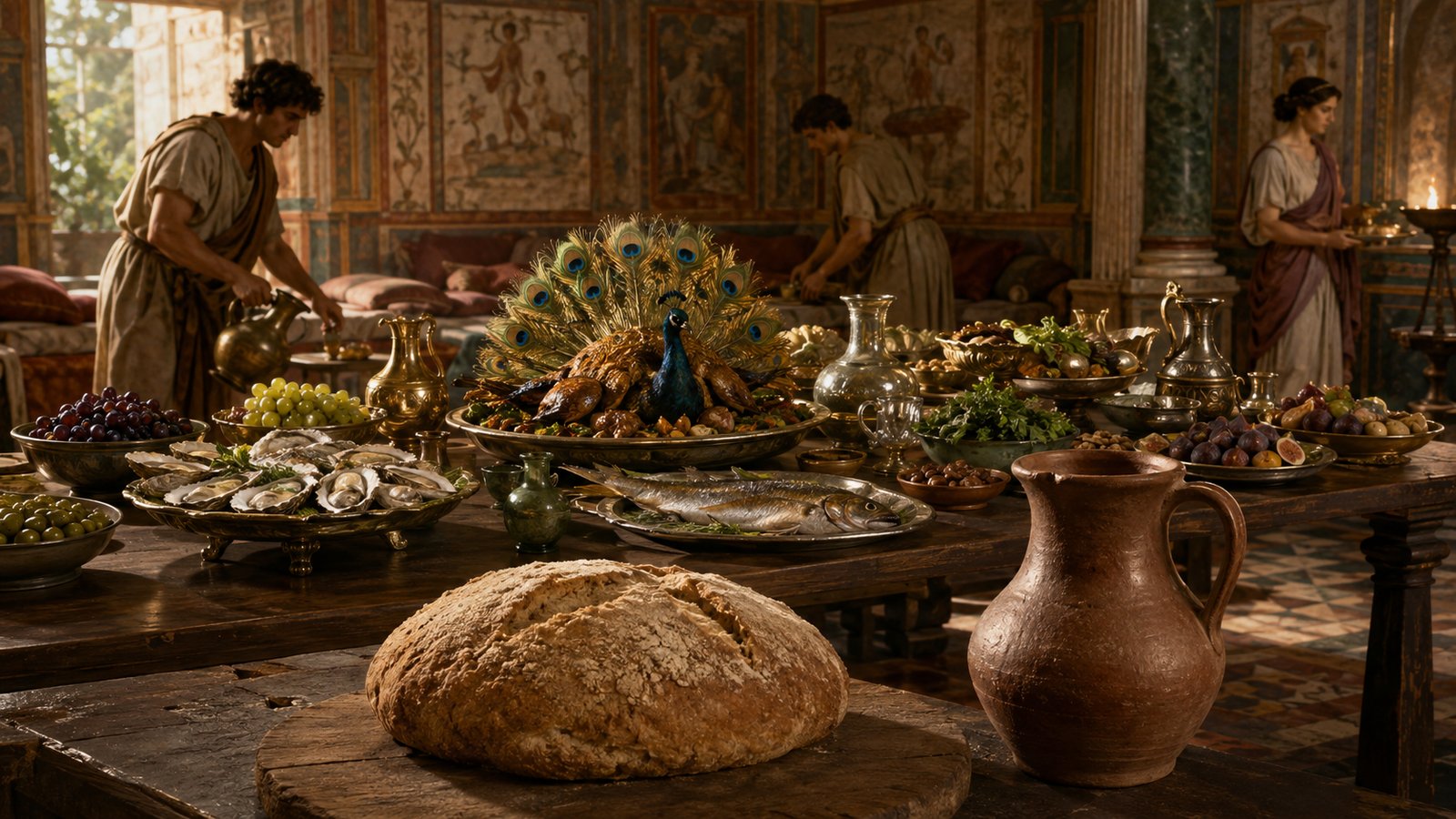
No single dinner described by Gellius needs to have served every item at once. The force lies in the aggregate map. Varro collected the places that elite taste treated as answers to particular cravings, then made their cumulative restlessness visible.
The list preserves a world in which food reputations crossed political and linguistic boundaries. Samos, Media, Sicily, Egypt and Spain could all occupy one Roman literary catalogue. The empire’s readers encountered them not as abstract dots but as origins attached to textures and tastes.
Yet satire prevents the map from becoming a celebration of connectivity alone. The routes are impressive because the demand is excessive. Labor and distance are mobilized so a full diner can distinguish one oyster, fish or nut from another.
That is the catalogue’s enduring insight. Luxury is not only a costly object. It is the power to make remoteness a requirement, to turn geography into seasoning, and to keep searching after necessity has already been satisfied.
Varro’s remembered menu begins as a parade of delicacies. By the time Euripides brings in grain and spring water, it reads as a map drawn by refusal: every line marks another nearby sufficiency that appetite has chosen to pass.
Sources
Aulus Gellius, Attic Nights 6.16; Marcus Varro, On Edibles, and Euripides, verses on luxury, as cited by Gellius.