
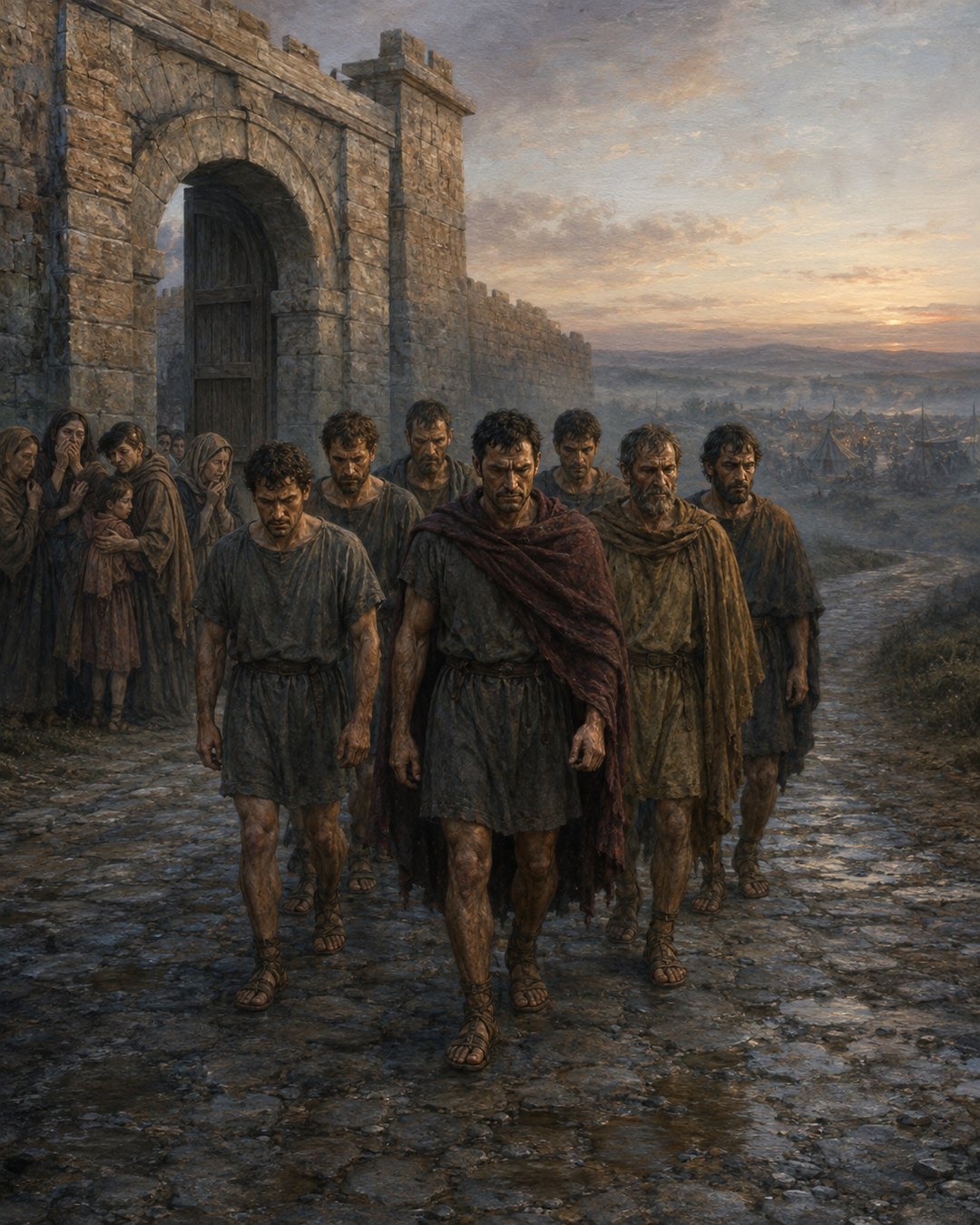
Ten Roman prisoners entered Rome after the disaster at Cannae. They carried Hannibal’s proposal for an exchange, but they also carried a promise: if the Senate refused, they would return to the Punic camp.
The Senate refused. Around the prisoners, parents and relatives embraced them and argued that reaching their native country had restored their freedom through the law of postliminy. Eight men rejected that comfort. An oath still bound them, they said, and they immediately began the road back to Hannibal.
Two stayed. They claimed they had already satisfied the wording by briefly turning back into the enemy camp after first leaving it, then departing again. The maneuver kept the letter while defeating the undertaking.
Aulus Gellius tells the episode in Attic Nights 6.18 as evidence for the sacred force Romans attributed to oaths. Its pressure comes from competing returns: return to country, return to freedom and return to captivity. The eight chose the last because they believed the promise survived the first two.
Hannibal Turned Ten Captives into Negotiators
After Cannae, Hannibal selected ten Roman prisoners and sent them to the city. Their task was limited. They were to ask whether Rome would accept an exchange of captives.
The terms included an arithmetic rule. If one side received more prisoners than the other, the excess would be paid for at one and a half pounds of silver per person. Captivity was therefore translated into both bodies and metal: matched captives could cross against each other, while an imbalance created a price.
Hannibal did not rely on goodwill to bring his envoys back. Before releasing them, he compelled them to swear that they would return to the Punic camp if the Roman people rejected the proposal. Their journey home was conditional rather than final.
This arrangement made the captives useful precisely because they were Roman. They could speak in their own Senate and draw attention from families, but those same ties increased the temptation not to return. The oath carried the negotiation across the gap where enemy custody no longer could.
The mechanism differs from the agreement that made Fabius sell his fields for 240 prisoners. That story turns an exchange imbalance into private debt. Gellius’s ten envoys turn a refused exchange into a test of personal return.
The Senate’s Refusal Activated the Oath
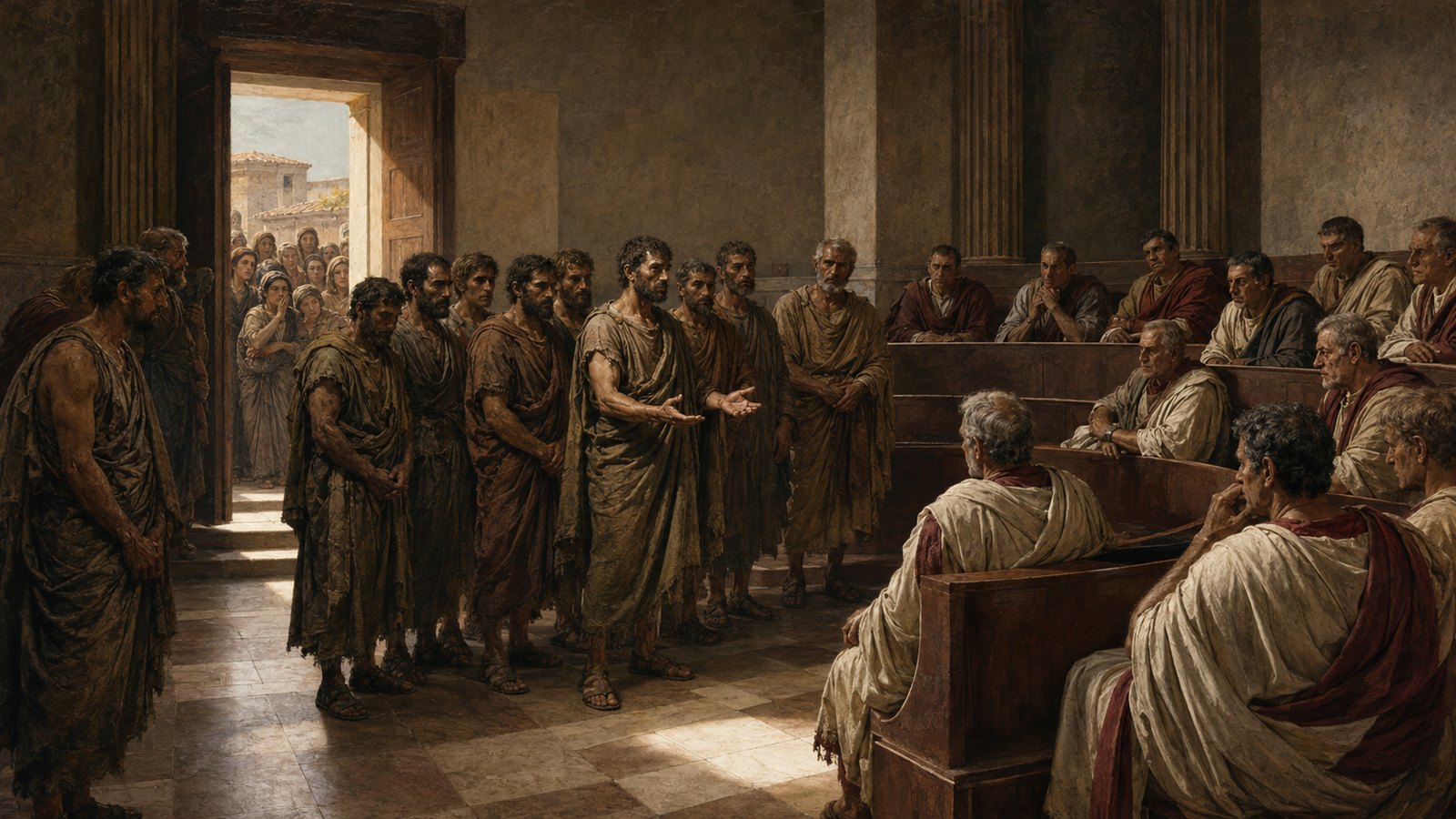
The ten delivered Hannibal’s message in the Senate. Gellius gives the institutional response in a single hard sentence: the Senate refused an exchange.
That decision closed the proposal but triggered the prisoners’ promise. Until rejection, their obligation remained conditional. Once the answer was no, the road back to the Punic camp became the act they had sworn to perform.
Gellius does not supply the Senate debate or its reasons in this chapter. It would be unsafe to invent them. The narrative focuses not on why senators refused but on what refusal required from the men who had brought the offer.
The official answer also placed state policy and private survival on different tracks. Rome would not make the exchange. Yet the state did not physically prevent the prisoners from deciding what their oath demanded. The most consequential judgment first occurred among the captives themselves.
Behind them stood one of Rome’s greatest defeats. Hannibal’s escape with burning fagots tied to ox horns shows him manipulating what a Roman force thought it saw. Here he used a sworn condition rather than a visual deception, making Roman ideas about honor help enforce his custody at a distance.
Families Claimed That Home Had Restored Freedom
The emotional center comes after the Senate’s answer. Parents, relatives and connections surrounded the prisoners with embraces. They argued that return to the native land had restored the men through postliminy and made their independent status complete.
Postliminy addressed recovery after enemy capture. In the families’ argument, crossing back into Roman space had repaired the legal rupture of captivity. The men were home, free and under Roman protection; they should not imagine themselves still belonging to the enemy camp.
The appeal combined law with touch. Gellius does not stage an abstract consultation among jurists. He places the claim amid embraces, where the legal language of restored status competes with the immediate human fact of reunion.
Eight prisoners nevertheless answered that they had no just right to rely on postliminy because an oath bound them. Their reasoning separated legal recovery from sacred obligation. Home might restore status, but it could not make the sworn condition disappear.
They returned at once. The speed matters. Delay would have increased pressure and made the journey harder. Gellius presents decision and departure together, as though the oath admitted no interval for bargaining once the Senate had spoken.
Two Men Made a Loop through the Punic Camp
The remaining two offered a technical solution. After originally leaving Hannibal, they had returned to the Punic camp on a casual pretext. Their real intention, Gellius says, was to deceive. Having crossed back once, they claimed the promised return was complete; they could then leave again without an oath hanging over them.
The maneuver depended on reducing “return” to physical movement across a boundary. It ignored why Hannibal demanded the oath: the prisoners were to come back into his custody if negotiations failed. A brief loop made before Rome’s decision could satisfy the verb while defeating the condition.
Gellius calls this cleverness dishonorable. The problem was not hidden. The two men openly described the device that supposedly freed them. Its ingenuity made the failure more visible because it showed planning directed at evasion rather than uncertainty about duty.
The contrast with the eight is exact. All ten reached Rome. All heard the refusal. Eight interpreted the oath by its undertaking and returned. Two interpreted it by a prearranged bodily motion and remained.
This distinction explains why literal compliance did not protect them socially. A community can judge a promise by the action it was meant to secure, not only by the sequence of steps a clever speaker can attach to its words.

Censors Finished What the Senate Would Not
Gellius says the oath evaders were despised and reproached. The censors later punished them with fines and every mark of disgrace available, on the ground that they had not done what they swore.
The censorial response turned moral judgment into civic consequence. The men had found no tribunal in Hannibal’s camp capable of enforcing the promise once they were in Rome. Roman public authority nevertheless treated their conduct as a failure worthy of recorded degradation.
Cornelius Nepos supplied another part of the aftermath. Many senators, he wrote, proposed sending those who refused to return back to Hannibal under guard. A majority defeated the motion. Rome therefore stopped short of physically completing the return on their behalf.
That defeat did not restore their reputation. Nepos said those who remained became so infamous and hated that they grew tired of life and killed themselves. The ending, preserved as Nepos’s report, shows punishment extending beyond formal fines into unbearable social exclusion.
Gellius’s example makes the oath sacred by showing its cost. Eight men walked voluntarily from family embraces toward captivity. The two who stayed kept liberty in a physical sense, but their loophole failed to secure civic belonging.
The story offers no easy celebration. Returning to Hannibal was terrible, and the final suicides are darker still. Its point is narrower and severe: in this Roman memory, a promise was measured by the obligation it created. Crossing a camp boundary once was not the same as going back when the promised condition arrived.
Sources
Aulus Gellius, Attic Nights 6.18; Cornelius Nepos, Examples, as cited by Gellius.