
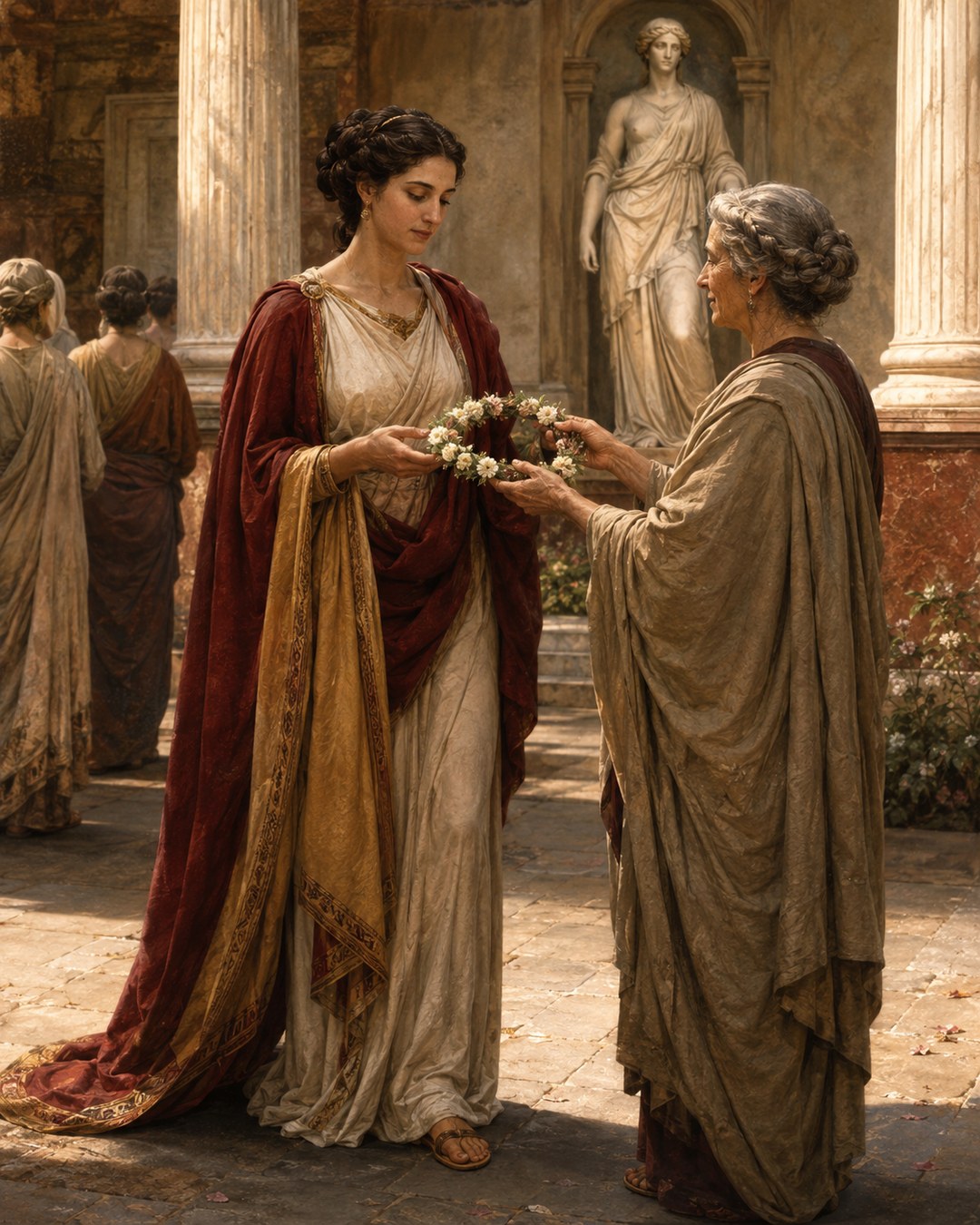
One hundred Roman women stood inside a selection whose surviving record gives only one name. From that group, Pliny the Elder says, the matrons chose Sulpicia, daughter of Paterculus and wife of Fulvius Flaccus. Their judgment named her the most modest woman and assigned her a public sacred task: dedicating an image of Venus.
The instruction, Pliny adds, came through the Sibylline books. That detail shifts the episode away from a private contest in good reputation. A religious requirement had created an office for one occasion, and a vote by women determined who would fill it.
Natural History 7.120 tells the story in a few lines. It does not preserve the names of the other ninety-nine candidates, the place where the matrons met, or the form of their ballots. What it does preserve is a mechanism: prior selection, female judgment, a named winner and a dedication before Venus.
Sulpicia matters because the machinery of the choice is still visible. Rome took an intimate social virtue, made it comparable across a bounded group and turned the result into ritual authority.
Pliny Set a Female Vote beside a Senate Judgment
Pliny introduces Sulpicia after another exceptional verdict. Scipio Nasica, he says, had once been judged the best man by an oath-bound senate. The distinction did not guarantee an easy political life: Pliny immediately notes electoral defeats and exile from his native land.
Then the scale changes. The senate’s judgment about a man is followed by the matrons’ judgment about a woman. Pliny’s compressed pairing does not make the two procedures identical, but it makes both public acts of evaluation. A collective body converted reputation into a singular title.
The Latin word attached to Sulpicia is pudicissima, a superlative built from pudicitia. “Most modest” or “most chaste” can translate the force of the term, but neither English phrase should tempt us to invent a private examination that Pliny never describes. His point is the verdict, not an intimate dossier.
He identifies Sulpicia through family relationships: daughter of Paterculus, wife of Fulvius Flaccus. Those names situated her for ancient readers while the other candidates disappeared. The result survives as both personal distinction and family identification.
There is a sharp documentary imbalance here. We know the winning name and the public purpose, yet almost nothing about deliberation. Rather than filling the silence with a pageant, the safer reading is to notice what the source considered worth keeping: who was chosen, by whom, from how many, and for what sacred act.
The Number One Hundred Marked a Selection before the Selection
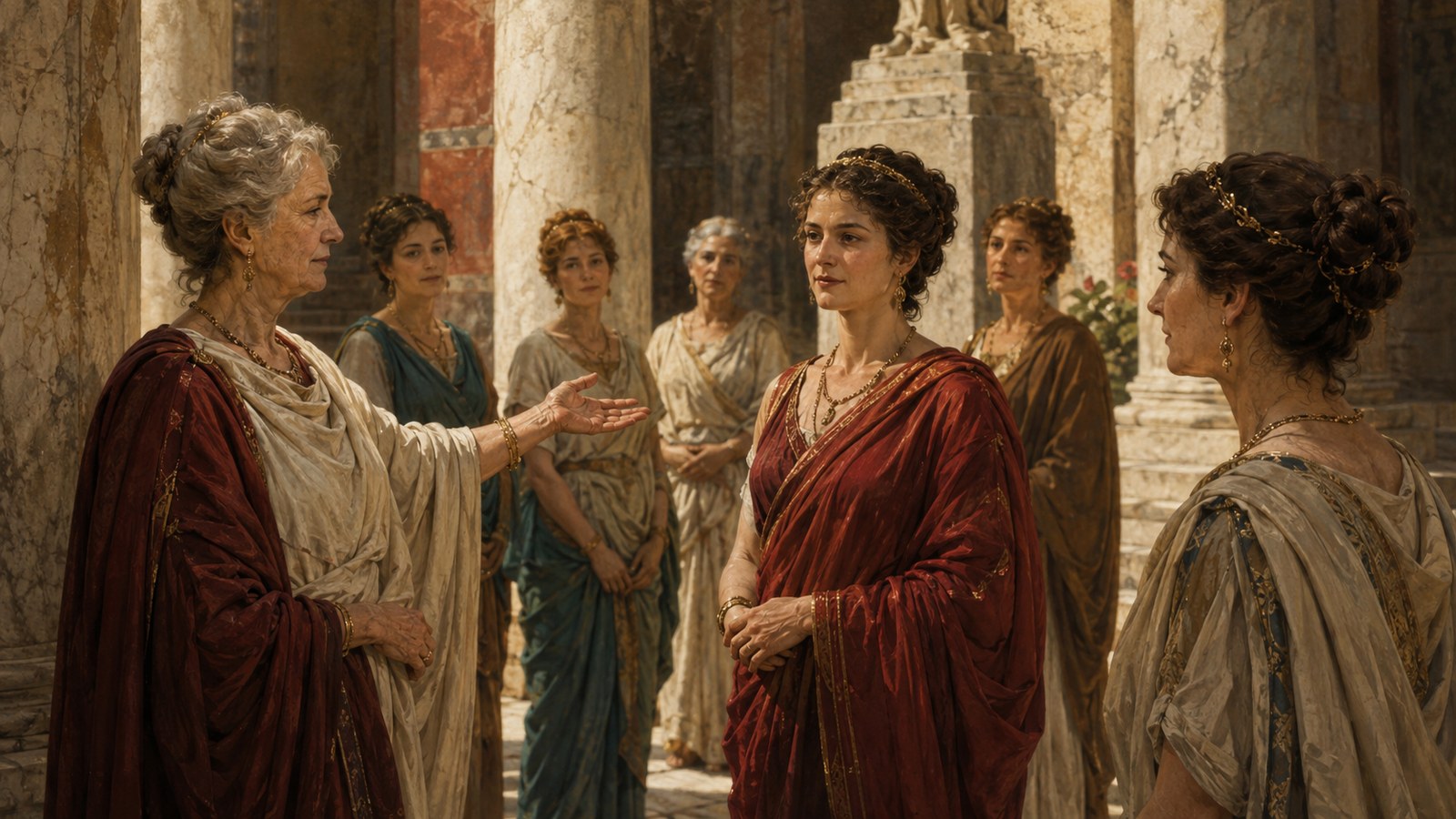
Sulpicia did not emerge from an undefined crowd. Pliny says she was elected from one hundred women who had been chosen beforehand. The sentence therefore implies two boundaries. First came the construction of the hundred; then came the matrons’ decision within it.
The source does not tell us who formed the initial list or which standards admitted a woman to it. It also does not say whether every matron in Rome participated. Those absences matter because “Rome chose” would be too broad. Pliny specifically gives the decisive judgment to the matrons.
Even with the procedure missing, the number performs real work. One hundred is large enough to show that Sulpicia’s title was comparative, not simply an honor bestowed without alternatives. Yet it is bounded enough to make a final choice possible.
This resembles other Roman habits of making religious action administratively manageable. The site’s account of the priestly college that guarded dangerous prophecies follows a permanent body with controlled access to sacred books. Sulpicia’s episode instead shows a temporary pool and a single ritual performer.
The distinction is important. The one hundred were not a new priesthood in Pliny’s wording, and Sulpicia did not acquire a general command over the cult of Venus. A specific need produced a specific choice.
Venus Turned Reputation into a Public Duty
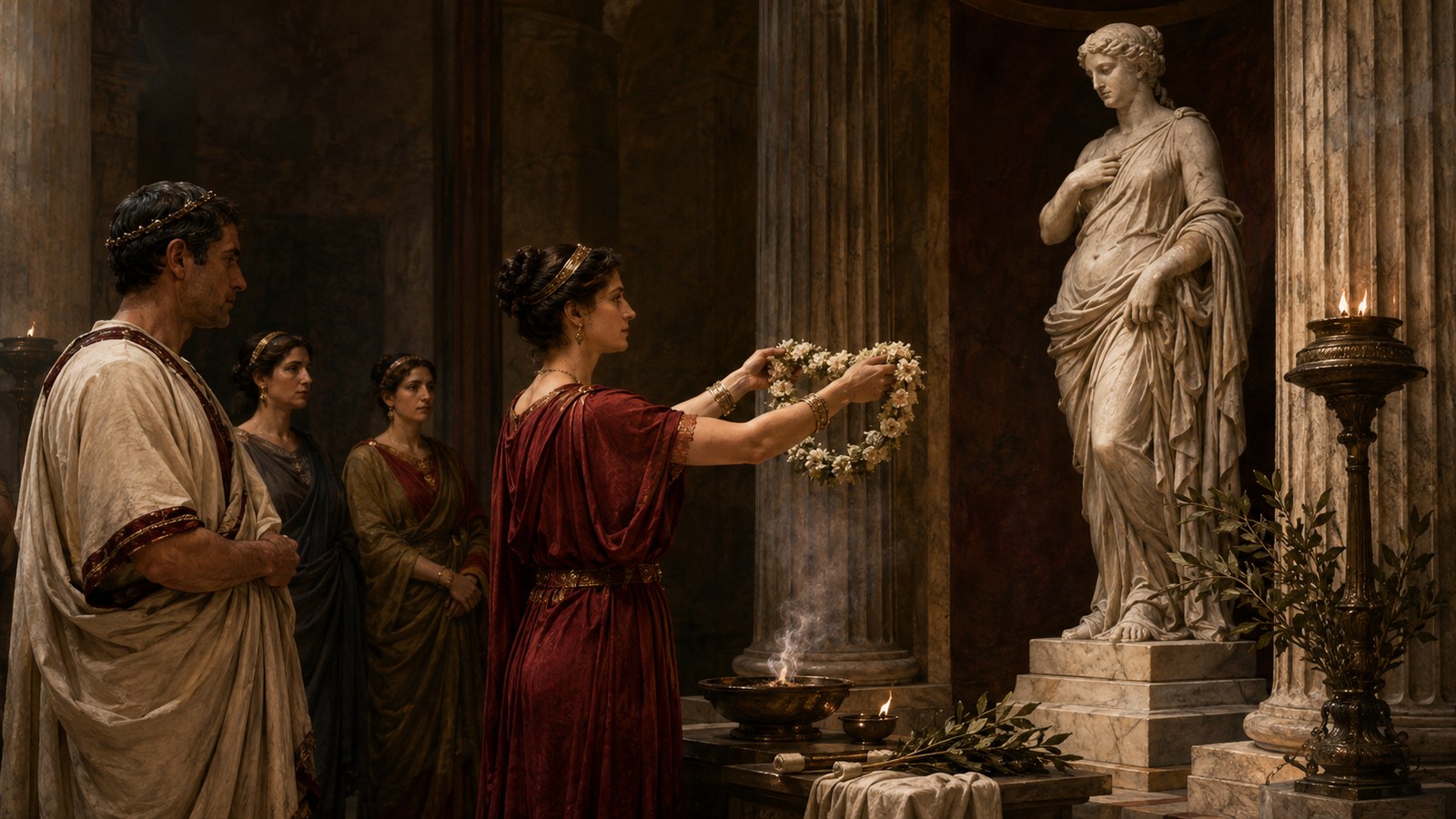
The winner had something to do. Sulpicia was selected to dedicate an image of Venus. The statue or image made the judgment visible beyond the meeting where it occurred. Her reputation now qualified an act meant to establish a sacred object in public religious life.
Pliny says the dedication followed the Sibylline books. Roman authorities consulted those books in moments that demanded prescribed responses, and their instructions could require unfamiliar or carefully staged rites. The archive’s article on opening the Sibylline collection in a crisis explains why the books belonged to state action rather than casual fortune-telling.
Here Pliny does not provide the crisis, the consultation debate or the exact wording of the prescription. He preserves only the chain from the books to the image and from the matrons’ vote to Sulpicia. That is enough to show public religion drawing on social judgment.
The connection with Venus gives pudicitia a particular edge. Desire, marriage, fertility and female reputation could all gather around the goddess, but Pliny does not offer a sermon about them. His sentence is procedural: the most modest woman was wanted for the dedication, and a selection identified her.
The ritual role also prevents Sulpicia from becoming a passive prizewinner. She was not merely called virtuous. The title authorized an action. Whatever the lost ceremony looked like, its essential movement was from verdict to performance.
Claudia Supplied Pliny with a Second Religious Test
Pliny immediately adds Claudia. He says that on another occasion she was distinguished by a test of religion when the Mother of the Gods was brought to Rome. The juxtaposition links two women, two sacred moments and two ways of making character publicly consequential.
The stories should not be collapsed. Sulpicia was selected from one hundred by matrons for the dedication of Venus. Claudia’s distinction emerged during the arrival of another deity. Pliny calls attention to sequence—first Sulpicia, then Claudia—without claiming that both women passed the same procedure.
The article on the black stone and the Mother of the Gods follows the wartime setting and the deity’s journey. In Sulpicia’s case, the revealing object is not a transported stone but a shortlist. Sacred necessity required the Romans to decide which woman could represent the required quality.
Pliny’s pairing also shows why named examples can distort our sense of participation. Sulpicia and Claudia remain visible because an encyclopedist chose them as superlatives. The many matrons whose judgment made Sulpicia’s result possible survive only as a collective noun.
That collective role is not incidental. Without the matrons, Sulpicia’s title would be Pliny’s praise alone. With them, it becomes the remembered outcome of a Roman decision.
The Missing Procedure Is Part of the Evidence
It is tempting to stage the vote in detail: whispered comparisons, tokens dropping into a vessel, anxious candidates waiting before a temple. None of that appears in Pliny’s paragraph. Images can evoke a formal gathering, but the history must keep its boundaries clear.
What survives is concrete enough. There were one hundred previously selected women. Matrons delivered the judgment. Sulpicia was named. Her father and husband were supplied. Venus received an image. The Sibylline books stood behind the dedication.
Those elements reveal a civic logic even when the room is gone. Reputation had to be translated into a decision; the decision had to be attached to an individual; and the individual had to perform the response that public religion required.
The story therefore belongs neither wholly to domestic morality nor wholly to priestly administration. It sits at their junction. Qualities cultivated and judged within Roman social life became qualifications for a sacred public act.
Pliny’s brevity is finally what gives the episode its unusual force. Ninety-nine names vanish, the voting method vanishes, and the ceremony vanishes. Yet one hundred, the matrons, Sulpicia, Venus and the books remain aligned. A small paragraph preserves the moment when Rome made virtue selectable.
Sources
Pliny the Elder, Natural History 7.120.