
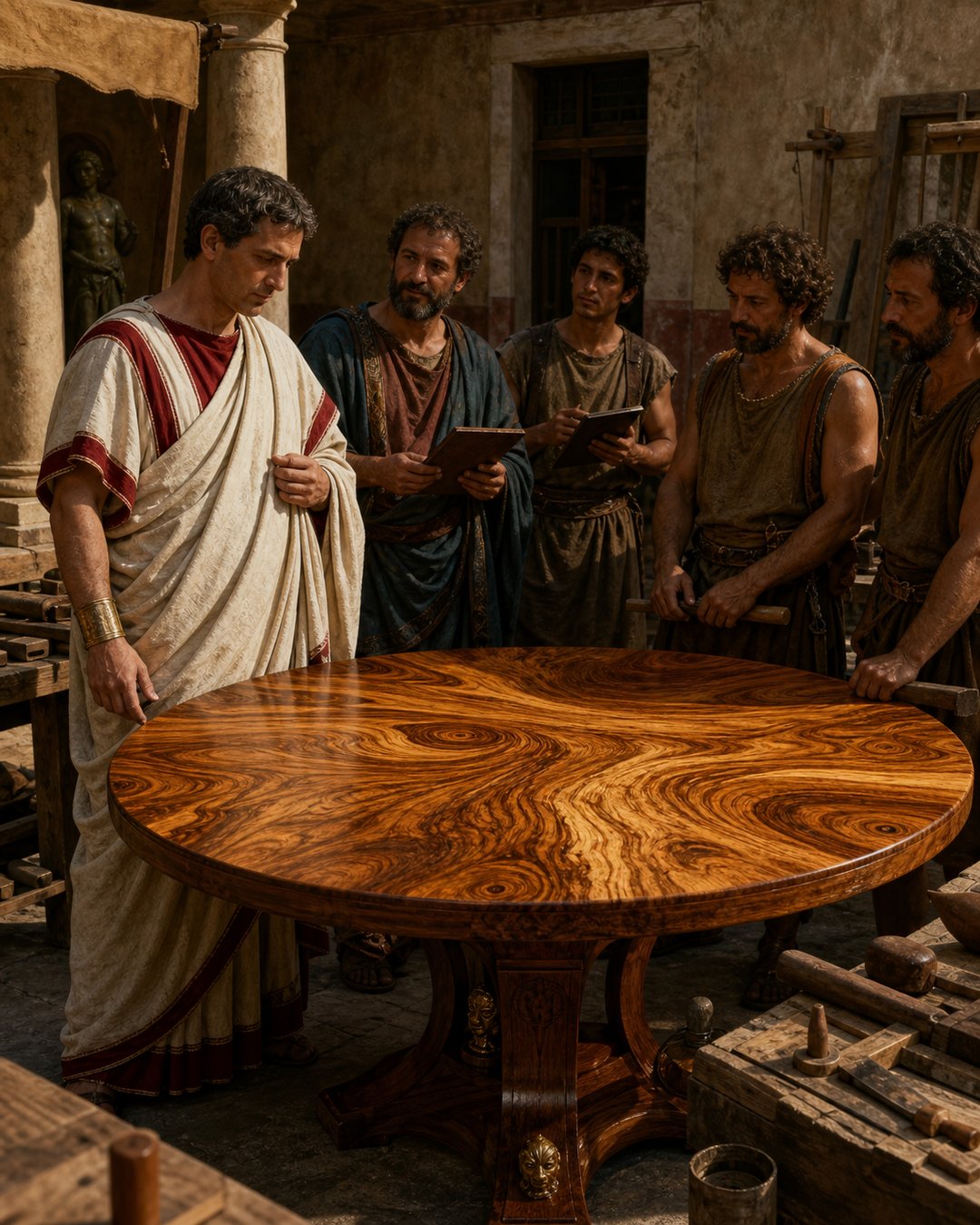
Cicero paid half a million sesterces for one table. Pliny the Elder finds the purchase surprising both for its date and for the statesman’s limited resources. Yet price is only the first clue in his account of Roman citrus wood.
The polished circle on which cups rested began as an abnormal growth around a tree’s root in Mauretania. Buyers judged its diameter, color and figured grain. Craftsmen had to cut, season, join or veneer it without losing the patterns. Owners maintained the surface with a dry hand.
Pliny’s catalogue turns furniture into a chain of expertise. A rare tree growth became a luxury not merely because it came from far away, but because merchants, carpenters and collectors had learned to classify every swirl.
The half-million figure therefore opens a material story. A Roman table could display a mountain’s exhausted supply, a cabinetmaker’s invisible join and an owner’s ability to recognize “tiger” or “panther” in wood.
Mauretania Supplied a Root Growth, Not an Ordinary Plank
Pliny locates the trees in Mauretania beside Mount Atlas. The name “citrus” can mislead a modern reader expecting the wood of an orange or lemon tree. His luxury timber belonged to a different North African tree valued for its root mass and grain.
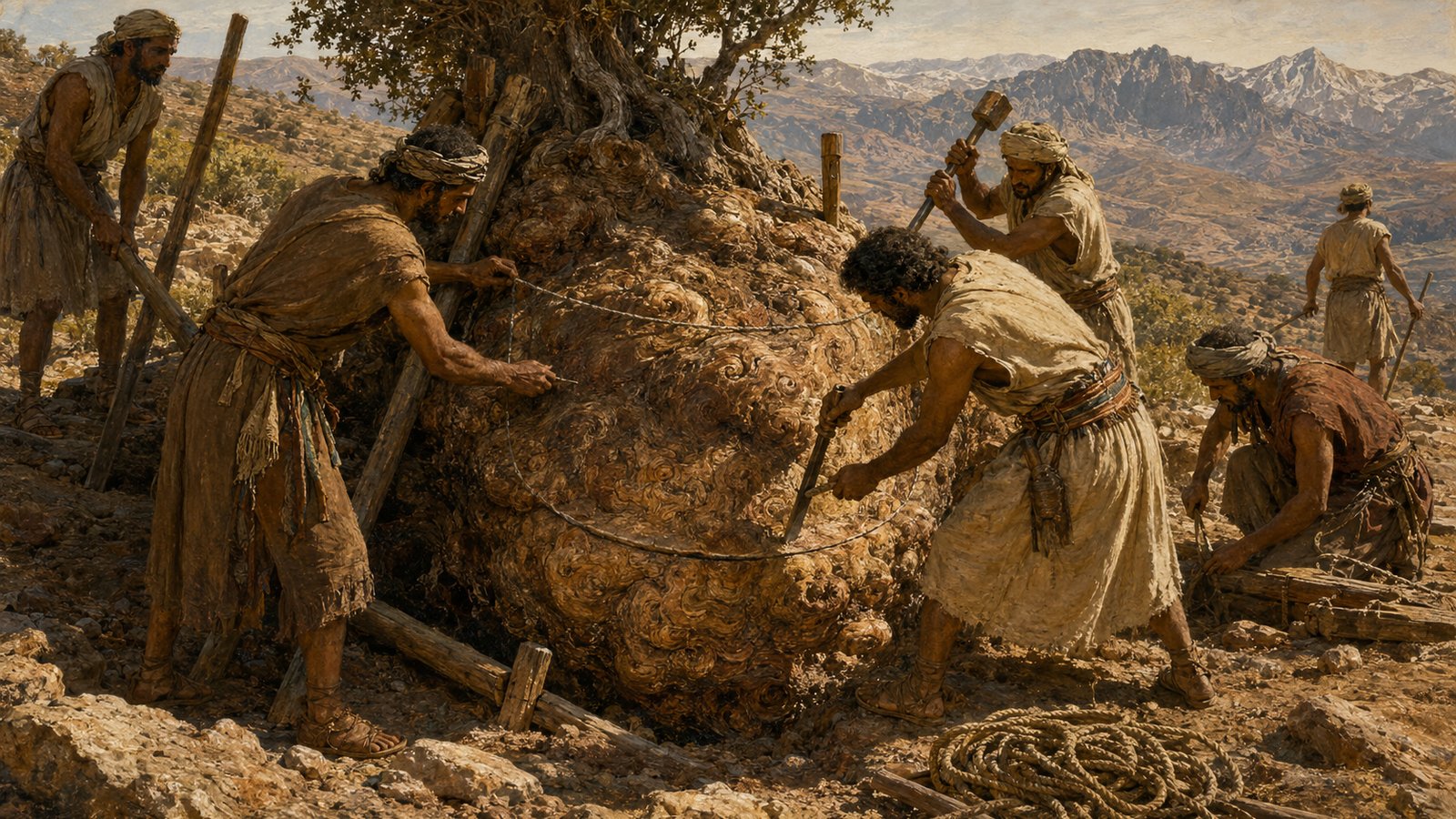
The prized material, he says, was an excrescence of the root. Growth wholly underground was rarer than knobs on trunk or branches. Pliny bluntly calls the valuable timber a disease of the tree.
That natural irregularity determined the shape of the market. Round tabletops revealed the size of the root. A large continuous slab could advertise that the tree had produced an unusually broad growth before any Roman carpenter touched it.
One source area had already become memory. Mount Ancorarius in Hither Mauretania supplied especially celebrated wood, but Pliny says its stock was exhausted. Scarcity was not an abstract sales story; collectors knew a named landscape whose best material had run out.
A related article about Segobriga’s translucent stone follows another provincial material whose physical peculiarities created distant demand. Citrus wood traveled through a similar logic, but its selling point was not thinness or transmitted light. It was the pattern locked inside a root.
Prices Climbed from Cicero to the Cost of an Estate
Pliny arranges a miniature price history around famous owners. Cicero’s surviving table had cost 500,000 sesterces. Asinius Gallus was associated with one priced at a million.
Two more were sold at an auction of King Juba’s property. One fetched 1.2 million sesterces and the other slightly less. A table handed down through the Cethegi reached 1.3 million before fire destroyed it.
Pliny translates the last sum into land: it was the price of a large estate. His comparison exposes the peculiar concentration of value. Productive acreage, tenants and harvests could be imagined on one side; on the other stood a round surface under dinner cups.
He also frames table collecting as an answer to criticism of women’s pearls. The remark is barbed social accounting. Male luxury did not disappear because it took the form of timber rather than jewelry.
The site’s article on Lollia Paulina’s pearl display shows Pliny calculating female ornament in public. His citrus passage applies the same suspicious arithmetic to elite men and their furniture.
Diameter, Thickness and an Invisible Join Set the Hierarchy
Measurements made prestige legible. Ptolemy of Mauretania owned a table four feet in diameter and three inches thick. It was not one natural disk: two semicircular slabs had been joined so cleanly that the seam vanished.
Pliny considers the invisible join more marvelous as workmanship than a single slab would have been as nature. The judgment is important. Collectors might praise unbroken timber, but a cabinetmaker could create a separate kind of wonder by defeating the eye.
Nomius, an imperial freedman, owned a single slab three feet eleven inches across and eleven inches thick. Emperor Tiberius had a still broader table, four feet two inches across, but only one inch thick and merely covered in citrus veneer.
The comparison lets surface and substance split apart. Imperial ownership did not guarantee a solid root disk. Veneer could deliver the visual signal of citrus while an imperial freedman possessed the more materially lavish object.
Pliny also notes that whole-trunk tables were admired, as were tops assembled by mortising several trunks. The market could reward natural scale, sophisticated joining or convincing display. “One table” concealed several construction strategies.
Tiger, Panther and Peacock Eyes Were a Buyer’s Vocabulary
Collectors did not value all figured wood equally. Long wavy veins produced what Pliny calls tiger-wood. Twisted spirals suggested panther markings. Other ripples resembled the eyes in a peacock’s tail, while dense clustered figures invited comparison with parsley.
Color mattered with pattern. Pliny praises a hue like mead, shining as if filled with the wine suited to the table. The metaphors taught owners to look. Animal skins, feathers, herbs and drink supplied a vocabulary for ranking wood.
Faults had names too. Dull uniformity, certain leaf-like or oak-like effects, dark crosswise streaks and irregular marks reduced a slab’s desirability. Heat and wind could create damage before the timber reached a workshop.
This classificatory eye transformed accident into grade. The root had no intention of drawing a tiger or peacock, but the market made resemblance repeatable. A merchant could point to a feature, name it and connect the name to price.
The visual system also explains why veneer worked. If the most recognizable value lay in a patterned surface, a thin facing could transfer much of the signal to a different core. Tiberius’s table looked the part even when Pliny knew it was not solid.
Wax, Grain, Sea Water and Dry Hands Finished the Object
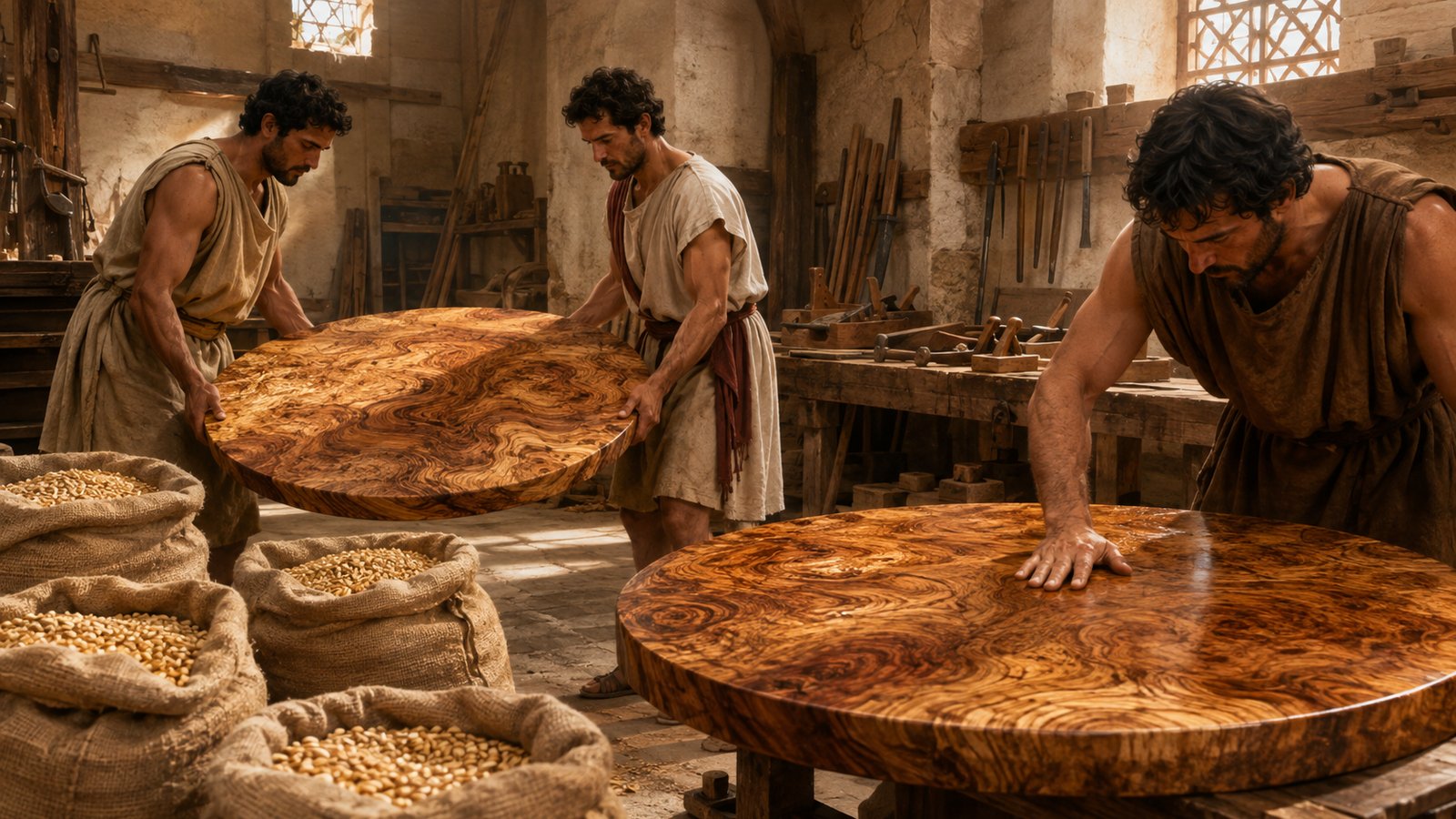
Fresh timber had to lose moisture without ruining the prized disk. Pliny says local people coated green wood with wax and buried it. Carpenters used another rhythm: a week packed among grain, a week out, then repetition. He remarks on the resulting loss of weight.
Shipwreck offered an accidental experiment. Citrus timber recovered from the sea appeared dried and hardened against decay. Pliny believed salt water produced this effect more powerfully than other methods.
Once installed, the table still required care. The recommended polish was the dry hand, especially after a bath. Spilled wine did not harm the wood, an advantage Pliny jokes was appropriate for material created to become wine tables.
These details bring labor back into an object often reduced to conspicuous consumption. Someone extracted the root, read the grain, cut the circle, managed weeks of seasoning, joined or veneered the pieces and maintained the sheen.
Pliny notes that Theophrastus had praised the timber centuries earlier but did not mention citrus tables. For him, the absence helps date the fashion: no table record preceded Cicero’s period. An old African tree had entered a comparatively new Roman mania.
Cicero’s 500,000 sesterces bought more than a platform for dinner. The sum gathered scarcity, distance, natural defect, pattern language and craft into one visible circle. A guest who knew how to look could read the supply chain before the wine was poured.
Sources
Pliny the Elder, Natural History, Book 13, chapters 29–30.