
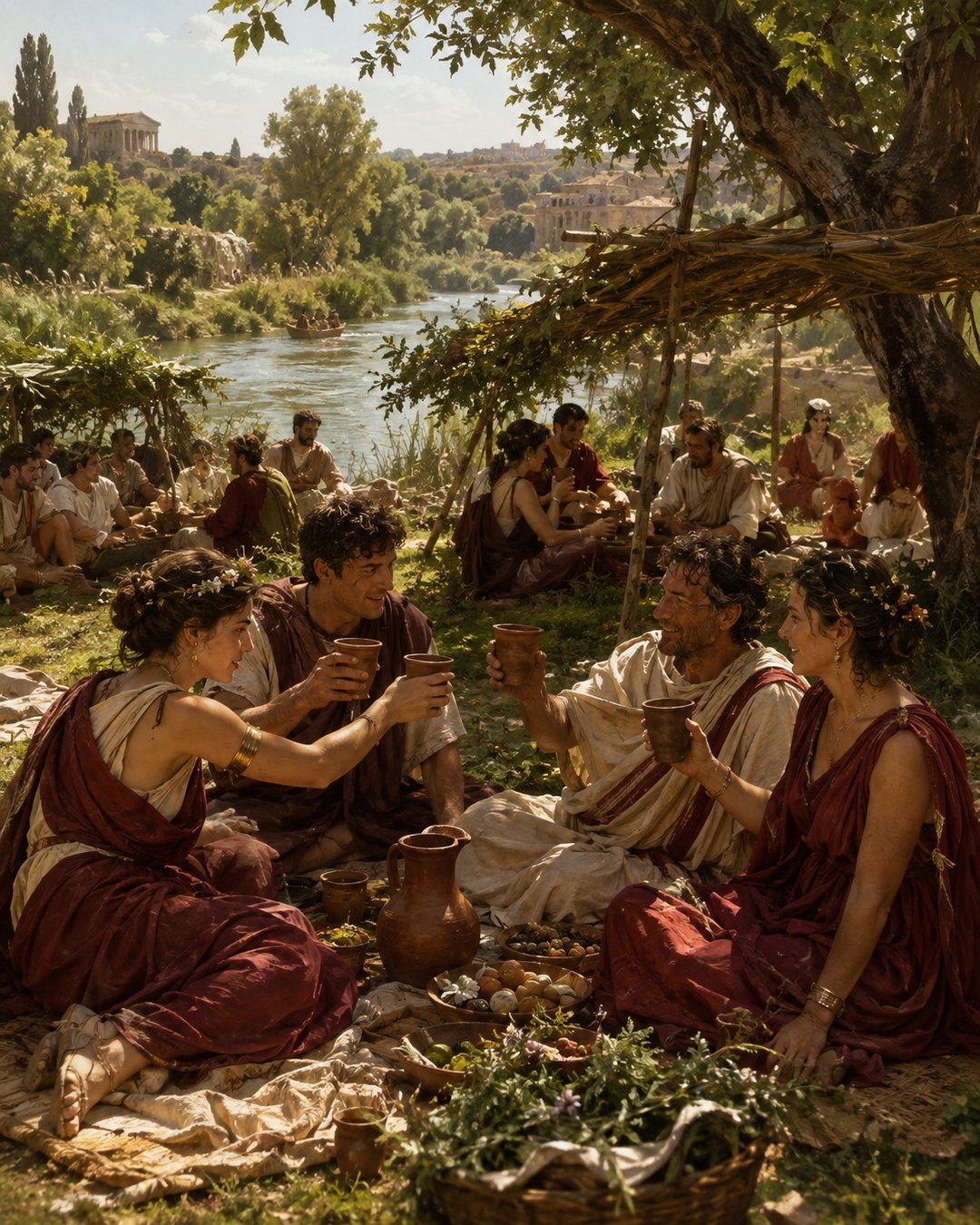
On the Ides of March, Romans carried wine cups to the grass beside the Tiber and began counting. Each cup represented a year they wanted to live. Ovid imagines one man drinking toward the fabulous lifespan of Nestor and one woman trying to reach the age of the Sibyl.
The arithmetic belonged to a feast, not an accountant’s table. Couples reclined together. Robes became roofs over reeds. Branches became huts. Songs escaped from the theatre into the open air, and drinkers put down their bowls long enough to dance.
This was the festival of Anna Perenna, a divinity whose name suggested the turning and continuation of the year. Ovid does not show worshippers studying a doctrine of time. He shows them making hoped-for duration visible, cup after cup, in a temporary settlement of ordinary people beside Rome’s river.
The scene matters because Roman religion could be exact without always being solemn. A date, a place and a repeated act gave the feast its frame. Within it came sunlight, wine, flirtation, improvised architecture and jokes about gods behaving badly.
The Ides Drew a Temporary Village to the Tiber
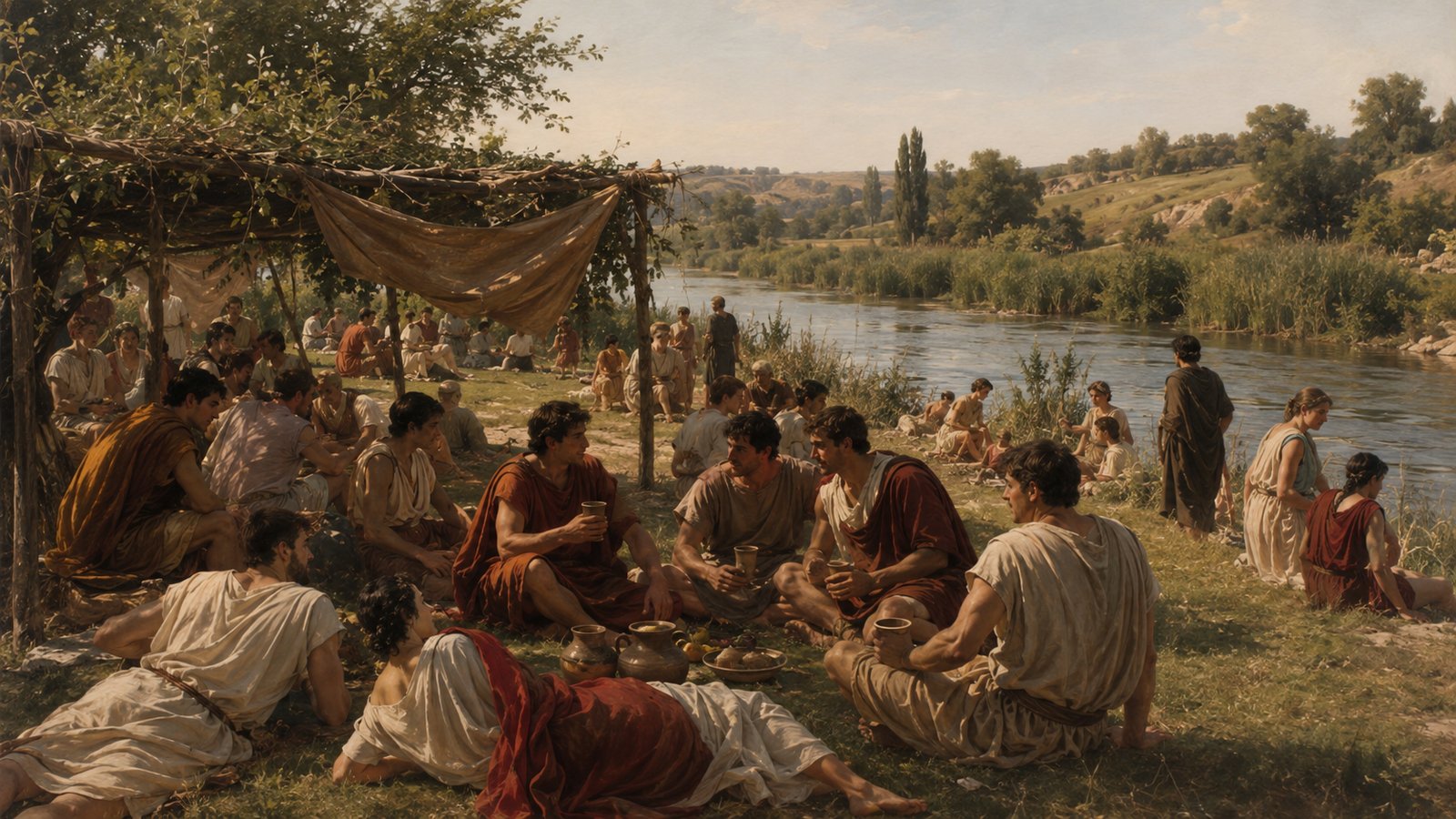
Ovid fixes the celebration on the Ides, the middle marker of March. In his description the feast takes place not far from the Tiber’s banks, where common people scatter themselves across green grass. The location is neither a marble sanctuary nor a closed priestly room. The riverside itself becomes the festival ground.
People do not merely arrive and stand through a rite. They settle in. Some remain beneath the open sky; a few pitch tents; others weave leafy branches into small shelters. Reeds serve as supports, and ordinary robes are stretched over them for cover.
Those details turn attendance into occupation. For a day, fabric normally worn on the body becomes roofing and vegetation becomes a wall. The crowd creates many little interiors while remaining part of one broad public gathering.
Ovid also places young men beside young women on the grass. His emphasis is social and physical: bodies recline, the sun warms them, and wine circulates. The feast gives the city’s common population room to appear as couples, friends, dancers and drinkers rather than as an ordered civic rank.
That looseness contrasts with the tightly divided jobs that protected a formal Roman prayer. Anna Perenna’s celebration still had its date and custom, but its visible machinery was made from cups, grass and what celebrants brought with them.
Longevity Became a Number the Body Could Drink
The central action is wonderfully concrete. Ovid says the revellers pray to live as many years as the cups they consume, and they count those cups. A general desire for long life is converted into a sequence of small completed acts.
The procedure binds wish and exertion together. To add another symbolic year, a drinker must lift and empty another cup. The hopeful total therefore grows at the same rate as intoxication. The ritual promise becomes less sober and the counting less reliable precisely as ambition rises.
Ovid sharpens the joke with legendary measures. Nestor, proverbially long-lived, supplies the target for a man; the Sibyl supplies it for a woman. Neither comparison is a demographic claim. They are comic horizons, the sort of impossible age that makes a boast vivid around a wine bowl.
Yet the joke does not empty the act of religious meaning. Repetition is the mechanism. The worshipper does not receive an abstract lecture on annual renewal. A hand, a cup and a spoken wish align the coming years with the recurring calendar.
Anna’s second name, Perenna, belongs naturally in that setting of continuation. Ovid himself reports uncertainty about who the goddess was, but the feast he observed needed no single biography to make its purpose legible. People wanted the year to keep turning and their own lives to keep turning with it.
Theatre Songs and Awkward Dancing Carried the Rite
After the counting came performance. Ovid says the celebrants sang ditties they had learned in theatres and marked the words with quick movements of their hands. This was not a specialist hymn preserved by a small priesthood. Popular entertainment provided material the crowd already knew.
Bowls were set down for dancing. Ovid is not flattering about everyone’s skill: one dancer lumbers while a better-dressed sweetheart skips with hair streaming. The contrast preserves the unevenness of an actual crowd rather than polishing it into a stately procession.
The journey home became another spectacle. Revellers reeled through the streets and attracted the attention of people they met. Ovid singles out an elderly pair: a drunk old woman was carrying a drunk old man. In a festival organized around longer life, old age appears not as a distant symbol but as two unsteady bodies helping one another home.
These observations give the account unusual texture. Temporary roofs sag over reeds; hands beat time; hair moves during a dance; a bowl waits on the ground. Roman ritual survives here through gestures that could have vanished without a poet interested in the crowd.
The participation of ordinary people also offers a different angle on civic memory from the matrons whose gold entered Rome’s public story after the Gallic ransom. One episode preserved elite collective generosity; the other fills a riverbank with popular claims on the future.
An Old Baker Gave the Festival a Plebeian Past
Ovid admits that stories about Anna’s identity conflicted. Among the explanations he records is a distinctly local and social one. During the plebeians’ withdrawal to the Sacred Mount, their provisions and ordinary bread ran short. An old woman named Anna, born at nearby Bovillae, came to their aid.
She was poor, grey-haired and industrious. Ovid pictures her hands trembling as she shaped country cakes. Each morning she distributed them hot. The details move the story away from royal genealogy and toward repetitive food work: kneading, heating and carrying enough bread to matter.
When peace returned, the people set up a statue to Perenna because she had sustained them in need. The tale makes the goddess’s annual continuity grow from daily supply. Survival was not secured by a grand banquet but by hot cakes arriving again the next morning.
Whether this narrative explains the cult historically is not something Ovid can settle. He presents it as one account among several. For the festival’s character, however, the choice is revealing. A celebration of common people beside the Tiber could remember its namesake as a working woman who fed common people during a political crisis.
The bread story and the cups belong together through repetition. Anna keeps producing cakes until scarcity ends; her celebrants keep emptying cups toward the years they desire. In both, continuity is made from a humble action performed once more.

Mars’s Humiliation Explained Why the Songs Turned Ribald
Ovid still needs to explain the scurrilous verses sung by girls at the feast. His answer is a divine comedy. Mars approaches the newly deified Anna and asks for help in winning Minerva, the armed goddess he desires. Anna appears to negotiate on his behalf and eventually announces success.
A bride comes veiled to Mars’s chamber. He lifts the covering to kiss Minerva and finds the old Anna beneath it. Shame and anger meet the laughter of the watching gods. According to Ovid, the trick gave the crowd a reason for its ribald songs.
The story reverses expectations several times. A war god needs an old woman as intermediary. The supposedly desired goddess never enters. A veil that should complete a prestigious union reveals the least martial figure in the tale, and wit defeats force without a weapon.
That comic license matches the riverside scene. The festival does not oppose religion and pleasure; it organizes pleasure as a religious act. Its songs, shelters and counted cups belong to the same calendar frame.
Anna Perenna’s worshippers asked for the largest gift in the simplest possible unit. Another year was one more cup. By nightfall, no one could know whether the goddess had accepted the bargain, but the crowd had already built, counted, sung and danced its desire to continue.
Sources
Ovid, Fasti 3.523–696.