
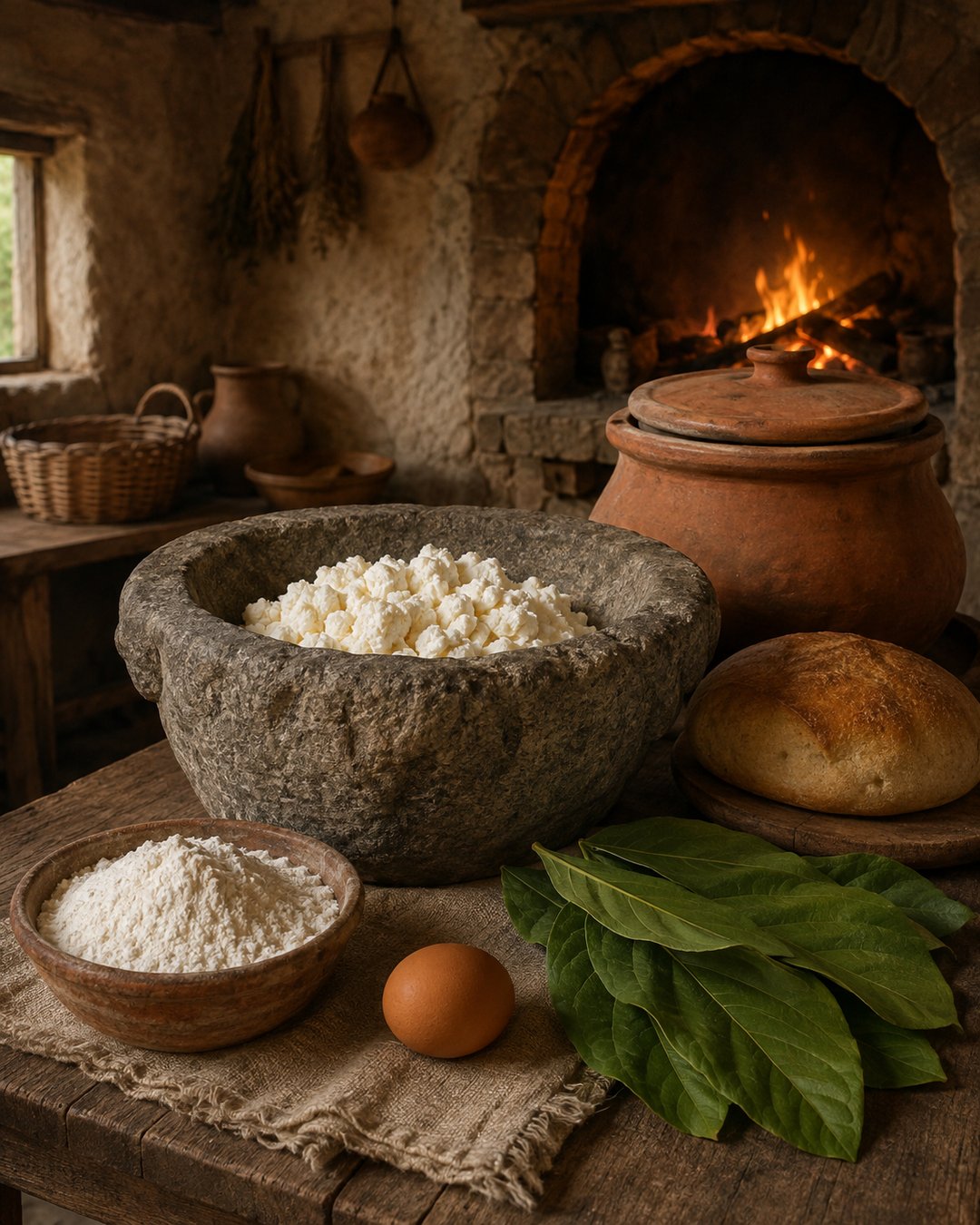
Cato’s recipe begins with an instruction that would tire the cook before the baking starts. Put two pounds of cheese in a mortar and pound it thoroughly. Only when the cheese is fully broken down should flour enter the bowl.
The ingredient list for libum is short: cheese, wheat flour and one egg. The process is not. Texture must be forced smooth, the proportion of flour chosen, the mixture worked into a loaf, leaves placed beneath it and a crock lowered over it on a warm hearth.
In section 75 of De Agricultura, Cato compresses that chain into a practical paragraph. Its value lies less in attaching a modern dessert label to an ancient food than in watching a Roman writer make kitchen work repeatable.
Every verb narrows the result. Pound, mix, work, pat, place and bake. The recipe controls moisture and structure before it controls heat, then turns an ordinary earthenware cover into a small oven.
The Mortar Did the Work Before the Flour Arrived
Cheese dominates the ratio. Cato specifies two pounds of it against one pound of wheat flour, with only a single egg to bind the mass. This is not bread lightly enriched with dairy. Flour is added to a cheese base already transformed by pounding.
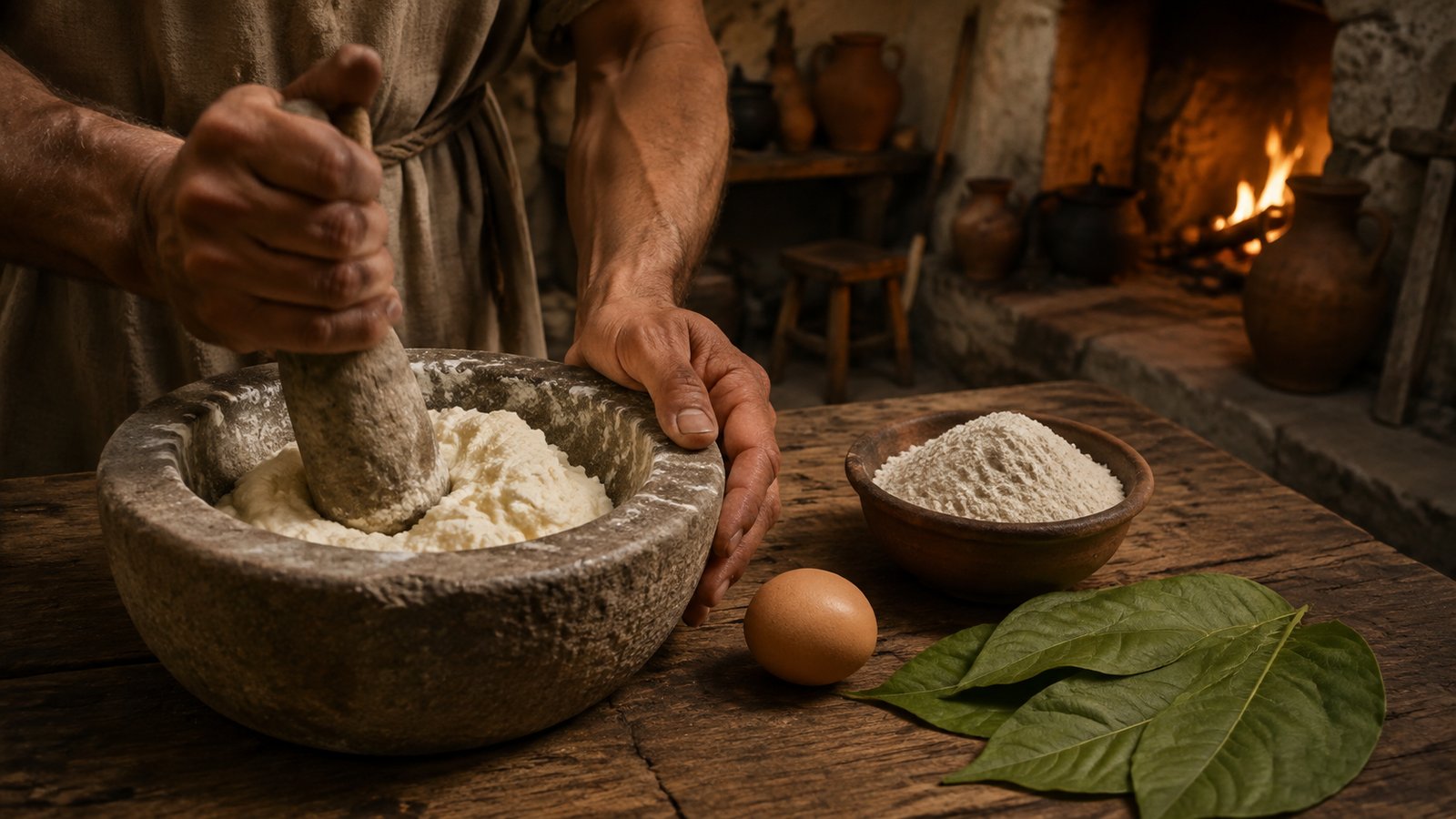
The mortar instruction is repeated for emphasis: crush the cheese thoroughly, and continue until it is thoroughly macerated. Lumps left at this stage would survive into the dough, while a smooth mass could distribute flour and egg more evenly.
Cato does not identify a modern cheese variety or provide the moisture percentage a present-day recipe might demand. That silence makes his process language more important. The cook is given a visible and tactile endpoint—cheese worked down in the mortar—rather than a brand or standardized product.
Clean handling was part of the surrounding kitchen logic. In the immediately preceding recipe for kneaded bread, Cato begins by ordering hands and bowl to be washed thoroughly. Meal receives water gradually and is kneaded before baking beneath a crock. The sequence establishes a work surface, then a controlled mixture.
This attention to ordered labour also appears outside the kitchen in Cato’s tightly specified olive-harvest contract. A recipe and a labor agreement are different documents, but both reduce a desired outcome to tasks that can be checked.
Half the Flour Bought the More Delicate Version
After the cheese is ready, Cato gives the cook a choice. The ordinary quantity is one pound of wheat flour. For a loaf described as more delicate, use half a pound of fine flour instead.
The change is small on the page and large in the bowl. With two pounds of cheese fixed, reducing flour from one pound to half a pound shifts the mixture from a two-to-one cheese ratio to four-to-one. The finer flour also changes how the dry ingredient enters the smooth dairy base.
Cato does not disguise the option as a separate dish. It is still libum, but a preference can be expressed inside the recipe. The cook chooses between greater flour structure and a richer, more cheese-dominant result.
Only after that choice does one egg enter. Cato then tells the cook to work the whole mixture well. The egg is not listed as a garnish or separate layer; it belongs to the binding stage, after cheese and flour have been combined.
This is why reducing the dish to an ingredient inventory misses its precision. Two kitchens could possess the same cheese, flour and egg yet produce different textures because one stopped pounding early, used the larger flour amount or failed to work the final mass thoroughly.
Leaves and a Crock Turned a Hearth into an Oven
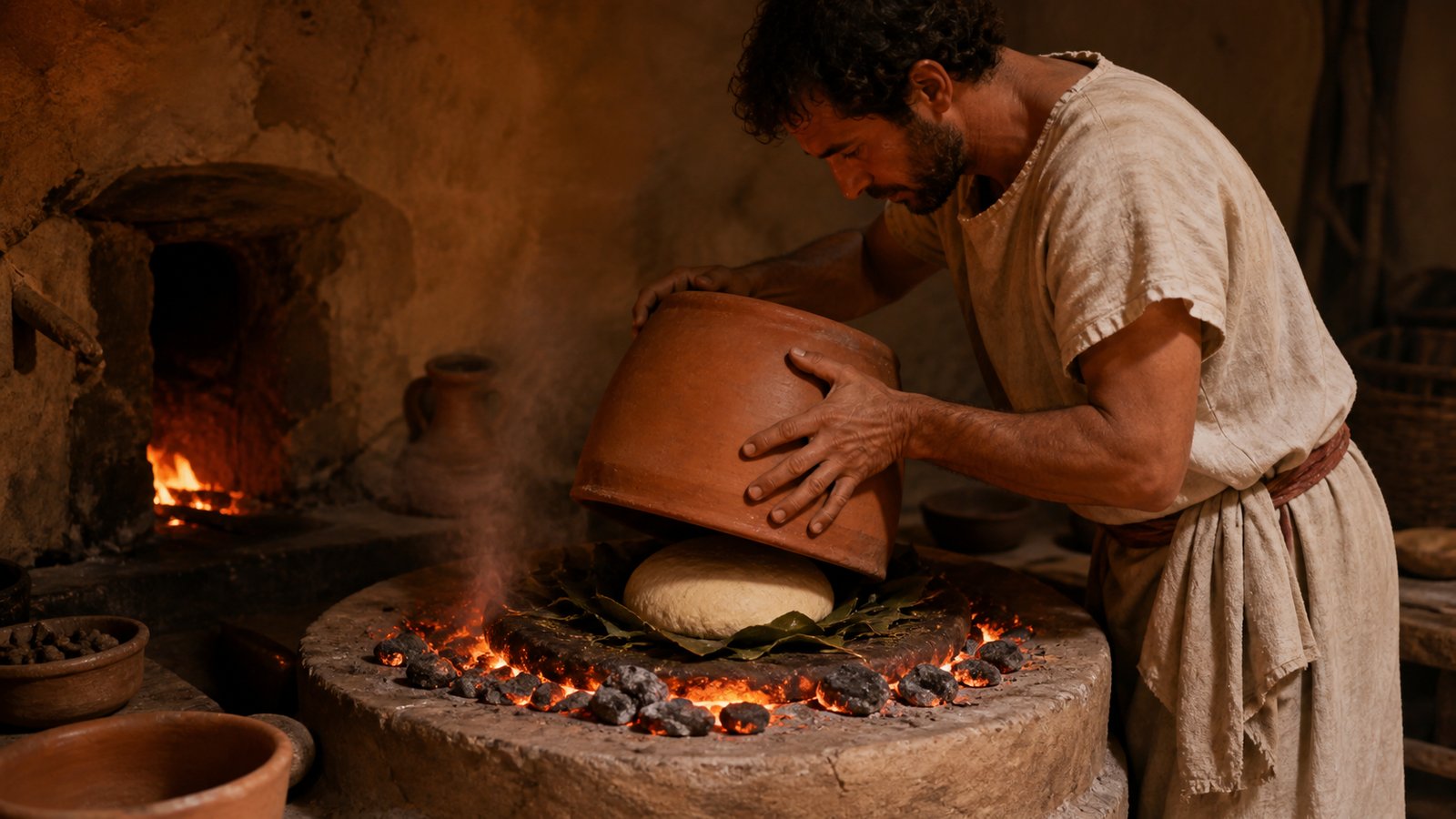
The finished mixture is patted into a loaf and placed on leaves. Cato does not identify the leaf in this sentence, so certainty should stop there. What the instruction clearly provides is a layer between the moist loaf and the heated surface.
The baking arrangement is equally direct. The loaf goes onto a warm hearth, a crock covers it, and the heat remains slow. Instead of exposing the top while only the base meets the hearth, the earthenware vessel encloses the loaf and traps heat around it.
The crock was not special to libum. Cato’s preceding kneaded bread is also baked beneath one. His next, far more elaborate recipe for placenta tells the cook to heat both hearth and crock thoroughly, place the covered cake down, heap coals on top and around it, and uncover it two or three times to inspect progress.
Those neighboring directions make the equipment easier to understand without importing a modern range. The crock acts as a movable baking chamber. Heat can reach the covered food from the hearth and, where specified, from coals arranged around the vessel.
Slow baking matters because the loaf is thick with cheese. Fierce heat could harden the outside while leaving the centre behind. Cato offers no clock time; readiness depended on managing the hearth and judging the food, a kind of practical calibration comparable to the repeated exposure used to judge building stone.
The Recipes Beside Libum Reveal a Working System
Section 75 sits inside a concentrated run of recipes, and its brevity becomes clearer beside them. The following placenta demands two pounds of flour for a crust, another four pounds of flour and two pounds of groats for sheets called tracta, fourteen pounds of fresh sheep cheese and four and a half pounds of honey.
Its cheese is soaked, with the water changed three times. Small portions are squeezed dry, worked smooth and forced through a flour sifter. Layers are assembled over oiled leaves, enclosed in crust and baked beneath a heated crock. Cato even tells the cook to uncover it during baking and inspect it.
Other entries change form and heat source while reusing parts of the same pantry. Globi combine cheese and spelt, then go into hot lard one or two at a time. Two rods turn them. Honey and poppy seed finish the fried pieces.
Savillum uses two and a half pounds of cheese, half a pound of flour, a quarter-pound of honey and one egg. It is poured into an oiled dish, covered with a crock and baked with special attention to the deep centre. More honey and poppy seed are added afterward.
Punic porridge changes the proportions again: one pound of softened groats, three pounds of fresh cheese, half a pound of honey and one egg. Across these recipes, cheese can become loaf, layered cake, fried ball, spooned bake or porridge because preparation, ratio, shape and heat are as decisive as the ingredient name.
Cato Preserved Decisions Rather Than a Taste Memory
Cato does not tell readers that libum smelled inviting or tasted comforting. He gives no dining room, named guest or emotional reaction. The passage preserves decisions a worker needs before the dish exists.
First comes the state of the cheese. Then comes the flour choice. The egg follows, the mass is worked, the loaf is shaped, leaves are positioned, and enclosed slow heat finishes it. Altering the order would alter the handling of the mixture.
That procedural voice is why the recipe remains vivid. A cook can feel the resistance of the mortar, see flour disappear into pale cheese and judge whether the hearth is warm rather than fierce. The physical details arise from the instructions themselves rather than from invented scenery.
The loaf also belongs to a larger Roman repertoire, not a solitary curiosity. The nearby recipes show a kitchen varying a compact set of materials through soaking, squeezing, sifting, layering, frying, boiling and covered baking.
Two pounds of cheese beneath a crock is therefore more than a surprising ingredient ratio. It is the centre of a small controlled system. Cato’s paragraph survives because it tells another pair of hands how to produce the same transformation.
Sources
Cato, De Agricultura 74–85.