
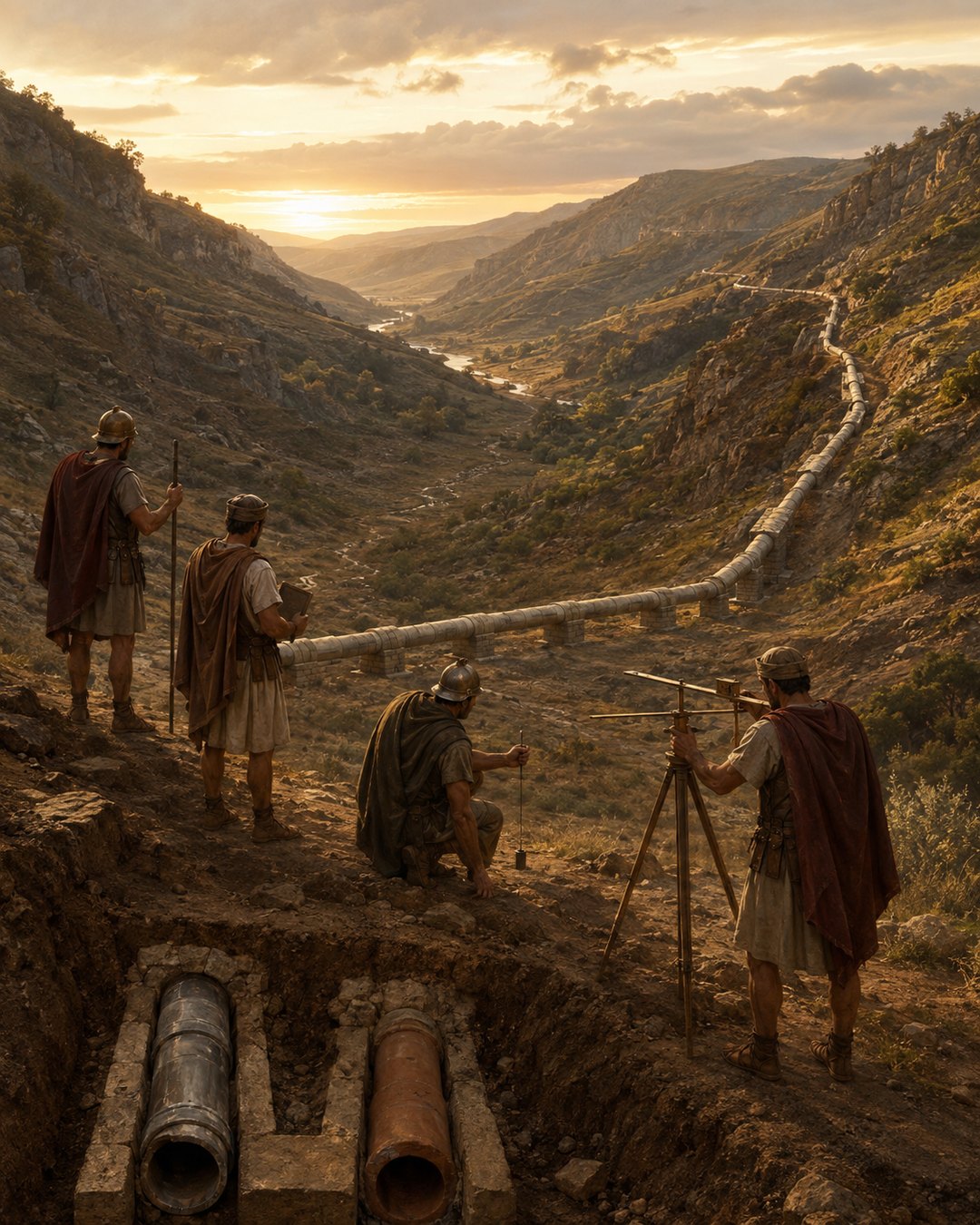
When an aqueduct reached a deep valley, the obvious line broke. Water descending one slope still had to rise toward the city on the other. Vitruvius offered an answer that placed the pipe at the bottom rather than the channel in the sky.
The line descended, crossed a long level section on low masonry and climbed the opposite slope. He called the bottom run the venter, the belly. Its shape let the weight of water on one side press water upward on the other.
This was not a licence to bend pipe sharply at the lowest point. Vitruvius warned that an elbow would concentrate violence and destroy the joints. The successful valley crossing depended on length, controlled changes of direction and places for trapped air to escape.
Aqueduct engineering therefore happened inside pressure as well as across landscape. The crucial structure could be almost invisible from a distance: joined lengths carrying water down, level and up.
Gravity Needed a Continuous Route, Not a Continuous Height
Ordinary masonry channels followed a gentle fall. Vitruvius specifies at least half a foot of descent in one hundred feet and recommends a roof so that direct sun reaches the water as little as possible.
Uneven ground complicated that rule. Small depressions could be filled with substructures; hills could be pierced by tunnels. A long valley posed a different problem because maintaining the channel’s gentle grade could demand an enormous elevated work.
A sealed pipe changed the available geometry. Water could lose height on the descent, remain confined across the bottom and recover height on the rise, provided the outlet remained lower than the source and the line held pressure.
Vitruvius does not present a modern equation. He gives builders a sequence of forms and warnings. The practical logic lived in what they could set out, join and inspect.
This solution differs from the monumental arcade that turned water supply into a visible political statement. A valley pipe could achieve the crossing with far less skyline. Its authority rested in controlled flow rather than height displayed in stone.
The Belly Protected the Joints from a Violent Turn
At the base of the descent, Vitruvius calls for a low level substructure carried as far as possible. This is the venter. Only after that long floor should the line begin climbing the opposite side.
The level run softened the transition. If the descending line met the ascent in one tight elbow, he says, the water would burst and tear apart the pipe joints.
Every joint was a possible weakness because the pipe was assembled from separate lengths. Vitruvius requires lead sections at least ten feet long and categorizes them by the width of the sheet before it was bent round. Fewer or stronger connections could reduce opportunities for leakage, but could not remove them.
The belly distributed the change in motion over distance. It made the valley floor an active component rather than dead space between slopes.
Workers had to read terrain with that construction in mind. A direct-looking route might create destructive angles. A slightly longer low line could preserve the pressure relationship while keeping bends manageable.
Air Needed Its Own Exit from the System
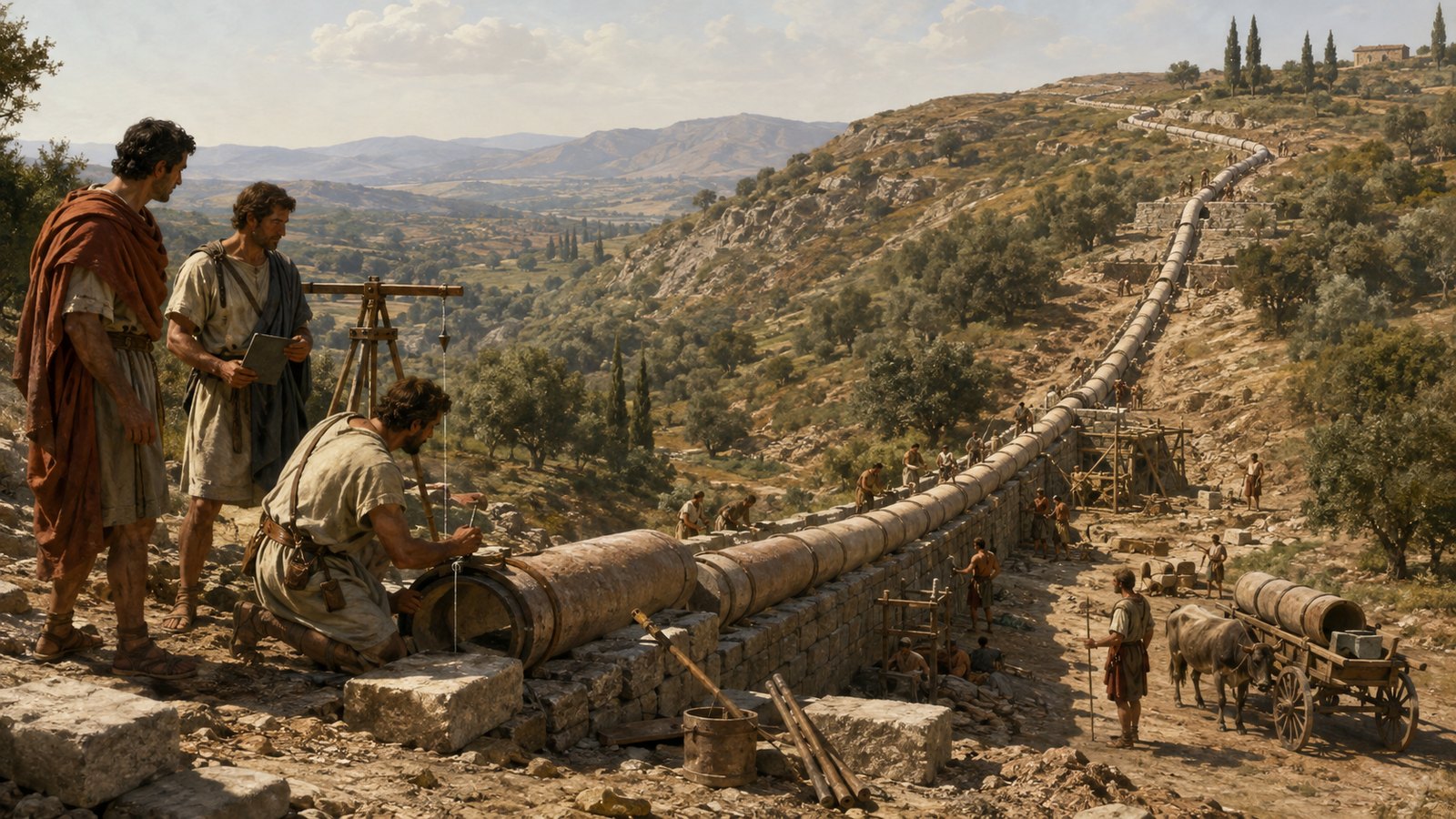
Water was not the only moving substance inside the pipe. Vitruvius repeatedly worries about air driven and compressed by flow. Over the venter he prescribes long standpipes through which its violence could escape.
An air pocket can interrupt water, strike fittings and intensify pressure changes. The standpipe offered a vertical refuge where air could separate from the main current instead of remaining trapped at a bend.
This detail makes the system more than two reservoirs connected by a tube. It had to manage different materials behaving differently: dense water following the line, compressible air seeking high points, lead or ceramic walls resisting both.
The concern resembles the paired pistons and valves in Ctesibius’s force pump. Both designs made uphill movement possible only by controlling pressure in stages. The valley crossing used the landscape and standing head where the pump used mechanical strokes.
Vitruvius’s language of violent air also warns against treating ancient hydraulics as serene. A functioning conduit could contain shocks capable of breaking stone, loosening seals and turning a hidden defect into a lost supply.
Repair Access Was Designed Before the Break
Vitruvius recommends reservoirs every twenty thousand feet. If one section failed, workers would not need to dismantle the entire route, and the damaged place could be found more easily.
He excludes the steep descent, venter, ascent and valleys from those reservoir positions. They belonged on plains, where storage and isolation would not add instability to the pressure crossing.
This is maintenance designed into construction. A line that delivers water on opening day is incomplete if its builders have no way to locate a leak years later.
Segmenting the route limited uncertainty. Reservoirs created known boundaries. Workers could observe which section lost flow and concentrate labour there rather than excavating blindly along miles of pipe.
The city reservoir applied a different division. Vitruvius gives it three outlets: fountains, baths and private houses. He arranged overflow so public needs would remain protected and proposed that private-water revenue support maintenance. Hydraulic design and civic finance met in the same structure.
Clay Changed Cost, Repair and the Taste of Water
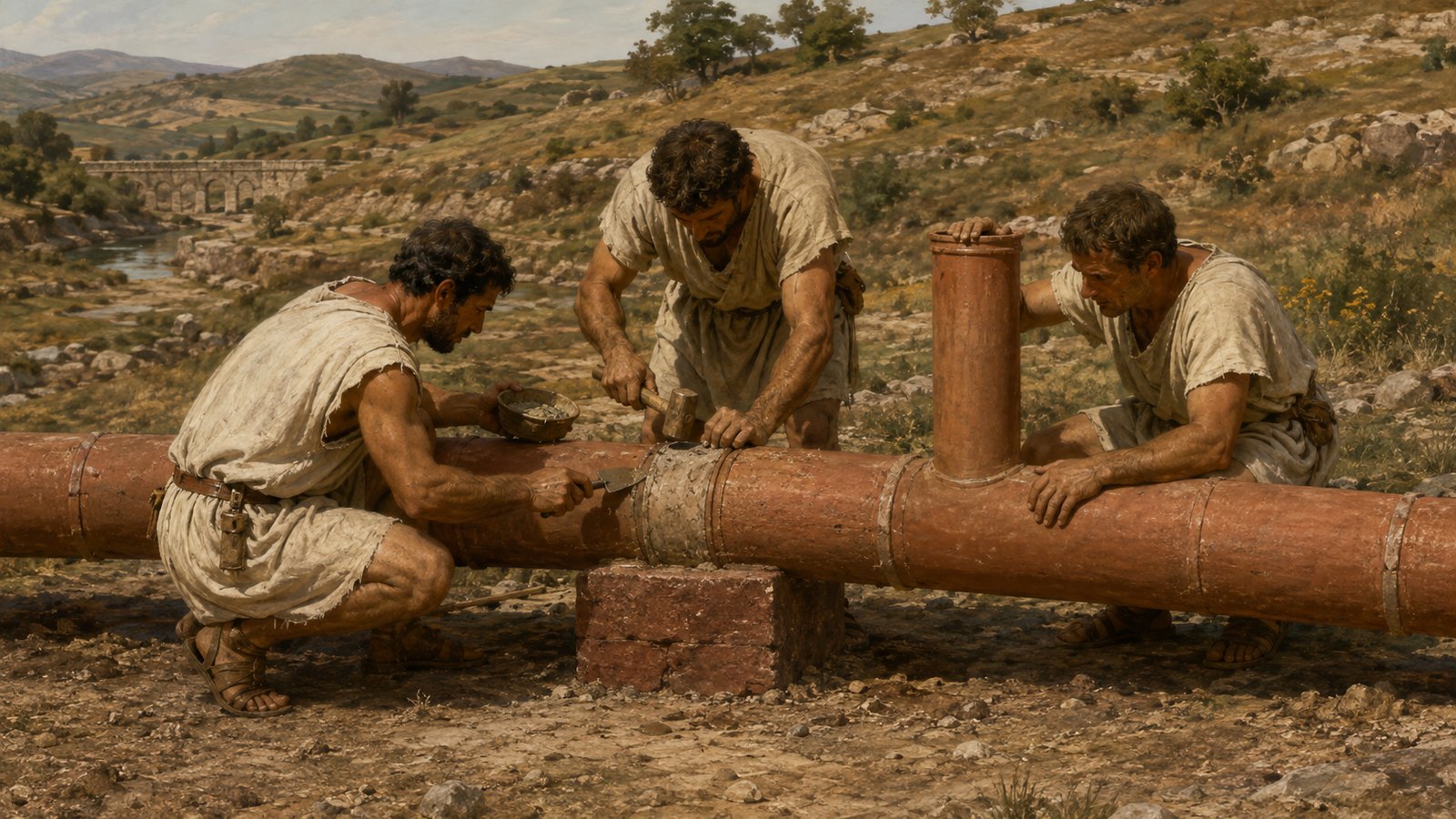
Lead was not the only material. Vitruvius offers thick earthen tubes as the more economical route. Each should be at least two inches thick, formed with a tongue or socket so one entered the next, then sealed with quicklime mixed with oil.
At changes between slope and level, perforated blocks of red stone received the ends of the ceramic runs. The block stabilized a place where geometry and force changed together.
When water was first admitted, ashes could be sent through to settle into imperfect joints. The measure did not replace careful sealing; it addressed small leaks revealed only under flow.
Vitruvius also preferred earthenware for health. He observed the pallor of lead workers and reasoned from harmful lead compounds and fumes that water should not be carried in the metal. His explanation is ancient, but the occupational observation gives the passage unusual urgency.
The material choice joined several calculations. Lead allowed long shaped pressure pipes but was heavy and hazardous. Ceramic was cheaper, repairable by ordinary workers and, in Vitruvius’s judgment, better tasting, but required many brittle joints and carefully supported turns.
His pipe names preserve another workshop calculation. A lead line was classified from the width of the sheet before it was rolled, and each ten-foot length carried a corresponding expected weight. The builder could therefore connect hydraulic capacity to metal supply, transport and labour before the conduit entered the valley.
Ceramic shifted that calculation toward repetition. More individual tubes meant more sockets to seal, but a damaged unit could be replaced by workers who did not need to cast and bend a massive lead sheet. The cheapest first construction was not automatically the easiest system to keep alive, which is why Vitruvius discusses repair beside flow.
The valley crossing worked only when all these choices agreed. Gradient established available head. The venter controlled direction. Standpipes released air. reservoirs divided maintenance. Joints and materials decided whether theory survived contact with ground.
From a distant hill, the water seemed to perform an impossible climb. Up close, nothing was miraculous. A source remained higher than its destination, a sealed path conserved pressure, and builders prevented abrupt corners or trapped air from spending that pressure destructively. The valley did not interrupt the aqueduct. Properly shaped, it became one of the machine’s working parts.
Sources
Vitruvius, De Architectura 8.6.