
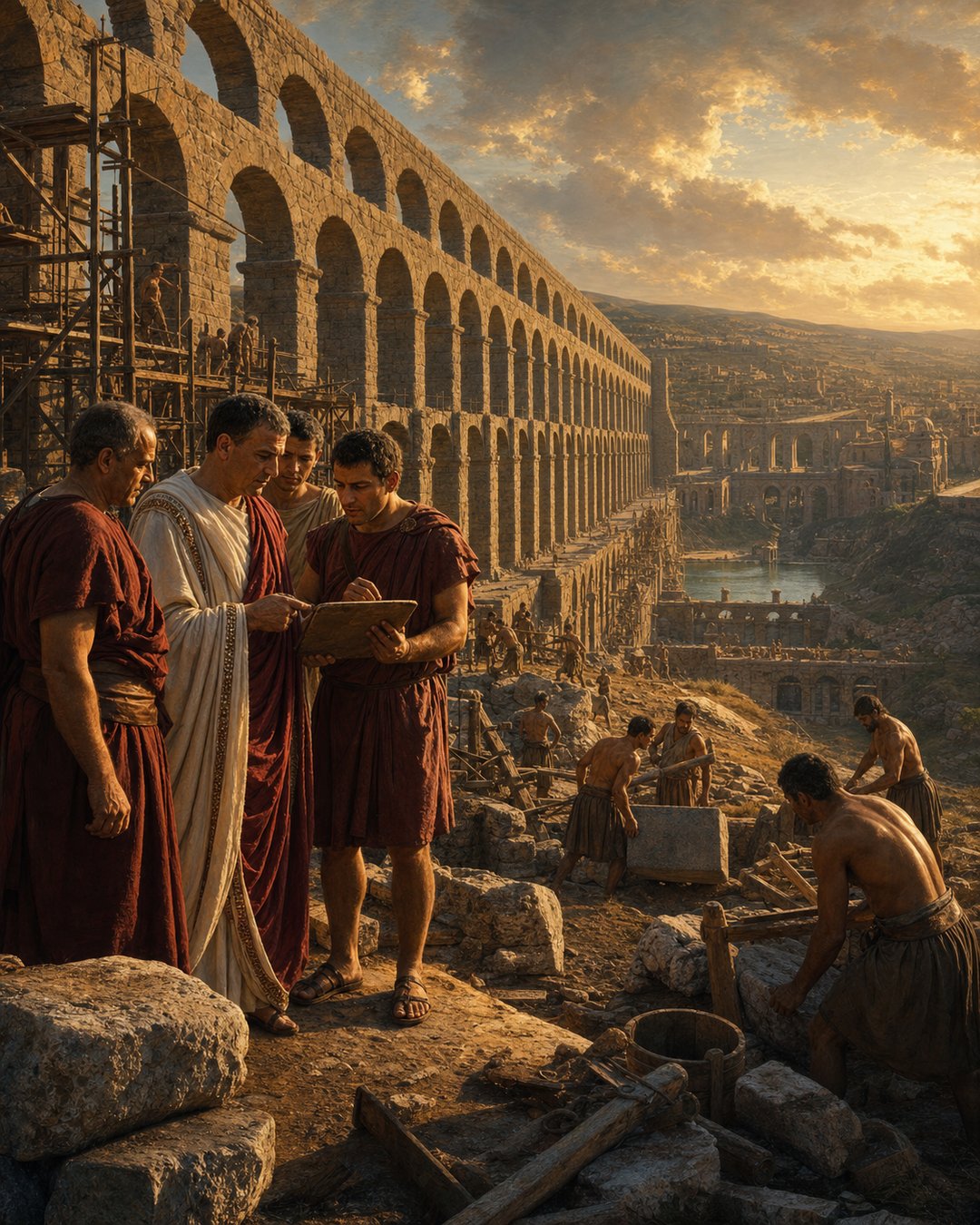
The most persuasive monument in Rome was not always a temple or a triumphal arch. Sometimes it was water arriving where nature had not put it. A Roman aqueduct made a political promise visible in stone: the city could command distant springs, measure gradients across miles, repair channels, punish theft, and make public benefit flow into crowded streets.
That is why aqueducts should not be imagined as neutral plumbing. They were technical systems, but also civic theatre. By the time Frontinus wrote about Rome’s water supply, he counted nine aqueducts serving the capital and described them with the precision of an administrator. His numbers and complaints reveal something larger than engineering pride. Water had become one of the ways Roman authority proved it could organize the world.
The water began as a measured act of command
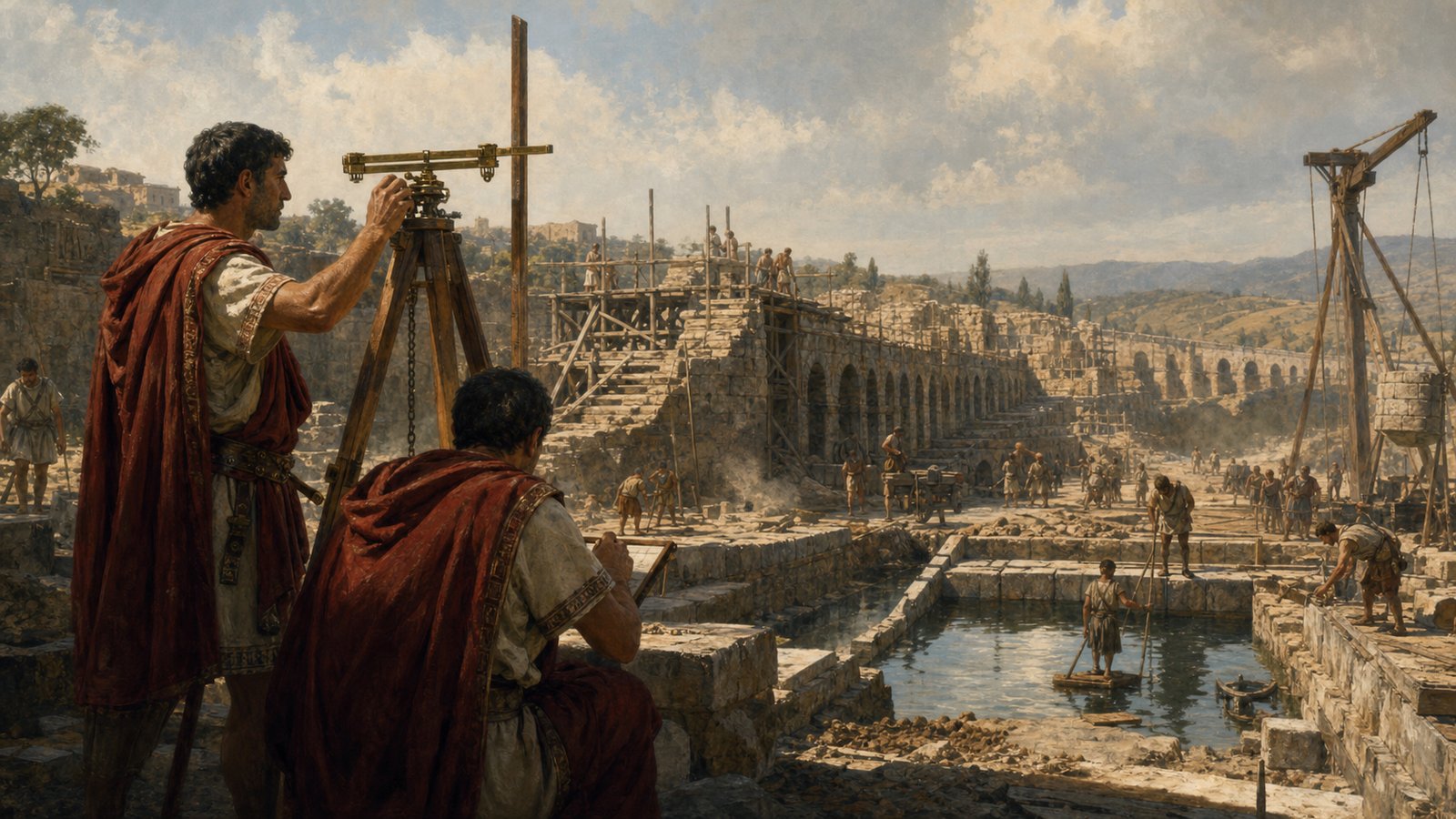
The first difficulty was not the arch. It was the decision to make faraway water obey the city. Vitruvius discusses testing springs, soils, and the character of water before a channel was built. Surveyors then had to hold a gentle fall over long distances, because Roman aqueducts normally depended on gravity rather than mechanical pumping.
That work turned landscape into a calculation. A valley, hillside, or buried channel was no longer just terrain. It became part of a public machine. The men who planned an aqueduct had to think in gradients, settling basins, maintenance access, and legal control. The result looked effortless only after enormous discipline had been hidden inside the route.
Claudius made arches into imperial evidence
The Aqua Claudia and Anio Novus were completed under Claudius in AD 52. Their scale gave the emperor something unusually useful: a public work that could be seen, used, and remembered daily. Unlike a speech, water returned every morning. Unlike a coin, it touched the body. Every fountain and bath supplied by the system repeated the message in practical form.
This mattered because emperors needed to appear as more than palace occupants. They had to show that their rule produced order. An aqueduct did that without needing an argument. It crossed valleys, entered the city, and delivered a benefit no senator could easily dismiss. Stone arches made administration dramatic.
Frontinus treated water like a public trust under siege
Frontinus is valuable because he refuses to let the system become romantic. As curator aquarum, he writes about sources, lengths, distribution, repairs, legal limits, and abuses. He complains about illegal taps and the loss of water through private fraud. His treatise shows that aqueducts needed government after they were built.
That detail is crucial. Public benefit did not maintain itself. Officials had to inspect channels, protect supply lines, and decide who received water. The aqueduct was therefore both a monument and a bureaucracy. Its beauty depended on paperwork, labor, and enforcement that most users never saw.
A fountain made distant power intimate
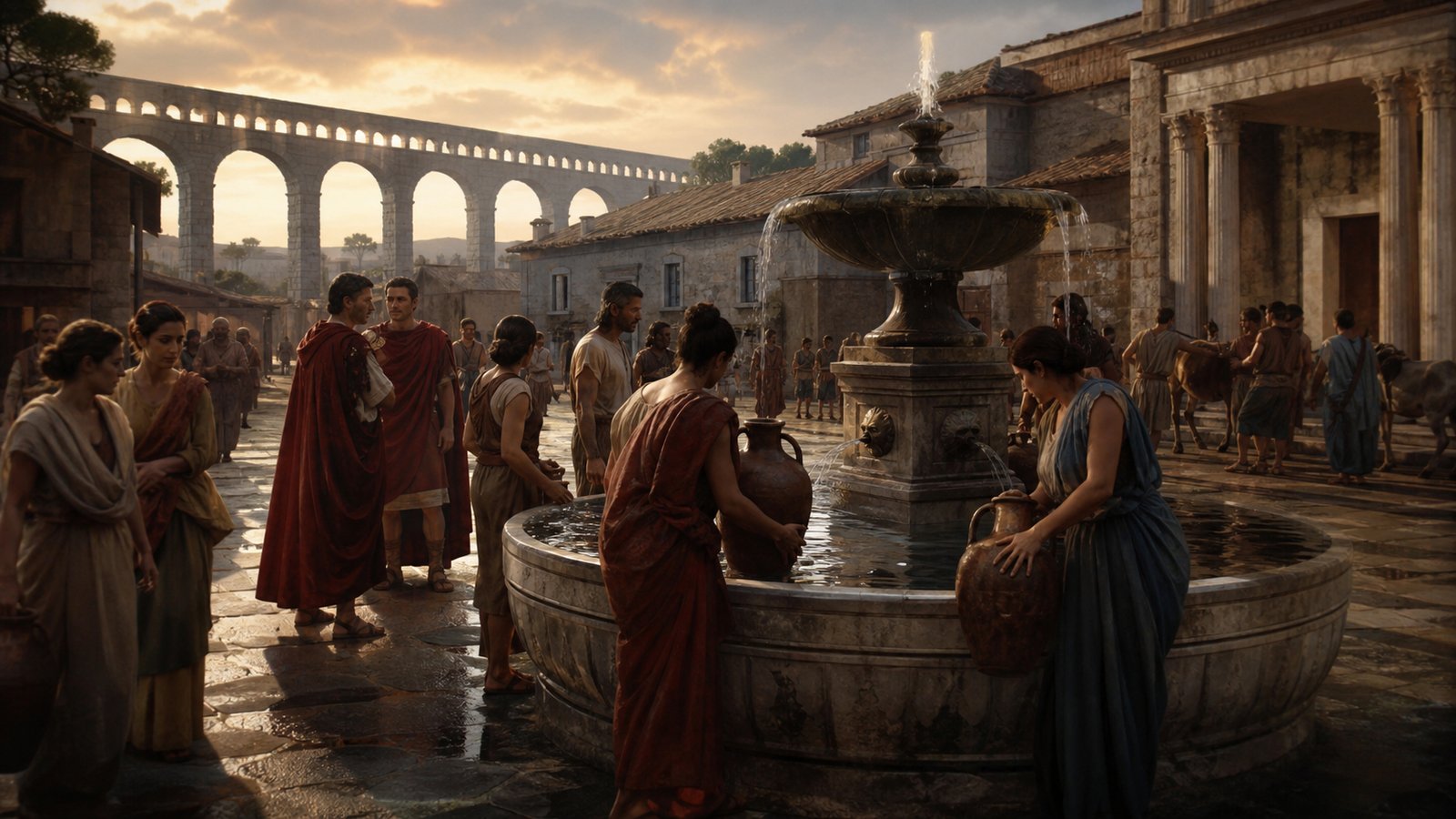
The political force of an aqueduct reached its strongest point at the neighborhood fountain. A citizen drawing water from a basin did not need to know the source spring or the full route. The physical experience was enough: cool water in a crowded city, brought by a system too large for any household to build alone.
That daily intimacy made aqueducts different from many imperial monuments. A temple might be visited on a festival. A triumphal arch might frame a procession. A fountain could meet a family every day. It turned state capacity into habit, and habit is one of the strongest forms of legitimacy.
Theft proved the system was valuable
Frontinus’ anger at illegal diversions is not a dull administrative detail. It proves that aqueduct water was valuable enough to steal. If private users secretly tapped public channels, the aqueduct had become a contested resource. The state then had to defend not only stonework, but the meaning of public supply.
That problem also reveals the limits of monumental power. Building a great channel could impress the city, but maintaining fair distribution required constant vigilance. Roman greatness was not a single moment of construction. It was the repeated act of keeping the promised water available.
The aqueduct made empire look useful
Romans celebrated conquest, law, and ancestry, but aqueducts added another claim: rule could be useful. They showed that power did not only command soldiers or collect taxes. It could carry water over distance, feed baths, supply fountains, and make urban life physically bearable.
This is why the aqueduct belongs beside Rome’s more obvious symbols of authority. It made control visible without needing a battlefield. It turned administration into a skyline. When water crossed a valley on arches and arrived in a public basin, Rome seemed to prove that its order was not merely imposed. It could be felt in the hand, poured into a jar, and carried home.
The lesson is not that aqueducts were propaganda instead of engineering. They were powerful because they were both. Their usefulness gave their symbolism weight. In a city that expected rulers to feed, protect, entertain, and impress, water was one of the clearest answers a government could give.
The same point explains why Frontinus sounds so severe about accounting. His concern with measurements, grants, repairs, and illegal pipes was not petty bookkeeping. In Rome, reliable abundance was a political achievement. If water vanished into private fraud, the public promise weakened with it. A stolen pipe was also a stolen piece of civic confidence.
Aqueducts therefore reveal a quieter side of Roman ambition. They did not merely conquer a people or decorate a capital. They made a daily dependency visible and then tried to administer it. The empire could be brutal, unequal, and self-interested, but it also understood that authority became harder to reject when it arrived as a practical service.
That mixture is what makes the stone channels so revealing. The arches impress modern visitors because they are beautiful ruins. For Romans, their deeper force was repetition. Every morning the water came back, and every return said that somebody had surveyed, funded, guarded, and repaired the route. Power had become infrastructure.
The arches also helped people see a chain of dependence that usually stayed hidden. A basin in a street implied springs in the hills, stonecutters, slaves, engineers, legal rights over land, and officials willing to punish anyone who damaged the flow. One drink could contain the work of an entire administrative world. That was the real monument.
So the aqueduct was never just about convenience. Convenience was the proof. Rome made the difficult look natural, and then let ordinary people build their routines around the result.
That routine mattered politically because it was shared. Rich houses, public baths, busy fountains, and workshops all depended on a system whose failure would be felt immediately. An aqueduct made state capacity measurable in splashing water, crowded basins, and the absence of panic. It was an argument repeated through use.
Sources & Further Reading
- Frontinus, De aquaeductu, 4
- Frontinus, De aquaeductu, 1
- Livius, Aqua Appia
- LacusCurtius, Aqua Claudia
- Frontinus, De aquaeductu, 5-15
- Vitruvius, De architectura, 8.1
- Vitruvius, De architectura, 8.6
- Encyclopaedia Britannica, aqueduct
- Frontinus, De aquaeductu, 78-87
- Frontinus, De aquaeductu, 105-129